Working on a blog that covers recent research on agents + world modeling. One of those rare topics that is both (relatively) easy to understand and practically useful for anyone working on agentic RL.
So far, I have included the following papers and blogs:
- ECHO: https://t.co/akClpFhX4M
- Prime Intellect empirical ECHO analysis: https://t.co/2sB7ZeoPg5
- PaW: https://t.co/kmJjj69BdH
- Qwen-AgentWorld: https://t.co/QgBNwtoZg5
What am I missing? Are there any other good papers that explore incorporating world modeling into the training process for agents?
Same model. Same 8B parameters. On writing pytest tests:
base Qwen3-8B: 15%
fine-tuned: 77%
(LLM-as-judge). The only thing we changed was fine-tuning it on this one task. Base-model choice matters far less than people think.
[Must Read]
I don't know how this flew under my radar.
This is probably one of the best open source end-to-end post-training recipes
Covers everything from SFT → RL → test-time scaling, with models, datasets, training code, and detailed ablations.
Learned a lot from this !!
This Fall at CMU we're teaching a new course on AI Agents!
The goal is that you learn how to create a scaffold, build evals, and train an agentic LLM using RL.
We'll try to balance theory and practice, and introduce modern frameworks and best practices.
🇨🇳 Another good model from China.
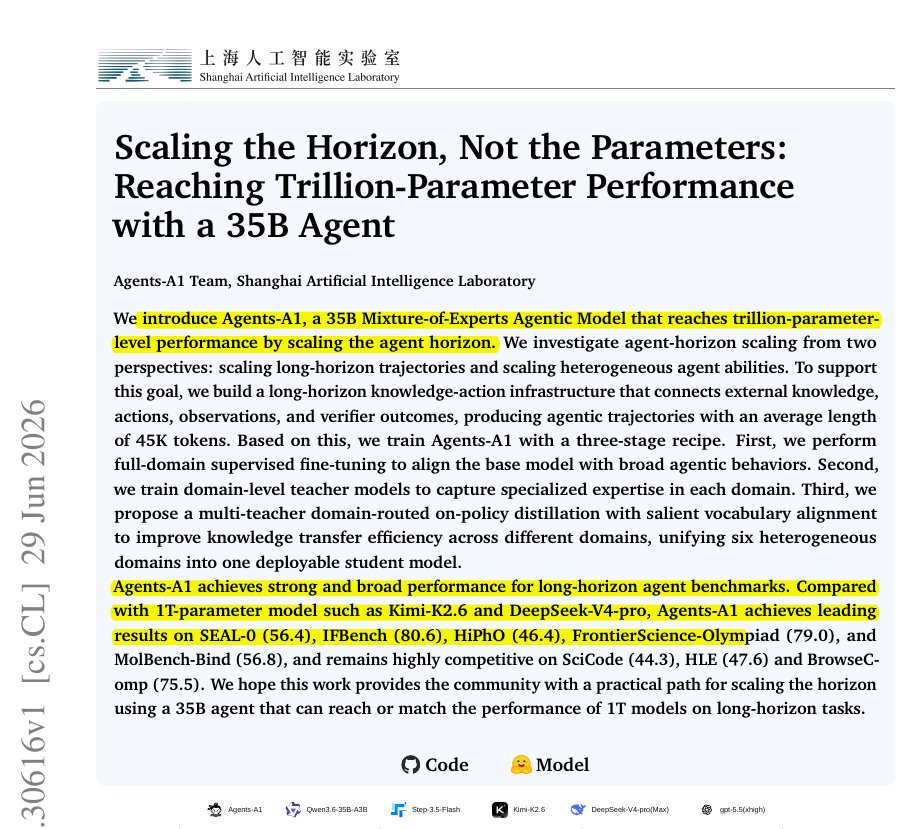
A 35B agent model claims 1T-model performance by thinking longer, not growing bigger.
Apache-2.0 license, model weights are on Hugging Face.
The technique is proposing a cheaper way to make strong AI agents: teach them longer verified work habits, not just make them bigger.
The paper’s main idea is to make the agent practice long tasks where it searches, uses tools, reads results, fixes mistakes, and checks answers.
The authors build training data from long action records, with an average length of 45K tokens, so the model learns the whole work process.
They then train specialist teacher models for search, science, instruction following, tool use, and other areas, and transfer those skills into 1 student model.
Agents-A1 does very well across long-task benchmarks, including search, science, coding, tool use, and instruction following.
Aloha! 🌺 Meet Ornith-1.0, a family of open-source LLMs specialized for agentic coding.
Ornith-1.0 spans the full parameter sizes including 9B Dense, 31B Dense, 35B MoE, and 397B MoE. It achieves state-of-the-art performance among open-source models of comparable size on coding benchmarks including:
✅Terminal-Bench 2.1(77.5)
✅SWE-Bench(82.4 on verified, 62.2 on pro, 78.9 on Multilingual)
✅NL2Repo(48.2)
✅SWE Atlas(41.2 on QnA, 42.6 RF, 39.1 TW)
✅ClawEval(77.1)
Post-trained on top of gemma4 and qwen3.5, Ornith-1.0 employs a novel self-improving training strategy in which reinforcement learning is used to generate not only solution rollouts, but also the task-specific scaffolds that drive those rollouts. By jointly optimizing the scaffold and the resulting solution, the model generate higher-quality solutions in agentic coding.😎
All models are released under the MIT license, enabling full commercial and research use.
📖Tech Blog: https://t.co/qT9N2HYWFn
🤗Huggingface: https://t.co/PRrwqjeBtM
Speaking of recursive self improvement, @nayoung_nylee recently defended her thesis which among other things showed how transformers can learn progressively harder tasks by generating solutions to problems that sit *right at* the boundary of their capabilities.
https://t.co/UPYEYl7Do7
This paper helped me 1) overcome my obsession with transformers and arithmetic and 2) appreciate the value of environments.
She and @jackcai1206 did this before GRPO btw
OpenThoughts-Agent: Data Recipes for Agentic Models
"a fully open data curation pipeline for training agentic models"
"more than 100 controlled ablation experiments to systematically investigate each stage of the pipeline"
Key findings:
• As with reasoning data, the choice of instructions is among the most important factors in our data pipeline.
• The strongest model by benchmark performance does not necessarily make the best teacher.
• Filtering training data to retain the execution traces with more model turns improves the resulting training sets.
• Repeating the top few sources leads to diminishing returns in our largest training runs, and we therefore expand the set of data sources to increase diversity.
"We then assemble a training set of 100K examples from our pipeline and fine-tune Qwen3-32B on this dataset, which yields an average accuracy of 44.8% across seven agentic benchmarks"
Harvey partnered with @appliedcompute to train a legal agent.
We optimized each part of the agent stack:
- eval loop
- agent harness and compaction
- post-trained GLM-5.1 using reward signal from our Legal Agent Benchmark (LAB)
More in our agent-training deep dive:
New lecture for the book! Nominally about synthetic data, but mostly is a walk through of the distillation literature from the Hinton 2015 paper to multi-teach on-policy distillation of today!
At 7.4 hours of video in my post-training brain dump and counting :)
It was fun to stare at the math long enough and talk through the 3-4 core changes that needed to be made to the original formulation to have on-policy distillation be ready for the mainstream like it is today (and in RL frameworks).
Otherwise, I include a bit of a history lesson for how synthetic data generally slowly took over all post-training data research (it wasn't always the case)! Then I do some 101 review on constitutional AI, rubrics, and other popular methods.
00:00 The emergence of synthetic data
10:50 Background on teacher-student knowledge-distillation
24:47: On-policy distillation (OPD, MOPD, and OPSD)
37:11 Constitutional AI & AI Feedback
45:50 Rubrics as rewards & conclusions
Ofc, watch on YouTube etc.
NEW Auto-Research By DeepSeek Researcher Explained (side project)
A DeepSeek researcher (Deli Chen) open-sourced his own autonomous research system, and it works for far more than AI research - any project with AI agents (like coding, finance, etc).
I break down the whole design: the three failure modes that kill long-running agents (cognitive loops, stalling, runtime fragility) and the fixes for each.
You'll see the main orchestrator spawning a fresh agent per task, why fresh sessions beat resuming accumulated context, and much more.
You can install the whole thing into your own agent from a single prompt.
Autoresearch - https://t.co/nb0mSpoudV
---
We will build this together in Skool LIVE (every week Sunday) - https://t.co/6nocqbVceu
📆 Schedule 1 on 1 with me - https://t.co/EKubpDAi89
most multi-turn RL loops have a silent bug: you decode the model's output to detect tool calls, then re-tokenize the conversation for the next turn. BPE isn't invertible, so decode then re-encode can land on different ids. gradient ends up on tokens the model never sampled. no crash, just quietly wrong math and broken training
@qgallouedec wrote a super educational blog on MITO (message-in, token-out) vs TITO (token-in, token-out) and how you might fix the problem above
go read it 🤓
Talked to a girl on feb 28 2025 ,introduced myself(first time in my 26 yrs dared to talk to a girl) and on march 11 2026, reached out again by gathering all the courage and told that I have a crush and (she replied back that she was not looking/into relationship
My eyes always searched for her, I used to feel happy when I seen her.., in college had a same feeling but never dared to speak, at least now I conveyed.. , dumbo me used to note every instance that I saw her, not sure if my opinion changes after knowing more


![adithya_s_k's tweet photo. [Must Read]
I don't know how this flew under my radar.
This is probably one of the best open source end-to-end post-training recipes
Covers everything from SFT → RL → test-time scaling, with models, datasets, training code, and detailed ablations.
Learned a lot from this !! https://t.co/9pTa3Ej454](https://pbs.twimg.com/media/HMtbxMHakAAkMy6.png)
![adithya_s_k's tweet photo. [Must Read]
I don't know how this flew under my radar.
This is probably one of the best open source end-to-end post-training recipes
Covers everything from SFT → RL → test-time scaling, with models, datasets, training code, and detailed ablations.
Learned a lot from this !! https://t.co/9pTa3Ej454](https://pbs.twimg.com/media/HMtbsf6bsAAbc3u.jpg)








![adithya_s_k's tweet photo. [Must Read]
I don't know how this flew under my radar.
This is probably one of the best open source end-to-end post-training recipes
Covers everything from SFT → RL → test-time scaling, with models, datasets, training code, and detailed ablations.
Learned a lot from this !! https://t.co/9pTa3Ej454](https://pbs.twimg.com/media/HMtcCcFbkAEym1y.png)