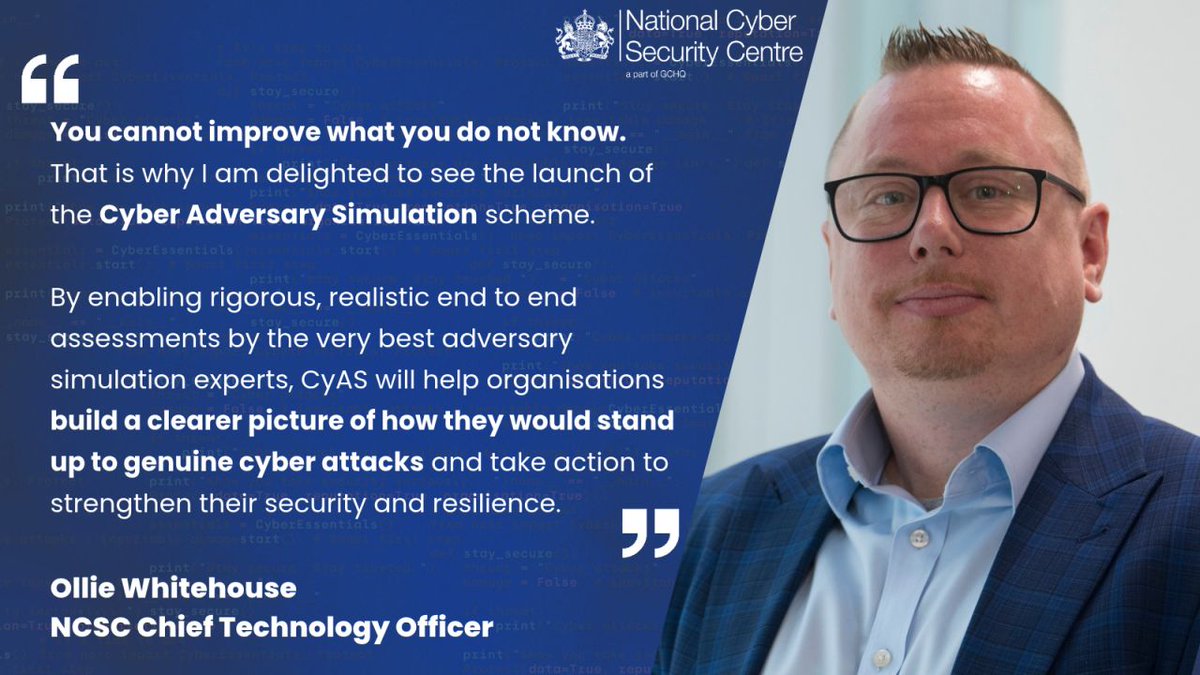
The NCSC has launched a new Cyber Adversary Simulation scheme that will help critical organisations strengthen their resilience through rigorous, real-world testing by trusted providers.
Read more:
https://t.co/G5ODYZIvkb
Fixes are available for CVE-2026-109518, a High severity vulnerability in APT, the package manager used in Debian, Ubuntu, and derivative Linux distributions. The CVE has a CVSS 4.0 score of 7.7.
Remediation details are available on our blog.
https://t.co/x3q5jIeD4J
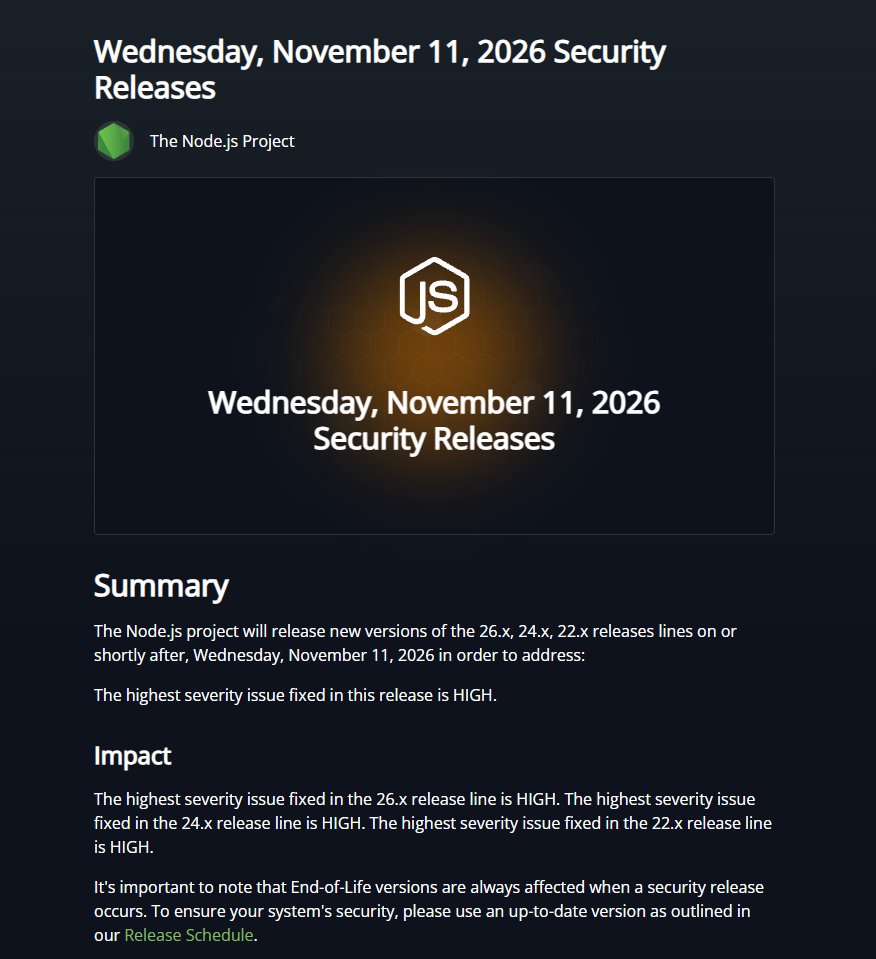
🚨 Node.js warns of HIGH-severity security vulnerabilities.
Security fixes are coming November 11 for Node.js 26.x, 24.x, and 22.x.
All three release lines are affected. Production users should take note.
Details: https://t.co/kyerFMiO8K
‼️ Ubuntu and Red Hat still have no fix for a Linux kernel flaw that Anthropic says its unreleased AI model turned into a remote root exploit.
The bug, CVE-2026-98432, is a use-after-free in the IPv4 TCP handshake, rated 9.8 out of 10.
The exploit needs no credentials and targets servers with a multipath TCP listener, which Go 1.24 and later open by default.
The fix reached stable kernels on 11 October and Debian has shipped it. Ubuntu still marks every release from 16.04 to 26.10 vulnerable.
Red Hat now rates it Critical but has no patched kernel for RHEL 8, 9 or 10.
Anthropic has not released the exploit. By its count, it takes 48 minutes to leak a kernel pointer and five more to run commands as root.
In lieu of flowers, memorial contributions may be made to:
Johns Hopkins Alzheimer’s Disease Research Center Fund
https://t.co/luC5CdcWDy
Alzheimer’s Foundation of America Caregiver Resources
https://t.co/zvNptfyuNd
Photo Credit: Tommy Garcia
We made a website to check if your http client is vulnerable to CVE-2026-111497 (Node2Shell/HTTP2Shell)
https://t.co/y4E3JX4GTL
Also open-source: https://t.co/qaf3NcjAG1
Some examples:
Le Web a découvert cette semaine qu’une partie de ses correctifs PHP passait par le travail bénévole d’Ondřej Surý, qui prépare des paquets pour Debian et Ubuntu.
Dans un nouvel entretien à la BBC, il raconte avoir reçu plus de 10 000 dollars de dons en quelques jours, soit environ une année habituelle de contributions.
https://t.co/KlqNiUxXXa
the cloudflare CEO just said something that should make every developer on the internet uncomfortable
cloudflare’s CEO just announced they’re expecting another critical vulnerability disclosure on par with the PHP flaw that broke the internet last week. not speculation, he said it’s “almost certain”
and it gets worse. he says they already have prior information about flaws in other software that haven’t been disclosed yet. multiple disclosures coming in the next few weeks to months
polymarket already opened a betting market on whether another major PHP flaw gets disclosed. that’s where we are right now. people are literally gambling on the next vulnerability
this is not normal. a CEO of one of the biggest infrastructure companies on the internet doesn’t come out and say “more is coming” unless he knows something specific. cloudflare sits between users and websites, they see everything before anyone else does
if you haven’t rotated your keys, updated your dependencies and enabled 2FA on everything by now, i genuinely don’t know what you’re waiting for
black october has a sequel and we’re watching the trailer
Unless you live under a stone, everybody will have heard about PHP today.
Now, please realize that the vast majority of Open Source Software, like PHP, and including PHP, is largely maintained by **unpaid volunteers**.
Tagging @ethicalhack3r@OliverSild@photomatt and @perezbox so you can loop in @GoDaddy if you still have contacts there. And looping in @gdb because he and @eastdakota are appearing together. Guys we haven't seen a single hacked WP site from #php2shell and we're (@wordfence is) protecting over 5 million PHP/WP sites. You know the deal. If it's exploitable, we all see site cleanings. No one in cybersecurity wants to minimize a vulnerability in case it does blow up. We're seeing reports from @Cloudflare and @eastdakota of attack attempts. We're seeing attack attempts in our telemetry. But we're not seeing a single compromised site. No one wants to say that it's not exploitable against vanilla PHP because it may turn out to be. I think we all know CVSS scores are imperfect. And the messaging here is off the charts. This has gone mainstream, but no one is talking about the fact that no one is seeing hacks. It's easy to take a bow and claim industry success, "go team cyber" and all that. But you know if these things are a legit risk you'll see compromised sites. Especially in the PHP/WP space where there are a lot of individual boxes out there with owners on vacation or MIA. And nothing. Not one. So I think the conversation that needs to happen is something like this: We're going to find scary vulnerabilities with the amazing capabilities that @OpenAI and @AnthropicAI are bringing online, but we need to calibrate the messaging to take into account how exploitable and scriptable each vuln is, or we risk alert fatigue and blowing credibility which we'll badly need when an exploitable scriptable vulnerability shows up.