mRNA will be crucial to beating cancer and solving disease but only if we can deliver it to the right cells.
Nanograb's AI-designed multivalent nanoparticles address a cell's unique receptor fingerprint, now proven in vivo across multiple cell types and scaling to many more.
In partnership with Vinod Khosla (@vkhosla), I’m proud to introduce Reservoir.
Billionaires have owned their cells for years. Starting today, you can too.
Sign up today: https://t.co/JftHvfPx6A
Today we're launching the Alzheimer's Translation Challenge, a global AI competition to discover new therapeutic hypotheses for Alzheimer's disease.
At its core is a new 150M cell atlas of neurons, astrocytes, and microglia across different genetic backgrounds under combinatorial perturbations, with multi-modal readouts.
The data will be made available through the AD workbench, Hugging Face and Prima Mente's modeling platform.
The challenge is led by @PrimaMente and @AlzData in collaboration with @nvidia, @huggingface, @nebiusai, Talisman Therapeutics, @UltimaGenomics, @cellanome, @PrimeIntellect, @GoodfireAI, and @boltz_bio.
In 1906, Alois Alzheimer described a new disease of the brain. After 120 years of progress, we still don't fully understand what drives this disease. We want to change that.
Participants will use the dataset to build AI models, assessed through a series of evals from general benchmarks to more complex tasks.
Top teams will be shortlisted, and their experimental hypotheses tested in Prima Mente's wet lab. Teams win when their hypotheses demonstrate the predicted molecular and functional effect.
This began as a personal essay, before the Foresight Institute invited me to write for their Existential Hope series. Read it here: https://t.co/ec8y2z2X5L
I've long wondered whether humanity has a purpose larger than itself, and a duty to help life flourish. A brush with mortality is what finally moved me to write about it, at a time when the pace of progress makes the long-term future harder to ignore.
In this essay (linked in reply below), I argue that helping life take root across the galaxy is the most important thing our species could ever set itself to do.
The vision is long-range, but each step is already an active research question: characterizing exoplanets, crossing interstellar distances, and engineering life capable of surviving there. None is solved, but all three have crossed from speculation into early science.
Grateful to the many friends and colleagues across biology, physics, and philosophy who shaped this thinking over the years. And to @ExistentialHope at @foresightinst for the audacity to encourage thought across the largest scales of space and time.
Tissue organization is fundamental to how tissues function - yet in cancer such spatial patterns can progressively break down. Ever wondered how?!
Check out our new study, where we investigate how lymphoma reshapes lymph node architecture 👀
100 companies started from an accelerator.
96% raise success rate.
How much equity do they take?
None.
That’s 5050.
No equity. No fees. No weird clauses.
Applications open.
Announcing our 2026 Fellows!
One is a neuroscientist exploring how the brain computes at a molecular level, another is a bioengineer 3D-printing human tissue. There’s a PhD student working on computational protein design, and an engineer developing robots to build large structures in space – just to name a few of the badasses in our new Fellowship cohort!
With this one-year program, we want to support early-career talents advancing important science and tech. We connect them with senior scientists, invite them to our technical workshops, seminars, and Vision Weekends alongside leaders in their fields, and offer platforms for sharing their work.
We are incredibly excited to introduce our 2026 Fellows!
Longevity Biotechnology
• Alex Plesa, Scientist, Harvard University @amplesa
• Donnacha Fitzgerald, Founder, Origenity @DN_Fitzgerald
• Gianluca Cidonio, Assistant Professor, Sapienza University @gianlucacidonio
• Jakub Lála, PhD Student, Imperial College London @jakublala
• Léo Lopez, Staff Scientist, Tufts University
• Nick Schaum, Postdoc & Co-Founder, University of Cambridge & https://t.co/I0Uj4HSz5u
Neurotechnology
• Avery Krieger, Founder & CEO, Constellation Systems @Biofall
• Constanze Albrecht, Graduate Student, MIT Media Lab
• Elisa Kallioniemi, Assistant Professor, New Jersey Institute of Technology
• Max Kanwal, PhD Student, Stanford University
• Sven Truckenbrodt, Group Leader, MRC Laboratory of Molecular Biology
Secure AI
• Huixin Zhan, Assistant Professor, New Mexico Tech
• Keith Patarroyo, Research Fellow, University of Glasgow @KeithPatarroyo
• Mateo Petel, Research Scientist, Stanford University
• Tianyi Alex Qiu, Research Fellow, Oxford Human-Centered AI Lab @Tianyi_Alex_Qiu
• Vivek Nair, CEO, Multifactor
Nanotechnology
• Alberto Privitera, Assistant Professor, University of Florence
• Kathryn Shelley, Postdoctoral Researcher, University of Washington
• Konlin Shen, Research and Development Engineer, University of California San Francisco
• Qiancheng Xiong, Senior Scientist, A*STAR Bioprocessing Technology Institute
Space
• Philip Linden, Space Systems Engineer, Planet Labs PBC
• Sidh Sikka, Co-Founder, Manifold Research @SikkaSidh
Existential Hope
• Abigail Olvera, Research Director, Golden Gate Institute for AI @Abi0lvera
• Fin Moorhouse, Researcher, Forethought @finmoorhouse
• Mahlaqua Mila Noor, Viral Immunologist, University of Cambridge
• Ninon Lizé Masclef, Research Affiliate, MIT Media Lab @ninon_lize
• Peggy Yin, PhD Student, Stanford University
• Ruairidh Battleday, AI Researchers & Founder, Thinking About Thinking @RMBattleday
Learn more about our Fellowship: https://t.co/2G3Q0Gx3pR
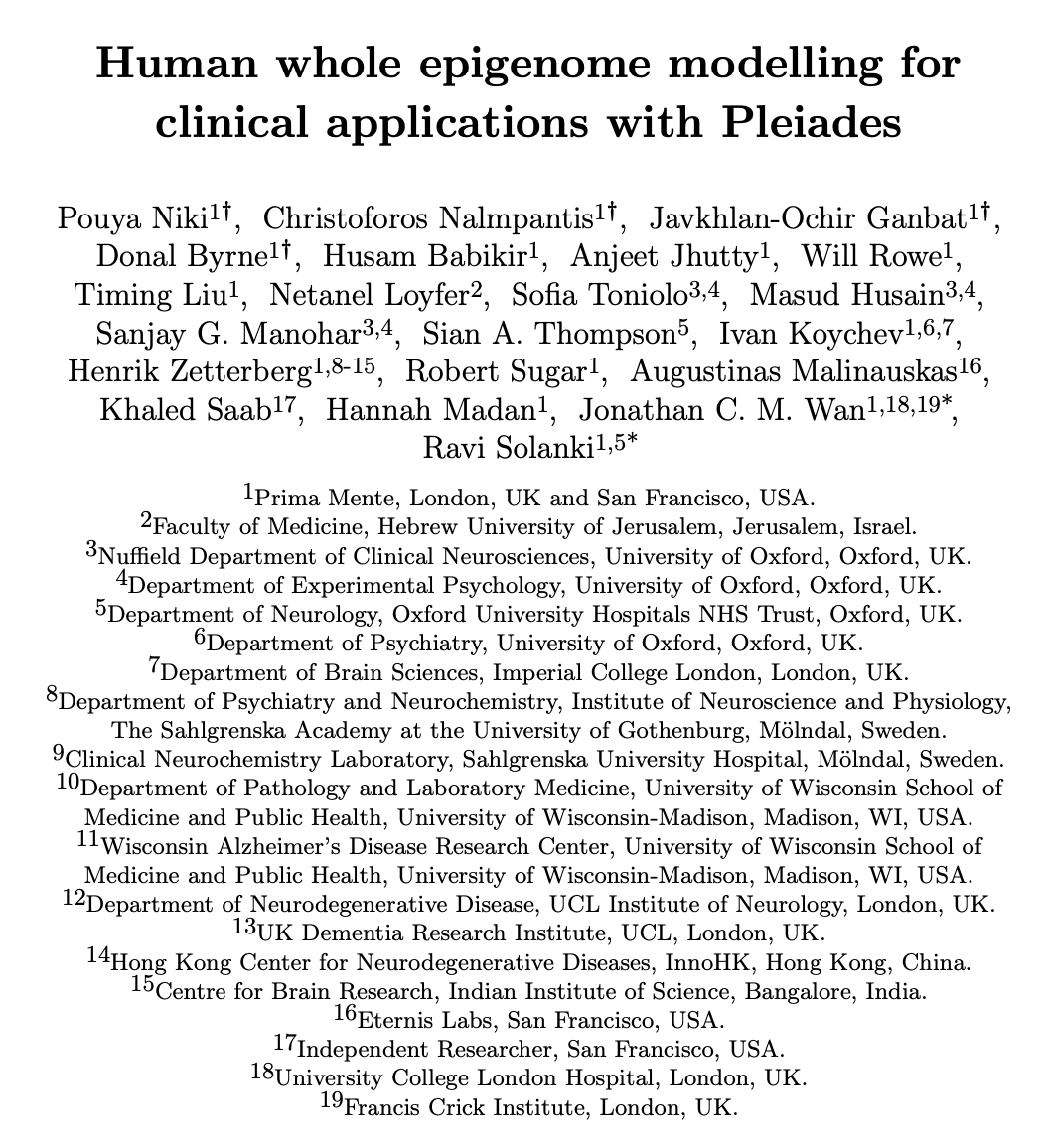
1/ Today we announce Pleiades, a series of epigenetic foundation models (90M→7B params) trained on 1.9T tokens of human methylation & genomic data. Pleiades accurately models epigenetics for genomic track prediction, generation & neurodegenerative disease detection from cfDNA, outperforming previous pure DNA baselines.
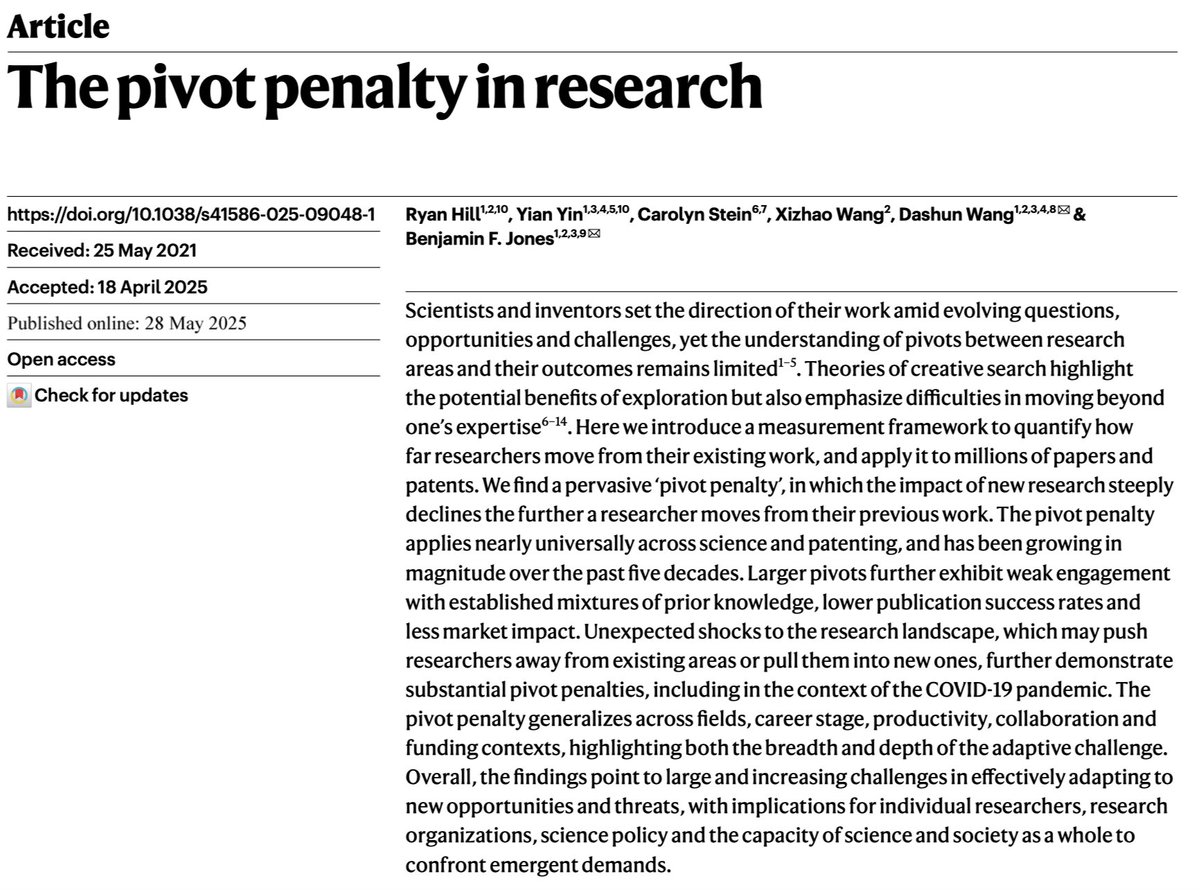
🚨New paper🚨 Excited to share our latest on @Nature today: The PIVOT PENALTY in research. https://t.co/V4ENiGCssY
More than five years in the making. Key finding: The impact of new research steeply declines the further a researcher moves from their previous work.
A special thanks to Giorgia Renne and Lucia Schmitz who were central to getting PROMETHEUS off the ground, Edith Heard, @JanKorbel5 and Alexander Aulehla for their early encouragement, Shreya Ghosh for initiating this article, and @EMBL for supporting this vision from the start.
I spoke with @EMBL about PROMETHEUS (Promotion of Ethics in Science), a new initiative to promote and optimize impact-driven science.
Learn more about our mission and how you can be part of it at https://t.co/bPoN3mCOh5
PROMETHEUS is an EMBL-born grassroots initiative to promote and optimise impact-driven science.
We had a chat with Donnacha Fitzgerald, the intiative's founder and bridging postdoc at EMBL Heidelberg, to learn more about its aims and activities.
https://t.co/aWnplADzCS
We are seeking to bring bright minds together across key expertise to research and publish on several topics: https://t.co/cagEO5T6Xr
Interested in any of these topics or have additional ideas? Reach out! https://t.co/KCu4KyBIYw
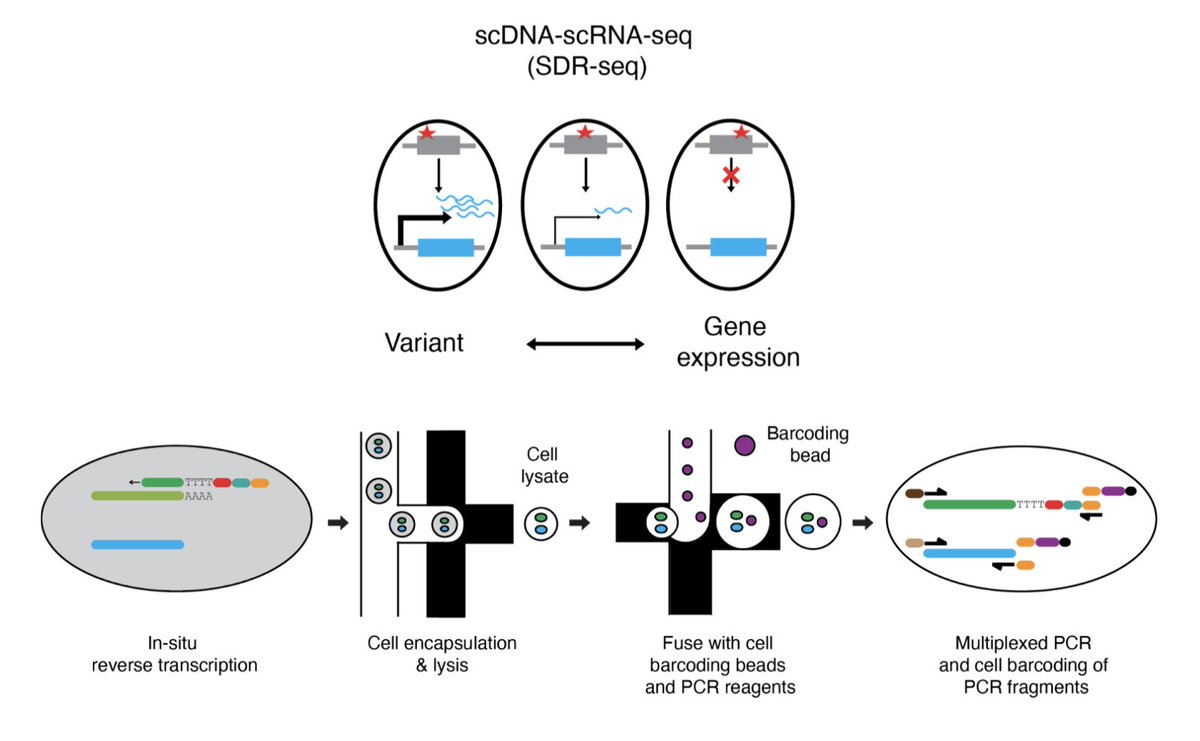
We are very happy to share our preprint (D. Lindenhofer et al.) of a high-throughput targeted scDNA-scRNA-seq (SDR-seq) method. Impactful for any application with a need to associate coding and non-coding variants to gene expression in tissue samples and cell culture systems.