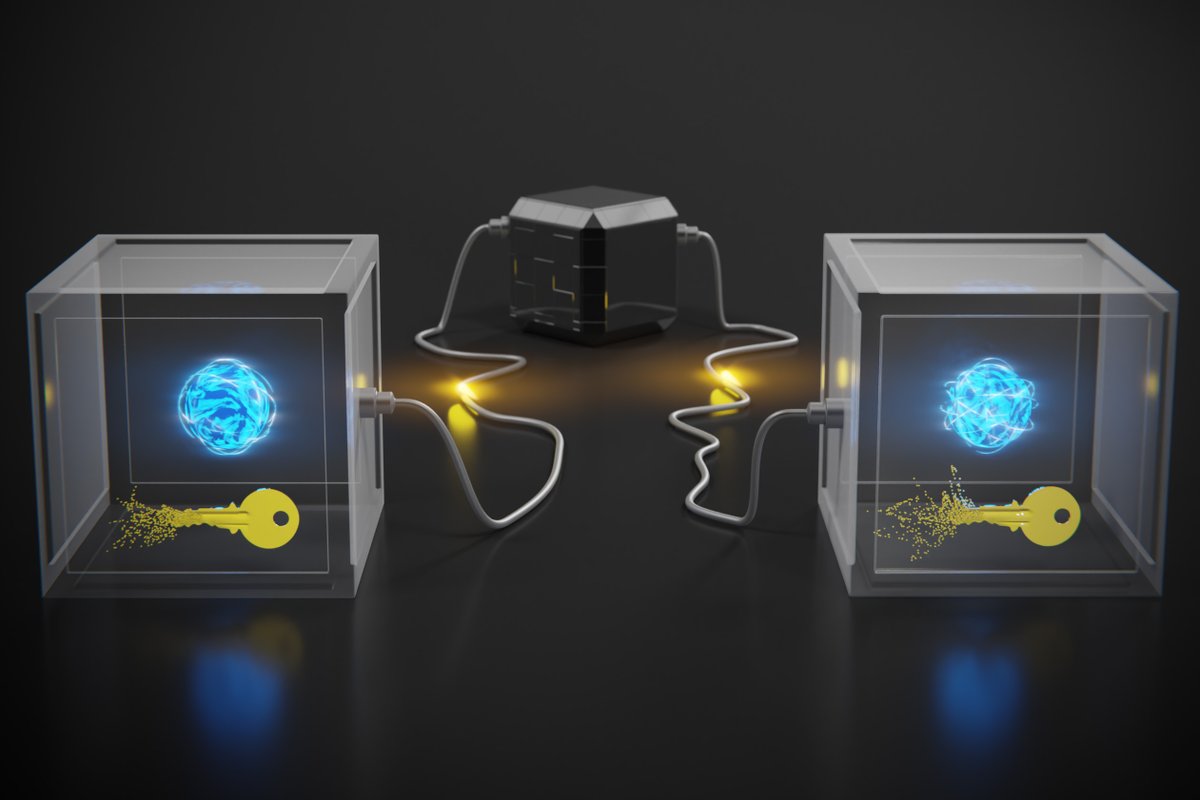
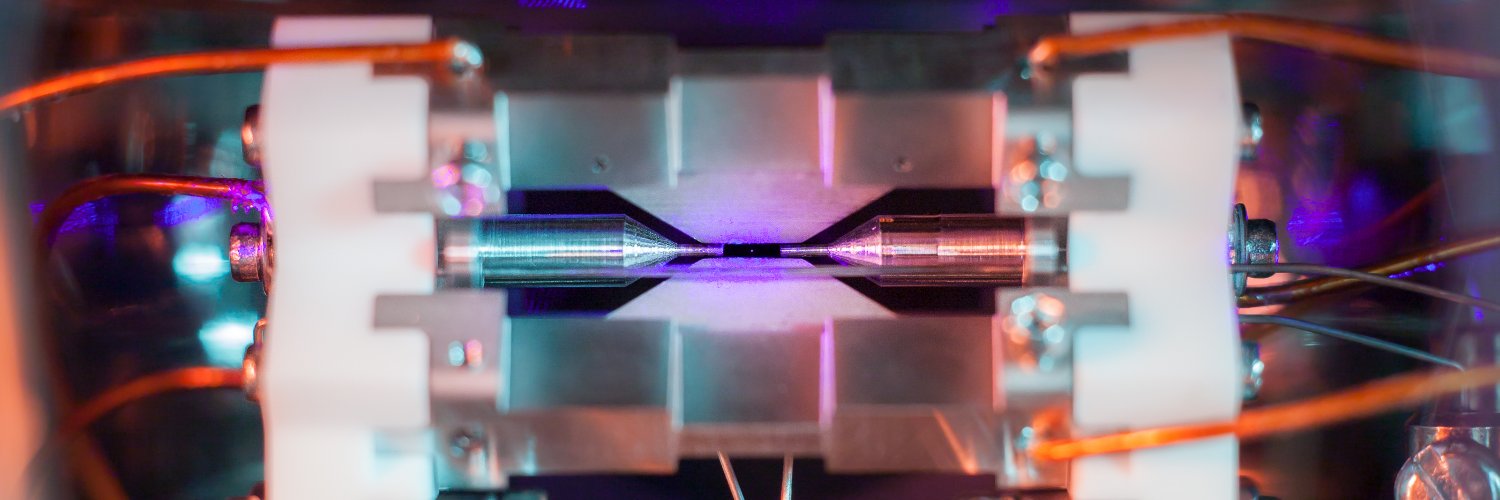
Got trust issues? (…regarding your quantum devices?)
Our demo of device-independent quantum key distribution (#diqkd) is now out in Nature: "Experimental quantum key distribution certified by Bell's theorem", https://t.co/G7Ql29ZFC2
("free" link: https://t.co/Jy1JCNV0HA)
1/4
@HyperboIeva If you'll indulge me: We've managed to get decent-enough remote entanglement to for the first time demonstrate fully device-independent QKD last year (https://t.co/G7Ql29ZFC2). Quite neat from a foundational perspective, still far removed from something easily deployable.
@AndreasAtETH@Nature@ETHBibliothek@qudev@ETHQuantumCntr@ETH_en@ETH_physics Congratulations! I was wondering how much the coax latencies were going to eat into your "light-cone budget"; the side-entry ports are a nice touch. Love the gorgeous figures in the supplement as well – for somebody not in the field, it's always nice to have that level of detail!
@StartsWithABang Ouch, looks potentially neat, but the subtitle and tweet are wrong and misleading. Entanglement e.g. between atoms and photons (entirely different particles!) was explicitly shown almost 20 years ago (Blinov et al., Nature, 2004), implicitly much longer. Many other demos too.
@DrGBuckingham The paw print to me is stably convex if I flip the image upside down, but stably concave in the original orientation (+sideways). Can't get it to flip.
Got trust issues? (…regarding your quantum devices?)
Our demo of device-independent quantum key distribution (#diqkd) is now out in Nature: "Experimental quantum key distribution certified by Bell's theorem", https://t.co/G7Ql29ZFC2
("free" link: https://t.co/Jy1JCNV0HA)
1/4
A huge thanks to everyone on our experimental team at @OxfordPhysics, and our theory collaborators at @EPFL_en, @ETH_physics, @unige_en and @CEAParisSaclay – it was greatly rewarding to collaboratively push the state of the art in such an interdisciplinary effort!
4/4
@OxfordPhysics@EPFL_en@ETH_physics@unige_en@CEAParisSaclay If you are unsure what this #qkd business is all about, might I suggest this brief explanation which I put together when we first released a pre-print version of this manuscript? https://t.co/yxtZmFrkaR
It's preprint time: device-independent quantum key distribution (DIQKD)! https://t.co/iaFQQyJIG4 Together with colleagues from Geneva, Zürich and Paris, we managed to demonstrate DIQKD for the first time, using our two-node ion-trap #quantum network. What is this all about? 1/n
Going to be in the US for the first time in a long while for DAMOP end of May. If any quantum/CS/generally awesome people would like to meet up in NYC end of next week (~27th), or in Florida the week after, let me know!
@hbkirb Thanks; I can see your point now, and partially agree – playing a role in shaping the future does require being willing to sit at the table in the first place. But then, I'm not sure to what extent it was always going to happen on the corps. terms anyway, with the FSF or without.
@Ion_busters@IQT_group But they are only using "fidelity" in the title/intro – in a qualitative sense, and in conjuction with motional excitation (-> two-qubit gate fidelity) and qubit coherence. For the loss p. number, they e.g. write "combining all losses implies a transport success [p.] of […]". :)