Google which is cash surplus, just announced an additional capital raise of $80 bn.
Google annual profit is $160 bn, last quarter $62 bn, and market cap $4.5 trillion. That is close to total profits and market cap of all Indian listed companies put together.
It’s a wake up call to all companies to invest into the future, whatever the present maybe.
Now that IPL is done and dusted, time for India to focus on business of business.
Worth a read! 😍
My mom wanted to send me homemade pickles. But I said ‘no’.
I was 27, living in New York, working on Wall Street. I didn't need pickles shipped across the world. The shipping would cost more than buying them here.
Three years later, I read the psychologist take on what I'd actually done. When you reject someone's offer to help, you're not just declining assistance. You're declining their need to matter to you!
Benjamin Franklin figured this out in 1736. He had a rival in the Pennsylvania legislature who hated him. Instead of trying to win him over with favors, Franklin asked the rival to lend him a rare book.
The rival agreed. They became lifelong friends. It's called the Ben Franklin effect.When people do something for you, they convince themselves they must like you. Otherwise, why would they help?
My mom didn't want to send pickles because I needed them.
She wanted to send them because SHE needed to feel useful to me. To feel like despite the ocean between us, she still had a role in my life.
Every time I said "I'll manage," I was taking that away from her. Here's what I learned after a decade of living away from home:
→ Accepting small favors isn't about you needing help.
It's about letting people you love feel needed.
Your dad wants to transfer ₹5000 even though you earn well?
Let him.
Your friend wants to pick you up from the airport even though Uber exists?
Say yes.
Your partner wants to make you tea even though you can make it yourself?
Accept it.
The people who love you don't want to solve your big problems. They want to matter in your small moments.
Let them. #lifelesson
DPIIT releases operational guidelines for ₹10,000 crore Startup India Fund of Funds 2.0—a major push to deepen India’s startup ecosystem.
#StartupIndia
Read more: https://t.co/OXd1l3ZXhi
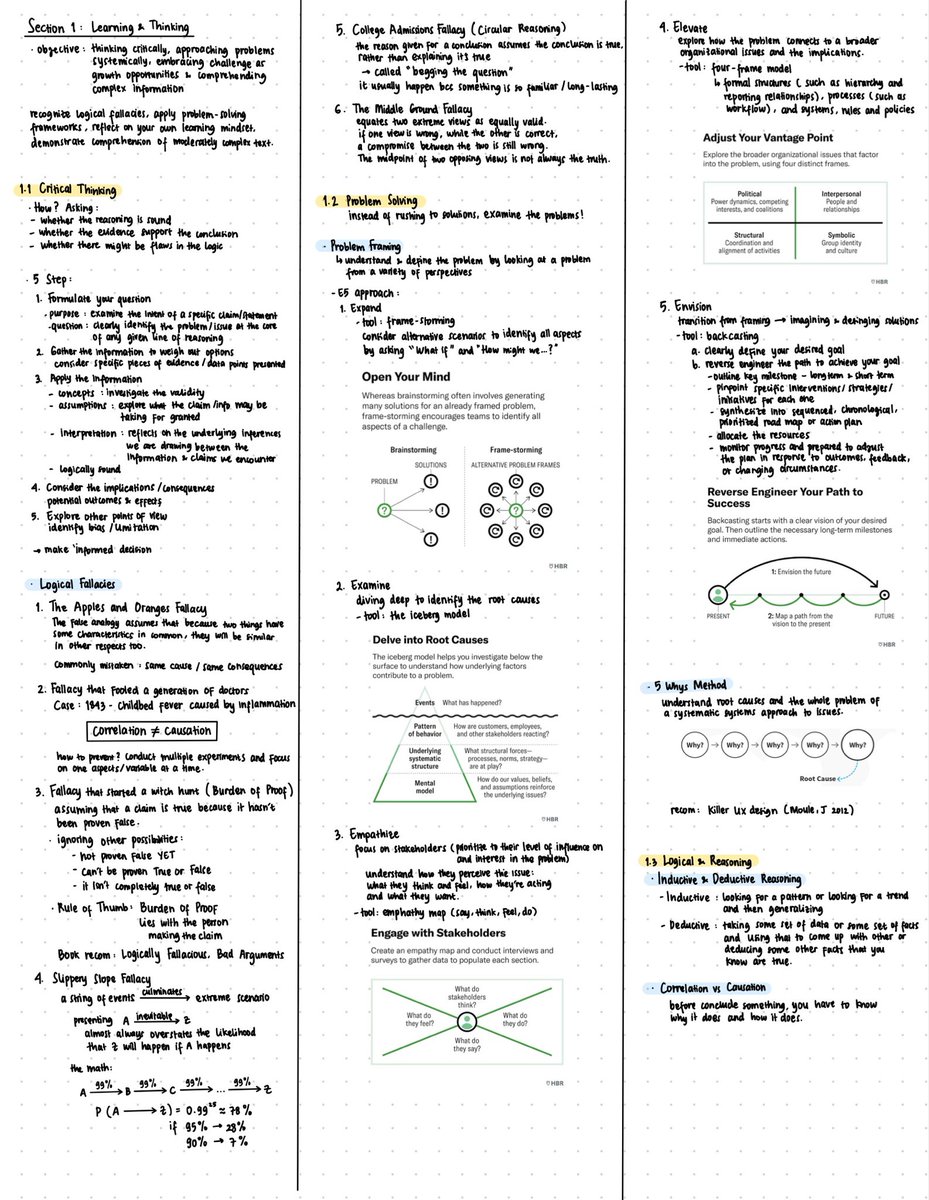
another day 1: learning how to learn and think
- critical thinking
https://t.co/8aqQzPnQKY
- logical fallacies
https://t.co/CV0a25EQtF
- reframe problem
https://t.co/Hu5RodZYCg
- 5 whys method
https://t.co/YC4Z94gfPX
- inductive & deductive reasoning
https://t.co/tR15VDewhR
Travelling on a state visit to India.
I will meet with President of India @rashtrapatibhvn and Prime Minister @narendramodi as well as other members of the state leadership.
The visit will further strengthen the relations between Finland and India – including in the area of trade.
In 1995, Charlie Munger gave a 1-hour masterclass on why smart people make dumb decisions.
His frameworks:
• 24 causes of misjudgment
• Persian messenger syndrome
• Lollapalooza effects
15 lessons from "Psychology of Human Misjudgment" lecture:
1. Man with a hammer syndrome
The @pmarca episode
Marc is a many-time founder, investor, co-creator of the web browser, co-founder of Netscape, the "a" in @a16z. In this very special conversation, we dig into why we’re living through one of the most unique times in history, and what comes next.
We discuss:
🔸 Why AI is arriving at the perfect moment to counter demographic collapse and declining productivity
🔸 How Marc is raising his 10yo kid to thrive in the AI future
🔸 The 3-way standoff that’s happening between PMs, designers, and engineers
🔸 What’s actually going to happen with AI and jobs (spoiler: he thinks the panic is “totally off base”)
🔸Why AI is "the philosopher’s stone" made real
🔸 Why you should still learn to code
🔸 His media diet: X and old books, nothing in between
Don't miss this one.
Full episode embedded here on X 👇
Elon Musk explains the mental model he uses to learn anything 10x faster:
"The normal way we conduct our lives is we reason by analogy. We're doing this because it's like something else that was done, or it's like what other people are doing. 'Me too' type ideas. Slight iterations on a theme."
Elon continues:
"It's mentally easier to reason by analogy rather than from first principles. But first principles is kind of a physics way of looking at the world. What that really means is you boil things down to the most fundamental truths and say, 'What are we sure is true?' and then reason up from there. That takes a lot more mental energy."
He gives the example of batteries:
"Somebody could say, and people do, that battery packs are really expensive and that's just the way they'll always be, because that's the way they've been in the past. Well no, that's pretty dumb. If you applied that reasoning to anything new, you'd never get to that new thing."
Elon explains how first principles changes the question entirely:
"They would say historically it costs $600 per kilowatt hour, so it's not going to be much better than that in the future. First principles would say: What are the material constituents of the batteries? What is the spot market value of those materials?
It's got cobalt, nickel, aluminum, carbon, some polymers, and a steel can. If we bought that on the London Metal Exchange, what would it cost? It's like $80 per kilowatt hour.
So clearly, you just need to think of clever ways to combine those materials into the shape of a battery cell, and you can have batteries much cheaper than anyone realizes."
The biggest opportunities for AI startups today
We surveyed my readers about how they're using AI today, and more importantly, how they want to be using AI.
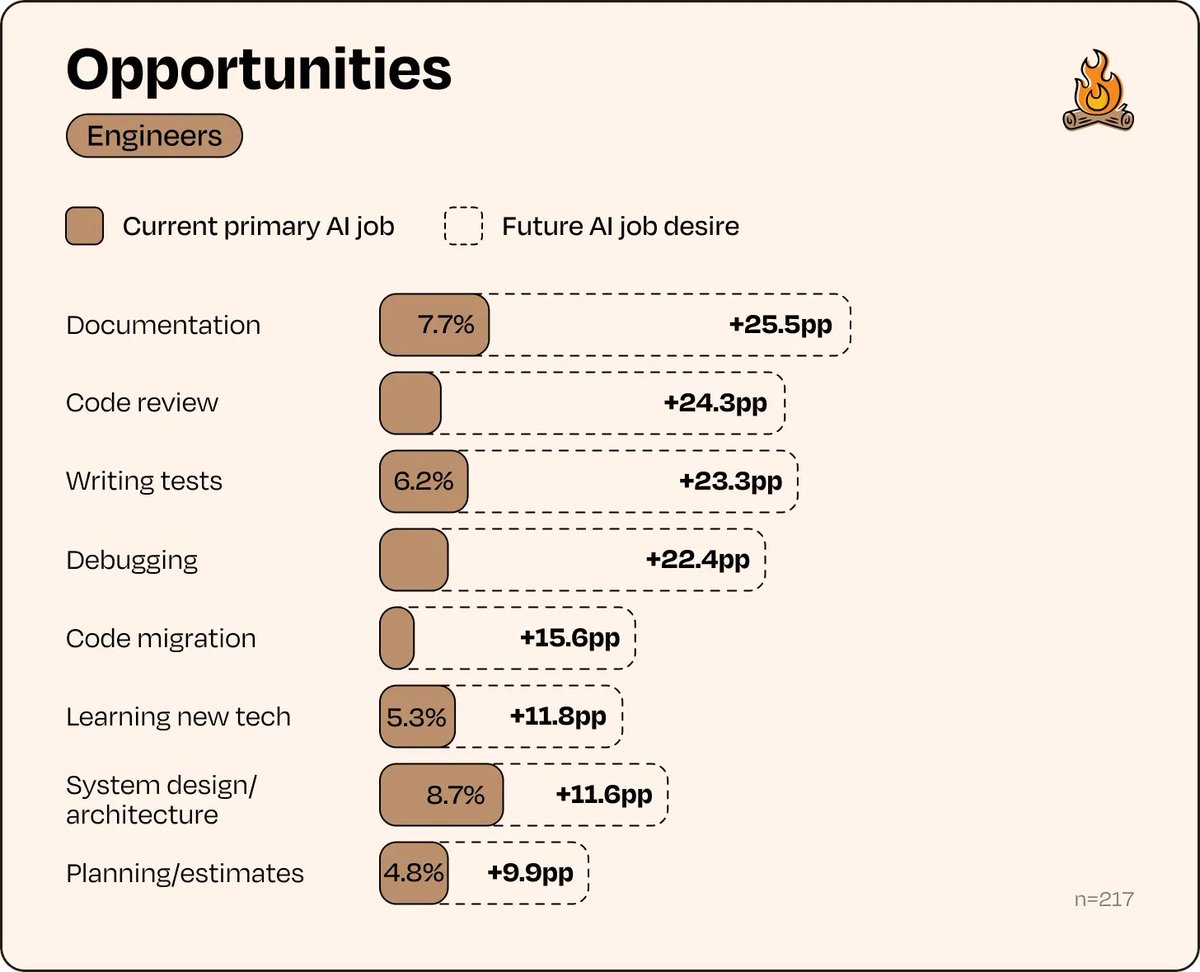
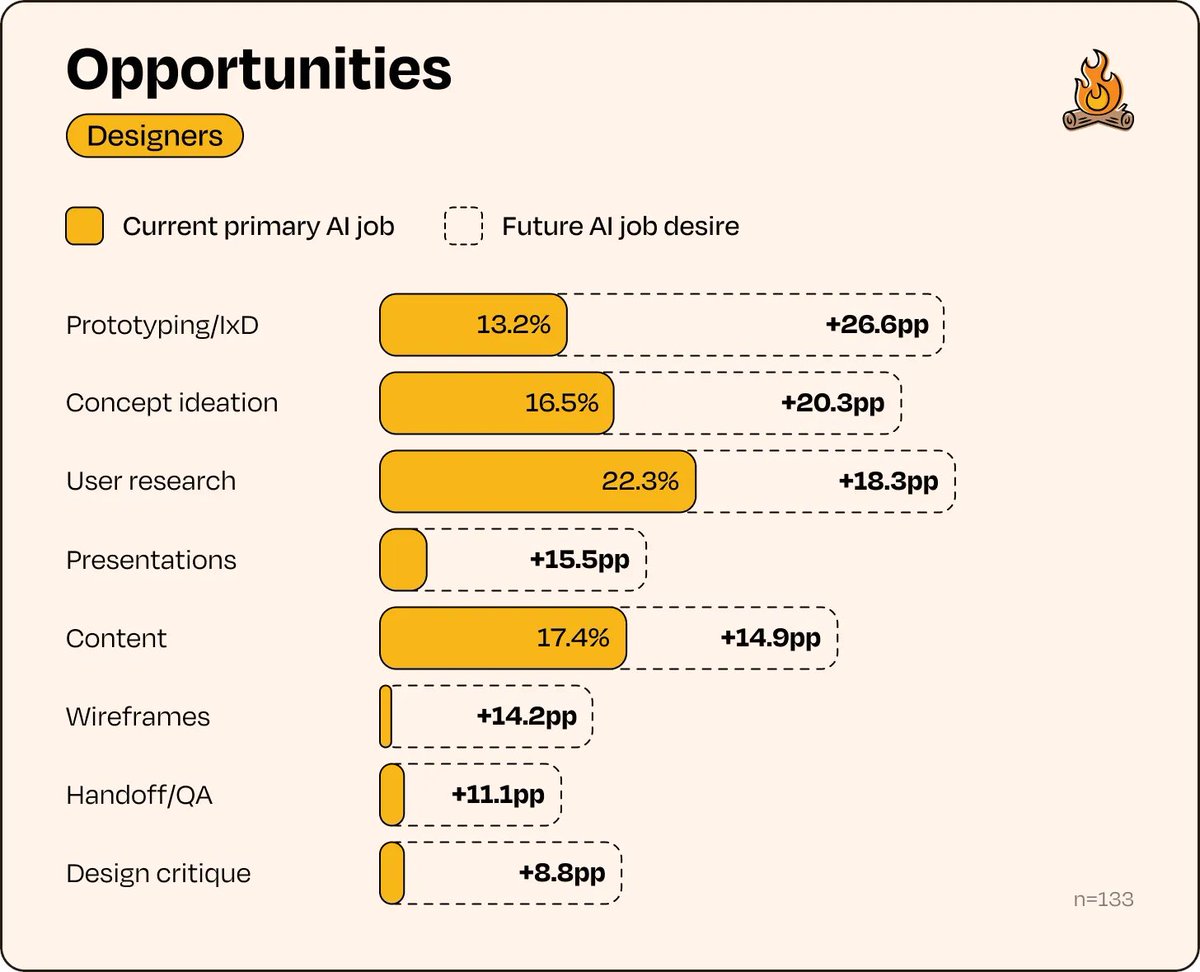
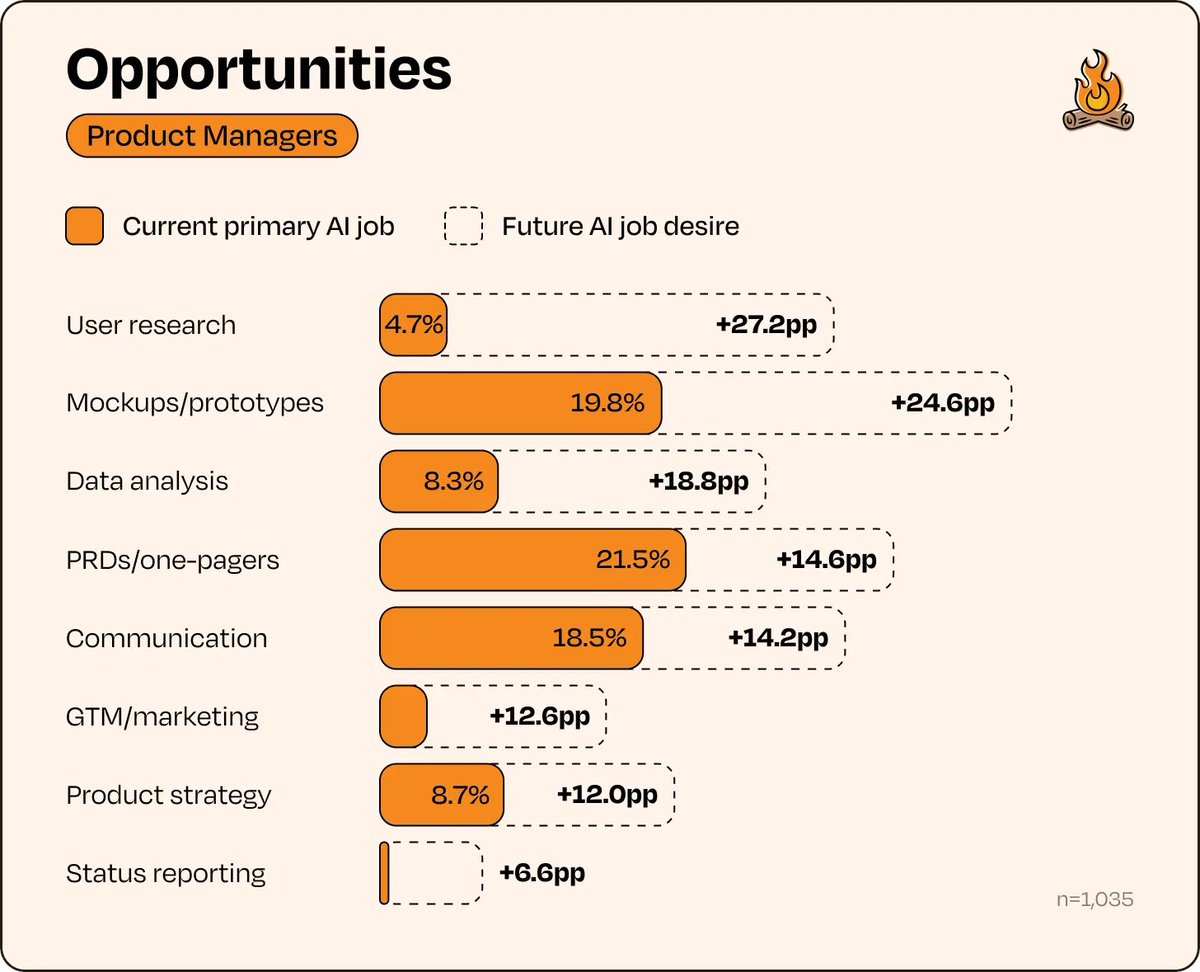
For PMs, the biggest opportunity is research. User research shows the largest demand gap of any task. Only 4.7% say it’s their primary AI use case today, but nearly a third want it to be. PMs have figured out how to use AI for output tasks like writing PRDs and drafting communications, but they’re hungry to apply it upstream, to the messy work of understanding what to build.
Prototyping is a breakout category across functions, both today and in the future. For PMs, “creating mockups/prototypes” jumps from 19.8% (currently using) to 44.4% (want to use next), a +24.6pp swing that makes it the single most-wanted future use case.
For designers, prototyping and interaction design show similar momentum (+27.8pp). This tracks with the rise of tools like Lovable, v0, Replit, and Figma Make.
Engineers are shifting their use of AI to handle work after writing the code. Writing code is by far their most popular use case (51% current), but it has a demand gap of only +5.6pp. However, documentation (+25.8pp), code review (+24.5pp), and writing tests (+23.5pp) all show massive opportunities for growth in engineering AI tooling.
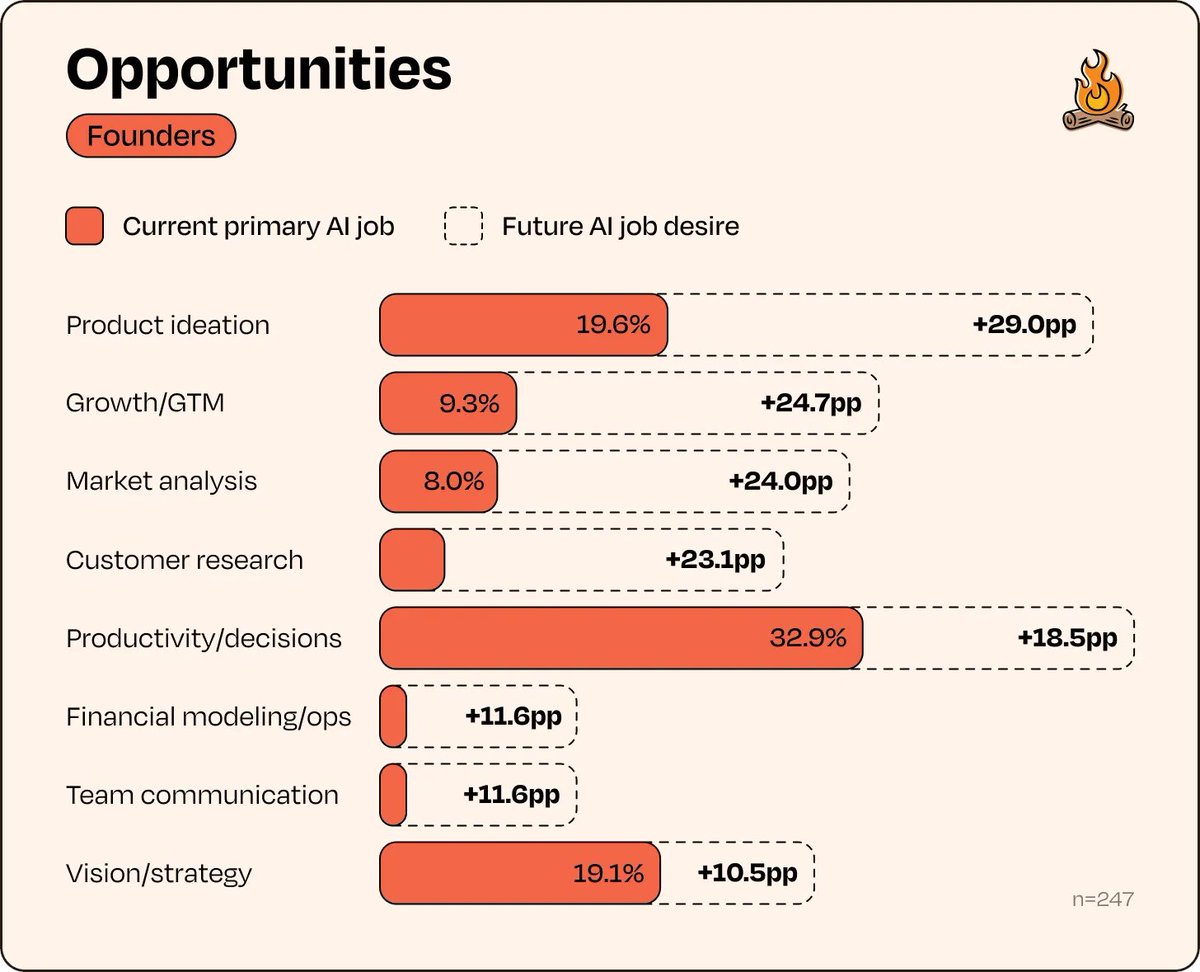
Founders are doubling down on AI as a thinking partner. Product ideation shows massive demand, jumping from 19.6% (currently using) to 48.6% (want to use next), a +29.0pp gap. Growth strategy and GTM planning (+24.7pp) and market analysis (+24.0pp) follow close behind.
Founders already use AI heavily for personal productivity (32.9% currently), but they want to move upstream. They’re looking for pressure-test ideas, explore markets, and think through go-to-market. AI as a co-founder, not just an assistant.
Full report by @noamseg: https://t.co/2ra234FE8e
Here some of my Tiny Lessons from this episode with @JamesClear
1. “Every action you take is like a vote for the type of person you wish to become.”
2. “You cannot outwork the person working on a better thing.”
3. “The cost of good habits is in the present. The cost of bad habits is in the future.”
4. Prioritize work that keeps working for you once it’s done. Build assets that accumulate, rather than tasks that evaporate.
5. Standardize before you optimize. You cannot improve a habit that does not exist.
6. Shape your environment with friction. Make things you don’t want to do harder and things you do want to do easier.
7. Intensity makes for a good story. Consistency makes for good results.
8. “Do the obvious things first. That gets you 80% of the way there.”
9. Live in two timeframes: 10 years and one hour. Do something right now that benefits you in a decade.
10. “Don’t be the first to tell yourself no. Let the world tell you no first.”
11. Use your current advantages to gain new advantages.
12. The work is not being wasted. It’s just being stored.
13. Success isn’t 10,000 attempts; it’s 10,000 iterations. Don’t just try again—try differently.
14. “The quest for novelty overpowers the desire for results.”
15. When something’s working, we underestimate how long it can go for and how powerful it can be.
16. A lack of patience changes the outcome.
17. “If you’re not outthinking them, you’re not outworking them.”
18. “The most powerful form of preparation is a mindset that can handle uncertainty.”
19. You don’t know when the break will come, but if you keep creating surface area, luck will eventually find you.
20. It is highly unlikely that whatever you are working on right now is the best use of your time.
21. “The heaviest weight at the gym is the front door.”
22. “To start, you only need points A, B, and Z. You don’t need to see steps C through Y.”
23. If your actions are not oriented toward your goal, they’re not accumulating.
24. “Almost every thought you have is downstream from what you consume.”
25. Just because improvements aren’t noticeable, that doesn’t mean improvement isn’t happening.
26. “The tighter you cling to an identity, the harder it becomes to grow beyond it.”
27. You don’t want to compete with the person having fun.
28. The fastest way to stop learning is to believe you already know it.
29. Knowledge is about the past, but decisions are about the future.
30. The desire to belong often overpowers the desire to understand.
31. “Habits are the repeated solutions to recurring problems.”
32. Broad funnel, tight filter.
33. Move like thunder: do fewer things, but with a crash that cannot be ignored.
34. Find ways to visualize your progress.
35. “The goal is not to beat the market. The goal is to end up wealthy.”
36. “Reputation takes care of itself if you take care of other people.”
37. Your first idea is not your best idea.
38. “We crave the status as much as we crave the outcome.”
39. Outcome over ego.
40. The only bad mindset is the one you’re fixed in.
41. People want to believe there’s a secret. There isn’t.
42. If you want to be a better writer, read more.
43. Maintain a positive mental attitude regardless of current circumstances.
44. So many problems in life come from your brain over-emphasizing minor details that don’t matter.
45. Success is having power over my days.
46. Don’t waste the reader’s time.