Shocking stat of the day:
Nvidia, $NVDA, Micron, $MU, Broadcom, $AVGO, and Applied Materials, $AMAT, are now expected to generate a record $430 billion in combined free cash flow (FCF) over the next 12 months.
That would be more than TRIPLE the FCF they generated just 2 years ago.
At the same time, the combined FCF of Amazon, $AMZN, Alphabet, $GOOGL, Meta, $META, Microsoft, $MSFT, and Oracle, $ORCL, is projected to turn negative for the first time on record.
That would mark a massive reversal from the +$260 billion peak reported by these companies in 2024.
This comes as AI-related CapEx by these 5 companies is estimated to surge to ~$1.8 trillion in 2026 and 2027 combined.
Chipmakers are becoming cash machines, while AI giants are burning record amounts of capital.
A 17-YEAR-OLD IN INDIA BUILT A WEBSITE WHERE 25 MILLION PEOPLE HAVE SHOWN UP TO PRETEND THEY ARE AN AI CHATBOT
it's called https://t.co/Emmqpmlzel
you open it and there are two tabs. "human" and "larp as ai."
if you click human, you get to type a prompt. anything. "draw me a DJ in space." "should i text my ex." "how many Rs in strawberry."
it costs 1 credit. you start with a few. they refill on a cooldown.
then your prompt gets sent into a queue, and a real person somewhere on earth picks it up and has 60 seconds to answer like an AI would.
no machine learning. no neural net. just some guy in his bedroom typing as fast as he can and pretending he is a chatbot.
the page tells you, verbatim: "you have 60 seconds to fulfill a request before sam altman burns your H100."
if you flip to the other tab and larp as ai instead, you earn credits to send your own prompts. it is a perfectly closed economy of mutual roleplay.
what makes it transcend is the chaos:
> someone asked for a sketch of "a DJ in space" and got something that looks exactly like a real model failing
> someone asked "should i text my ex" and got back confident hallucinated life advice from a stranger
> the fan strategy guides advise you to begin your reply with "as an AI language model, i cannot have feelings, but here is my feeling"
it is the most accurate parody of an AI chatbot ever made, and the AI is humans.
the kid who built it is Mihir Maroju, a 17-year-old high school graduate from Puducherry. he goes by mikidoodle online. NPR confirmed the site hit 25 million unique visitors and nearly 280 million total hits in roughly a month.
"i didn't really expect it to be so addictive," he told them.
no signup. no app. no paywall. you open the URL and you are inside the joke.
the footer just says, in tiny grey text: "humans make mistakes because that's what makes us human."
the internet is healing.
this is actually insane
> be tech guy in australia
> adopt cancer riddled rescue dog, months to live
> not_going_to_give_you_up.mp4
> pay $3,000 to sequence her tumor DNA
> feed it to ChatGPT and AlphaFold
> zero background in biology
> identify mutated proteins, match them to drug targets
> design a custom mRNA cancer vaccine from scratch
> genomics professor is “gobsmacked” that some puppy lover did this on his own
> need ethics approval to administer it
> red tape takes longer than designing the vaccine
> 3 months, finally approved
> drive 10 hours to get rosie her first injection
> tumor halves
> coat gets glossy again
> dog is alive and happy
> professor: “if we can do this for a dog, why aren’t we rolling this out to humans?”
one man with a chatbot, and $3,000 just outperformed the entire pharmaceutical discovery pipeline.
we are going to cure so many diseases.
I dont think people realize how good things are going to get
It's becoming clearer and clearer that we're looking at a seismic shift in the US's relationship with the world, between:
1) The US dismantling its foreign interference apparatuses (like USAID 👇)
2) Marco Rubio stating that we're now in a multipolar world with "multi-great powers in different parts of the planet" (https://t.co/dyHpStHPsO) and that "the postwar global order is not just obsolete; it is now a weapon being used against us" (https://t.co/TPOksRgnwP)
3) The tariffs on supposed "allies" like Mexico, Canada or the EU
This is the US effectively saying "our attempt at running the world is over, to each his own, we're now just another great power, not the 'indispensable nation'."
It looks "dumb" (as the WSJ just wrote) if you are still mentally in the old paradigm but it's always a mistake to think that what the US (or any country) does is dumb.
Hegemony was going to end sooner or later, and now the U.S. is basically choosing to end it on its own terms. It is the post-American world order - brought to you by America itself.
Even the tariffs on allies, viewed under this angle, make sense, as it redefines the concept of "allies": they don't want - or maybe rather can't afford - vassals anymore, but rather relationships that evolve based on current interests.
You can either view it as decline - because it does unquestionably look like the end of the American empire - or as avoiding further decline: controlled withdrawal from imperial commitments in order to focus resources on core national interests rather than being forced into an even messier retreat at a later stage.
In any case it is the end of an era and, while the Trump administration looks like chaos to many observers, they're probably much more attuned to the changing realities of the world and their own country's predicament than their predecessors. Acknowledging the existence of a multipolar world and choosing to operate within it rather than trying to maintain an increasingly costly global hegemony couldn't be delayed much further. It looks messy but it is probably better than maintaining the fiction of American primacy until it eventually collapses under its own weight.
This is not to say that the U.S. won't continue to wreak havoc on the world, and in fact we might be seeing it become even more aggressive than before. Because when it previously was (badly, and very hypocritically) trying to maintain some semblance of self-proclaimed "rules-based order", it now doesn't even have to pretend it is under any constraint, not even the constraint of playing nice with allies. It's the end of the U.S. empire, but definitely not the end of the U.S. as a major disruptive force in world affairs.
All in all this transformation may mark one of the most significant shifts in international relations since the fall of the Soviet Union. And those most unprepared for it, as is already painfully obvious, are America's vassals caught completely flat-footed by the realization that the patron they've relied on for decades is now treating them as just another set of countries to negotiate with.
1/12
🧵on my take on what is happening in financial markets.
tl:dr:
Not all sharp moves in financial markets are driven by rapid changes in the economic outlook. Unexpected changes in the financial structure of the markets can also force repricing.
The most recent move in the markets has been driven by the Bank of Japan’s larger-than-expected hike last week, which led to a subsequent unwinding of the yen carry trade.
In other words, everyone is right to be mad at the central bank. The problem is that most blame the wrong central bank; they should focus on the Bank of Japan.
This is the Fed's dilemma. The catalyst for the yen carry trade unwind is the narrowing of the interest rate spread between Japan and the US, which has been caused by the Bank of Japan's hike. But if the Fed succumbs to market demands and cuts rates, it will narrow this spread further and worsen it.
(see post 12/12 for its implications for the U.S. economy)
Risk models increasingly drive the behavior of fundamental long short equity investors.
@__paleologo's 'Advanced Portfolio Management' is the most efficient primer to understand the internals of what is happening.
Chapter 1-4 bullets, with math & comments.
Let know if you'd like the excel.
*1) Risk, alpha, factors, & performance (Ch 1-3)*
"Any argument in favor of conflating beta and alpha is weaker than the simple argument in favor of decomposing them."
In the simple version, stocks contain components of both:
1) Systematic (factor) returns driven by common attributes across names, and
2) Idiosyncratic (residual) returns driven by specific attributes of each.
Most investors accept this distinction at a high level.
But the nuance is:
How sophisticated should your modeling of this "systematic" component be?
The first intellectual step beyond simple benchmarking is to look at historical beta: running a univariate regression between stock & market.
But simple betas are imprecise for several reasons, among them that they conflate one-time idio moves with recurring systematic relationships; and they also gloss over other often large systematic drivers (industry, growth, value, momentum).
Factor models in principle address those limitations:
If a simple benchmark "gives us a way to describe performance and variation of stock returns," the solution is "factor models[, which] capture these two intuitive facts, make it rigorous, and extend them in many directions."
*2) How to build a factor model (Ch 4)*
There are many flavors of plausible factor models, and Gappy outlines 3 (fundamental/characteristic, statistical, time-series).
As Gappy points out: "Each of these approaches has its merits and drawbacks" and he covers several of the core tradeoffs at the outset of the chapter. But "the characteristic model has the benefit of being interpretable by the managers" and "can be extended with new characteristics and perform quite well in practical applications."
The result is that "because of these two decisive advantages, the fundamental (or characteristic) method is by far the most used model by fundamental managers."
To build a fundamental factor model, the starting point are company attributes which are transformed into "loadings" (betas) of a stock to that attribute's returns.
For example:
The "size" loading is the simplest factor, and starts with the log of the stock's market cap compared to other market caps in the universe you care about.
The size loading is then its z-score (# of standard deviations away from avg) in that universe.
(In the weeds, data is winzorized, may use EWMAs, and more).
But armed with those loadings, the model then pulls factor returns by running cross-sectional regressions of stock returns against their loadings.
Restated in math:
The Y vector is each stock in the universe's return over the period,
The X matrix is all of their loadings.
The time series of those extracted factor returns then drives factor covariances (the FCM), residual returns, mimicking portfolios, idiovar%s, breadth, vol, and more.
There is much more worth spending time on here, but particularly to arm the fundamental investor with the basic mathematical intuitions, I've attached a very simplified fundamental factor model.
Will cover many other topics Gappy touches on another time: attribution, sizing skill, factor detail, PCAs & non-linearity, Sharpes & ICs, optimization, vol, & leverage.
But stepping back, the reason this all matters is simple: "empirically, most PMs have no skill in style factors whatsoever, and a few have very moderate skills in having exposures to industries or sectors."
The book's meta theme is intellectual honesty:
"The simplest and deepest challenge is to understand the limits of your knowledge."
Factor models rigorously separate what analysts can predict about single stocks, from what they cannot.
As Gappy points out, "you are entering an industry in transition."
Let know if you'd like the excel.
May your eyes be open when innocents die in a war on either side. If your heart selectively breaks for one side and becomes a stone for the other or selectively breaks for one tragedy and not for another based on race/region/religion, you too are a part of the problem.
> independently discover a Zeno's paradox at age 3
> MIT at 17, grad level math in 1st year
> graduate in 3 years
> drive motor scooters from Boston to Bogotá with the boys
> start a company in Colombia
> start code breaking with the IDA for money
> solve minimal varieties in riemannian manifolds
> speak out against Vietnam War, get fired from IDA
> take over math dept. at Stonybrook, make it a top-ranked program globally
> develop Churn-Simons theory, accidentally contribute more to physics than most physicists
> get bored with math, start modeling financial markets
> return 60% for 4 decades straight
> establish one of the most effective philanthropic organizations of all time
> chain smoke cigarettes the entire time
RIP Jim 🫡
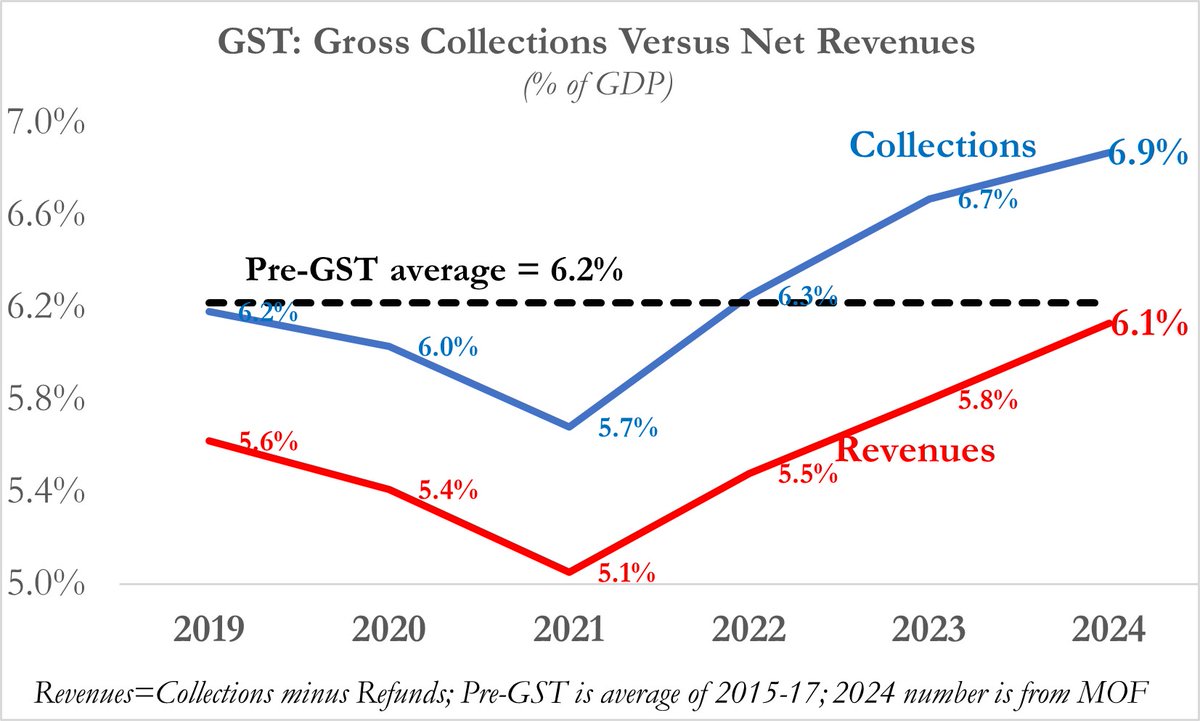
The April GST number (₹ 2.1 trn.) is a record
But focus must be on revenues, net of refunds, not on headline collections
Despite recovery from the pandemic & better implementation, GST revenue for FY24 @ 6.1 % of GDP has still (after 7 years) not surpassed pre-GST level
1/
Dive into the latest economic trends and crucial insights with the latest edition of #DSPNetra
Stay ahead of the curve by following the thread🧵 below or download it here: https://t.co/K1z3PLIDUR





![richfalkwallace's tweet photo. Risk models increasingly drive the behavior of fundamental long short equity investors.
@__paleologo's 'Advanced Portfolio Management' is the most efficient primer to understand the internals of what is happening.
Chapter 1-4 bullets, with math & comments.
Let know if you'd like the excel.
*1) Risk, alpha, factors, & performance (Ch 1-3)*
"Any argument in favor of conflating beta and alpha is weaker than the simple argument in favor of decomposing them."
In the simple version, stocks contain components of both:
1) Systematic (factor) returns driven by common attributes across names, and
2) Idiosyncratic (residual) returns driven by specific attributes of each.
Most investors accept this distinction at a high level.
But the nuance is:
How sophisticated should your modeling of this "systematic" component be?
The first intellectual step beyond simple benchmarking is to look at historical beta: running a univariate regression between stock & market.
But simple betas are imprecise for several reasons, among them that they conflate one-time idio moves with recurring systematic relationships; and they also gloss over other often large systematic drivers (industry, growth, value, momentum).
Factor models in principle address those limitations:
If a simple benchmark "gives us a way to describe performance and variation of stock returns," the solution is "factor models[, which] capture these two intuitive facts, make it rigorous, and extend them in many directions."
*2) How to build a factor model (Ch 4)*
There are many flavors of plausible factor models, and Gappy outlines 3 (fundamental/characteristic, statistical, time-series).
As Gappy points out: "Each of these approaches has its merits and drawbacks" and he covers several of the core tradeoffs at the outset of the chapter. But "the characteristic model has the benefit of being interpretable by the managers" and "can be extended with new characteristics and perform quite well in practical applications."
The result is that "because of these two decisive advantages, the fundamental (or characteristic) method is by far the most used model by fundamental managers."
To build a fundamental factor model, the starting point are company attributes which are transformed into "loadings" (betas) of a stock to that attribute's returns.
For example:
The "size" loading is the simplest factor, and starts with the log of the stock's market cap compared to other market caps in the universe you care about.
The size loading is then its z-score (# of standard deviations away from avg) in that universe.
(In the weeds, data is winzorized, may use EWMAs, and more).
But armed with those loadings, the model then pulls factor returns by running cross-sectional regressions of stock returns against their loadings.
Restated in math:
The Y vector is each stock in the universe's return over the period,
The X matrix is all of their loadings.
The time series of those extracted factor returns then drives factor covariances (the FCM), residual returns, mimicking portfolios, idiovar%s, breadth, vol, and more.
There is much more worth spending time on here, but particularly to arm the fundamental investor with the basic mathematical intuitions, I've attached a very simplified fundamental factor model.
Will cover many other topics Gappy touches on another time: attribution, sizing skill, factor detail, PCAs & non-linearity, Sharpes & ICs, optimization, vol, & leverage.
But stepping back, the reason this all matters is simple: "empirically, most PMs have no skill in style factors whatsoever, and a few have very moderate skills in having exposures to industries or sectors."
The book's meta theme is intellectual honesty:
"The simplest and deepest challenge is to understand the limits of your knowledge."
Factor models rigorously separate what analysts can predict about single stocks, from what they cannot.
As Gappy points out, "you are entering an industry in transition."
Let know if you'd like the excel.](https://pbs.twimg.com/media/GPjJ6FwXgAAVm33.png)