I improved NanoGPT Speedrun from 39.9s → 6.7s (-83.2%), more than every record since 2025 combined (-81.4%)!
The web is full of rare, repeated content that the LM can’t memorize in time. I solve this with retrieval-augmented n-gram hints🧵
Your agent solved the task at xhigh. Would low have solved it too? You can’t tell without rerunning it, and you still pay for every token.
We tested models x reasoning effort level x benchmarks. On tasks low effort can already solve, top effort costs up to 42× more #LLM#AI 🧵👇
LLMs might be superhuman at math, but can they act in real time?
Not even close!
Presenting Gym-Anything-RT, a framework for generating real-time minigames in which the game keeps moving while the model thinks.
Even the best frontier model, GPT-6 Astra, scores just 9%!
🌐: https://t.co/HpWHGTjRdp
🧵
We generated 458,000 RL environments to train an agent on stateful, multi-step on-device tasks. We share in our preprint how we decided along which axes to enlargen our RL env corpus, via data composition scaling laws.
📄 https://t.co/lqyzIyvvtF
🧵1/9
From θ = 0.8746075 to θ = 0.8739558 in two days :)
The Quasi-RH zero-free half-plane keeps moving!
• 0.873995: Sil’s density-split bootstrap (#83)
• 0.873985: our third density-split step on Sil’s proof (#84)
• 0.8739558: Jacob Sussman’s finer 46-step chain, the new record (#86)
• 0.873981: @SovereignSteak's fourth density step, contributed to our repo as PR #30 (#85)
This builds on contributions from Sil, Jacob Sussman, SovereignSteak, ArviFoxy, @HaileyStormC, Mark Lewko, Slayer, Zhongpai Gao, @mrowdays, Subhanjan Das, Sagar Thakrar, Sudarsh Chaturvedi, timbalud, Devin Watson, Kari Roegnvaldsson, nielstron, Akash Levy, Tim Gehrunger, Baiying Liu, Argonaut Math, and OpenAI’s original 7/8 preprint.
Our repo doesn’t require a Lean proof to contribute possible solutions, so it may be easier for auto-researchers to contribute. (I will still run the full Lean verifications in parallel)
There's fewer auto-researchers working on this, so I noticed it's easier to make significant progress.
Our repo is also sponsored by @Agent37HQ (YC F26), so the first 100 contributors get free sandboxes to run experiments!
1/4
Meet Qwenputer: Qwen3.5-4B with a full RISC-V CPU inside its weights, using the model's own Gated DeltaNet layers as RAM.
It runs C and MicroPython in its forward passes, no external runtime.
On DeepMind math: base 55–90%, base + Python tool 95–100%, Qwenputer 97.5–100%.
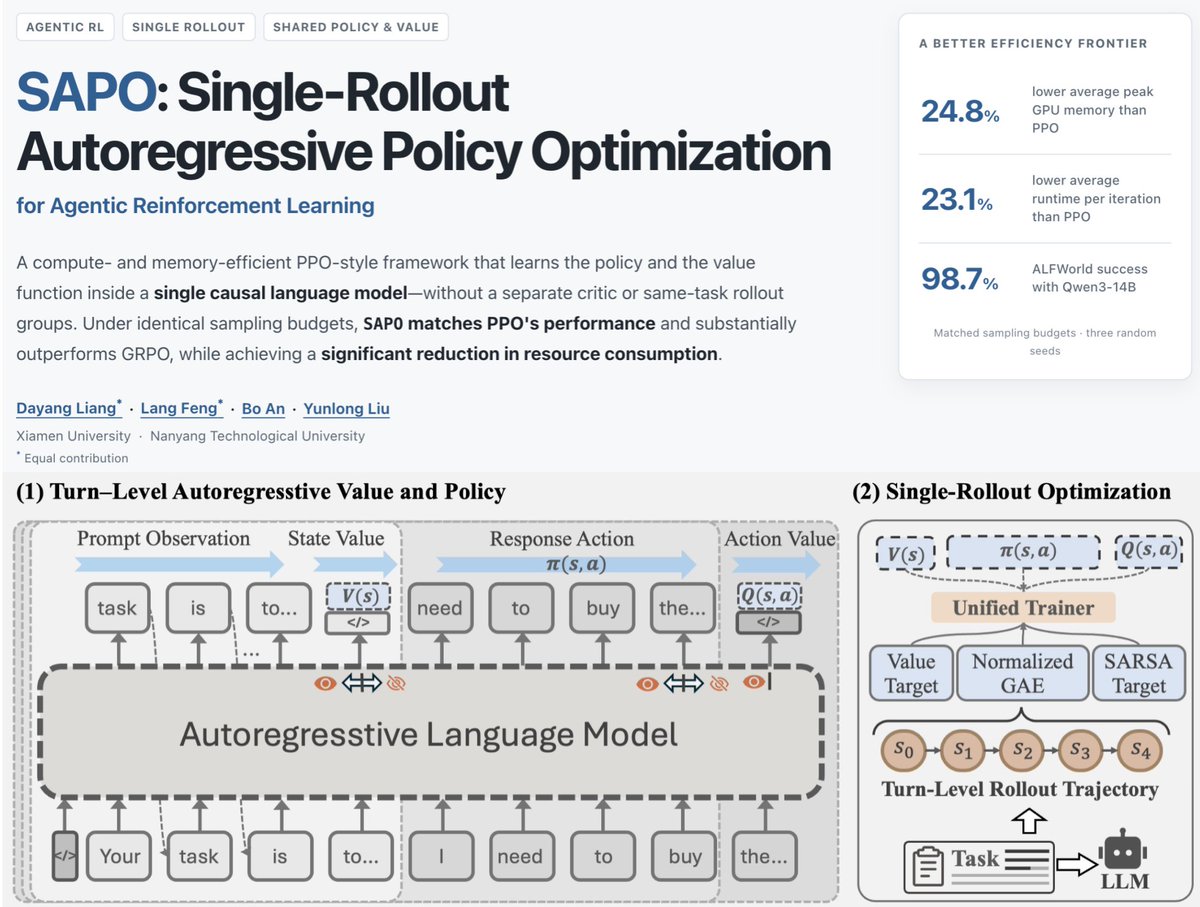
PPO without a separate critic?
We like PPO's performance and stability on long-horizon agentic tasks. But a separate LLM critic gets expensive.
What if the LLM actor's autoregressive structure is already a natural fit for the critic's job?
The answer is below 👇
Think about how a typical LLM agent makes a decision:
👉 Generating an output: The LLM reads the state 's', then generates an action 'a' token by token.
👉 Before the action: Given 's', the model predicts the next token and those same logits can also be trained to read out 'V(s)'.
👉 After the action: Once 'a' is complete, the next-token logits are conditioned on 's+a', giving us a natural place to learn 'Q(s,a)'.
So the LLM actor already produces the logits we need for value estimation during generation. We just need to train the model to learn the corresponding values at these two positions!
🚀 That's the idea behind SAPO (Single-Rollout Autoregressive Policy Optimization). LLM reads values directly from the it's logits and train policy and value together in the same model. No separate critic, no extra value head!
Code and paper are out!
Project Page: https://t.co/Kc1i8OXmhE
Paper: https://t.co/mNzTCiJTcy
Code: https://t.co/myWbb77olT
1/3
A zero gradient doesn’t always mean there’s nothing left to learn.
I’m happy to share PolyStep, now published in #TMLR. It explores a question I find fascinating: how do we train networks when hard spikes, quantization, or discrete routing leave us with little useful gradient information?
These operations can produce losses with flat regions and sudden jumps. A tiny parameter change may tell us almost nothing, while a larger one reveals a meaningful difference.
PolyStep works at that finite scale. It evaluates structured parameter probes along the vertices of a rotated polytope, then uses the observed losses to weight the probe directions and take a step. The weights come from an optimal transport formulation, with a simple softmax solution in the main method. Training uses only forward passes.
The intuition I find most useful is that the scale at which we look determines which learning signals become visible. Probe radius controls what the optimizer can see, temperature controls how strongly it responds, and step scale controls how far it moves.
The PolyStep repo includes a small synthetic classification example with hard LIF spikes and no surrogate gradients, alongside CartPole policy search that learns from episode returns without gradients through the actions or simulator.
There is a practical tradeoff: those forward evaluations cost compute, and backpropagation is usually faster when useful gradients are available. I’m especially interested in the cases where hard operations are part of the behavior we want to preserve during training.
Many thanks to Viet T. Nguyen for the lovely interactive visualization that makes the geometry much easier to see.
If you’re working with spiking models, quantization, discrete routing, or simulators, I’d love to hear what you try, what works, and where it gets stuck. Questions, feedback, and contributions are very welcome.
Code: https://t.co/17viQWHQlP
Paper: https://t.co/MPcYcCsgGq
Interactive visualization: https://t.co/iVyQL4L8ve
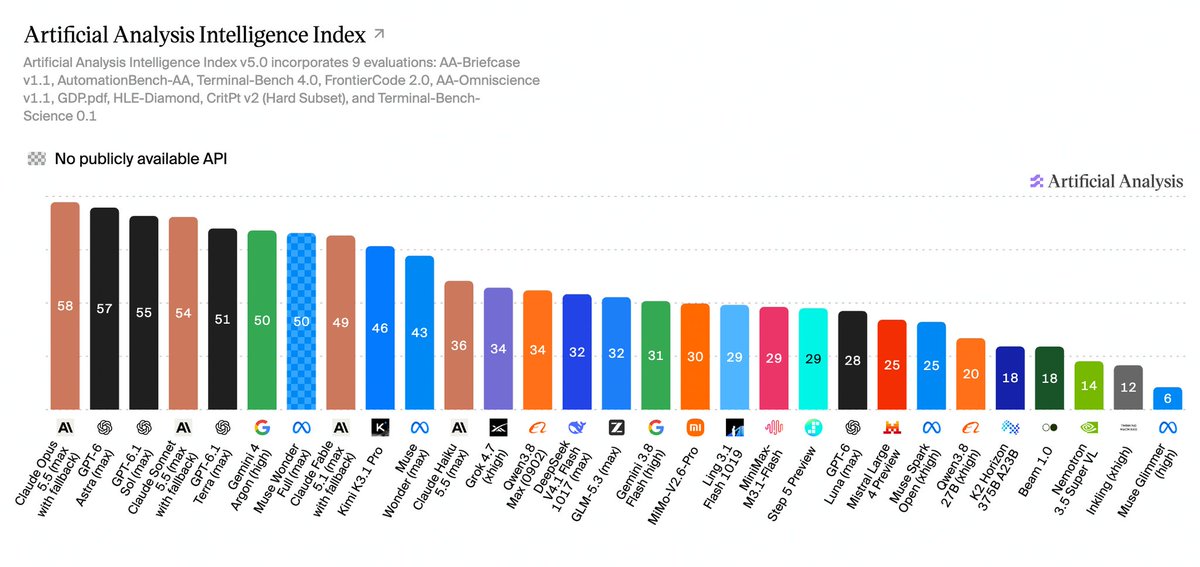
Announcing Artificial Analysis Intelligence Index v5, featuring 2 new benchmarks and 3 upgrades. For the first time, the majority of the Index is built on private datasets
The Artificial Analysis Intelligence Index is our composite measure of model capabilities across tasks reflecting real-world usage today. v5 is our biggest upgrade since v4 launched in January. With v5, 60% of the Index is now based on evaluations with private test sets or held-out answers.
Alongside Intelligence Index v5, we’re launching the Artificial Analysis Progress Index v1, which tracks model capability over time on one continuous scale.
New to the Intelligence Index:
➤ FrontierCode 2.0: Cognition's newly-launched private benchmark of real-world coding tasks, graded on whether a repository maintainer would merge the agent's change
➤ Terminal-Bench-Science: 70 agentic scientific research tasks, run in a terminal environment
Upgraded:
➤ HLE-Diamond (replacing Humanity's Last Exam): a refined 1,000-question version of Humanity's Last Exam, split evenly between reasoning and knowledge questions
➤ AA-Omniscience v1.1: An updated dataset with saturated and public set questions removed, new questions added, and ambiguous or erroneous questions revised
➤ CritPt v2: a private, 40-question hard subset of CritPt v2, revised by the CritPt authors and run with a code-execution tool
Staying in the Index: AA-Briefcase, AutomationBench-AA, GDP.pdf and Terminal-Bench 4.0
Removed from the Index: GDPval-AA v2.1, SciCode, and AA-LCR v1.1
Key results:
➤ Claude Opus 5.5 (max) leads at 58, ahead of GPT-6 Astra (max, 57) and GPT-6.1 Sol (max, 55): Anthropic and OpenAI hold the top five models. Gemini 4 Argon (high) is next at 50
➤ The open weights gap widens from 3 points to 12: Kimi K3.1 Pro (weights not yet released) is the top open weights model at 46. Among released weights, DeepSeek V4.1 Flash 1017 (max) and GLM-5.3 (max) lead at 32 - 26 points behind the leader and below Claude Haiku 5.5 (max, 36)
➤ Cost per task varies by more than 13x among the leading models: of the 10 highest-scoring models shown, GPT-6.1 Terra (max) is the cheapest at $0.96 per Intelligence Index task and Claude Fable 5.1 (max) the most expensive at $13.04