5 things you don't know about Moderna's cancer "vaccine" 🧬
1) It's called a vaccine because it uses the same mRNA technology as the COVID-19 vaccine. However, it doesn't prevent melanoma. It treats melanoma and helps prevent metastases after surgery.
2) AI is used to develop this personalized therapy, but the work didn't start with the recent AI boom. The therapy was already in development before the COVID vaccine even existed.
3) The vaccine isn't given alone. It's administered in combination with pembrolizumab, the best selling cancer drug in the world.
4) The market is pricing in potential for this therapy because, just as it worked for melanoma, it could work for other cancers. Phase 3 trials are already underway for NSCLC (non-small cell lung cancer). Success in these new trials isn't guaranteed by the melanoma results, but it's certainly a positive signal.
5) Other companies, like BioNTech, are developing therapies based on the same technology.
Could this be the next revolution in cancer treatment, following the remarkable success of monoclonal antibodies (immunotherapy)?
All you need to do when trading $SPY
Mark your previous day high/low
Mark your pre market high/low
Let the market open for the first 15 minutes
Mark your 15 minute opening range
Mark the high of that 15m candle
Mark the low of that 15m candle
Once you see a breakout of the 15 minute opening range high or low… it starts here…
Your first price target will be the pre market high/low you marked prior to this
Second price target will be previous day high or previous day low from there
It’s simple
Don’t make it difficult on yourself
If you found this thread valuable make sure to like/share/drop a comment below the first post in this thread ... it goes a really long way! https://t.co/S484hxiwYl
Tesla vs Nvidia: Pioneering Decision-Making in Autonomous Vehicles
Tesla and Nvidia, two giants in the tech industry, have recently patented innovative technologies aimed at revolutionizing decision-making processes in autonomous vehicles. Both companies are tackling the complex challenge of real-time decision-making in dynamic driving environments, but with distinctly different approaches.
Commonalities
1️⃣ Hierarchical Structures:
Both patents employ hierarchical approaches to manage the complexity of decision-making in autonomous driving.
2️⃣ Real-Time Processing:
Both systems are designed for rapid decision-making, crucial for safe autonomous operation in dynamic environments.
3️⃣ Multi-Factor Consideration:
Both approaches aim to balance various factors such as safety, efficiency, and traffic rules in their decision-making processes.
4️⃣ Focus on Inference:
Both technologies are geared towards making inferences about the best course of action based on current environmental data.
Differences
1️⃣ Structural Approach:
- Tesla uses a multi-layered graph structure (goal, trajectory, and interaction layers)
- Nvidia employs a rule-based hierarchy with explicitly prioritized rules
2️⃣ Decision Mechanism:
- Tesla generates and evaluates multiple potential paths through its graph
- Nvidia uses a two-stage optimization process based on rule satisfaction
3️⃣ Adaptability:
- Tesla's system dynamically builds and prunes its decision graph based on the environment
- Nvidia relies on a predefined rule hierarchy that can be adjusted for different scenarios
4️⃣ Transparency:
- Nvidia's explicit rule structure might be more transparent and easier to audit
- Tesla's dynamic approach might be more complex but potentially more adaptable
Conclusion
Tesla's Hierarchical Nodal Graph offers a highly adaptable system that can potentially handle a wide range of unforeseen scenarios.
Nvidia's Hierarchical Rule-Based approach provides a clear, transparent decision-making process that might be easier to validate from a regulatory standpoint.
The development of these technologies underscores the industry's move towards more sophisticated, context-aware decision-making systems in autonomous vehicles.
VIX 1st future at 18.60 just surpassed VIX 2nd future at 18.30 which means VIX term structure is in Backwardation. If you closed your long portfolio every time this happened and waited for contango to return you WOULD HAVE AVOIDED ALL MARKET COLLAPSES THROUGHT HISTORY.
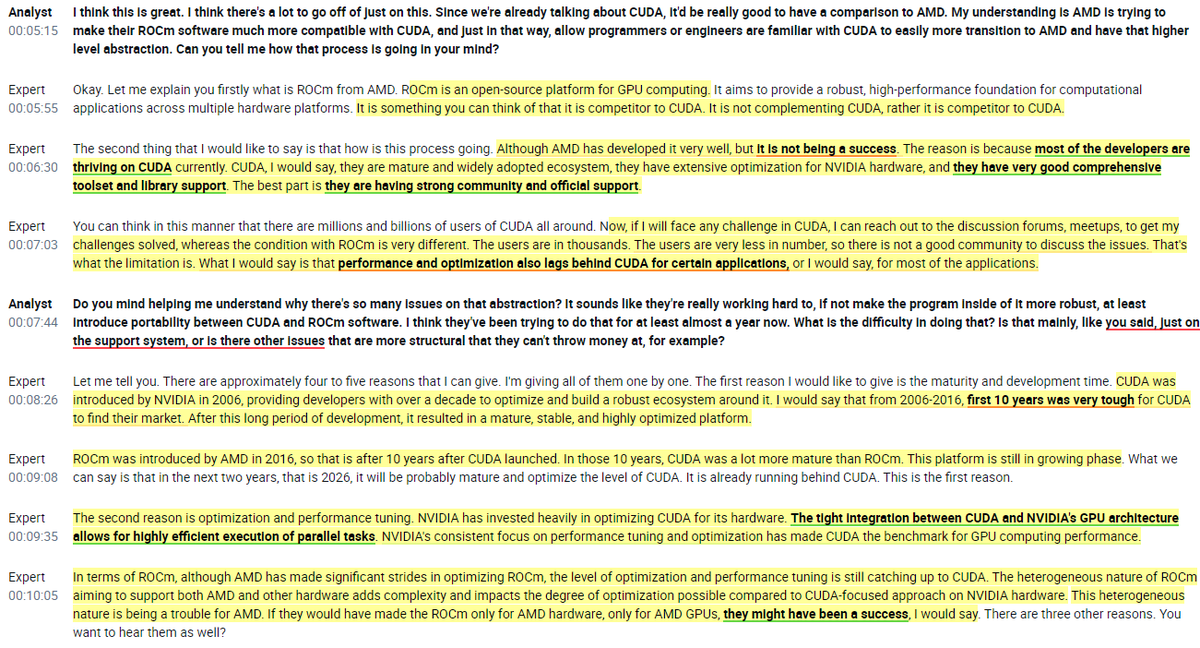
Interview with a Former $NVDA employee on what is next for the semi-market and $NVDA's CUDA in detail:
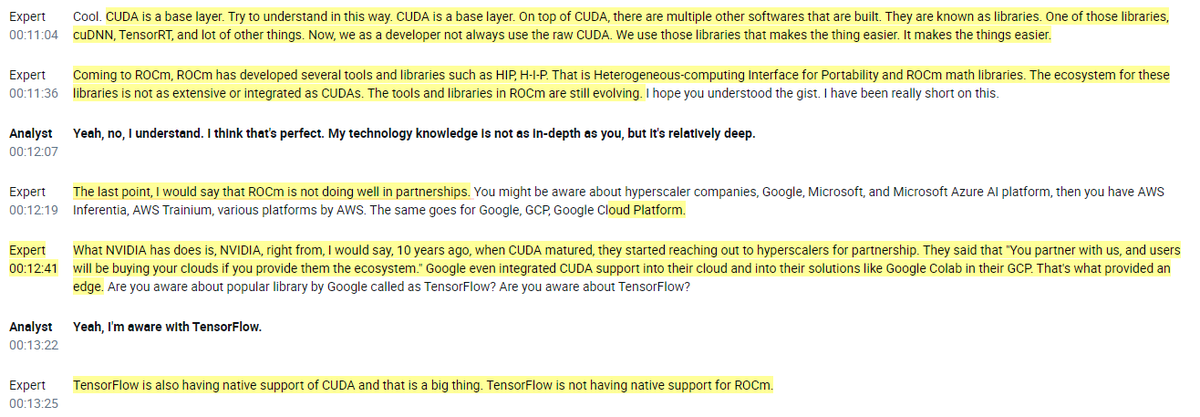
1. $AMD's answer to $NVDA's CUDA is ROCm. But he thinks there are big differences between these two. CUDA is a mature ecosystem, and most developers know CUDA as it has been around since 2006. CUDA is also much more optimized and stable.
2. $AMD has made significant strides in optimizing ROCm, but it still needs to catch up with CUDA. He also thinks ROCm's disadvantage is its heterogeneous nature of supporting $AMD and other hardware, which adds to the complexity. CUDA, on the other hand, is optimized for $NVDA hardware only.
3. CUDA has an extensive layer of libraries, while ROCm's libraries are still evolving. He also notes that ROCm is not doing well with partnerships compared to CUDA, which has partnerships with hyperscalers.
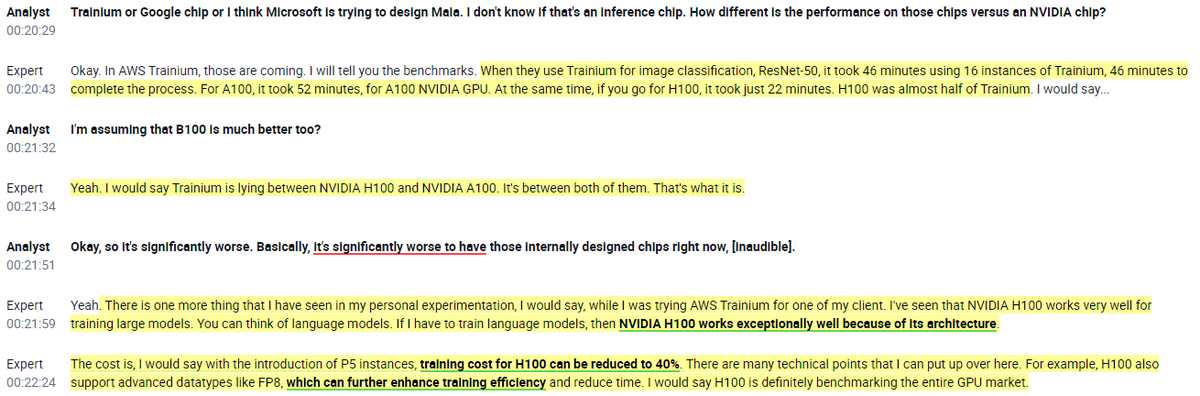
4. He thinks $AMZN AWS's Trainium chip is performance wise between $NVDA H100 and $NVDA A100. He really likes H100 for LLMs; with the introduction of P5 instances, they have reduced training costs by 40%.
5. He sees a few bottlenecks for the industry, including $NVDA:
- Advanced nodes with issues related to yield, defect densities, and overall process stability
- Material limitation, with silicon reaching physical limits now.
- Heat dissipation challenge. He notes that $NVDA is having difficulty balancing power consumption with performance.
- Interconnected latency. While $NVDA has developed NVLink and Infinity Fabric, there are still issues surrounding this topic.
6. In his view, the most exciting developments in the industry are optical interconnects, where people are exploring optical interconnects to replace traditional copper-based interconnects, offering higher bandwidth and lower latency.
7. $NVDA, $MRVL, and $AVGO are currently in a race to develop optical interconnects with 1.6T transceivers.
This is not very different from Tesla with self-driving networks. What is the "offline tracker" (presented in AI day)? It is a synthetic data generating process, taking the previous, weaker (or e.g. singleframe, or bounding box only) models, running them over clips in an offline 3D+time reconstruction process, and generating cleaner training data, at scale, directly for the 3D multicam video networks. The same has to play out in LLMs.
The first Hubble Deep Field (HDF) was a groundbreaking image of a small region in the constellation Ursa Major, taken by the Hubble Space Telescope in 1995. It was the result of a series of observations that lasted for 10 days, with a total exposure time of more than 100 hours. The HDF revealed about 3,000 galaxies, some of which were among the youngest and most distant ever seen. The HDF showed how galaxies evolved over time and provided clues about the origin and fate of the universe.
The HDF was created by pointing the Hubble telescope at a seemingly empty patch of sky, about one 24-millionth of the whole sky, or equivalent in angular size to a tennis ball at a distance of 100 metres1 The telescope used its Wide Field and Planetary Camera 2 (WFPC2) to capture images in four different wavelength bands, from ultraviolet to near-infrared. The images were then combined to form a full-color picture that spanned a range of about 1 billion light-years in depth.
It was remarkable because it showed galaxies that were very different from those in the nearby universe. Many of them were smaller, irregular, and undergoing intense star formation. Some of them were so far away that their light had taken more than 10 billion years to reach Earth, meaning that they were seen as they were when the universe was only a few billion years old. The HDF also revealed the existence of gravitational lensing, a phenomenon where the gravity of massive objects bends the light from distant sources, creating distorted or multiple images.
The HDF was one of the most important scientific achievements of the Hubble telescope, and it inspired further deep field observations in other regions of the sky and with other instruments. The HDF was followed by the Hubble Deep Field South in 1998, the Great Observatories Origins Deep Survey in 2003, the Hubble Ultra-Deep Field in 2004, and the Hubble eXtreme Deep Field in 2012. These images have pushed the limits of observation and revealed more about the history and diversity of galaxies in the universe.
[Credits: @NASA ]
Just finished a one-week trip to China. I've now "survived" all the major (~20) L2 self-driving and robotaxi vehicles in both the US and China. Some thoughts & observations:
▶️L2 self-driving
I tested major brands like $Huawei, $Li, $NIO, $Xpeng, and $Xiaomi. Overall, they exceeded my expectations. The rides were not overly cautious and handled complex situations (yes, road conditions in China are very challenging!) quite well.
Nothing compares to $Tsla's approach. I see imitation learning/end-to-end as the only effective approach for self-driving. While Chinese peers perform well on main roads, they struggle on frontage roads due to reliance on high-precision maps and rule-based methods (e.g. cars stopped in the middle of the road where there was no clear white lining).
Chinese EVs' self-driving capabilities are far ahead of those from US and EU brands.
I doubt any Chinese players can profit from L2 self-driving, not because it’s not useful, but because it’s hard to differentiate, and price wars dominate the market in China.
Chinese consumers and regulators seem much more receptive to self-driving. Even with a 5/10 self-driving capability, cars are practically *hands-free(!)*
Insurance-wise, for L3+ cars, OEMs bear responsibility for incidents, so OEMs avoid labeling cars as L3+.
▶️Robotaxi
I tested major brands like https://t.co/EHRrVhy7ec, $Didi, and $Bidu. I'd rate https://t.co/EHRrVhy7ec equal to $Waymo, and it's ahead of other peers.
However, the same issue applies here: user experience is nearly perfect (in Yizhuang, Beijing), but expansion is the real question.
Chinese robotaxi companies are very sophisticated. While the rest of the world focuses on technology, Chinese peers treat it as a product, considering unit economics, operations, mass production, etc.
Interestingly, most companies expressed a preference NOT to operate fleets themselves. They aim to be asset-light and let fleet managers handle operations.
Policy Support: China has a very clear approval process, driven by data (autonomous driving distance, fully driverless distance, intervention rate, passenger ratings, etc.).
▶️Chinese EVs
In major cities like Beijing or Shanghai, EV adoption (green license plates vs. gas cars with blue license plates) seems to be 40%+. If 40% of cars on the road are EVs, then EV penetration (defined as the % of new car sales) must already be over 50%.
In shopping malls, the ground floor is filled with EV showrooms—easily 10+ brands, many of which are unfamiliar Chinese brands. It appears almost too easy to make an electric car, which is a stark contrast to the US. $Xiaomi, for example, can achieve a 10% gross profit margin in its first year of operation, compared to $RIVN's -45%. Additionally, $Xiaomi cars are priced at 30% of $RIVN's price.
It's fascinating to see how China transitioned from "couldn't make their own gas cars at all (only JVs)" to "dominating EVs globally." The government deserves credit for setting the direction and executing effectively. China now controls the entire supply chain, with $CATL holding 40% of the global market share.
🔹How did it happen? The success of the industry
Incentives were set just right: the government provided incentives early on to make EVs and gas cars have comparable MSRPs, allowing consumers to choose based on functionality. This approach differs from how the IRA offers incentives...
Perfectly competitive market: $TSLA was brought in, and competition was welcomed, unlike the US, which has a 100% import tax on Chinese EVs.
Strategic regulations: License plate restrictions were used effectively; for example, taxis and minivans are required to be EVs.
🔹The challenges
Despite the success, the industry faces challenges with low-margin companies and struggling stocks.
The intense competition shows no sign of ending. Well-funded global OEMs and Chinese state-owned car companies continue to subsidize, leading to new EV brands emerging annually.
The natural tendency in China is to race to the bottom. I think this ties back to China's history as the "world’s factory," where manufacturers price products at "cost plus" versus the US and developing countries, which price based on "affordability/value creation."
🔹The wow EV feature
>Software features that surprised me the most:
- Everything in the car can be voice-controlled. Not just simple tasks like playing music; users can adjust the height of the steering wheel and set the temperature easily.
- Self-parking, which $Tsla has yet to release to all FSD users, is already a table stake in China (I'd rate the quality as 10/10).
>Other fun hardware features:
- Mini fridges in the car
- Infotainment systems
- IoT: remote access the car/home via cellphone - all connected together
- Heads-up displays
- UV-protected glass roofs: $Xiaomi took $Tsla's design, but the glass roof of the $Xiaomi car is made of double layers with silver, blocking 99.9% of UV and infrared rays...as a result, heat is no longer a problem inside the car
23) Ōura Ring or Whoop
Both offer a day-to-day, tracking key metrics in the background.
Understanding the metrics helps identify areas to focus on.
Guessing blindly can do more harm than good.
Track then optimise.
the fact that miles per crash has doubled over the course of this chart, and is 8x better than the national average, becomes even more impressive when you consider the fact that the total Tesla fleet size has 10X’ed over this 6-year span.
more cars = more miles = greater crash probability, but that hasn’t been the case.
Over the weekend, I want you to think about this week’s biggest event. It's still stuck on my mind how the world will change.
No, wasn’t OpenAI chatgpt4o or GoogleIO. It was Unitree’s $16,000 humanoid robot. Down from $150,000. Annnd it’s open sourced 🤯
https://t.co/gYBDotxs0M
$16K for human labour that works 24 hours. Do the maths and scale that by a billion. Assuming there is zero improvements and Moore’s law stagnant, who is going to catch up? @Tesla? 😂 Maybe @Figure_robot with the support of openAI and nvda
On scaling production. Only china has the ability to scale and produce at such price point. Look at their EVs. Tesla will never be able to make a $11,000 EV that meets international standards.
https://t.co/vCPMSNXQAR
Don't think about what happens in 5 years. Just think about next year. What this robot will do? What kind of job this robot replaces? Companies will simply choose better value proposition.
Stage 1: Replace all repetitive high cost human labour
Stage 2: Replace all repetitive human labour
Stage 3: Replace high cost human labour
Stage 4: Replace all human labour
Any country that puts tariffs on China products will lag behind in GDP growth by simple maths. Cheap labour + high productivity = Bonkers GDP
Markets will front will run events so I really do think we have till end 2025 - 2026 before the economy as we know changes.
Sorry for the rant. But you really need to think this through. Your life as you know it, gonna change.





![PhysInHistory's tweet photo. The first Hubble Deep Field (HDF) was a groundbreaking image of a small region in the constellation Ursa Major, taken by the Hubble Space Telescope in 1995. It was the result of a series of observations that lasted for 10 days, with a total exposure time of more than 100 hours. The HDF revealed about 3,000 galaxies, some of which were among the youngest and most distant ever seen. The HDF showed how galaxies evolved over time and provided clues about the origin and fate of the universe.
The HDF was created by pointing the Hubble telescope at a seemingly empty patch of sky, about one 24-millionth of the whole sky, or equivalent in angular size to a tennis ball at a distance of 100 metres1 The telescope used its Wide Field and Planetary Camera 2 (WFPC2) to capture images in four different wavelength bands, from ultraviolet to near-infrared. The images were then combined to form a full-color picture that spanned a range of about 1 billion light-years in depth.
It was remarkable because it showed galaxies that were very different from those in the nearby universe. Many of them were smaller, irregular, and undergoing intense star formation. Some of them were so far away that their light had taken more than 10 billion years to reach Earth, meaning that they were seen as they were when the universe was only a few billion years old. The HDF also revealed the existence of gravitational lensing, a phenomenon where the gravity of massive objects bends the light from distant sources, creating distorted or multiple images.
The HDF was one of the most important scientific achievements of the Hubble telescope, and it inspired further deep field observations in other regions of the sky and with other instruments. The HDF was followed by the Hubble Deep Field South in 1998, the Great Observatories Origins Deep Survey in 2003, the Hubble Ultra-Deep Field in 2004, and the Hubble eXtreme Deep Field in 2012. These images have pushed the limits of observation and revealed more about the history and diversity of galaxies in the universe.
[Credits: @NASA ]](https://pbs.twimg.com/media/GSdACFQWIAATRQ8.jpg)