Registration and abstract submission are open for the SCGDB annual meeting in Seattle! Deadlines: 8/24 abstract for short talk, 9/8 abstract for poster, 9/8 registration. More information at https://t.co/fa1Y9WZLhx
Anthropic just released a 4-hour course to getting a $500k AI engineering job:
00:15 - The right way to prompt Claude
33:21 - What makes Claude act dumber on your code
01:33:39 - How Anthropic use Claude every day
02:50:56 - The fix that makes Claude way smarter This
4-hour Anthropic free course replaces about 10 paid engineering courses.
Watch it today, then read the step-by-step guide on building loops below.
How science works according to Nobel Prize winner Thomas Südhof:
Very often, politicians think that you can tell scientists what they’re supposed to discover. You can’t! Scientists don’t know what they are going to discover. They have to try things. They have to have curiosity and ideas, but they also have to have the knowledge to try things. Very often, it leads to nothing; it’s a waste. But we didn’t know when we started it’s a waste. But when something does work. When something clicks, it is exciting and rewarding but it’s never just one click. You get a result on it, you’re hopeful, you build on it. Maybe it’s confirmed you’re even more hopeful. So it’s an incremental process. It is never one thing - boom we discovered a major thing, my god this is it. It is more like walking up a flight of stairs where each step counts and the higher up the stairs you go the better you can see what’s on top and become excited about what’s there and how you can use.
Thanks to the organizers of the Europ. Amphibian Conf. 2026 in Prague @science_charles University, V. Krylov, J. Harnos, R. Sindelka, V. Soukup. 3 days of exciting and beautiful #xenopus, #axolotl, #salamander science. In a wonderful city! 💚
Biologically immortal sea cucumber tissues may provide new opportunities for ethical aging research in regenerative biology, biomedical research, and tissue engineering.
Learn more in @ScienceAdvances: https://t.co/noQni2L33k
Y for lacY: Lactose crosses the outer membrane of Gram-negative bacteria through non-specific porins such as OmpF. It is then transported across the inner membrane by lactose permease, a specific symporter encoded by the lacY gene of the lac operon.
This landmark study looks at how patterned human gastruloids provide insights into neural tube closure. This technical tour de force is exceptional and one of the first studies to reveal new knowledge on human development through embryo models.
https://t.co/TpcmFVmc9J
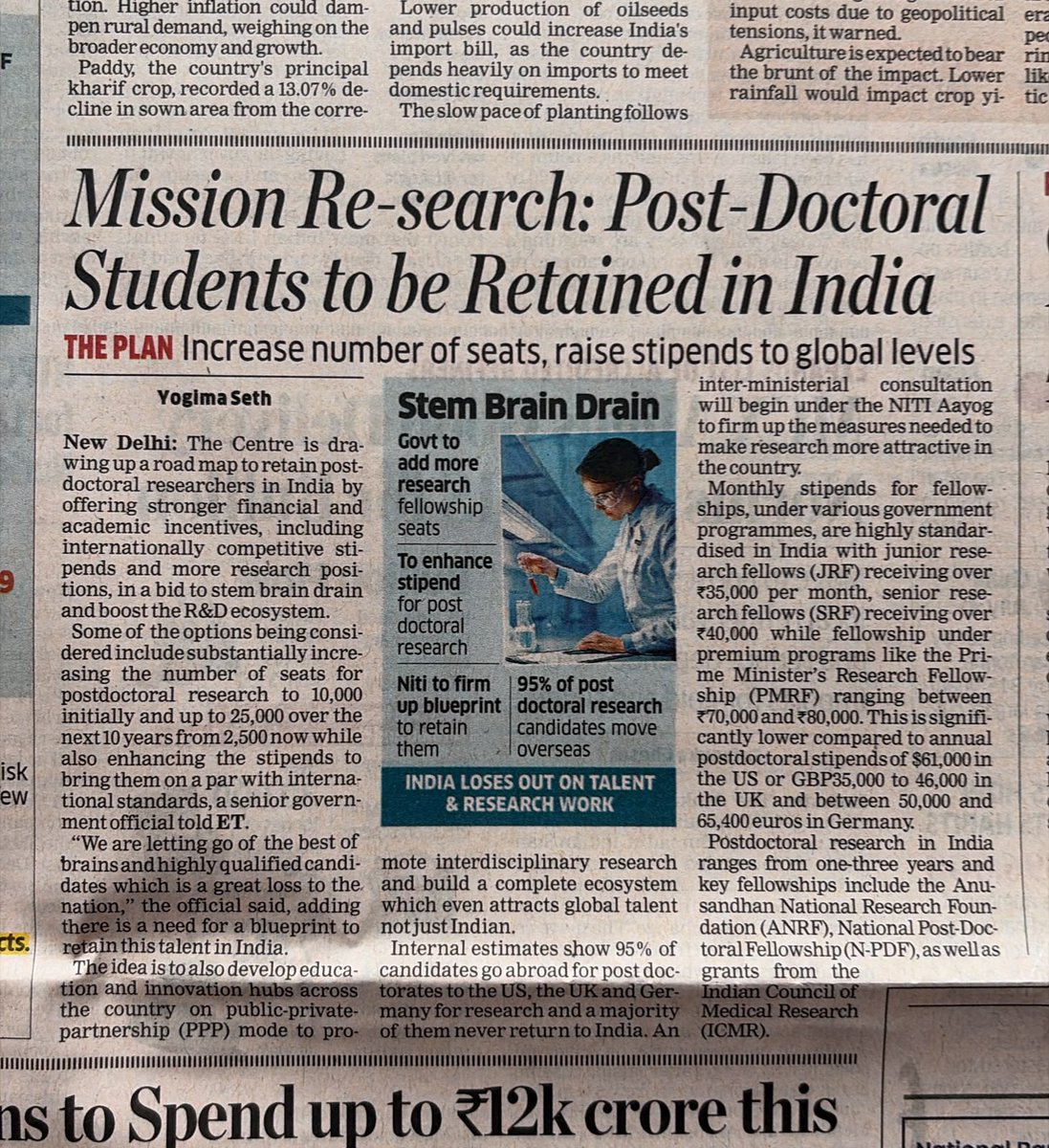
Emphasis on postdoctoral programs, and making them more prestigious and globally competitive, is a far more welcome initiative than discriminative student fellowship programs.
The world has made tremendous progress.
I believe we will overcome the major crises of our time and continue advancing humanity.
Be an agent for good.
via @toddrjones
The new @GoogleDeepMind Omni video is amazing! This is the best cartoon animation of a T cell killing a cancer cell that I was able to create to date! I love it 😍
A window into early development! 🔬
2-photon image: Ciona neurula embryo reveals a nuclear SoxB1 (grey) and a membrane Msxb reporter, color-coded along the anterior–posterior axis, highlighting the organization of the developing NS.
📷: Laurence Lemaire #FluorescenceFriday
Scientists say they have built a cell from scratch for the first time that can feed, grow and replicate like a natural cell. This breakthrough in synthetic biology could usher in an era of made-to-order organisms that function like living machines. https://t.co/weTPfCIQi8