The shape of your pollinator garden matters more than its size.
Most native bees have small foraging ranges. Peer-reviewed research on solitary bees found female flight distances of just 73 to 121 meters from the nest. A small bee born in your neighbor's yard might not reliably reach a flower patch in the middle of your yard if there's a length of mowed grass between them.
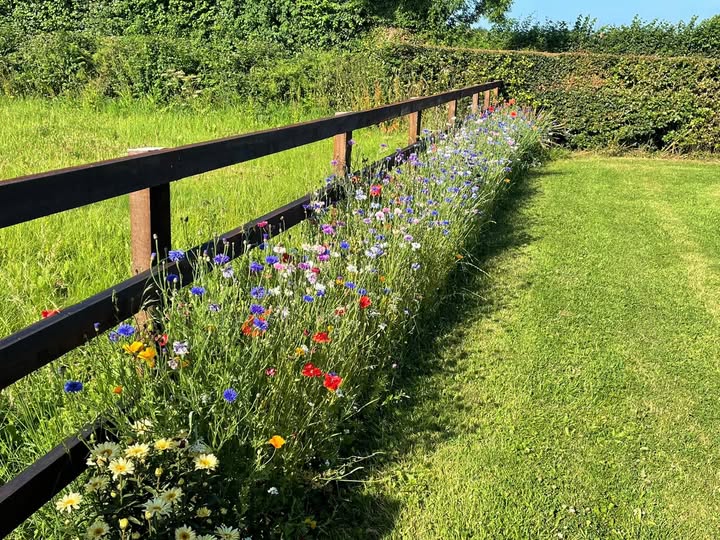
What works is linear pollinator habitat. A strip along a fence line, a corridor along the driveway, or a narrow band of natives running the full length of the property is best.
A 2018 study in the journal Ecography found that the length of linear semi-natural habitat was the single strongest predictor of wild bee species richness and connectivity in agricultural landscapes. Bees track edges.
A 2-foot-wide strip running 50 feet does more ecological work than a 10x10 island in the middle of the lawn. The strip gives pollinators a route to follow, something that guides their movement across the landscape.
The effect multiplies when your neighbors do the same. A strip along your fence meets a strip along theirs, and so on.
Most butterfly gardens are built to feed butterflies. The good ones are designed to make more butterflies.
A yard full of nectar flowers is a snack bar for the adults, and that's a fine thing to offer. But flowers alone make a rest stop, not a home. A few other pieces turn it into the real thing.
The big one is host plants. Caterpillars don't drink nectar, and most won't eat just any leaf. Monarch caterpillars need milkweed; black swallowtails want dill, parsley, or fennel. Without the specific plant a species lays its eggs on, your garden raises no butterflies of its own.
Then the small stuff. A flat rock or two in full sun gives them somewhere to bask, since a butterfly can't fly until the sun has warmed its wings. A shallow dish of wet sand lets them "puddle," pulling up the salts and minerals nectar doesn't provide. A wind-sheltered corner, with a few stems and leaves left standing through winter, gives them places to rest and overwinter.
And no spray, not even the organic kind, since most of it kills caterpillars just as readily as the pests.
This is how your butterfly garden stops being a place they pass through and starts being a place they come from.
@Keir_Starmer Your inaction and lack of comment for days is what’s unforgivable. You hoped it would go away but were finally forced to address the situation, albeit poorly. You should be ashamed.
📢 Elk calving season has begun in Yellowstone. Be aware of your surroundings!
Cow (female) elk may appear very docile and sweet with their babies, but don't let that fool you! Cow elk are much more aggressive toward people during the calving season and may run toward you or kick, even if unprovoked. If you are hoping to watch elk during your upcoming visit, keep these safety tips in mind:
- Stay alert! Look around corners before exiting buildings or walking around blind spots: cow elk may bed their calves near buildings and under cars.
- Be extra cautious during early morning and evening hours when it can be difficult to see wildlife.
- Always maintain a distance of least 25 yards (23 m), or the length of two full-sized buses, from elk.
- Attacks can be unprovoked and unpredictable. If an elk runs toward you, run away. Find shelter in your vehicle or behind a tall, sturdy barrier as quickly as possible.
- You are responsible for your own safety.
👉 View more of our safety tips for your park visit at https://t.co/IaHWB5JIFc
Now Biden insists, "I couldn't come out and publicly say ...Joe you did a terrible job in that debate." So instead she declared victory, denied any evidence of mental decline, and gaslit America. She may well become the country's leading fiction novelist. https://t.co/88YQst1vP1
The Trump EPA is eliminating animal testing by accelerating the shift to modern, gold standard science. Today, we are announcing 13 new high-quality alternatives to animal testing that will deliver faster, more accurate scientific results. https://t.co/0HQgSHD5lG