A honor to publish with such an amazing team!!!
Congrats to Eva @Dvea17, team members, collaborators and exquisite leadership of Vanessa Adaui!
Frontiers | Novel CRISPR-based detection of Leishmania species https://t.co/lYHQHeTgCP
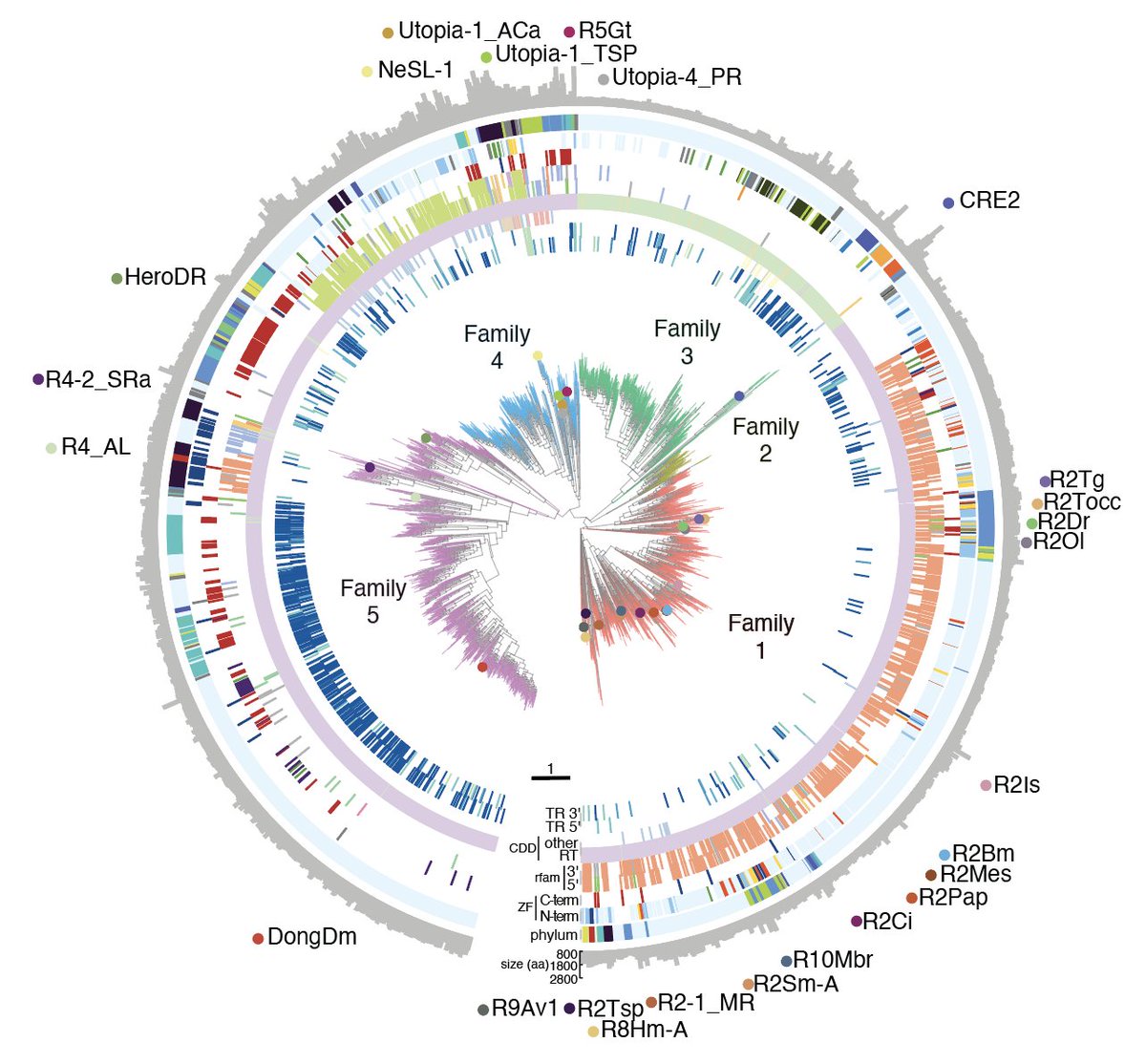
Inserting large, scarless DNA sequences is a major hurdle for gene therapy.
We explored if site-specific retrotransposons, natural genome editors found across the tree of life, could be engineered for this task.
Excited to share STITCHR in @Nature with @jgooten!
Congratulations to @rumya_r@mircoscopy@DStrebinger@blake_lash@cyrusbiotech and colleagues on an exciting study combining AI and protein engineering to minimize the immunogenicity of Cas9 and Cas12a nucleases. These approaches have the potential to improve the safety and efficacy of gene editing therapies. See Rumya’s posts for highlights.
1/Here’s an excellent article - published in the recent @WIRED issue, by Nobel prize winner Jennifer Doudna about how AI & machine learning are amplifying the impact of CRISPR & Gene editing in all walks of life - medicine, agriculture, climate change & research landscape.🧵👇
Glycosylation is among the most important modifications in biology.
We know relatively little about glycobiology, because it is hard to study.
This Nat Rev Methods primer describes our best tools for analyzing glycosylation 🔽
Stanford team creates $2 CRISPRkit, bringing affordable gene-editing experiments to high schools. Students can now perform and analyze CRISPR experiments with just a smartphone,#STEM https://t.co/OrxlFdUfXu
What if we could universally recombine, insert, delete, or invert any two pieces of DNA?
In back-to-back @Nature papers, we report the discovery of bridge RNAs and 3 atomic structures of the first natural RNA-guided recombinase - a new mechanism for programmable genome design
My favourite discovery ever has just come online. Can I please tell you about some seriously wacky molecular biology? The story starts with a reverse transcriptase that SOMEHOW defends bacteria from viruses.
(👇 I recommend sound ON for the video 🎹)
1/
When Human Genome Project researchers announced that they had successfully completed sequencing the human genome, it was only about 92% complete. There were still hundreds of gaps or missing DNA sequences. Why was it so difficult to complete the sequence? Let’s break it down!
Happy Birthday, Rosalind Franklin! We celebrate her work and influence in science. Thanks to her, we have the historic Photo 51, which revealed that DNA has a double-helical structure!
New paper!
We provide a scRNA-seq pipeline for simultaneous gene expression and 3′UTR length analysis.
We quantified 3′UTRs in 474 cell types and found that 3′UTR length provides information that is independent of gene expression.
https://t.co/hZto8xdfzE