Retrotransposons are cool - but harnessing them for kilobase insertions AND seeing their molecular structure is even more exciting.
Great work led by @GraceKC
Check it out!!
Can we use RNA to insert kilobases of DNA into the human genome, opening up a new way to engineer cells or treat disease?
Excited to share our latest work turning a retrotransposon (a “jumping gene” with an RNA intermediate) from songbirds into a genome editing tool. 🧵 (1/7)
Can we use RNA to insert kilobases of DNA into the human genome, opening up a new way to engineer cells or treat disease?
Excited to share our latest work turning a retrotransposon (a “jumping gene” with an RNA intermediate) from songbirds into a genome editing tool. 🧵 (1/7)
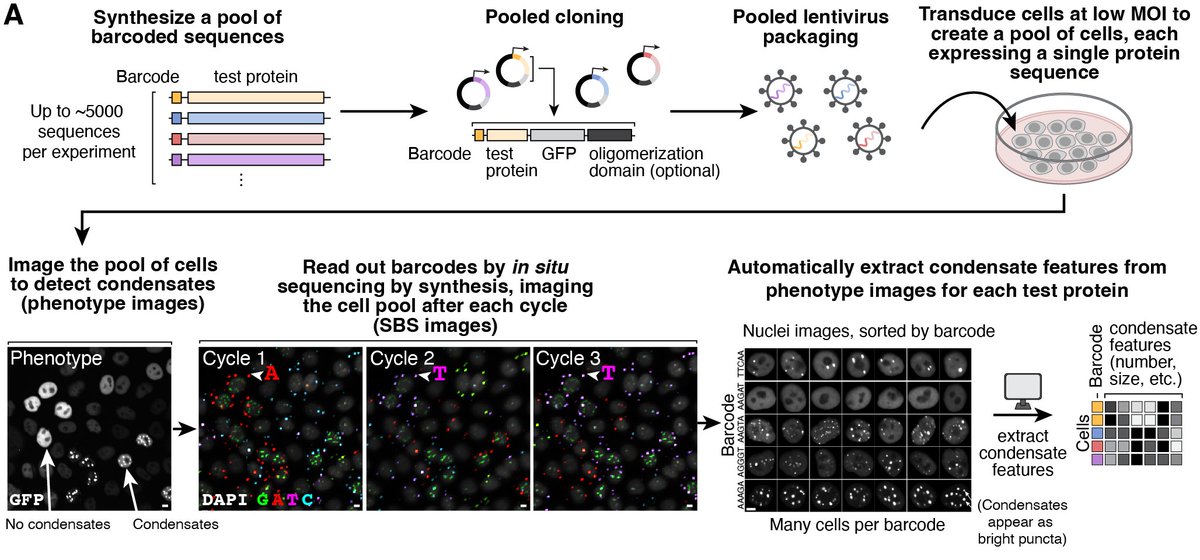
Exciting work from @KalliKappel - using pooled optical screening to determine sequence features that contribute to condensate formation!
If interested in this topic reach out to Kalli, who just started her lab at UCLA. She is an amazingly insightful scientist and a great person!
In the nucleus, many intrinsically disordered proteins (IDPs) form condensates. What IDP sequence features drive this behavior? We developed CondenSeq, a high-throughput method to measure nuclear condensate formation & applied it to ~14000 IDPs to find out
https://t.co/qfa8jtvFOp
Introducing CondenSeq, an imaging-based high-throughput approach for characterizing protein condensates within the nuclear environment. @KalliKappel
https://t.co/M6mIQAqs38
We're hiring! Our lab at the Ragon Institute of MGB, MIT, and Harvard is looking for a motivated postdoc with experience in developing and applying deep learning models. You'll work at the intersection of spatial transcriptomics and structural biology. #postdoc
1/ Thrilled to share an advancement in gene therapy from my PhD in @NatureComms! We've developed a new approach to reduce immune responses while maintaining efficiency—paving the way for safer, more effective therapies. Big thanks to @zhangf & @mircoscopy! https://t.co/eXZkpgiMXq
Help is on the way! Ready to take stem cell technologies to the next level for drug development @CReM_Boston@GSK: Global Biopharma Giant GSK and BU/BMC Announce Collaboration to Pioneer New Lung Disease Treatments https://t.co/ZKCxs6tt7a @BUPulmonary @The_BMC@BUMedicine
Our paper on continuous mutagenesis in living cells using HACE is now out in @ScienceMagazine!
We now demonstrate that HACE continuously generates mutations over a 10-day period and enables targeting using dCas9 without introducing DNA nicks.
https://t.co/2h7Skln60Q
covercovercovercovercovercovercovercovercovercovercover this is terrifically exciting
(Also please dw, the central dogma is still very much intact, this is just a bit of a funky spin on it)
So excited to announce that the Kappel Lab will open at @UCLA@uclachem in July 2025! We’ll combine high-throughput experiments and computation to build predictive sequence-structure-function models of RNA, proteins, and their interactions. More here: https://t.co/qxh7QbXnHV
We are excited that DIRECTED will enable delivery to cell types that are difficult to target for therapeutics. Future developments will unlock the full potential of cell-type-specific enveloped delivery! All constructs will be on Addgene shortly. 7/7
Excited to share DIRECTED (Delivery to Intended REcipient Cells Through Envelope Design): a programmable platform for cell-type-specific delivery. https://t.co/CRGaG3szJ5
Thank you to @FrangiehChris, @mircoscopy, @GuilhemFaure, Rhiannon Macrae, @zhangf 1/7
DIRECTED is compatible with delivering many cargo types, including proteins and RNPs (e.g. Cas9-sgRNA). We show that DIRECTED allows the specific transduction of T cells or B cells in PBMCs, which are a complex mixture of different cell types, and even works in whole blood. 6/7