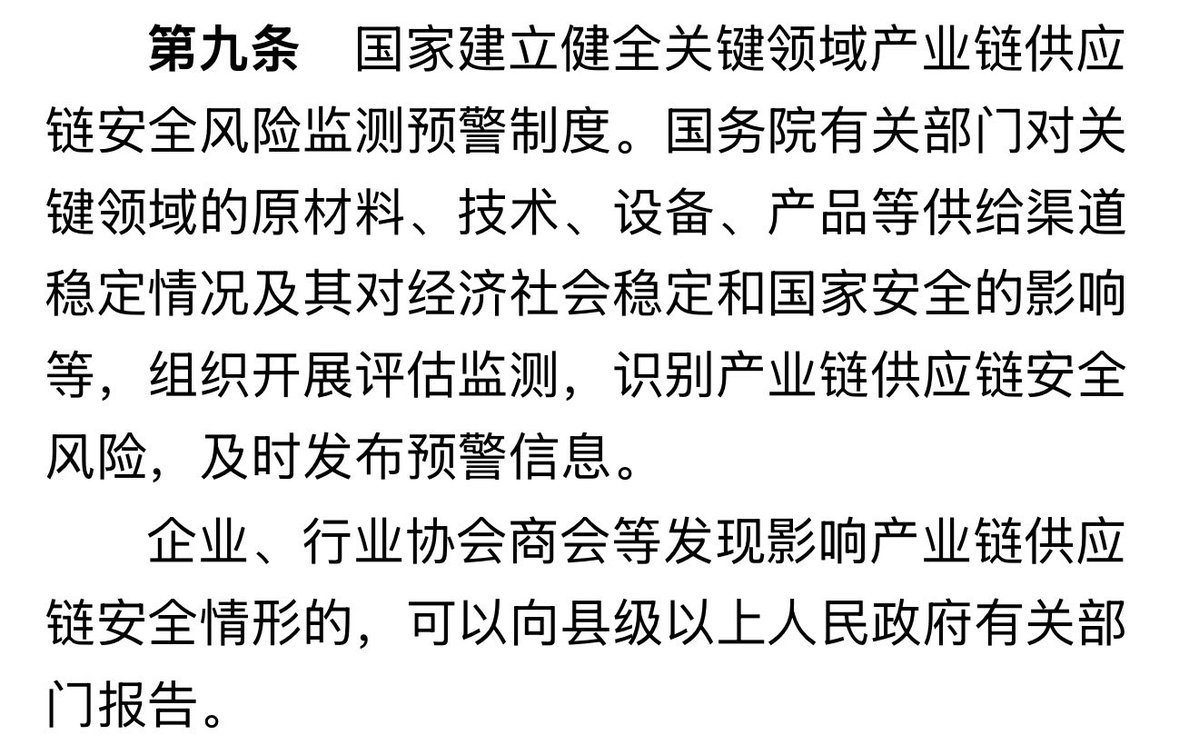
The US should establish a supply chain risk monitoring mechanism like this from China’s new supply chain security rule:
“Article 9: The state shall establish and improve a monitoring and early warning system for security risks to industrial chains and supply chains in critical sectors. Relevant departments under the State Council shall organize assessments and monitoring of the stability of supply channels for raw materials, technologies, equipment, products, and other inputs in critical sectors, as well as their impact on economic and social stability and national security. They shall identify security risks to industrial chains and supply chains and promptly issue early warning information.
Enterprises, industry associations, chambers of commerce, and other entities that discover situations affecting the security of industrial chains and supply chains may report them to the relevant departments of people’s governments at or above the county level.”
🎧 NEW on the Pivotal States podcast:
The war with Iran, Trump’s claims on Greenland, and possible U.S. troop withdrawals have all put U.S.-German relations under strain.
Has trust been irreparably broken?
@SophiaBesch joins @CChivvis to discuss⤵️
https://t.co/jTwyDeIDAQ
NEW ODD LOTS:
A massively underdiscussed element of the modern economy
@tracyalloway and I talk to @samanth_s about the extraordinary complex of undersea cables that keep the internet alive https://t.co/sgTEqIyPUM
Why Germany's and Europe's efforts to decrease dependencies on 🇨🇳for critical raw materials have failed, what we need to do better & how we can learn from others.
New study out today supported by Otto Wolff Stiftung and in context of our work with AA & Gulbenkian Foundation.
My new Penguin e-book, Inflection Point: Biden, Trump, and the Future World Order, is now available to buy (for $6). This is a part of @LowyInstitute's wonderful Penguin paper series. Many thanks to @mfullilove and @SamRoggeveen.
The overall argument of the book is that there are now two Americas—an internationalist America that will likely focus on strategic competition and deepening alliances and an America First movement that will be much more skeptical of allies, favorable to punitive tariffs and predatory.
Unlike strategies of containment in the Cold War, these are largely antithetical.
Each will compete with, but will never fully vanquish, the other—at least not for some time. If you look at all US presidential elections since 1944, Republicans are currently in their 42nd year and Dems have had 40. So it splits 50:50.
The challenge for the world is to hedge against this dramatic fluctuation.
Two of the chapters are on my time in the Biden administration. Two are on Trump’s second term. And one looks at where we go from here.
The two Biden chapters offer my reflections on our Ukraine and Indo-Pacific policies in particular. Some specifics that you all might find interesting:
My account of the risk of Russian nuclear use in October 2022.
How we actually thought about escalation and military assistance to Ukraine.
What we thought of the Global South’s peace efforts (some were legitimate and sincere, some were not).
How we thought about the diplomatic endgame in Ukraine.
My account of the balloon incident of 2023 and the trajectory of our China policy.
How AUKUS came to be—why it might not have happened if the president knew how France would react but why it was still the right thing to do.
The lessons Democrats are learning from Biden’s foreign policy and where it is likely to go from here. And what America First may look like after Trump.
I hope you all get a chance to read Inflection Point. I will be in Australia next week for a series of events to launch it.
https://t.co/FkSW4c15J6
Excited to share a new @CarnegieEndow article, co-authored with @danbbaer, on the second Trump administration’s self-contradictory approach toward Europe (link below)
New piece in @ForeignAffairs examining the new US--and European--willingness to *seize* sanctioned tankers, not just to sanction them.
1. Driven by the declining impact of sanctions/emergence of China-centered trade networks.
2. Carries plenty of risk, and needs a doctrine.
James Talarico's foreign policy, rooted in a moral framework that the biggest divide in America is not left versus right but top versus bottom, could have wide appeal for Democrats, write @cw_herrmann and @JyShapiro.
Read our latest commentary: https://t.co/6awrc8HAiY
The Department of War weaponizing its procurement process against Anthropic is an example of the U.S. government bringing the economic weapons of war it has for decades deployed abroad back to the homefront.
The strategic concept of U.S. economic coercion has been chokepoints: finding an asymmetric economic chokepoint, and weaponizing it to gain leverage over adversaries.
U.S. financial dominance, particularly in payments, is the basis for U.S. financial sanctions.
U.S. technological dominance in tech like semiconductors is the basis for U.S. export controls.
DoW is finding a domestic economic chokepoint, the scale of federal procurement, and weaponizing it against an American company. DoW is not simply saying "we will not buy Anthropic," which would be well within DoW's rights.
Instead, DoW is leveraging its purchasing power to try to block other private companies from buying Anthropic.
It is a similar approach to the one against law firms last year--leveraging the fact that major law firms need access to regulatory processes to pressure them into agreeing to the government's terms. Or the approach of leveraging NIH funding and possibly visa policy to gain leverage over universities.
The U.S. has decades of experience identifying economic chokepoints to serve as a basis for economic warfare abroad. Now it appears to be bringing these tools back home.
Carol Leonnig: "The whistleblower says in Dec. 2025, when there was a mass shooting at Brown University, Kash Patel was on his FBI director jet in Florida and that there was only one other available jet, but Patel had ordered it to be put on standby for another team. That meant that an evidence review team had to drive through the night ... "
New toolbox, funding priorities, €347M investment: today we are strengthening submarine cable security.
We continue delivering on the commitments of the EU Action Plan on Cable Security and show that Europe can respond quickly to rising threats.
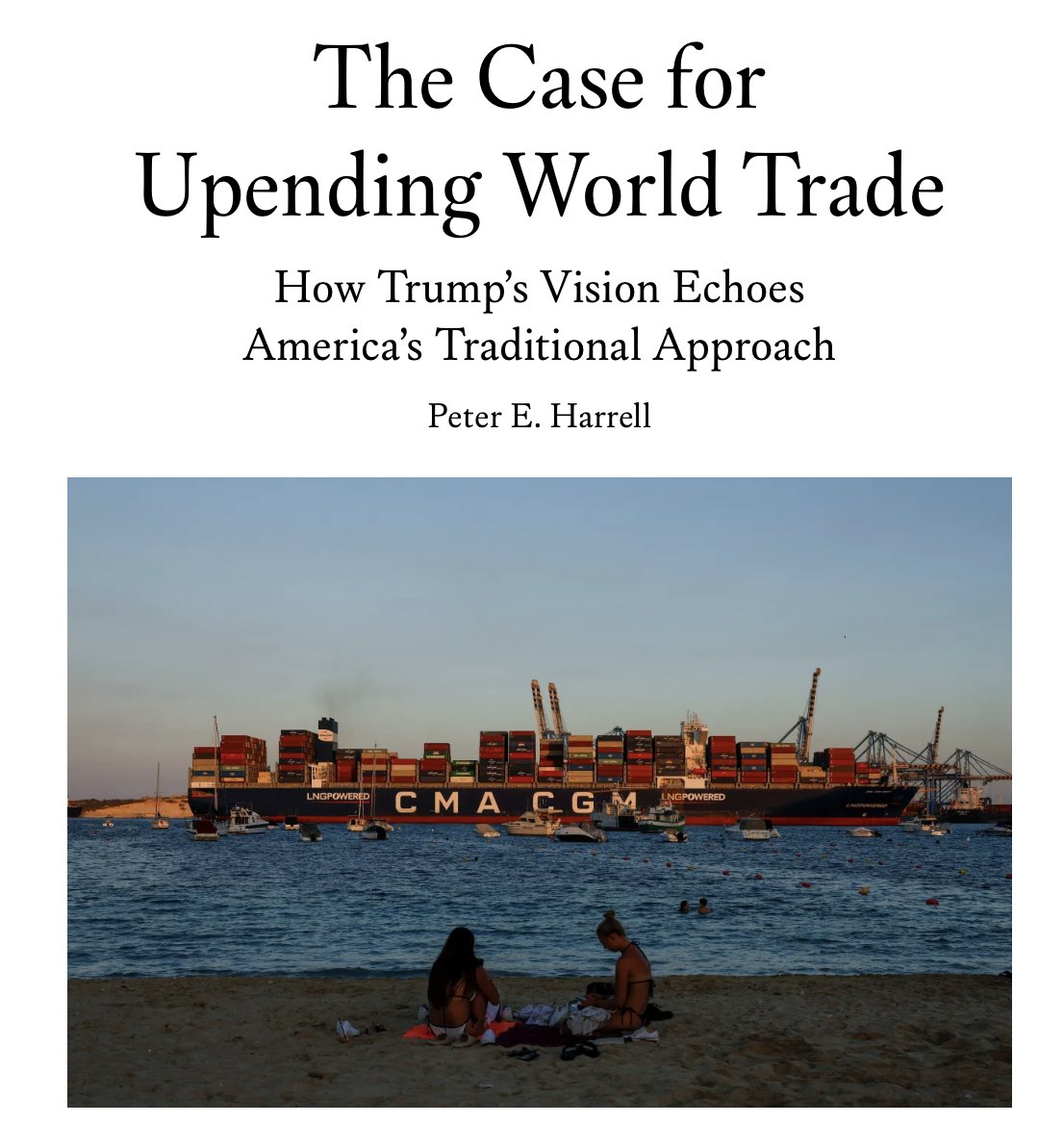
I have an article in @ForeignAffairs arguing that Trump's trade disruption provides policymakers an opportunity to pivot to a less ideological, more pragmatic approach to trade. That doesn't mean embracing Trump's tariffs, but it also means not returning to excessive "rules."
After Davos - what lessons should Europeans take away from this episode of the Greenland crisis? New from me this morning for @CarnegieEndow https://t.co/7C3tKCvVCL
Facing acute threats, states in Northeastern Europe are pioneering a pragmatic model of defense-industrial cooperation.
It offers lessons for managing transatlantic dependencies in an era of uncertainty, write @SophiaBesch, @ebrown278, & Rafaela Uzan.
https://t.co/SVcayfrBOP
These are difficult questions with answers that could have implications well beyond the Baltic. The immediate lack of cable cutting incidents following the introduction of Baltic Sentry and Nordic Warden offered a respite in having to provide answers. That break is now over.
Great piece by @shashj outlining the (most) recent Baltic Sea cable cuts and dilemmas faced vis-a-vis attribution and legal jurisdiction. The boarding of ships isn't quite new--Finnish and Swedish authorities each boarded vessels suspected of damaging cables a year ago.
A separate, but related, open question that remains is what is permissible if suspicious vessels do not comply with authorities' requests to stop or enter territorial waters for boarding--as was the case in May 2025 with the shadow fleet vessel JAGUAR? https://t.co/MyNMiPSx4g