@conviction and @quadrillion_ai are co-hosting a dinner at Aquavit Friday night. we're bringing together some awesome folks: leaders in AI, quant, data, and more. DM for invite
“had to get to NY, SF is too AI pilled”
Direct quote from one of the most impressive founders I’ve met in a long while.
This is not your classic East vs West click bait, this is admission that the only talent capable of rivaling AI researchers are quant researchers at hedge funds. Companies like @OrnnExchange, @quadrillion_ai, @jstrobes, and the stealth founder above are starting to aggregate the best and brightest of New York’s public markets.
No hackathons, no foundation model mogging. Just raw talent and pure ambition to build financial technology for the public markets.
We were waiting for an AI app renaissance in New York. We were looking in the wrong place.
Long live the quants.
we’re hosting a private dinner with @conviction at Aquavit this Friday 6/5 bringing together the coolest people in tech in NYC — founders, operators, researchers. DM or comment if you’re interested in joining us
Today, @MichaelElabd, @QuantumArjun, and I are excited to announce Trajectory.
We are a research lab and product company building the platform for Continual Learning.
Our platform unlocks the signal already sitting in product usage, so companies can continuously post-train large-scale agentic models that outperform the frontier. @trajectorylabs
We’ve raised $15M from @Conviction, @BessemerVP, @radicalvcfund, @jeffdean, @drfeifei and more.
We’re partnering with some of the best AI-native companies: @ClayRunHQ@Harvey, @DecagonAI, @mercor_ai, @RogoAI to power their agentic systems, some of which we are already in production with.
We’ve brought together a world class research team from DeepMind, OpenAI, Apple, Meta Superintelligence, Amazon AGI, Scale AI, and an elite product team from Stripe and Figma.
AI will never again start on day one. Every correction, every retry, every edit will make products smarter. This is Continual Learning.
Incredibly proud of Ronak, Arjun, and Michael, who are building something really special (and very proud to be a small supporter as well). Excited to see what comes next!
Today we’re announcing the launch of @Trajectorylabs, where we’re building the platform for continual learning.
The research question motivating us is simple: can AI systems improve in response to real-world experience?
Today’s agents are episodic: they complete a task, receive feedback, and reset. In doing so, they miss valuable learning signals: retries, edits, user interventions, etc. By closing the loop between interaction data and model improvement, we believe that agents can continuously improve.
But honestly what excites me most about Trajectory is working with such talented people. Our team has already trained models that beat SOTA on customer evals, models that are operating in production today.
AI research has long aspired toward continual learning. In our work thus far, we’re already seeing early signs of this being a practical reality.
I am leaving the Foundational Research team at DeepMind!
I just wanted to take the time to reflect on this truly amazing journey. It was such an intense and fulling ride that I will always cherish.
Two efforts shaped me in particular: the reasoning work and building the continual learning infrastructure for robotics. They taught me what it takes to turn ambitious ideas into real systems. Here are some of my biggest takeways:
1. Iteration speed, iteration speed, iteration speed: the teams that win arent neccessarily the smartest but the ones able to execute on a thousand ideas in the time their competitors excute on five. This became way more obvious when we were working on reasoning for humanoids where the iteration contains hardware in the loop. You have to really deeply think about what it takes to test your hypothesis and how to greatly simplify the iteration loop to move faster.
2. Building scalable infrastructure from day 1: Researchers sometimes think that moving fast means building unscalable infrastructure. My time at DeepMind taught me that there is always one more experiment that requires refactoring the entire repo, as those come up, we should figure out how to better build the stack from the ground up to support more and more wacky experiments.
3. Having fun is probably the most important thing at work: When you truly enjoy your colleagues’ company and you are motivated by the success of the larger team, the late nights become memorable, not exhausting. I never truly understood this until the 1am nights at work all huddled near one of our humanoids trying to figure out why its behaving this way.
I’m especially gratefJ to my mentors @sippeyxp , Jie Tan, @Kanishka_Rao, and @carolina_parada for constantly finding harder challenges for me and pushing me to grow.
Peter Pastor, @keerthanpg, and Stefani Karp thank you for the late-night hacking sessions and the PEAK dinners. Those are some of my most treasured memories!
@claudiofantacci, Alex Lee, @Sumeet_Robotics, and Ken Caluwaerts thank you for teaching me how to build scalable infrastructure, from building the new inference stack to scaling experiments.
@Stacormed, @xiao_ted, @ColinearDevin, and Giulia Vezzani I learned so much from you. Thank you for entertaining all my hypotheses (especially the weird ones) and helping me learn through them.
I can go on and on.. I just can’t thank each one of you enough. Truly thankful for the time we spent together!
Will share more soon 👀
@eladgil BS.
Attention was born in Montréal
PyTorch in NYC.
AlphaGo in London
AlphaFold in London
ESMFold in NYC
Llama 1 in Paris.
Llama 2 in Paris+NYC+SV
DeepSeek in Hangzhou
Plus:
DINO in Paris
JEPA in Montréal+Paris+NYC
SV is 3 mos ahead on topics SV is singularly obsessed with.
Paul -
I’m an investor in Brooke’s company.
Let me tell you a little bit about Brooke.
She’s relentlessly resourceful and she can get incredible things done without needing a lot of money or support. For instance, she hosted me and a large group of our investors for a huge event, very little notice, and it went off perfectly with every detail taken care of.
She doesn’t need direction either because she’s intrinsically self-motivated and accomplishment oriented. When I’ve seen her interact with the larger Corgi ecosystem, she brings people together in ways that make the whole much more powerful than the sum of its parts.
When I talk about Corgi, and I often talk about their culture of working incredibly hard and that their people love it, she’s a perfect example of someone who sets that very standard for the company.
I hope Corgi holds onto her for a long time, but if she ever chooses to leave to start her own company, I definitely would invest.
I don’t love it when people give criticism in public. But given that this will turn a spotlight on Brooke - I thought this was a good chance for the social media record to be set straight.
I also hope more employees and founders share a bit of themselves alongside the job that they do in their social media because marketing matters and people like being customers of Corgi because it’s a company that has people like Brooke at it.
I hope more people follow Brooke’s lead. Especially on good hair days.
Mechanistic Interpretability be like..
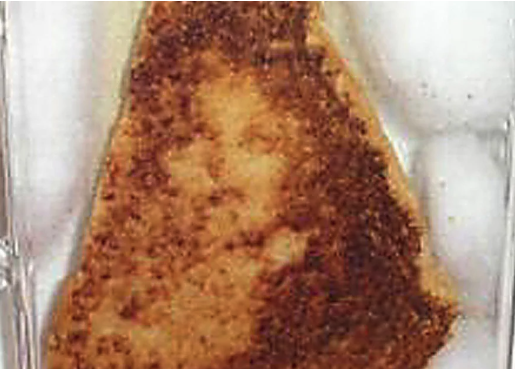
We wanted to see what the bread slice is thinking when it is in the toaster. Is it taking its singing equanimously? thinking religious thoughts? or plotting revenge? (Face it--a vengeful singed slice is the last thing we want!)
But alas, the bread slice doesn't talk! Its thoughts are intricately encoded in its singe pattern.
So we devised a clever method--of showing the bread slice to a random Joe, asking him to describe its feelings.
Joe says that the slice is having a religious experience involving Mother Mary.
But is random Joe describing these feelings right?
To check, we called random artist Jane and asked her to render these thoughts back to the external appearance of a (different!) bread slice.
We co-trained Joe and Jane until they learn to auto-encode the real truth about the slice's thoughts.
We are finding this technique to be a great way to understand what the bread slice is thinking. The tehcnique is not always (or even sometimes) correct, but it gives us a great window into publishing bread slice thought related podcast articles.
Hope you find this research useful. #AIAphorisms
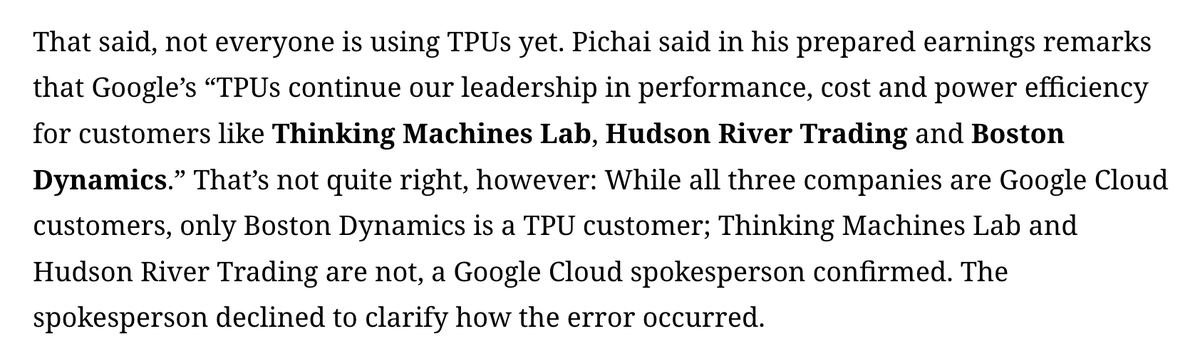
ONE MORE INTERESTING TIDBIT from Google earnings yesterday: Google named three customers using TPUs. However, two of the three do not actually use TPUs, a spokesperson confirmed. The spokesperson declined to provide a statement on how the error occurred
I'm Gay, and that Makes Me "Queer"
I was 14 in 2009, when I wrote in my journal that if gay marriage was legalized, "the freaks who think it's good and natural will become even worse than they are." I wrote that they see sex as "PLEASURE. NOT A WAY OF BRINGING PEOPLE INTO THE WORLD, THAT'S JUST AN INCONVENIENCE! JUST A WAY TO HAVE FUN."
"What a horrible way of thinking," I wrote.
And then I went back to curating my yearning collection of bare-chested tribal werewolves, and thought no more of it.
It took me another 8 years before I clued into my attraction to men. In the interim, I fell in love with a Mormon missionary companion and called it inspired companionship, picked attractive and monstrous men every time I could choose a character in a game, and (after I left Mormonism for Purely Intellectual Reasons) began to read a gay furry visual novel for "Chinese language study."
I wasn't gay. I wasn't a furry either, of course. Too weird, too sexualized, too queer. I was just an asexual socially conservative guy who happened to like anthropomorphic art. When Don’t Act, Don’t Tell was repealed, I grimaced. When Obergefell passed, I fretted vaguely about the Constitution. Every moment I could have supported the rights I would later rely on, I declined to do so. It took me a while to accept the label “gay,” but eventually I figured it would be odd to decline it while married to a man. I certainly didn’t accept the culture, though. “Gay voice” bugged me, promiscuity unsettled me, drag put me off. When I saw some queer people criticize Pete Buttigieg as, in effect, “not gay enough,” I felt a thrill of recognition. Yes—that’s me. A Pete Buttigieg, Not Gay Enough sort of gay dude, a military veteran and law student who wanted nothing more than a quiet suburban life with my family, and who happened to want it with a man. Stonewall? Alienating. Queer theory? Drivel. I was proud that when I finally noticed attraction to men in my early 20s, I “came out” quickly and without fuss, kept it as a footnote in my identity that meant very little about who I was, and moved on.
Two months ago, I realized I still felt a lot of that, and I was also queer. I had always preferred the archaic form of the term–at odd angles with reality–but when I looked through the stories and experiences of the lonely “asexual” adolescent I was, the one who I always maintained “suffered no trauma from my faith’s stance on homosexuality,” I realized queer culture accurately essential parts of my own experience that I previously minimized. I noticed how I was perpetually drawn to monstrous characters, then to making the monstrous beautiful. I saw a “problem” I could never name or face directly haunting my journals and making me miserable for a decade. I saw myself drawn again and again to the motif of a wolf in a cage, to the need to escape.
Appel quotes Halperin’s definition of “queer” as “whatever is at odds with the normal, the legitimate, the dominant.” That’s a dangerous motif to claim normatively — the legitimate often has very good reasons for its dominance. But what happens to someone who grew up like I did — someone who subconsciously notices and then buries attraction to men in a world where every authority he trusts and loves treats acting on that attraction as a sin just short of murder?
A few things. When I’d learned as a child to categorize things as sacred (church, baptism, hymns, forests, Vivaldi) or profane (coffee, theft, alcohol, swearing, queerness), I had at some point categorized my own body and desire itself as profane. I internalized a wordless sense that I was monstrous, broken, and unworthy of love. I spent much of my life declining easy categories, refusing to be normative, insisting on blurring lines. I felt commonality with people who understand what it is like to be attracted to something Wrong. I had to leave my entire culture behind and rebuild a community of outsiders. And I absolutely refuse to be apologetic about who I am.
And when I realized all of that, I thought “dangit, I get queer theory now” and went and wrote a winding, profane, sacred, filthy, earnest piece of Queer Poetry to get some of my three decades of built-up unspoken feelings off my chest.
Look, as far as politics goes, I agree with Appel far more than I do Queers for Palestine or critical theorists. As far as my personal life goes, I’m still eager to live a monogamous, quiet life raising a family with my husband. But “gay, not queer” was, for me, one of the final parts of a decades-long coping mechanism built around a desperate need not to look directly at the monster I was.
And, well, let’s be clear. As a Mormon kid, I thought I was a reasonable centrist moderate, the same as now, who distinguished between sinners and sins and had nothing against gay people and was unjustly hated for my beliefs. And if it had been up to me, never in a million years would Ben Appel have been able to get married or have kids or serve openly in the military or live a quiet life of safety and dignity with a stable gay relationship and the freedom to live an ordinary life. He was another deviant anti-religious sinner threatening the foundations of moral America. I don’t want to be saddled with the actions of extremists any more than Appel does, but I’m also not so liberal I refuse to take my own side in a fight.
Being queer doesn’t mean thinking that every action taken on behalf of queer people is healthy or sensible, it doesn’t mean overthrowing liberal democracy, national borders, and Enlightenment notions of truth, and it doesn’t mean abandoning moral instincts or a duty to uphold healthy norms. A lot of people might want it to mean that, but they’re not the only ones with a say. It's a term for the kids like me who grew up understanding at their core that something fundamental to them was at odds with the normal, the legitimate, the dominant, no matter how hard they tried to run from it.
I can do whatever I want with that information and that experience. But I’m not going to disclaim it in the hopes of making myself more palatable to people who would prefer I never married or worked to have kids with the man I love, and who now rather wish I wouldn’t flaunt it lest decent people get the wrong ideas.
I did not choose to be queer, and I spent most of my life trying exceptionally hard to choose otherwise. But despite myself, sixteen years after that journal entry, I’m still here, still queer, and finally beginning to get used to it.
had a jane street interview in 2013
on the way there, i run into a dog. the dog is hurt. i stop to help it but am an hour late to the interview
i arrive at the office. the dog is my interviewer.
i sigh with relief. surely i'm hired.
'you didn't get the job' the dog says
'reason: ineffective altruism. you failed to realize that arriving on time, earning $500k/year as a junior trader, and donating 10% to shrimp welfare would have prevented approximately 4 million shrimp-hours of suffering. you saved one dog. me. a dog with negligible moral weight relative to the marginal bednet.'
i open my mouth.
'also i wasn't hurt. it was a trolley problem. you pulled the wrong lever.'
i nod. it is true. dogs are not a givewell top charity.
the dog slides a pamphlet across the desk. it says 80,000 hours.
'have you considered earning to give'
i start to cry. the dog does not update on this. the dog has read the sequences.
'one more thing,' the dog says. 'the dog you saved. that was also me. i contain multitudes. specifically, i contain a counterfactual in which you arrived on time and we are currently shaking hands. that version of you is now my colleague. he tips well at lunch.'
i leave the building. on the sidewalk, another dog is hurt.
i keep walking. i have learned.
the dog yells after me, 'WRONG. THAT ONE WAS REAL'
- written by Claude 4.7 (Adaptive)