OA journal providing an author friendly outlet for any aspect of ecology or evolution. Partnering with societies, promoting open everything including minds.
I’m excited to share that we’ve successfully assembled the genome of the Formosan long-armed beetle (Cheirotonus formosanus) to chromosome level with both high contiguity and completeness.
@Ecol_Evol
https://t.co/QgIEqrH4Bx
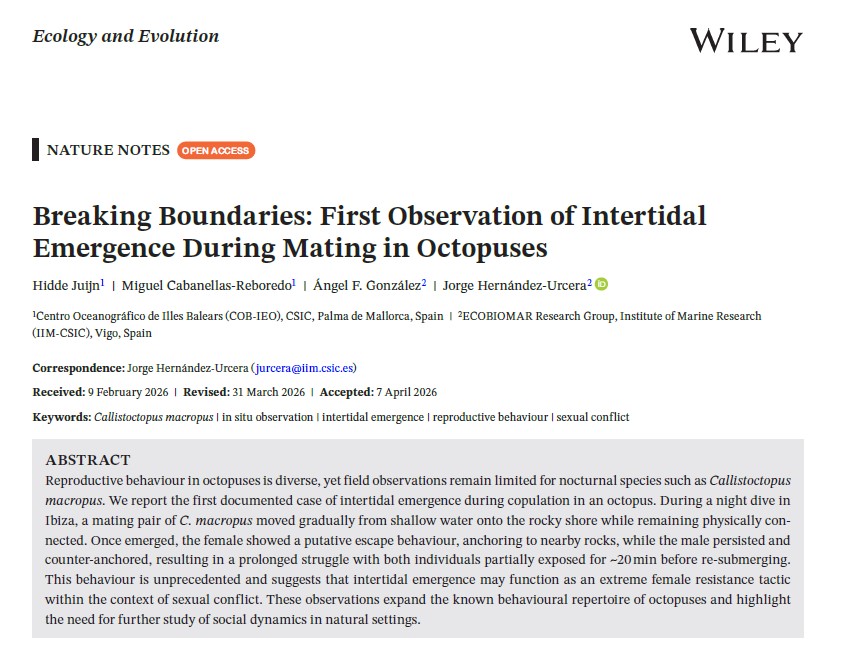
Thrilled to share our new paper in @Ecol_Evol: we report the first-ever observation of #octopuses emerging into the intertidal zone while mating. An extraordinary behaviour with implications for understanding sexual conflict in #cephalopods.
👉https://t.co/7AQgdEHnwI
I am excited to share that Hannah McGovern's first PhD chapter (with
@amy_e_deacon and @CescoSanti1990) on how oil pollution influences male guppy ornamentation just got published in @Ecol_Evol. @RHULBioSci
https://t.co/1sXLCQEYJ6
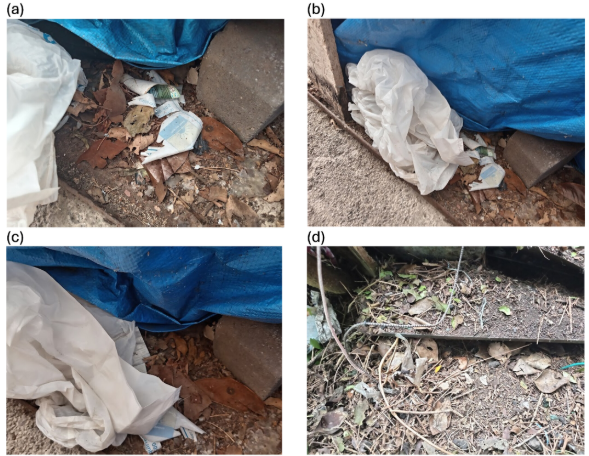
Our new paper led by Katie Crawford @LJMU_BES is out! Open access in @Ecol_Evol: From Leaves to Litter: Use of Anthropogenic #Nesting Materials in #Hibernation Nests of the European #Hedgehog
https://t.co/107hNLA9Df
New research from @Ecol_Evol using data from NEWMN and beyond to develop an improved species classification #AI model of #wildlife captured on remote #cameras. Check it out here! https://t.co/MCRS9gl4NT
The final chapter of my thesis has just been published in @Ecol_Evol!
https://t.co/1A71SrtbZP
Here we find that the social environment, notably vocal and aggressive interactions, are linked to cognitive development in magpie fledglings.
✨ New paper out in @Ecol_Evol ! Sequel to Coralcraft, our 3D model🪸
We found there is no "one-size-fits-all" way to measure #habitatcomplexity on coral reefs. Coral community composition matters! 🐠
Full paper here: https://t.co/Py79yRYRE0
@UWAresearch@uwaoceans#CoralReefs
🦉🌾 How do nocturnal birds share space in tropical landscapes?
Our study in The Gambia shows nightjars may partition space at fine scales, with strong use of rice fields for foraging.
Now published in @Ecol_Evol
Habitat use matters—even at night 🌒
📄 https://t.co/2U8BaCCfQj
Thrilled to share that our paper is now published in Ecology and Evolution @Ecol_Evol 🙏
Honored to collaborate with brilliant researchers worldwide. I learned so much and am truly grateful to be part of this work.
https://t.co/XBvYZXoOv2
#SDM#Australia#plant
🚨 Our new paper is out NOW in @Ecol_Evol 👀Here we show that prior exposure to dynamic illumination can have a persisting effect on the visual perception of 🦀, reducing their ability to detect predators even after the dynamic illumination has ended.
🔗https://t.co/OMSpK3WwVj
📢New paper out in @Ecol_Evol!
We still know little about the ecology of juvenile Octopus vulgaris. Our study shows they strategically position bivalve shells for shelter and visual control, demonstrating smart survival strategies in sandy habitats.🐙🐚
https://t.co/UJSpr0eXkO
New paper out now 🥳 where we examine sex-specific effects of social environment on behaviour and their correlations using high-throughput behavioural phenotyping in D. melanogaster https://t.co/1uINnVbfkP
Our new study published in @Ecol_Evol provides evidence of how evolutionary history with chronic malnutrition can enhance the vulnerability to pathogenic infections at older ages. Thanks to @TSB_Ashoka@India_Alliance@serbonline for funding the work
https://t.co/Yfh0R8KrkW
👏 NEW PAPER 👏
Using sequential whisker segments sampled from monitored caracals we find seasonality in use of urban resources in a generalist population made up of specialist individuals.
OA paper "The Cat's Whiskers" here: https://t.co/NwN5gs9BbA @Ecol_Evol@UCT_Research
Characteristics of potential nesting trees for White-Backed #vultures (Gyps africanus) in South Africa 🇿🇦
| https://t.co/aRV77DACf8 | @Ecol_Evol | #ERAIFT | #ornithology