Delighted to share new work published in @ScienceMagazine entitled 'Tumor-derived antioxidants suppress immunity by depriving T cells of reactive oxygen species,' led by @XanWesolowski in the lab https://t.co/Urzw44VngI
Euchromatin is mostly condensed⁉️
With @shiori_iida, we revealed the detailed structure of euchromatin using super-resolution imaging.
Cohesin regulates the function of euchromatin via chromatin dynamics!
(1/n)
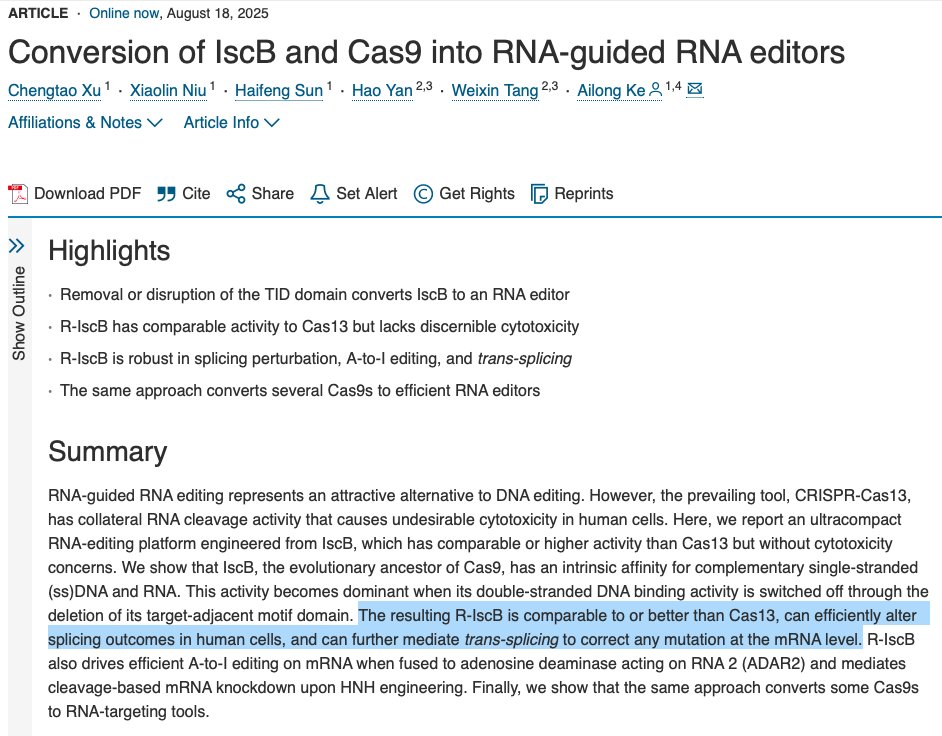
A new paper in Cell shows that it is possible (simple, really) to convert DNA-editing CRISPR proteins, such as Cas9, into RNA editors.
All you have to do is delete a chunk of them.
Deleting 55 amino acids from a DNA editor called IscB (the ancestor of Cas9) turned it into a “robust and versatile” RNA-guided RNA editor in human cells. This modified protein was used to cut mRNAs, knockdown gene expression levels, and even make an A-to-I base editor for RNA.
There are existing RNA-editing proteins, of course, with Cas13 being the most commonly used. Cas13 uses a short snippet of RNA to seek out, and then cut, target RNA molecules. But it also has a major problem: After it cuts its target RNA, Cas13 causes “collateral damage” by also randomly chopping up nearby, bystander mRNAs. This is toxic to bacterial and mammalian cells.
So in this paper, the authors deleted a part of the IscB protein (called the target-adjacent motif interaction domain, stretching from amino acids 433-487), which is normally responsible for its grabbing tightly onto DNA. And that deletion alone converted this protein into an RNA editor. The reason this works is because IscB naturally grabs onto both DNA and RNA, but is heavily biased toward DNA. So this deletion just removes its ability to grab onto DNA, thus biasing it to RNA.
The resulting RNA editor is not only “more active than Cas13,” according to the paper, but it also “has no discernible cytotoxicity in human cells.” The author also show that the same exact approach works for other Cas proteins, including Cas9. Lots of gene editors can be converted into RNA editors, in other words.
Good paper. Gene editors are even more versatile than we appreciated.
#TalentsCNRS | Chargée de recherche @CNRS au Laboratoire des pathogènes et immunité de l’hôte, Ana Rita Batista Gomes reçoit la médaille de bronze CNRS.
➡️ https://t.co/YGmVVfIbee
@CNRSbiologie@umontpellier
🦍Postdoc in Somatic Evolutionary Genomics🦍
Join my team @GeneticsCam on a pioneering project mapping somatic mutations across primates!
🌍Collaborate with experts @UCBerkeley & @sangerinstitute.
🔍Experience in genomics? Apply by Nov 16!
Details: https://t.co/1pDO1tzzcP
A scientist who successfully treated her own breast cancer by injecting the tumour with lab-grown viruses has sparked discussion about the ethics of self-experimentation https://t.co/WEXHrXZvKU
🦟❓How do mosquitoes respond to a bloodmeal at the #SingleCell level ? Please have a look at pre-print https://t.co/btQjSmJHiR and website https://t.co/A2dgszpebl to find out and look at your favorite cells and genes ! #Aedesaegypti
Re-posting this 4 years later, as it remains as relevant as ever
We need leaders that believe in scientific evidence
So much is at stake, next week in the USA and right now all over the world
@PLOSBiology
https://t.co/YC8KgQ2sKw
I spoke with BBC @sciencefocus about a new paper pitting intermittent fasting against full-time calorie restriction.
If you’re doing fasting for longevity you definitely want to check it out!
✨💃 It's not easy to upstage the great @jdiego_florez: but at the Salzburg Festival a young double bassist grabbed the spotlight by dancing alongside the legendary tenor during a performance of El Alcatraz with the @SINFONIAperu Orchestra! ✨💃 https://t.co/MxQtj977qO
Only 5 more days! Every morning I am reminded that @VectorBase is going away! @NIAIDFunding what were you thinking?!? This resource is critical to so many research labs. MUVE_ESA @ACME_ASTMH
What's happening in the sky above Stonehenge? A meteor shower: specifically, the Perseid meteor shower. A few nights ago, after the sky darkened, many images of meteors from this year's Perseids were captured separately and merged into a single frame. Although the meteors all traveled on straight paths, these paths appear slightly curved by the wide-angle lens of the capturing camera. The meteor streaks can all be traced back to a single point on the sky called the radiant, here just off the top of the frame in the constellation of Perseus. The same camera took a deep image of the background sky that brought up the central band of our Milky Way galaxy running nearly vertical through the image center. The featured image was taken from Wiltshire, England, being careful to include, at the bottom, the famous astronomical monument of Stonehenge. Although the Perseids peaked last night, some Perseid meteors should still be visible for a few more nights.
Image Credit & Copyright: Josh Dury
In conclusion, despite believing they could do it, the 152 astrologers seemed to lack any ability to match people to their astrological charts.
You can learn a lot more about the study (including its limitations and how we sought to address them) here:
https://t.co/XiLo0FlWIV