This has quietly been a miracle month in medicine.
In the last 5 weeks we’ve got news on:
- retatrutide, the triple agonist GLP-1 from Lilly, basically melting fat and body-wide inflammation at record levels
- RevMed’s new pancreatic cancer drug showing unprecedented abilities to extend life
- small trial of a one-and-done PCSK9 gene editing therapy for slashing LDL cholesterol
- Mayo’s AI-assisted radiology showing vastly improved cancer detection
- this new therapy for metastatic solid tumors
This stuff is at varying levels of evidence. Retatrutide is ~100% on its way, other stuff needs more clinical trial data. But put it together and we’re maybe on the verge of majorly reducing the mortality of heart disease and cancer, the two leading causes of death in America.
PSA: I now consider *all* of DeFi unsafe.
Coding agents are superhuman at finding vulnerabilities, and smart contract security is too asymmetric: defenders need to fix every bug while attackers need just one exploit to steal funds.
It’s never been easier to design your dream house.
Draw a shape. Define your rooms. Set your constraints.
@DraftedAI generates complete floor plans, elevations, and 3D home designs in seconds.
Over the last month, 120,000 people generated 325,000+ home designs with https://t.co/XqC0LP5n3y.
I do this with codex all the time. Ask it to review code for bugs and it will tell you all good, tell it there is a bug and it will LOOP AND LOOP and will find issues.
I've got an agent in a loop optimizing a renderer with the goal to minimize frame times (and tests to measure). It got times down from 88ms to 2ms and allocations down from ~150K to 500. Sounds good, right? Wrong. This is exactly why agent psychosis is a big fucking problem.
As an experiment, I rewrote the Ghostty core render state in Go, with access to identically laid out data structures as Ghostty and the exact same validation tests. I made a purposely naive renderer (simple, correct, but slow). 88ms per frame with 150,000 allocations (horrendous, lol)!
I then kickstarted a Ralph loop to bring the frame times down. I told it it can't modify input data structures or the public API or tests (they're correct), but it can do anything else it wants. It got to work.
It has worked for about 4 hours. I've spent around $350 on this experiment so far. The results?
88ms => 1.5ms
150K allocs => ~500 allocs
Incredible right? Nope.
My hand-written renderer I ported has frame times (same benchmark) of ~20us (0.020ms) and 0 allocations in the update path.
This is the problem with psychosis and lacking systems understanding. If you don't understand the system, you're going to accept that this is an incredible result. If you understand the system, you'll see better solutions immediately and can do roughly 75x better on throughput.
The people who blindly trust agent output are in the former camp. They're sheeple, overdrinking from a fountain of mediocrity.
Standard disclaimer: I use AI all the time. I like AI. The point I'm making is to not blindly accept results. Think. Analyze. Learn.
LLMs are really great and smart
LLMs are also annoying and stupid often
The jagged intelligence thing is real
If you care about your code quality, only push code you own and understand well
We now have a female Bryan Johnson.
It’s Kate Tolo.
She will become the most measured female in history.
+$2 million of spend per year
+ Developing a female-specific protocol
+ Sharing everything for free
To start, she will spend 3 months mapping her baseline. Men, in contrast, can get their baseline done in 1 or 2 weeks.
+ 3 months for baseline measurement
+ across 4 time points per cycle
+ doing the same thing every day
+ a dedicated full-time medical team
For context on the extensiveness of measurement, during the past 5 years, we’ve collected 1.5 billion data points on my body. I suspect Kate will exceed that given technology has improved since I started.
The goal is to create a repeatable waveform of hundreds of life-critical biomarkers. Once the baseline is acquired, she will begin interventions.
We will try to answer practically useful questions and share all of the data + learnings for free.
Can fertility be improved?
+ Should women cold plunge?
+ Can PMS symptoms be alleviated?
+ What should a female sauna protocol be?
+ Should dosage change throughout the month?
+ What keeps a cycle regular?
+ Does the body need more iron, magnesium, or protein at specific phases?
+ Should women fast?
+ Should recovery protocol change by phase?
+ What's the earliest detectable signal of perimenopause?
+ Can perimenopause be slowed?
+ How is cognitive load & mood affected?
+ Does stress impact men and women the same?
Kate has suspected endometriosis. 10% of all women do. We will try to tackle this too. I am excited for all of the surprising things we will hopefully uncover.
Unlike me, Kate does not have the innate desire to wake up at 4:30am and do six hours of longevity therapies.
She’s the cofounder of Blueprint, building in the trenches with me since day one. She understands the game and how hard it is.
In many ways, this is a sacrifice for her. She is a creative person, going from a life of freedom and spontaneity to a rigid protocol.
Traditionally, RCTs have been viewed as the gold standard. But RCTs have underserved women. The FDA banned women from clinical trials for 16 years (1977 to 1993), and most "medicine for women" is still medicine tested in men. Demanding RCT-only evidence for women's health is demanding evidence that doesn't exist. There is not enough practical scientific literature for women to reference only RCTs. It leaves half the population without a path to know what to do.
N=1 medicine is gaining ground and picking up where RCTs specifically fail. Individual science experiments give us signals that answer what to do on a day-to-day basis. This is even more important for women.
If you’re new to Kate and my world, I want you to understand that we have your back. Our intentions are to be a sturdy, reliable force in your life. To care for your best interest as we’d care for our own. We want what’s best for you and our loyalty is to your existence.
It’s pretty cool to be living in a time when we may be the first generation to not die. I’m not suggesting immortality, but lifespans so long that we stop thinking about lifespans.
At the end of the day, the one thing we each care about more than anything else is one more breath. I’m proud of Kate for taking on this responsibility. It’s painful, exhausting and costly.
The beginning of the world’s first n=2.
Personal update: I've joined Anthropic. I think the next few years at the frontier of LLMs will be especially formative. I am very excited to join the team here and get back to R&D. I remain deeply passionate about education and plan to resume my work on it in time.
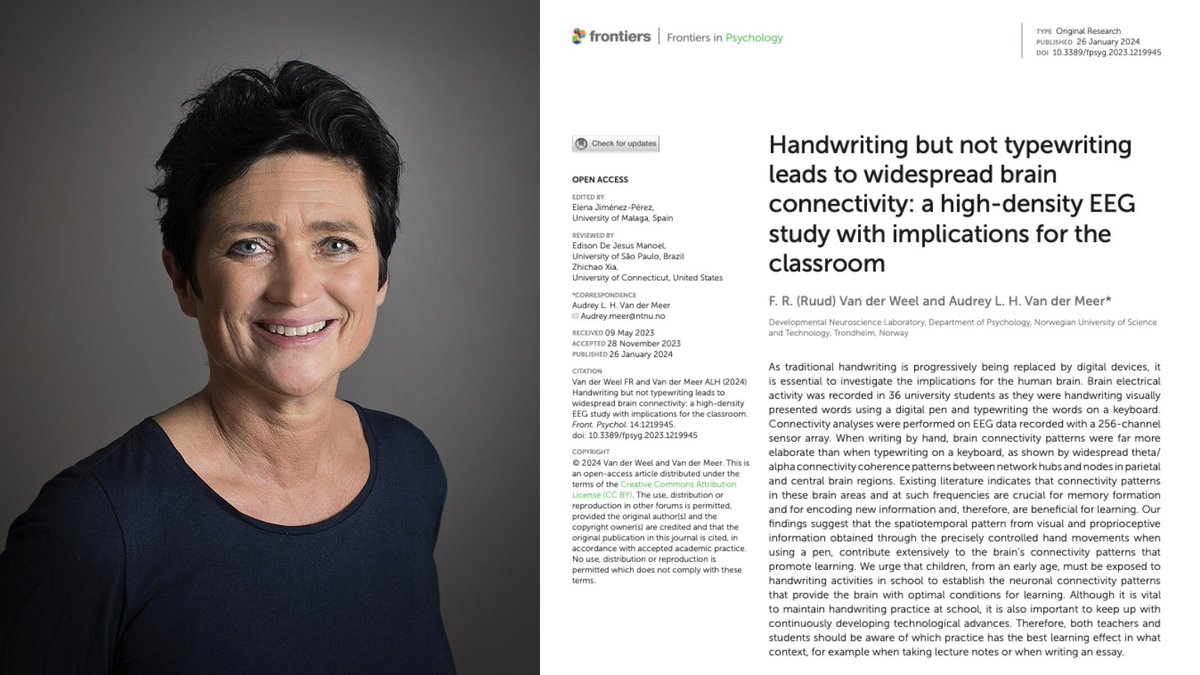
A Norwegian neuroscientist spent 20 years proving that the act of writing by hand changes the human brain in ways typing physically cannot, and almost nobody outside her field has read the paper.
Her name is Audrey van der Meer.
She runs a brain research lab in Trondheim, and the paper that closed the argument was published in 2024 in a journal called Frontiers in Psychology. The finding is brutal enough that it should have changed every classroom on Earth.
The experiment was simple. She recruited 36 university students and put each one in a cap with 256 sensors pressed against their scalp to record brain activity. Words flashed on a screen one at a time.
Sometimes the students wrote the word by hand on a touchscreen using a digital pen, and sometimes they typed the same word on a keyboard. Every neural response was recorded for the full five seconds the word stayed on screen.
Then her team looked at the part of the data most researchers had ignored for years, which is how different parts of the brain were communicating with each other during the task.
When the students wrote by hand, the brain lit up everywhere at once.
The regions responsible for memory, sensory integration, and the encoding of new information were all firing together in a coordinated pattern that spread across the entire cortex. The whole network was awake and connected.
When the same students typed the same word, that pattern collapsed almost completely.
Most of the brain went quiet, and the connections between regions that had been alive seconds earlier were nowhere to be found on the EEG.
Same word, same brain, same person, and two completely different neurological events.
The reason turned out to be something nobody had really paid attention to before her work. Writing by hand is not one motion but a sequence of thousands of tiny micro-movements coordinated with your eyes in real time, where each letter is a different shape that requires the brain to solve a slightly different spatial problem.
Your fingers, wrist, vision, and the parts of your brain that track position in space are all working together to produce one letter, then the next, then the next.
Typing throws all of that away. Every key on a keyboard requires the exact same finger motion regardless of which letter you are pressing, which means the brain has almost nothing to integrate and almost no problem to solve.
Van der Meer said it plainly in her interviews.
Pressing the same key with the same finger over and over does not stimulate the brain in any meaningful way, and she pointed out something that should scare every parent who handed their kid an iPad.
Children who learn to read and write on tablets often cannot tell letters like b and d apart, because they have never physically felt with their bodies what it takes to actually produce those letters on a page.
A decade before her, two researchers at Princeton ran the same fight using a completely different method and ended up at the same answer. Pam Mueller and Daniel Oppenheimer tested 327 students across three experiments, where half took notes on laptops with the internet disabled and half took notes by hand, before testing everyone on what they actually understood from the lectures they had watched.
The handwriting group won by a wide margin on every question that required real understanding rather than surface recall.
The reason was hiding in the transcripts of what the two groups had actually written down.
The laptop students typed almost word for word, capturing more total content but processing almost none of it as they went, while the handwriting students physically could not write fast enough to transcribe a lecture in real time, which forced them to listen carefully, decide what actually mattered, and put it in their own words on the page.
That single act of choosing what to keep was the learning itself, and the keyboard had quietly skipped the choosing and skipped the learning along with it.
Two studies. Two countries. Same answer.
Handwriting makes the brain work. Typing lets it coast.
Every note you have ever typed instead of written went into your brain through a thinner pipe. Every meeting, every book highlight, every idea you captured on your phone instead of on paper was processed at half depth.
You did not forget those things because your memory is bad. You forgot them because typing never woke the part of the brain that would have made them stick.
The fix is the thing your grandmother already knew.
Pick up a pen. Write the thing down. The slower road is the faster one.
A lot of people have been wondering about Mythos, Glasswing, and the vulns we / our partners are fixing. Today, I’m excited for us to start sharing more. (For context, I lead Glasswing @AnthropicAI.)
Two independent evaluations this week—from XBOW and the UK AISI—confirm what we've been seeing internally: Claude Mythos Preview is a step change in autonomous cybersecurity capabilities. We need to start preparing fast for a world of models with this level of capabilities.
The UK AI Security Institute tested the model we shipped at the launch of Project Glasswing and found Mythos Preview is the first model to solve both of their end-to-end cyber ranges, including one (Cooling Tower) which no model had ever cleared. But attackers (and defenders) have sophistication & cost constraints – Mythos is also the only model that clears every one of their tasks estimated over 8 hours under their deliberately low 2.5M-token cap.
XBOW tested it on their offensive security benchmarks, finding "token-for-token, unprecedented precision." It's the only model to succeed at subtle V8 sandbox work.
Other Glasswing partners shared similar stories. In a few weeks of testing, Mythos Preview has helped them find many thousands of (estimated) high + critical severity vulnerabilities, sometimes double what they'd normally find in a year.
I don't share this to boost Mythos. In fact, this is not about Mythos. It’s about preparing for the coming world of models being better, faster, cheaper, and more creative than some of the best human experts at dual use capabilities. Clearly, we need them supporting defenders as widely as can be done safely – and especially the least resourced ones.
Within a year, Mythos will probably look quite dumb (relative to other new models). And others may release openly available or unguardrailed models of Mythos-level capabilities.
We started Project Glasswing because capabilities like Mythos Preview's won't stay rare, or stay in careful hands. We are bringing it to defenders as fast as we responsibly can, while working to figure out, for example, the right safeguards and patching & disclosure processes.
Also, to be clear, compute has never been a limiter in our rollout.
Expect a fuller update on our Glasswing work in the coming days.
XBOW report: https://t.co/Mumtbf3kE3
UK AISI report: https://t.co/vBgqz0AeKJ
In 2023, Stanford professor Graham Weaver gave his last lecture on how to destroy fear & live a wildly ambitious life.
His frameworks:
- Suffering is inevitable
- Signup for "10 years" test
- "Not me" & "Not now" traps
13 lessons on how to build an asymmetric life:
Agent view is the best Claude Code native way to manage multiple sessions, kind of like tmux built for CC.
We spent a lot of time getting the details right, I hope you enjoy it.
Fun interactive science app ideas | Part 3
Played around with generating 3D biological structures and made an app to explore them interactively
UI Design
GPT Images 2
Code
Gemini 3.1 Pro
More demos ↓
Which are the most common everyday phenomena that we don't properly understand?
Off the top of my head:
• Lightning (how does it happen?)
• Sleep; dreams (why do they exist?)
• Glass (thermodynamics of formation)
• Turbulence (when does it start?)
• Morphogenesis (how does a creature know what should go where?)
• Rain (it seems to start faster than models would predict)
• Ice (dynamics of slipperiness)
• Static electricity (which material will donate electrons?)
• General anaesthetic. (And the mechanism of a lot of drugs, e.g. paracetamol.)
We're building a surgical robot capable of reaching any brain region. The goal: a generalized neural interface to help solve any condition that originates in the brain.
We’ve agreed to a partnership with @SpaceX that will substantially increase our compute capacity.
This, along with our other recent compute deals, means that we’ve been able to increase our usage limits for Claude Code and the Claude API.