I'm about to start giving away alpha on the stuff I always wanted to build on Euler but never had the resources to ship as CEO.
Designs, vibe coded examples, and the thinking behind them. Free for anyone who wants to build something.
First up: a propAMM design on EulerSwap that uses credit-based market making and something called a feeCompass. An attempt to make LPing about as good as it can get onchain.
Second: how to bootstrap deep liquidity for a new stablecoin on EulerSwap for close to free. You get your own mini Aave-style lending market baked in.
Many more after that. Happy to take requests too.
Publishing here on X and on Medium, code on GitHub - bookmark and turn on notifications if you want to learn everything I know about DeFi.
Interesting idea. Likely numerous challenge to be implemented in any useful manner.
I feel a decentralized reserve currency replacing $USDT would already go a long way.
Re-posting the idea from the second half of this post a few months ago https://t.co/5yHyRCsvVV:
(This is very relevant to the options ideas from yesterday)
Question: if we're making a synthetic stable, what should it really be stable WITH RESPECT TO? USD is actually far from the best choice.
---
What do people who want stablecoins ultimately want? They want price stability. They have some future expenses in mind, and they want a guarantee that will be able to pay those expenses. But if crypto grows on top of USD-backed stablecoins, crypto is ultimately not truly decentralized. Furthermore, different people have different types of expenses. There has been lots of thinking about making an "ideal stablecoin" that is based on some decentralized global price index, but what if the real solution is to go a step further, and get rid of the concept of currency altogether?
Here's the idea. You have price indices on all major categories of goods and services that people buy (treating physical goods/services in different regions as different categories), and prediction markets on each category. Each user (individual or business) has a local LLM that understands that user's expenses, and offers the user a personalized basket of prediction market shares, representing "N days of that user's expected future expenses".
Now, we do not need fiat currency at all! People can hold stocks, ETH, or whatever else to grow wealth, and personalized prediction market shares when they want stability.
Avichal Garg on why he’s bullish ETH
“What ETH has that is very difficult to reproduce is credible neutrality. And if you think there’s going to be a global financial system settlement layer, I think that is the critical thing — that trust and neutrality is basically irreproducible… ETH has that.”
“For me the turning point for ETH was when the United States decided to seize Russian assets and weaponize the dollar… If you’re Germany, France, India, Turkey, Brazil, or most of the world, you’re looking at the world and saying, I don’t think I want to be allied with the Chinese — India certainly doesn’t — but now I’m worried that if I ally with the US and then they want me to do something and I don’t do it, they’re just going to take all my money? What you want is a US dollar denominated system that the US cannot single-handedly decide to boot you from and where the United States cannot just take all your assets. That’s literally what Ethereum is.”
“[Ethereum is] a US dollar denominated system, that nobody in the world controls, that anybody can mutually agree to transact upon, where the United States can’t steal your assets — and there are ways to structure synthetic dollar assets that are not sitting in US banks, just like the Eurodollar system. What is that worth? I think that’s worth a lot of money.”
“If you’re any bank, country, or central bank, [Ethereum] is the only place you can do that. Now how does that get valued? Does that mean ETH becomes a store of value as the endogenous backing asset for the thing which can be used as collateral? We tend to think that those things are true, and we’ve written about this.”
“You can go talk to anybody on Wall Street. Where are they building? Everybody’s trying to build on ETH. Where’s Coinbase building? Where’s Robinhood building? Where’s SoFi building? Underneath it all, all of the activity for that sort of behavior — geopolitically, central bank level, important behavior — is happening right now in this space [on Ethereum], and I think it will take some time for people to appreciate and underwrite that.”
“In 10 years people will look around and be like, ‘Oh wow, that’s really important, and I should own a piece of that.’ I don’t know when it rerates, but I think at some point people will get their heads around that there is something unique to this thing that nobody else will be able to reproduce, and that thing is valuable.”
Source: @theempirepod (Jun 2026)
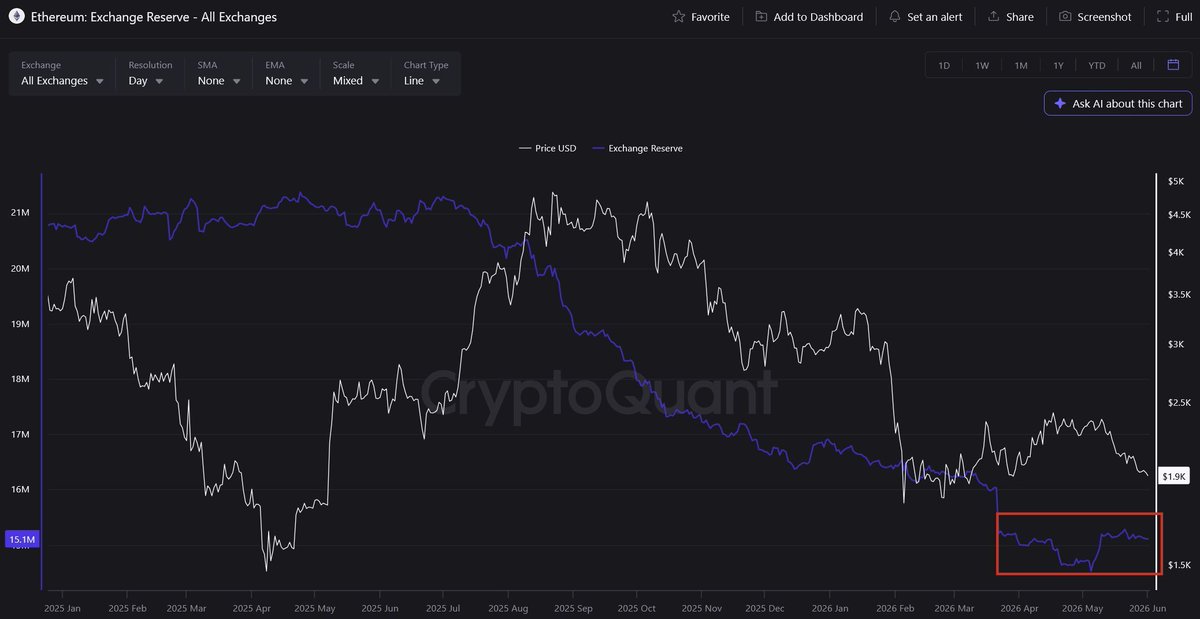
ETH price is stuck near $1.9K. Everyone's bearish.
The onchain data tells the opposite story! 📊
🔹 ETH on exchanges: crashing to ~15.1M (multi-year low)
🔹 Staking rate: fresh ALL-TIME HIGH at 32.42%
🔹 Transactions: ALL-TIME HIGH
Less ETH on exchanges = less supply to sell.
More ETH staked = more supply locked away.
Holders aren't selling. They're accumulating and committing.
Price follows sentiment short term.
Onchain follows behavior.
Right now they point in opposite directions.
Data via @cryptoquant
Pretty cool to see Cyclical Rates finally go live.
I came up with the original mechanism during my time at Euler as a way to bridge the gap between variable-rate lending and fixed-term credit.
Instead of fixed maturities, Cyclical Rates use recurring repayment windows that repeat forever. Borrowers get a predictable rate for most of the cycle, but face sharply higher rates during the repayment window, creating a strong incentive to refinance or repay.
The result is a perpetual fixed-rate lending market: borrowers get rate certainty, lenders get structured liquidity events, and positions remain fungible and composable onchain.
As far as I'm aware, there isn't really a traditional finance analogue. It's a genuinely crypto-native lending primitive that only works because smart contracts can coordinate these recurring incentive cycles automatically.
Very cool to see the team take it from concept to production.
Tom Lee: Ethereum DATs can use ~$500 million in annual staking rewards to fund grants for Ethereum ecosystem
“The Ethereum Treasuries — Bitmine and Sharplink among others — now own 7% of the Ethereum supply… Treasury stock is essentially supply permanently taken out from the ecosystem, but we also own the yield. The yield is around 3% so today these public treasuries are generating ~$500 million in rewards, and that is what we can use to fund and grant the crypto ecosystem.”
Lee believes that the Ethereum Foundation narrowing its focus to CROPs (censorship resistance, openness, privacy and security) is the right decision.
“Ethereum is a $240 billion network value entity. It has been operating for 11 years without a single day of downtime. There’s 11,500 nodes in 89 different countries. And there’s 15,000 developers. I think this is too big to be coordinated by a single foundation.”
As Ethereum continues to scale, he believes the ecosystem will move beyond a foundation-centric model and points to private companies like Etherealize, Optimism, Consensys, Enterprise Ethereum Alliance, and Offchain Labs that represent the Ethereum ecosystem and are already doing enterprise engagement.
“This list doesn’t yet reflect the spinoffs coming from the Ethereum Foundation. There’s at least five, and I think Bitmine will play a role in granting and supporting any of those that come out.”
“I think Ethereum is in good hands because the foundation is going to be stronger by staying focused. We have a lot of private sector companies already building products and important L2s on Ethereum. And of course, the treasuries are here to help with funding and granting… If you’re bearish, you are selling at the bottom.”
1/ Predictable pricing is what lets capital lend and borrow at scale. Onchain ETH credit has rarely had it.
KPK ETH Yield Term, live on @eulerfinance, brings a fixed, benchmark-set rate to ETH lending.
Ink is currently experiencing chain-wide outages with intermittent network availability. At this time, it is not yet stable.
We are actively investigating with our infrastructure partner, Gelato, to identify the root cause and restore stability.
We’ll share more updates once we have a more complete picture.
At this time, expect transactions and bridging to be unreliable until the chain is stable again.
Follow this account for updates. A full post-mortem will be published once the issue is resolved.
1/ $USDat is our stablecoin, backed by tokenized US T-bills, designed for settlements and DeFi liquidity.
It also flows the T-bills yield towards $sUSDat, bumping the base APY from $STRC above 11.5%.
While this might not seem anything extraordinary at first, it acts as a real line of defence when STRC fluctuates from its $100 par.
@dcfgod Impressive rally. Don’t know if it will hold but Impressive.
I was expecting the price to fall further before a recovery. Potentially misses the entry.
Coinbase Ventures is proud to back @Ethena through an open market purchase of ENA.
Ethena is a critical player in onchain finance, and we are excited for the closer partnership with Coinbase and USDC.
Ethena and @coinbase have partnered to grow onchain finance and savings products for their 100m+ userbase, with the first growth initiative launching next week.
Alongside this partnership Coinbase Ventures have also made their first investment into Ethena on the open market.
Why do you care about the $GHO growth potential as a $sGHO holder? You mention growth potential as something that will accrues to $sGHO holder. The growth perspective is about ethereum:0x7fc66500c84a76ad7e9c93437bfc5ac33e2ddae9 if GHO grows. For holder only yield and security count.
Introducing MGUSD.
MoneyGram's native U.S. dollar stablecoin.
Natively issued on @StellarOrg.
Built with @Stablecoin, @M0 and @FireblocksHQ.
Live in the U.S. today.