The U.S. has tried diplomatic pressure, economic sanctions, financial isolation, blockades, military containment, deployments, and direct strikes against Iran. None has delivered the desired outcome. Perhaps it is time to give genuine diplomacy a real chance.
The Mecca Treaty and I2U2 represent competing security paradigms: one based on regional ownership and collective security; the other on external alignments and including apartheid & genocidal Israel. It’s not hard to see which is more likely to shape the region’s future.
Simplistic reading of the 🇸🇦 🇹🇷 🇵🇰 pact couched in unhelpful sectarian language. It’s a hedge against multiple instability sources: US failed war on Iran, Israel's hegemony push. Iranian proxies (rather than Iran itself) are only part of the picture, not the main or only reason.
Turkey, Saudi Arabia and Pakistan sign a “collective defense” agreement today called the Mecca accords. Details yet to emerge but this creates a significant Sunni block against Iran. İt also has a significant defense industrial cooperation element.
Looking for the most idiotic take on the Saudi–Turkey–Pakistan deal? Joe Wilson reliably delivers. No, this pact isn't a POTUS achievement—it's a reaction. A defensive hedge by regional powers against an Israel-First policy and a failed war on Iran.
The mutual defense pact of Saudi Arabia, Türkiye, and Pakistan is another achievement of @POTUS promoting stability, peace, and prosperity in the Middle East. With our prosperous Gulf allies, a liberated Syria, and Lebanese-Israeli negotiations, it is clear the murderous regime in Iran is isolated and the people of Iran can regain a new government worthy of Iran’s rich history.
Even pro-EU Icelanders are rejecting Brussels’ interference in their democratic process.
The EU's bureaucratic overreach is so toxic that supporters of joining are telling them to back off. Well-deserved pushback against foreign meddling.
https://t.co/g7sz5Qj9oH
Told @Glenn_Diesen that the Pakistan/Turkey/Saudi pact is a natural reaction to the collapse of confidence in the American security umbrella. However, Tehran has to be careful to ensure that a US-driven project to isolate Iran is not replaced by a regionally driven campaign with the same objective.
https://t.co/RjmmAMWlmU
Good Israeli perspective on the Saudi-Pakistani-Turkish pact:
"Turkey has outmaneuvered us...
It seems that the agreement between Riyadh and Ankara distances normalization with Saudi Arabia a bit further–the most vital strategic development for bolstering Israel's position and its integration in the region–which has been put on the shelf for now...
In the geopolitics of the Middle East 'there is no vacuum'. The Israeli government's policy of 'bull in a china shop' in the region has led to the freezing of [Arab] normalization moves and the organization of a moderate camp. This has paved the way for [novel] constellations and the entry of new players, not always positive ones."
Describing the Saudi–Turkey–Pakistan deal as a kind of "Islamic alliance" or "Sunni NATO" is unhelpful and misleading. It is not a religious or sectarian alliance, but rather a pragmatic security arrangement between three states that see incentives in working together.
saudi arabia, turkey, pakistan defense pact—in effect a core islamic alliance— is a direct response to us iran war and perception the united states can’t be relied on for regional security.
(and, goes without saying, a very different direction in the region than the abraham accords)
Always grateful to @CharlieCHoyle and the team at @The_NewArab for publishing my pieces. My latest article is about the Iran-Oman Hormuz deal, featuring quotes from @abaabood, @rparsi, and @AliVaez.
https://t.co/tI20KHAJJ8
The Pakistan-Saudi Arabia-Türkiye Comprehensive Defence Pact is more than a military agreement—it is the first concrete building block of an emerging regional security architecture for South and West Asia. As reliance on extra-regional security providers declines, regional powers are beginning to assume greater responsibility for their own stability. If this momentum continues, it could open the door to addressing decades-old conflicts, including the enduring Palestinian issue, through a more regionally driven approach.
A Few Observations on the Saudi-Turkish-Pakistani Agreement From an Israeli and Iranian Perspective
1. Israel may be uneasy, but Israel is not the main reason for this agreement.
There will undoubtedly be voices in Israel that interpret the agreement as the emergence of a more assertive Sunni bloc that could eventually pose a challenge to Israel. But that would miss the primary Saudi motivation. For Riyadh, the agreement is first and foremost about a much deeper concern: whether Saudi Arabia can withstand the security challenges surrounding it on its own. The kingdom is looking for additional strategic depth and partners at a time when its regional security environment remains highly uncertain.
2. The real test will come when the agreement carries actual military costs.
The continuing Houthi attacks on Saudi Arabia provide an immediate test. Will they lead to meaningful Pakistani or Turkish involvement against the Houthis? The Houthis have already shot down a Turkish-made Bayraktar drone, although it was apparently operated by Saudi Arabia rather than Turkey itself. That distinction matters. The much bigger question is what happens in a genuine regional escalation. Imagine, for example, that Iran responds to a U.S. strike by attacking Saudi oil infrastructure. Would Turkey and Pakistan actually be prepared to take military action against Iran? That is where declarations of solidarity meet geopolitical reality. Neither Ankara nor Islamabad is eager for a confrontation with Tehran, and Pakistan's traditionally cautious approach toward Iran illustrates just how difficult such a decision would be.
3. The agreement does not close the door on Saudi-Israeli normalization.
From an Israeli perspective, the agreement should not be interpreted as determining the future of normalization with Saudi Arabia. Riyadh's security partnerships and its relationship with Israel operate on related but ultimately separate tracks. If Israel were to make dramatic progress on the Palestinian diplomatic track, it is entirely plausible that Saudi Arabia would once again show interest in advancing normalization. This agreement does not fundamentally change that calculation.
4. The agreement also reflects Saudi doubts about relying exclusively on Washington.
One of the most important drivers behind this development is Riyadh's disappointment and declining willingness to depend exclusively on the United States for its security. Yet Washington may not necessarily view the agreement negatively. An arrangement that contributes to regional stability without requiring additional American military resources could fit comfortably with longstanding U.S. demands that regional partners assume more responsibility for their own security. President Trump, in particular, has repeatedly described Turkey as an important regional actor. There is, however, a significant limitation: resources. Turkey faces serious economic constraints, while Saudi Arabia has its own growing fiscal pressures. This may be an important political and strategic agreement, but building a genuinely integrated military architecture will require considerably more money, capabilities and political commitment than signing one. In that sense, the agreement can also be understood as another consequence of the region's unsuccessful attempts to contain Iran through escalation alone.
5. Tehran may ultimately have more reason to watch this agreement carefully than Jerusalem does.
Turkey, Pakistan and Saudi Arabia are not looking for a war with Iran. But the agreement nevertheless has the potential to alter a regional balance of power that had increasingly been moving in Tehran's favor. Even without producing a formal anti-Iranian alliance, closer coordination among three major Sunni states, each possessing different military, economic and geopolitical assets, complicates Iran's strategic environment. The significance lies less in what the three countries intend to do today than in what they might be capable of doing together during a future crisis.
6. The UAE will also be watching closely.
Abu Dhabi has reasons to be considerably less enthusiastic about a growing Turkish role in Gulf security. The UAE has long viewed Turkish regional influence, particularly Ankara's historical ties to political Islamist movements such as the Muslim Brotherhood , as a strategic challenge. A deeper Turkish role in Saudi security affairs could therefore introduce another source of friction between Abu Dhabi and Riyadh, even as the two remain important partners on many other issues.
Bottom Line
The biggest tests of this emerging partnership are still ahead.
The continuing confrontation between Saudi Arabia and the Houthis is unlikely to disappear, and its potential for escalation remains significant. Saudi Arabia gains meaningful strategic backing at a moment when its security challenges continue to demonstrate the limits of acting alone. Turkey gains a potentially important foothold in Gulf security affairs. Pakistan, meanwhile, may gain the ability to share a burden it has historically faced largely on its own whenever Saudi security is threatened.
But the gap between strategic declarations and military commitments can be enormous.
The key question is therefore not what the agreement says on paper. It is what happens when one of these countries is actually attacked, particularly if responding means confronting Iran.
That will determine whether this becomes a genuine regional security architecture or remains primarily a political declaration of solidarity.
#IranWar
#turkey
#ksa
#Pakistan
Vox’s Abascal calls himself a "Spanish patriot," yet he flies to Israel to kneel before war criminals who just cheered on the invasion of his own country.
That's not patriotism. That's treason.
Israeli Diaspora Affairs Minister Amichai Chikli on Spain:
Pedro Sánchez is one of the most anti-Israel heads of government. During the first hostage deal, he announced Spain's recognition of a Palestinian state.
So we asked: Who is Sánchez's strongest political opponent? Who speaks out against Hamas? Who understands the threat of radical Islam?
The answer was Santiago Abascal, the leader of Vox. We brought him to Israel—to the City of David—for a meeting with the Prime Minister.
You cannot fight wars of choice on the cheap , by @JohnHulsman1 https://t.co/2tPKYRa2PI Fiscal and munitions realities intrude in the Iran War. Realism is set to best Neo-conservatism at last, not because we have been so clever (we have not been) but because we do not have the money or wherewithal to run an overly-expansive foreign policy anymore.
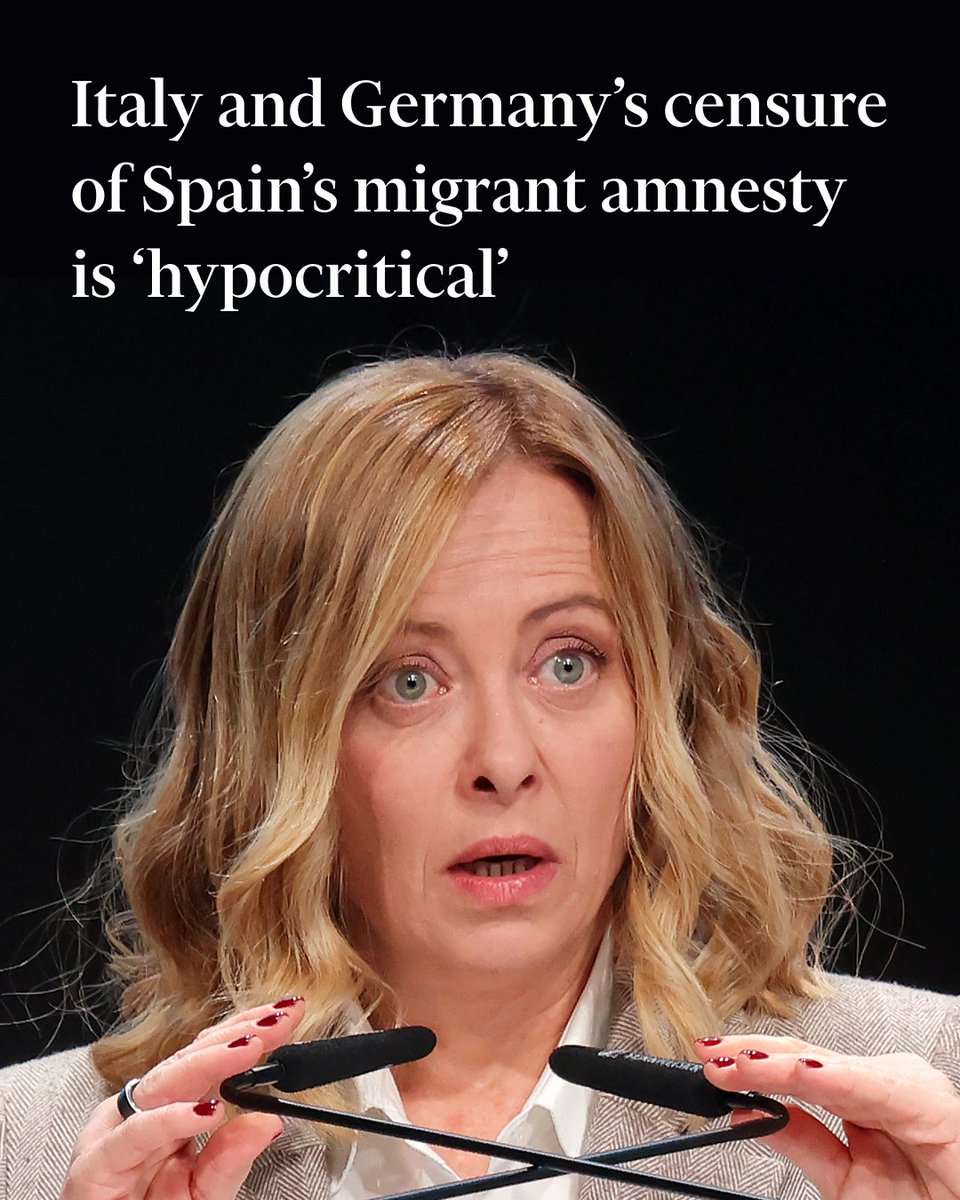
Italy, Germany and other countries that accused Spain of attracting migrants with its amnesty scheme have also quietly legalised the status of people who arrived irregularly in their own territory. https://t.co/qyXCOjNgWL
Very happy to see my recent @FPIF piece on how the US contributed to the mess in Ceuta by backing Moroccan territorial claims against Spain relublished in @Truthdig.
https://t.co/l0ZNDscJBg
Our friend, political prisoner Bahruz Samadov is kept in a tiny, dark cell without even a TV in Umbaki prison.
His weak eyesight is now near total blindness. A doctor warned he shouldn't stay in these conditions.
Nobody should be kept in these conditions.
#FreeBahruz