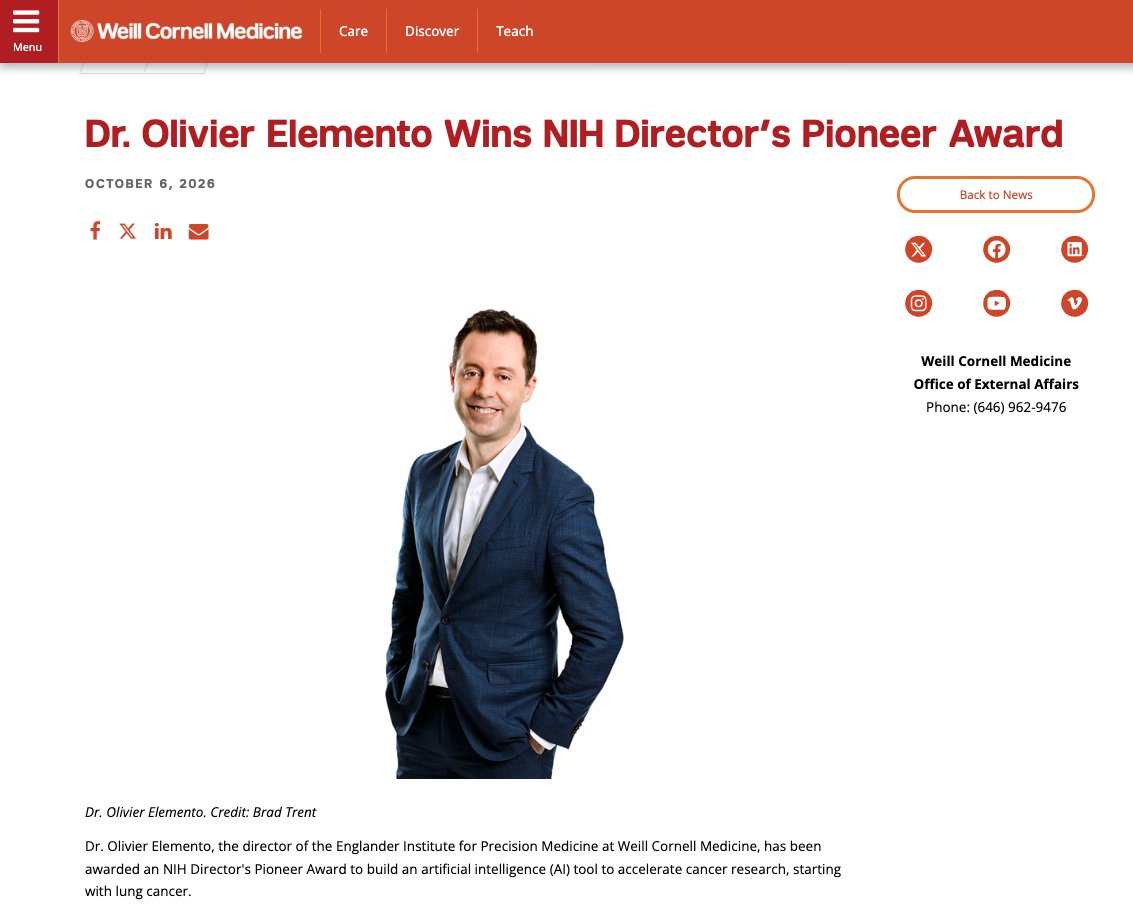
Big news today: I am deeply honored to receive the NIH Director's Pioneer Award, one of only seven given this year across all fields! We will build an AI engine that generates cancer hypotheses from human data and tests them with robots in tumor organoids https://t.co/n4rqtssmYB
A universal predictive model of the cell would dramatically accelerate science, allowing biologists to perform experiments digitally. Today we’re announcing a major partnership with the DOE and NIH. The goal of this partnership is to generate the data that will be needed to build an accurate model of the cell with artificial intelligence.
Isomorphic, Google DeepMind, and Meta are joining us as founding partners in the Virtual Biology Initiative. This is the beginning of a large scale coordinated effort to map cellular biology to power the development of digital models of life. Other leading scientific institutions and consortia including the Allen Institute, Broad Institute, Gladstone Institutes, the Human Cell Atlas, the Human Protein Atlas, the Wellcome Sanger Institute, as well as NVIDIA, are working together as part of this international scientific project.
Creating a predictive model of the cell is one of the most important challenges for the next decade of science. The insights that come from this could unlock a far greater understanding of disease, and open new paths for cures.
We invite the worldwide scientific community and other funders to join us in this effort.
Meet Mistral Large 4, aka Le Chonk.
• 1T parameters, natively multimodal. 49B active.
It is the best open weights model from US or Europe on aggregated benchmarks.
• State-of-the-art on critical workloads, including cyber defense, manufacturing and finance and it surpasses closed frontier models on visual grounding.
• Forged in Europe end-to-end and is deployable from Europe via our own Mistral Cloud infrastructure.
• Available to all via API today. Working with cybersecurity partners privately.
Open weights release end of October.
Check out PIE! Our latest perturbation generalization model from @arcinstitute. Congratulations to everyone, but especially @i_m_rive and @yusufroohani!
I'm almost ready to share it, but Claude Code is very good at keeping consistency across views and chapters.
For example, I can specify a heart phenotype, and will make all the images consistent and physiologically plausible.
Even with unlimited time, I don't think I could create such a nice tutorial!