Now online in @CD_AACR: A Foundation Model of Cancer Genotype Enables Precise Predictions of Therapeutic Response - by JungHo Kong, @zhenwang9102, @TreyIdeker, and colleagues @UCSanDiego
"CRISPR Shreds Undruggable Cancer Cells with Precision"
'Guardian of the genome' p53 is now therapeutically accessible using CRISPR-based technology from the Doudna lab.
@xiaofei_lin reports for @GENbio
https://t.co/BQJhOPITRh
A very impressive study for how we could prevent lung cancer more than 5 years before it is diagnosed. Using machine learning, discovery of a 14-plasma protein signature of risk that predicts responsiveness to an antibody therapy to interleukin, IL-1β
Validated across 8 cohorts
@CellCellPress@CharlesSwanton
https://t.co/qpPtgs1dH0
Exciting breakthrough technology from the lab, now live in @CellCellPress ! Instead of cutting the genome where proteins bind (e.g., Cut&Tag), D&D-seq scars the DNA with a deaminase, allowing single cell genome mapping of TFs and chromatin remodellers!
A holy grail for our lab has been tracking myeloid cells in human tumors in the same way that we track T and B cells with TCR/BCR.
@vincentzliu and @CalebLareau solved it!
We developed Mitotrek using scATAC-seq + mitochondrial DNA to do exactly this. Using Mitotrek, we find that new myeloid cells clones constantly infiltrate the tumor via circulating monocytes — and that their macrophage or dendritic cell fate is epigenetically programmed before tumor entry.
@10xGenomics@parkerici@CancerResearch@TheMarkFdn
https://t.co/Y37qbyw3F5
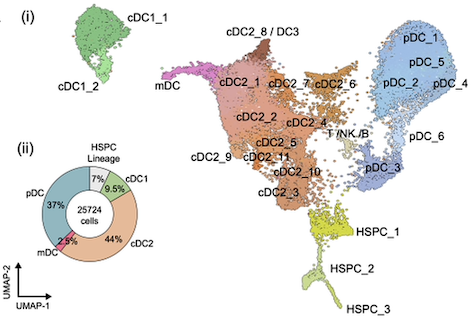
Decades of research have revealed the intricacies of how dendritic cells (DCs) function, but fundamental questions remain about how this group of cells develops in humans and how this process goes awry in disease. A thread on our new work! (1/9)
https://t.co/9hgDt3r8n1
Excited to share some of my PhD work out today in @NatureCancer! Integrating bulk and single-nucleus genomic approaches, we identify distinct determinants of survival and acquired resistance to ICB versus standard chemoradiation in glioblastoma. https://t.co/EqeJLUvbou
New preprint alert! 🚀 Across 60 human cancer cell lines spanning 20 cancer types, single-cell RNA+ATAC reveals pan-cancer cell-state heterogeneity, core gene-regulatory networks, and an EMT axis conserved across tissue origins.
Huge congrats to first author @xu_zxu, who recently defended his PhD, and Aileen Ugurbil from our lab @RockefellerUniv! https://t.co/4fNQJlJY3m
Characterizing AI-designed proteins requires quantitative biochemistry at massive scale. Enter Amplicon/Protein Bead Display (APB-Display), a fully in vitro platform that quantifies Kd's for >100,000 variants in <3 days (preprint link below!) @Stanford_ChEMH@czbiohub (1/n)
Autoinflammatory syndromes of STING and TREX1 dysfunction: https://t.co/SQa3SGGpAS
Jonathan J. Miner @miner_lab & team @PennMedicine contribute to the JCI’s Review Series: The cGAS–STING pathway: DNA sensing in health and disease, proposing a DNA-damage theory of autoimmunity and inflammation.
#cGASSTING #Autoimmunity
Surveying recent progress in neoantigen cancer vaccine development, this Review highlights areas where further technological advances and optimized trial design could enhance clinical impact https://t.co/Y9GMf7yUcj
https://t.co/86zEizP7a3
For readers interested in cyclin-dependent kinase inhibitors in cancer, here's a comprehensive review discussing their progression beyond CDK4/6 inhibitors for breast cancer https://t.co/jAQnkSQcVO
https://t.co/39JOxXgD1a
#ASCO26