- IMIDAZOLIDINONE - ASTHMA - T-18 - PETRI DISH - IRRIDIATING A R226 TARGET WITH A PROTON - KNOCKING IT OFF WITH 2 NEUTRONS - 1.3 - DIM - ETHYL - 2 - LITHIUM -
🚨 IBM Says 2026 Could Change Everything About Computers!
Imagine a computer so powerful it can solve problems that even today’s fastest supercomputers struggle with. IBM has announced that 2026 may be the year quantum computers finally outperform classical computers on real-world tasks. This isn’t science fiction — it’s a bold prediction straight from the tech giant’s roadmap.
Experts call this milestone “quantum advantage,” and it could revolutionize everything from medicine to climate modeling. But here’s the twist: this power won’t be for all problems, just the ones quantum machines are uniquely built to handle. Could we really be on the edge of a new computing era… sooner than we think?
Stay tuned, because the future might arrive faster than anyone expects.
Source: IBM. (n.d.). Five predictions for technology in 2026. IBM Think
Dividing a solid sphere of radius R into thin disks and integrating their moments of inertia about a diameter gives the rotational inertia formula.
For a disk at z, y² = R² − z², dm = ρ π y² dz and dI = ½ y² dm. Thus I = ½ ρ π ∫_{-R}^R y⁴ dz = (8/15) π ρ R⁵.
With ρ = 3M / (4 π R³) this becomes I = (2/5) M R².
How fast a sphere rolls under gravity or spins when torque is applied in mechanical systems can be determined by it. It is also used in astronomy.
When Machine Learning Tries to Store Two Memories on the Same Neural Sheet
The same self-organizing map (SOM) is forced to learn two incompatible worlds.
Training repeatedly switches between an emerald Swiss roll and an electric-blue torus knot
x ∼ (1 − α(t))Pₐ + α(t)Pᵦ
The network is never reset. Some neurons preserve the old geometry while others defect to the new one, creating moving domain walls across the sheet.
Each colour change marks a local memory being overwritten.
#MachineLearning #SelfOrganizingMap #NeuralNetworks #Animation #ArtificialIntelligence #DataVisualization #Mathematics #ComputerScience #Topology
A spinning ball does not break the laws of physics. It uses them.
The Magnus Effect is what makes a football bend into the top corner, a baseball curve past the batter, and a tennis serve suddenly dip. Spin changes the airflow around the ball, creating a pressure difference that pushes it sideways.
The next time you see a perfect curve, remember it is not magic. It is physics in motion.
When dealing with a severe bacterial infection, doctors need to know exactly what kind of germ is responsible so they can prescribe the right antibiotics. Traditionally, this process requires sending samples to a laboratory, treating them with chemical dyes, and waiting for the results. In urgent medical situations, this waiting period can be a significant obstacle to a quick recovery.
A groundbreaking new study published in Nano Energy introduces a fascinating solution: a robotic system that identifies bacteria simply by touching them.
Scientists have engineered an automated robotic platform equipped with a highly sensitive, self-powered touch sensor. Instead of relying on complex chemical tests or microscopes, the robot interacts directly with the microscopic biological samples. Because different groups of bacteria are built with distinct outer cell walls, they produce uniquely different electrical signals when physically touched by the sensor.
The robot instantly reads these microscopic physical differences. It can immediately categorize the bacteria in real-time, completely bypassing the need for chemical stains, lab preparation, or even an external power source, as the sensor generates its own electricity from the physical contact.
This immediate, physical detection method represents a massive leap forward for modern healthcare. By providing rapid diagnostic information on the spot, medical providers could soon deploy targeted treatments faster than ever before. This innovation not only promises to improve patient recovery times but also offers a powerful new tool to help prevent the misuse of antibiotics.
Reference: Fu-Cheng Kao et al, Triboelectric nanosensor-based robotic platform for rapid label-free discrimination of Gram-positive and Gram-negative bacteria, Nano Energy (2026). DOI: 10.1016/j.nanoen.2026.111879
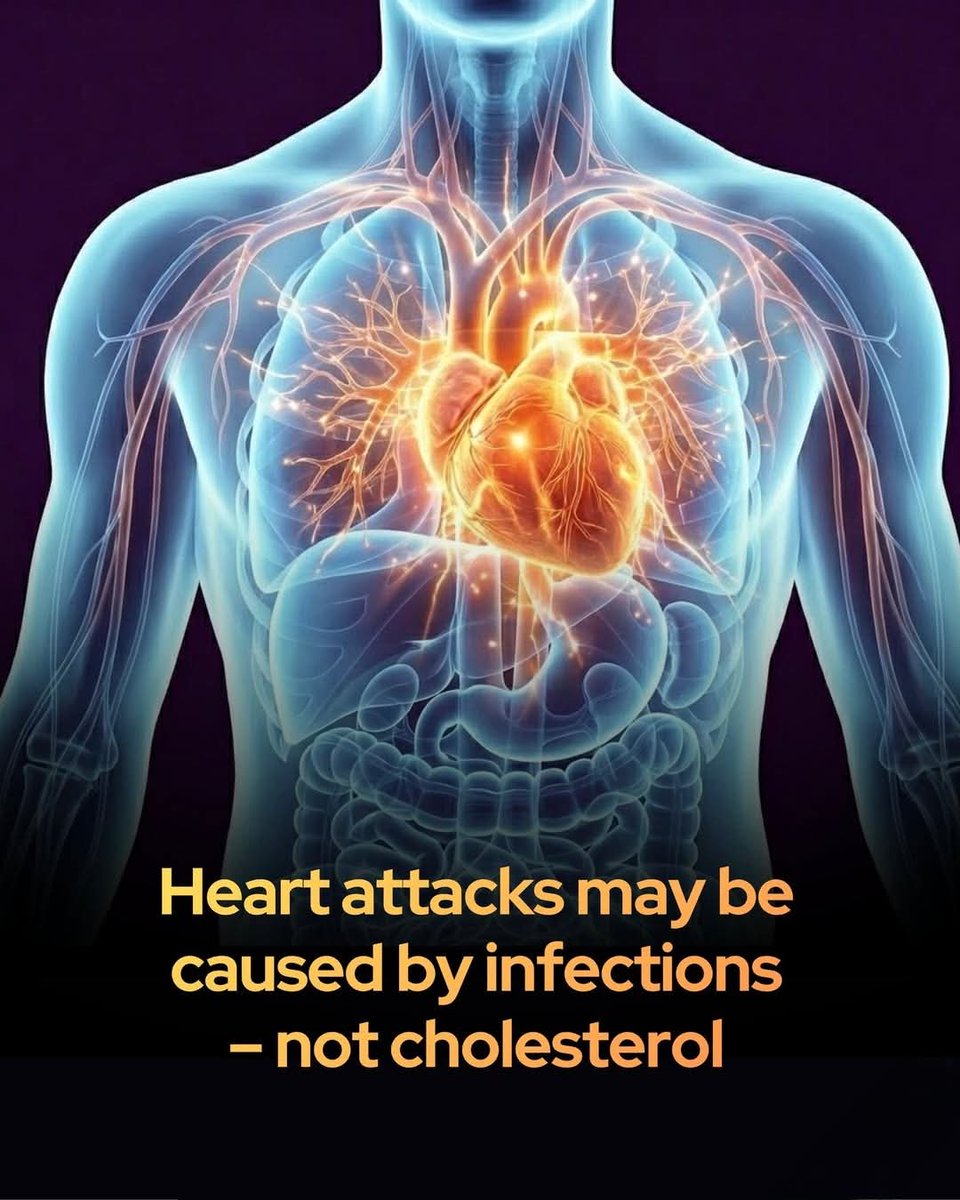
🫀BREAKING: Heart attacks may actually be caused by bacterial infections.
A groundbreaking study from Tampere University and the University of Oxford is reshaping our understanding of what causes heart attacks.
Long blamed primarily on cholesterol and lifestyle factors, new research now points to a hidden culprit: bacterial infections.
Scientists discovered that within the fatty plaques of coronary arteries, bacterial biofilms—gel-like communities of bacteria—can lie dormant and undetected for years. These microbial invaders, particularly strains like viridans streptococci commonly found in the mouth, evade immune detection and traditional antibiotics by embedding themselves deep within plaque tissue.
The danger arises when the body is hit with a viral infection, which ramps up immune activity and disturbs the biofilms. That disturbance can reactivate the bacteria, triggering a sudden surge of inflammation. In turn, this can weaken arterial plaques, causing them to rupture and form clots—leading to heart attacks. Researchers were able to map these biofilms in tissue from patients who died from cardiac arrest and found that antibodies could unmask their full structure. This discovery could pave the way for new diagnostics or even vaccines to prevent infection-triggered heart attacks, signaling a major shift in cardiovascular medicine.
Source: Viridans Streptococcal Biofilm Evades Immune Detection and Contributes to Inflammation and Rupture of Atherosclerotic Plaques. Journal of the American Heart Association, 2025.
Every photon has to climb out of gravity.
As light escapes a massive object like a star, gravity reduces its energy. Because the speed of light stays constant, its frequency decreases while its wavelength increases. This phenomenon is known as gravitational redshift, one of the most fascinating predictions of Einstein's General Theory of Relativity.
Formula:
ν′ = ν(1 − GM/Rc²)
Where
ν′ = Observed frequency
ν = Emitted frequency
G = Gravitational constant
M = Mass of the object
R = Radius of the object
c = Speed of light
The stronger the gravitational field, the greater the redshift.
🚨 Tiny Vibrating Molecules Just Crushed 99% of Cancer Cells
What if the future of cancer treatment doesn't involve chemotherapy?
Scientists have created tiny molecules that act like microscopic jackhammers. When activated with near-infrared light, they vibrate fast enough to break apart cancer cells. In lab tests, they destroyed 99% of cancer cells, and in mice, half became completely cancer-free.
It's still early research, but this breakthrough could lead to a whole new way of fighting cancer with fewer side effects.
Source: Hernandez, J. V., et al. Nature Chemistry.
An artificial neural network built into a computer memory chip reconstructs the human cortex with high accuracy in real time.
Learn more in a new #SciencePerspective: https://t.co/8p23jVLm1f
Euler's formula turns rotation into algebra:
e^{iθ} = cos θ + i sin θ
For any real angle θ, the complex exponential lands on the unit circle. Its real coordinate is cos θ and its imaginary coordinate is sin θ.
That single identity connects exponentials, trigonometry, and complex numbers. It is why rotations and oscillations can be handled so cleanly in signal processing, AC circuits, wave physics, and quantum mechanics
Scientists built a new sodium metal battery that fully charges in just 4 minutes while retaining 90% of its capacity after 2,000 charge cycles.
This breakthrough comes from a new Sn-FB Quasi-Solid Electrolyte that suppresses dangerous sodium dendrites, stabilizes the Solid Electrolyte Interphase (SEI) and enables smooth sodium-ion deposition on the metal anode.
The battery also operated for over 6,000 hours without dendrite-induced short circuits.
Because sodium is 1,000× more abundant and cheaper than lithium, this breakthrough could change the game.
Acceleration is everywhere!
Conditional probabilities link events via their intersections in the sample space.
Nodes show regions A ∩ B, Ā ∩ B, A ∩ B̄, Ā ∩ B̄ and events A, B, Ā, B̄ around Ω. Arrows label conditionals such as P(B|A), P(A|B), P(Ā) and P(B). The equality P(A|B) ⋅ P(B) = P(A ∩ B) = P(B|A) ⋅ P(A) holds.
It lets one calculate joint probability using a conditional and the event's probability.
Medical diagnostics uses it to revise the probability of a disease given a positive test by incorporating prevalence and test accuracy.