Today marks 3 years of publicly sharing #OPTEXMODEL signals for $QQQ.
The results speak for themselves:
📈 +164% cumulative return
📉 Less than 15% maximum drawdown
🎯 1.6 Sharpe ratio
But here's what makes that particularly interesting...
$QQQ itself has been on an extraordinary run, gaining 107% over the same period; a top-decile 3-year return.
Despite that formidable benchmark, the long-only OptEx model delivered:
✅ ~10% higher annualised returns
✅ ~30% lower maximum drawdown
✅ Sharpe of 1.6 vs 1.3
✅ Average exposure of 94%
Beating the market is hard. Beating one of its strongest 3-year runs ever, with less risk, is harder.
Three years of signals. No hindsight.
$QQQ $NDX #Trading #QuantTrading
this chart goes back to 1972 and has never printed this number
The 3-week realized vol of the momentum factor is now 4x the vol of the S&P 500. Not 1997, not 2000, not 2008, not the 2021 unwind. Never.
Translation: the index is quiet while the stocks inside it swing like it's a crisis. Winners get dumped, losers get squeezed, and the rotation eats momentum traders alive.
When maximum churn meets minimum index movement, someone is handing over a lot of shares. Distribution rarely announces itself louder than this.
Indeed 🚨🤯
We have confluence of Oversold conditions at Friday's Close: zero $SMH stocks trade above 20-EMA and pctg of stocks trading above 50-DMA fell from 24% to 8%.
Monday likely to see the benefits of a washout from $SOXX where savvy bulls step up.
$SPX $QQQ $NVDA $MU $CEVA $AMD $MRVL $NDX
Memory is the new GPU story, to the best of my assessment, which makes it outright hilarious that we price these names at 7–8x forward P/E. In my view, those multiples need to be 2–3x higher.
Most traders don't need a new trading signal. They need a better way to trade the ones they already know.
Nearly 35 years after Toby Crabel, Larry Connors and @LindaRaschke introduced the Opening Range Breakout (ORB), we revisit one of the most influential intraday trading ideas ever published.
Can a handful of simple, economically motivated enhancements transform a naive 5-minute ORB into a genuinely robust systematic strategy?
The results are compelling:
📈 CAGR: 1.0% → 12.1%
📊 Sharpe Ratio: 0.14 → 0.84
💡 Annualized Alpha: 1.75% → 12.80%***
The edge does not come from inventing a new signal. It comes from learning how to trade an existing one more intelligently.
In the article, we explain every enhancement, the intuition behind it, and its incremental contribution to the final performance.
👇 Link in the first comment.
@BearBullTraders #QuantitativeFinance #AlgorithmicTrading #SystematicTrading #TradingResearch #DayTrading #SPY
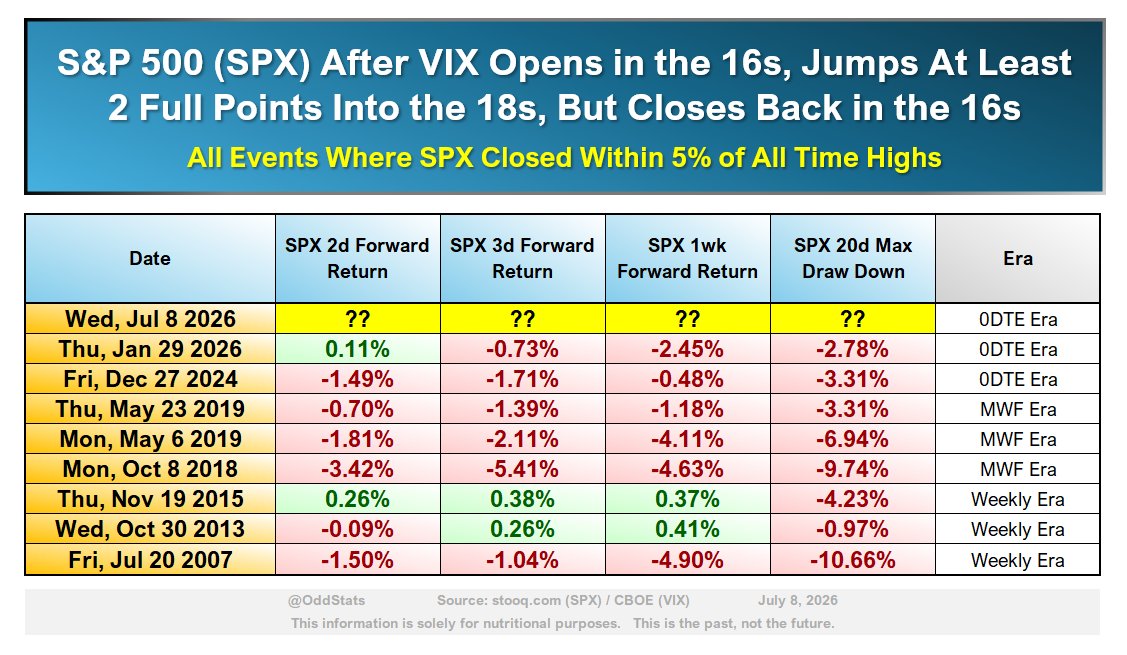
For only the 9th time ever, VIX
▪ Opened in the 16s
▪ Jumped 2.00+ points midday into the 18s
▪ But then closed back in the 16s
▪ With SPX no more than 5% from all time highs
CERTAINLY that must be bullish for SPX, right?
[20d max draw down included below]
🚨 Everyone is watching the wrong bubble.
And missing the greatest opportunity in 40 years because of it.
While the crowd argues about AI and crypto, the real story is the asset sitting in every "safe" portfolio on earth.
Bonds.
The 1981 top printed 14% yields. The 2020 bottom printed 0%. That was 39 years of falling rates, and it ended in a single Covid panic.
Covid was the turn. Rates hit zero, the system flooded itself with liquidity, and the 40-year bull in bonds quietly ended in the very moment everyone felt rescued.
That's reflexivity in the Soros sense. For four decades, falling yields lifted every asset, which convinced everyone yields would keep falling, which lifted assets again. Belief and reality reinforced each other all the way down to zero. Then the loop turned. And here's the part almost no one has grasped: a turn this big isn't the end of the game. It's the start of a far better one.
Here's why I'm genuinely excited.
For 40 years, falling rates lifted everything together. Correlations converged. The tide carried every boat, so owning the whole ocean beat knowing which boat was seaworthy. Index beat judgment. Skill was a rounding error.
That era is over, and what replaces it is the best environment for active investing in two generations.
When the secular tide reverses, dispersion comes roaring back. Winners and losers split apart violently. Suddenly the things that were invisible for 40 years, valuation, balance-sheet quality, real cash flow, pricing power, decide everything. The gap between the great business and the mediocre one stops being a footnote and becomes the whole return.
This is the world that made Buffett, Lynch, and Templeton. It's the world before 1981, where picking actually paid. It's coming back.
And it arrives at the most lopsided starting line imaginable, which is exactly what makes the opportunity so rich.
Concentration at a record. A handful of names carrying the entire index. Record IPOs listing at peak valuations and getting forced straight into peak index weights through mechanical, price-insensitive buying. The passive bid that everyone treats as ballast has become the marginal price-setter at the worst possible altitude.
JPMorgan's own Guide to the Markets makes the setup clear. Map starting valuation against subsequent ten-year returns, and today's level points to roughly zero percent per year from the S&P over the coming decade.
Sit with that. Zero from the broad index for ten years.
Now flip it over. If the average is zero, the spread around that average is enormous. Some things compound beautifully. Others go nowhere or worse. A flat index for a decade isn't a dead market. It's the richest hunting ground for active investors in living memory, because the distance between right and wrong has never paid more.
The whole architecture of modern investing was engineered for the era that just ended.
- Buy stocks and chill. Built on a discount rate going one direction. Down.
- The 60/40. Built on bonds rallying whenever equities fell.
- Just buy the ETF. Built on a 40-year tailwind no one managing money today has ever seen reverse.
That's the trap. And the mirror image of every trap is an opening for the people who see it first.
Strauss and Howe gave this moment a name. The Fourth Turning. The last of the four cycles, the Crisis, when the institutions built for the old era meet the conditions of the new one. These turns feel like danger to everyone clinging to the last playbook. They are the launchpad for everyone holding the next one.
The tide is turning. The old map is worthless.
And the greatest opportunity of our generation is hiding in plain sight, inside the thing everyone still calls safe.
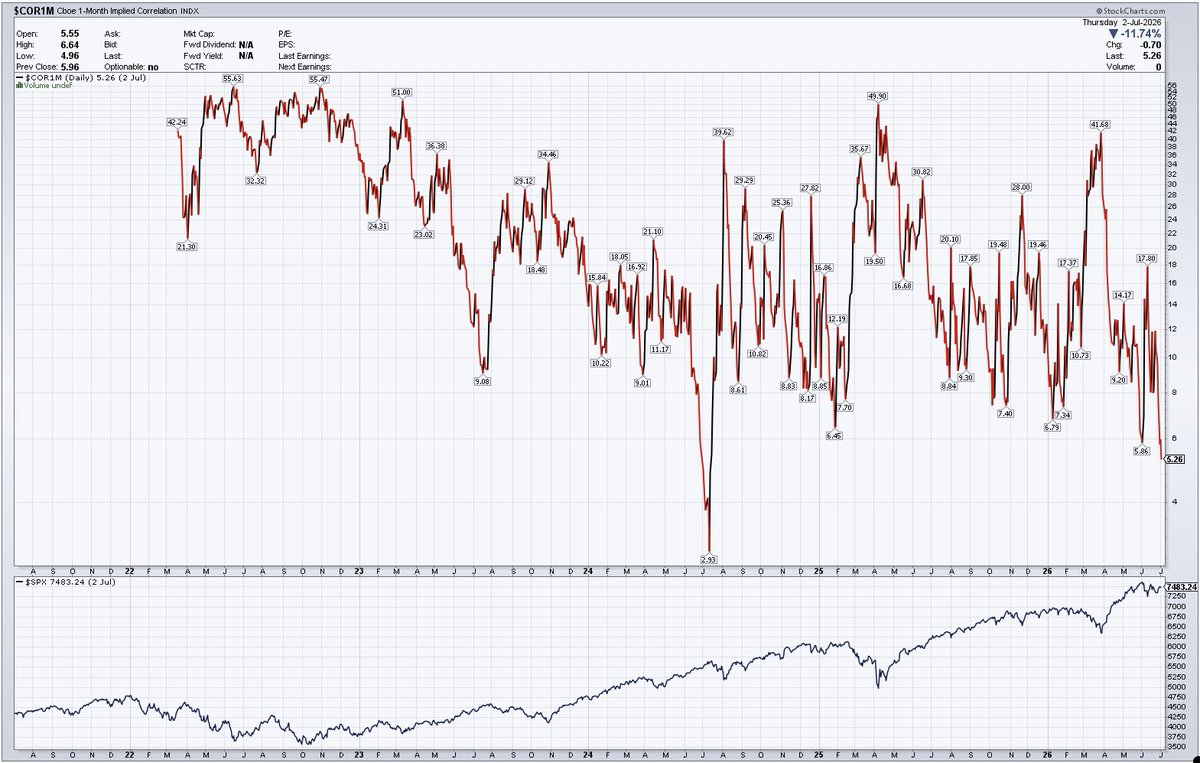
Cboe 1-Month Implied Correlation Index ~5.26.
Historically these low-dispersion stretches don't last.
When correlation mean-reverts, it usually comes with a vol spike.
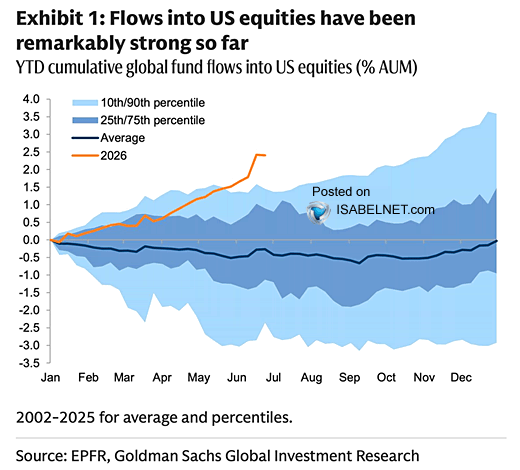
🇺🇸 Equities
US equity inflows have been running hot this year, with leveraged bets on US exceptionalism still firmly in place
👉 https://t.co/blMxcoFA78
h/t @dailychartbook $spx #spx
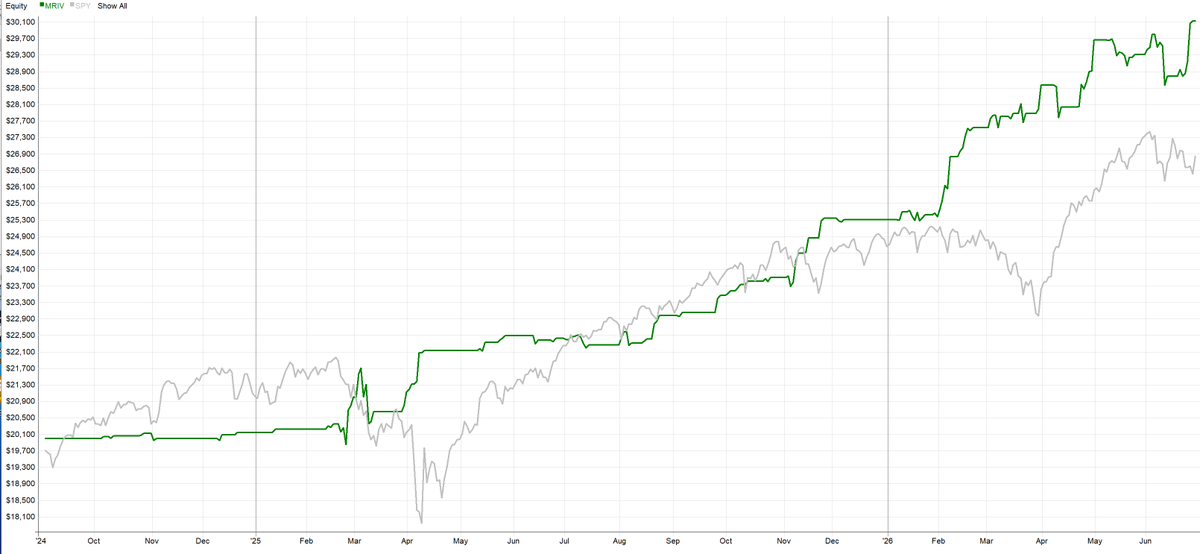
Out-of-sample update on my published IV mean reversion model.
Since the deep dive, it has beaten SPY with:
27% CAGR
-6.2% max DD
2.35% expectancy/trade
2.4 Sharpe
No leverage
Fees included
The best part:
Only 6.3% exposure.
Simple idea:
Monitor realized moves in US stocks vs implied volatility.
When the realized move is large relative to IV, I try to buy the mean reversion with a limit order.
Deep dive:
https://t.co/kKm6ercJVg
Algorithmic Short Selling with Python, Second Edition delivers what most trading literature avoids:
A rigorous, code-first treatment of the short side.
Short selling carries structural risks that long-only frameworks don't address, including unlimited loss potential, crowding, and squeeze exposure.
This book builds its methodology around managing those risks systematically rather than treating shorting as an afterthought to long strategies.
The regime detection and sector rotation frameworks in Chapters 4 and 7 are particularly useful for practitioners managing capital across changing market conditions.
Rather than relying on static screens, the book shows how to build classification systems that adapt as market character shifts, a critical capability given how quickly short setups can invalidate.
The position sizing and four-exposure portfolio management approach in Chapters 6 and 8, covering gross, net, beta, and concentration, translates directly into a deployable risk framework, not just a set of formulas.
What sets this edition apart is the AI-powered trading journal in Chapter 10.
Most quant texts stop at strategy logic.
This one extends into the behavioral layer, using AI to surface the subconscious biases that erode discipline in live trading.
For practitioners who have built strategies that backtest well but underperform in execution, this addition closes a real gap.
Every concept ships with working Python code against S&P 500 data, so readers can move from framework to implementation without translation loss.
This is not a theory book with code added on.
It is a working system, documented.
For quant traders, portfolio managers, and algorithmic trading developers looking to build short capability with real risk discipline, this is a strong, practical reference.
Grab it here: https://t.co/TfpXhLGRWm
This market is Waayyyy out of gear!
HIgh Low Logic Index is at levels that typically warn of a correction within 6 months. HLLI warned in 2000 (bust) 2007 (GFC) 2015 (Yuan) 2019 (Covid) 2021 (2022 bear mkt) and 2024 (2025 tariff tantrum)
$SPX $NYA $SPY $QQQ $IWM $DIA $VIX $RUT
JULY 1st, 2026 - FOR THE RECORD:
The Zeberg Business Cycle(TM) COI Cross-over has just been confirmed. We are in CONTRACTION PHASE.
But - the Recession Probability is at 5.28% according to traditional ways of forecasting Recessions. See chart below!
This number by-the-way was 6.05% in January 2008, when the Recession was 2 months old.
Remember - my COI cross-over does NOT mean immediate Recession. We need Imminent Recession Indicators to flash. THEN - I will call it. But we are closing in.
But - oh boy - the Financial Industry is going to run over the edge again with full speed.
Selling ∆-hedged straddles remains hard to beat.
One-year backtest updated to June:
• Sell 7 dte straddle Friday 8AM
• Delta-hedge every 24 hours
• $100k constant notional
Similar result as in May:
• $30K cumul P&L
• 1.99 Sharpe
The beauty is:
• You know you have edge (VRP)
• Drawdowns are ok if you ∆-hedge
• You can trade it systematically
Hardest part is to control your discretion:
• Strait of Hormuz closes -> sell vol
• STRC loses par -> sell vol
• BTC loses 60k -> sell vol
Keep it simple, trust your system.
Should take 10 min's each week.