Weigh your options before you commit, there is a reason why a new neocloud is popping up every day. Most of the time owning the compute can be a better financial decision than renting.
A 3-year GPU commit costs more than owning the servers.
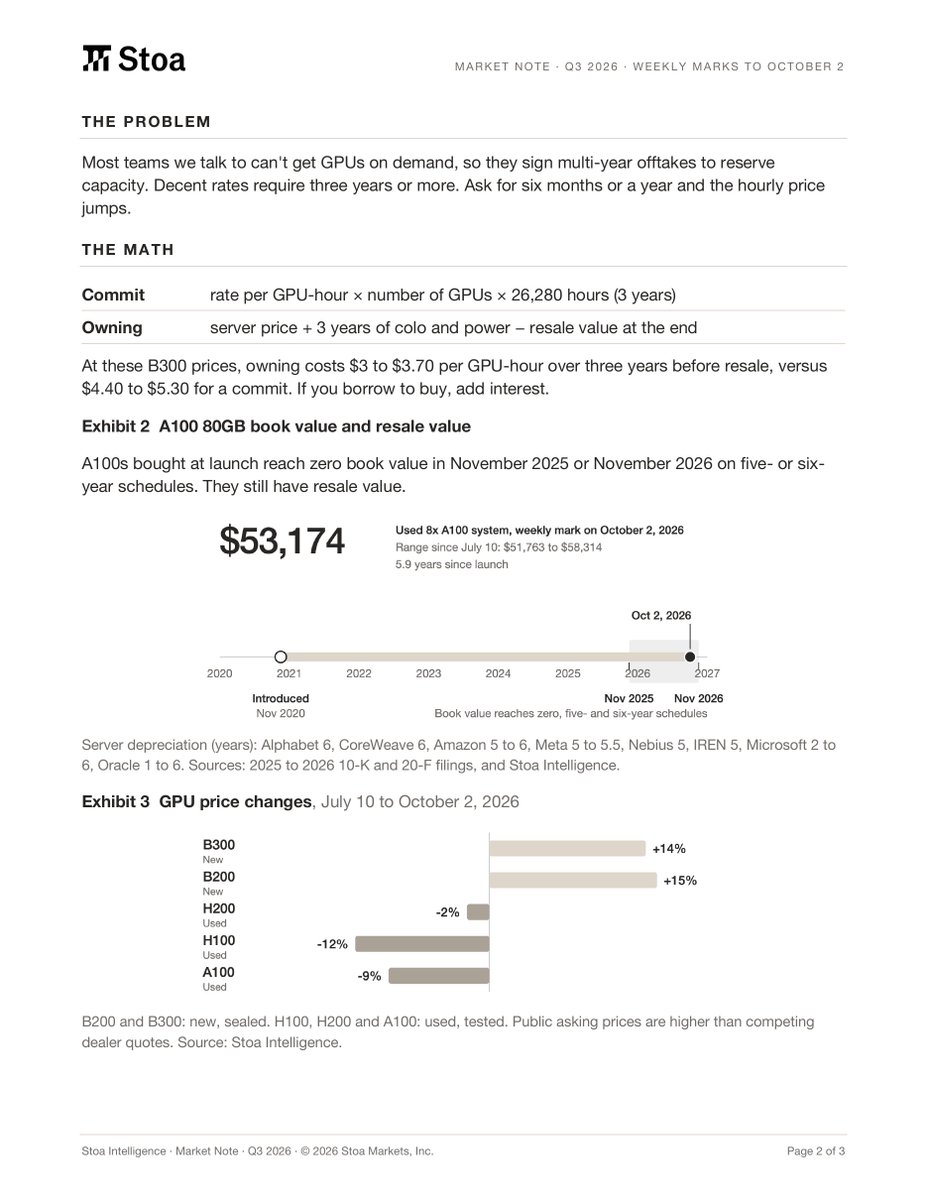
Most teams we talk to can't get GPUs on demand anymore, so they sign an offtake to reserve capacity. Decent rates only come with commitments of three years or more. Ask for six months or a year and the hourly price jumps.
When we run the numbers, owning beats a three-year commit, including colo (rented rack space) and power. At the end, you still have a server you can sell.
At $500K to $650K for a new 8x B300 server, owning comes to $3 to $3.70 per GPU-hour over three years before resale. A three-year commit costs $4.40 to $5.30 per GPU-hour, with 30% prepaid. Owning pulls ahead between months 10 and 26.
The hardest part is figuring out what you can sell the hardware for. Used GPU transaction prices aren't public. At Stoa Intelligence, we price five @nvidia platforms every week using executed trades and firm dealer quotes.
The A100 80GB came out in November 2020. One bought at launch hit $0 on the books in November 2025 on a five-year depreciation schedule. Our weekly price for a used 8x A100 system stayed between $51,763 and $58,314 from July 10 to October 2, 2026.
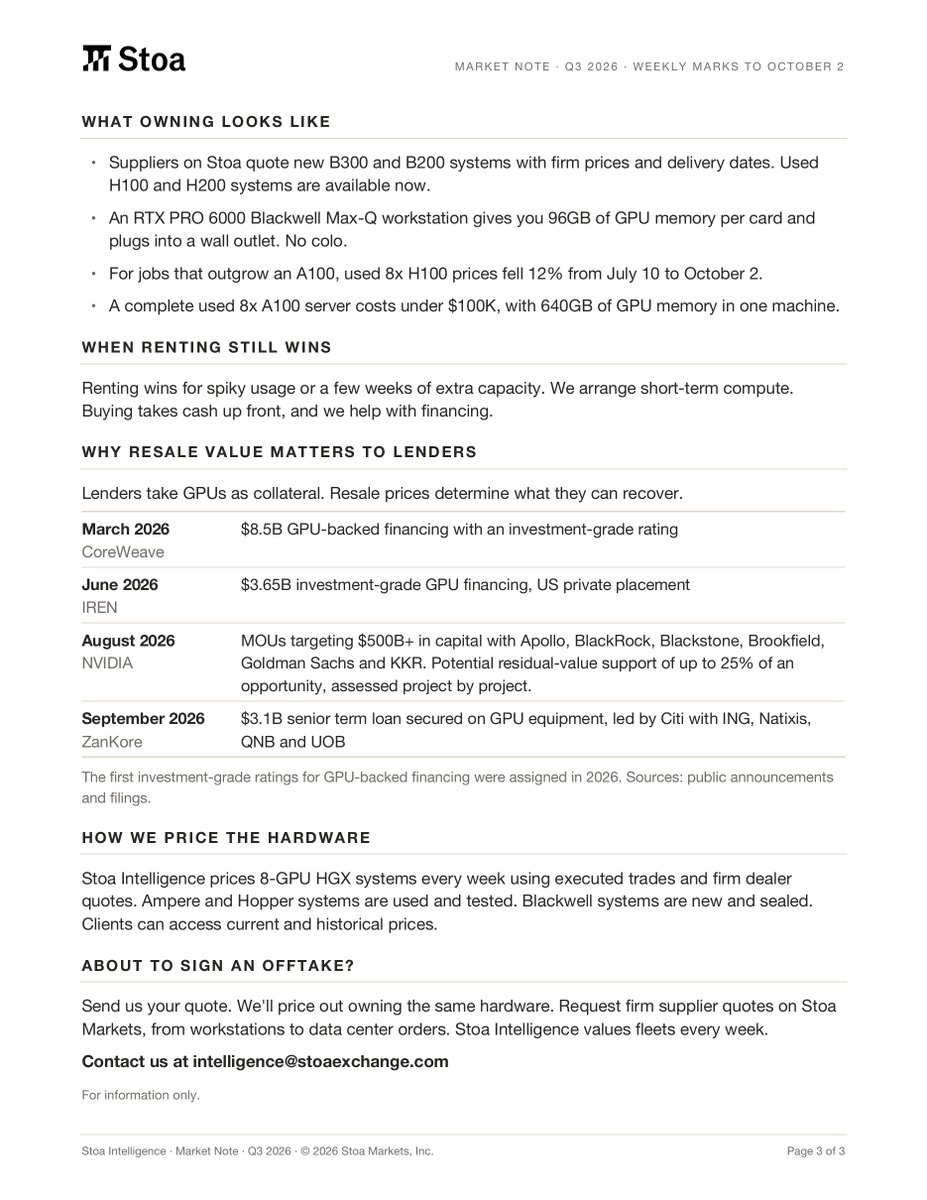
Owning is more doable than it sounds. A complete used 8x A100 server costs under $100K and gives you 640GB of GPU memory in one machine. Used 8x H100 systems got 12% cheaper over the same period. Suppliers on Stoa quote new B300 and B200 systems with firm prices and delivery dates, and used H100 and H200 systems available now.
Renting makes more sense if your usage is spiky or you need a few weeks of extra capacity. Buying takes cash up front, and we help with financing options.
The math and price charts are in the note below.
If you're about to sign an offtake, DM me your quote. We'll price out owning the same hardware.
Already own GPUs? Stoa Intelligence can value your fleet every week. DM me to set it up.
Today we are launching Stoa Intelligence, a product I am particularly excited about.
For months the same question kept coming up in customer conversations: where would a given GPU configuration clear today?
There is plenty of pricing in this market. The problem is it lives in private quotes and bilateral trades, so any one desk only ever sees its own flow. Rental and residual value models fill some of the gap. What they cannot tell you is where a specific configuration is being bid, offered, or traded right now.
That matters when you are deciding whether to hold inventory or rotate a fleet. It matters a lot more when you are valuing a portfolio or lending against the hardware.
Stoa Intelligence takes pricing activity captured on Stoa and turns it into hardware marks, current market levels by configuration, fleet and collateral monitoring, and analysis for valuation and GPU backed financing. A wider view of the market than any single desk can build from its own quotes and trades.
Sign up at https://t.co/zydaN1IntD.
I think you have to consider the incentives for all the parties:
$NVDA: this means taking some of the balance sheet weight of backstopping/underwriting, and outsourcing this stabilizing role to financial institutions. smart and unlocks more revenue for them as barrier to entry to buy nvidia chips is now smaller.
financial institutions: they have the ability to source the debt, and sell it out in the secondary market. Debt ETFs, structured credit, there are liquidity vehicles that they have access to which nvidia may not. Also smart for them as they get the 25% residual value guarantee from nvidia and get access to this highly demanded AI credit profile
how can we be responsible about it? we need to understand the value of these chips better in the secondary market. As Jensen puts it, the value of compute and the hardware is market driven now, rather than just through a price tag.
Everyone hates the $NVDA financing which probably means it’s ultimately going to work.
No, we’re not smarter than Jensen Huang and the executives at Goldman, Blackrock, Blackstone, Apollo, and Brookfield who are structuring these deals.
We provide the pricing and trading layer of this hardware at @stoaexchange. Residual value so far has been resilient, but this type of a financing scheme makes transparent, market driven residual value marks more important than ever
“This is Nvidia's way of saying that Hyperscalers will not be the only ones that get investment grade (IG) financing. Nvidia is making IG financing available to all Neoclouds and AI Platforms.”
The way you put it unfortunately reminds me of something that starts with subprime.. i think thats kind of a misrepresentation
seeing how our clients leverage gpu hardware directly instead of compute rentals to adapt open source workflows amazes me every day. opens up so many possibilities
Per Pinterest earnings call, open models they post-trained on their own data costs under 8% per transaction versus comparable closed models
Their CEO said: "Any CEO that’s not taking advantage of open source models is almost certainly wasting a lot of their shareholders’ money"
@paulg as software becomes more commoditized with AI, the focus on hardware seems to have gone up. its encouraging to see more and more hardware startups