In an early meeting at Facebook (c. 2007), when I was describing the goals of Facebook Platform (an area I oversaw) Bill Gates yelled at me/us.
His quote has stuck with me to this day:
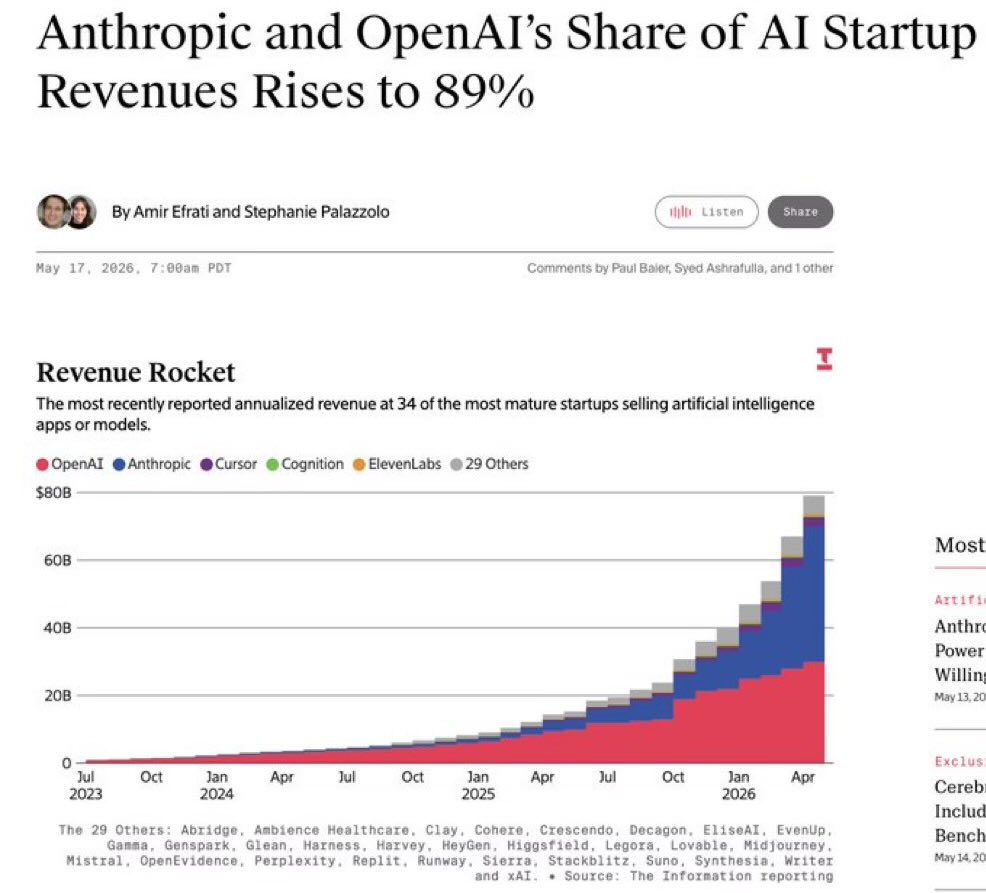
“This isn’t a platform. A platform is where the collective sum of revenues of the participants exceeds those of the platform itself.”
Ladies and gentlemen, I present to you the tokenmaxxing circle jerk.
Since we open-sourced pi-autoresearch, @Shopify teams have been running it on everything.
Results so far:
Unit tests: 300x faster
React component mounting: 20% faster
CI build time: 65% reduction
Made pnpm run faster
Autoresearch never stops trying things you'd never have time to try.
Repo: https://t.co/473UFWKanV
Someone recently suggested to me that the reason OpenClaw moment was so big is because it's the first time a large group of non-technical people (who otherwise only knew AI as synonymous with ChatGPT as a website) experienced the latest agentic models.
Introducing Steer AI. We made an AI that can't stop thinking about any concept you choose, by steering a model's internal representations at inference time.
Ask it anything, and watch it bend reality around that concept. Available for one week only.
New Anthropic research: Emotion concepts and their function in a large language model.
All LLMs sometimes act like they have emotions. But why? We found internal representations of emotion concepts that can drive Claude’s behavior, sometimes in surprising ways.
@Rahatcodes 👋 This is one of the signals we use to figure out if people are having a good experience. We put it on a dashboard and call it the “fucks” chart
I’ll simply say this:
Everyone I know working at a frontier AI model company is either suffering from extreme AI psychosis or genuinely believes we’re single digit months away from liftoff.
People get high on abstraction too early. They want the system before they’ve earned the insight.
But the good abstractions are never designed. They’re discovered. You do the stupid manual thing enough times and the real bottleneck just emerges. Your initial agency might be driven by a hunch you had in the shower, but that moment won’t get you all the way to making something people want. The right way to make anything is forced on you by reality: what are the real jobs to be done? And what sequence?
This is why “do things that don’t scale” still hits, especially now when AI makes it trivially easy to scale things that probably shouldn’t be scaled yet. PG’s point was never about suffering. It was about contact. When you’re the one manually doing the loop, you see the edge cases. The weird user behavior. The failure modes nobody designed for. The hidden dependencies that only show up at 2am when some flow or intermediate step breaks in a way you didn’t anticipate. If you automate before you have that contact, you just scale your misunderstanding faster.
When the machines can help you vibe code perfection it gives you a false sense of power. I love that feeling as much as you do. But fuck perfection. Do it live. Be the loop.
Feel every friction point. Notice what’s actually true every single time versus what just looked true because you hadn’t seen enough cases yet. Formalize that. Build the recursive version. Then keep checking that your abstraction is still attached to real humans and their needs. Because reality drifts. Your users drift. The ground truth changes under you. You may think you understand but no plan survives contact with the real users and what they want. You find those body blows in analytics and user feedback and we call them the roadmap.
Humans left with not enough data hallucinate too. But just like the LLMs with enough data you unlock real transcendence. Real utility. Prosperity for humans in real life.
The abstraction is a tool, not a destination. The moment you forget that, you’re cooked.