Research-track resident in psychiatry @ Stanford, MD/PhD @ Penn, SB @ MIT. Interested in the neural electrophysiology of cognition, perception, and psychiatry.
New TBS findings w/ iEEG by brilliant @YuhaoHuangMD! TBS → plasticity in minutes; DLPFC stim affects ACC; Connectivity predicts response! 🧠⚡️Opens new avenues for TBS optimization. More w/ TMS-iEEG, 3x TBS & units soon! Thanks @ACPaulk & team for collaborating 🙏 @StanfordBrain
Theta-burst stim (TBS) is used to treat depression, but how does it work? I dug into this question in my research yr with @DrCoreyKeller@ACPaulk, now out in @NatureComms, finding that TBS can produce plasticity-like changes in just minutes of stim. https://t.co/hDCFvqwsxJ
7/ A deep dive into nature of provoked rhythms -- big shoutout to FOOOF (https://t.co/DMzwOLNL6u, @Tomdonoghue ) -- revealed that single-pulse TMS caused the emergence of "true" theta oscillations in ACC and orbitofrontal regions.
6/ Anterior cingulate cortex -- a key node in networks mediating psychiatric illness like depression -- was specifically engaged in the theta band by DLPFC stimulation.
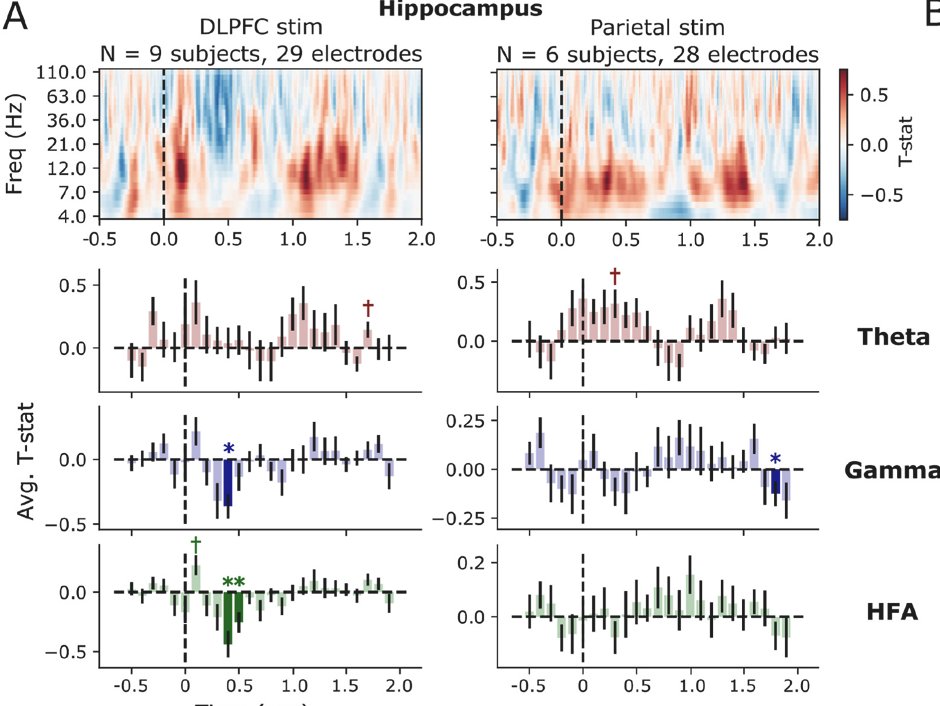
5/ TMS to the posterior parietal cortex -- specifically targeted to regions with maximal functional connectivity to the hippocampus -- caused increases in MTL/hippocampal theta power, while DLPFC stim caused decreases in hippocampal gamma power.
Now out in @brainstimj from @KellerStanfordU and @boeslab! What does TMS do to the human brain? Using a combination of intracranial EEG and TMS, we published one of the deepest explorations of TMS-related change in human neurophysiology to date. 1/7 🧵https://t.co/vvcwAVE72t
3/ In 17 neurosurgical patients with intracranial electrodes, we gave single-pulse TMS and analyzed the ensuing neural activity to get a high-resolution picture of how TMS affects activity throughout the brain, including deeper structures like hippocampus, amygdala, and cingulate
2/ TMS is a powerful brain stimulation technique, but its effects have usually been studied with non-invasive EEG, which has limited spatial resolution and can't access deep structures beyond the cortical surface.
Our work with @boeslab now out at @brainstimj! 👏
Using TMS w/ iEEG we show that single pulses evoke spectral responses throughout the brain, including deep brain structures such as hippocampus & cingulate https://t.co/FlInkGesaT
@StanfordBrain@Stanford_Neuro@UIowaNeuro 🧠⚡️
@psybalazs@US_FDA@MAPS To me, the fact that the study authors themselves made little/no effort to quantify the expectancy effect -- or even report basic data on it! -- is one of the most concerning things. Why is the onus on the public to try to impute the effect from other studies?
🎉 We're excited to finally announce our lab's official name: Stanford Precision Neurotherapeutics Lab! 🧠🚀
Our website relaunch is now live 🌐 Check out our latest research and discoveries at https://t.co/IlOlpOUCI3
@StanfordBrain@StanfordMed#Neuroscience#StanfordScience
Interested in using intracranial recordings and stimulation in humans to study memory, and leveraging this knowledge to treat memory-related disorders like PTSD?
I am recruiting a postdoc to our emerging interdisciplinary team at @JeffersonUniv! RTs appreciated
@gershbrain Difference between believing these are true and asking if they can be alternatively explained by psychological phenomena following life-altering or traumatic events, like getting an organ transplant.
Exciting times ahead in the lab! Anticipating valuable insights from behavior, invasive ephys, and video, as we deepen collaboration with @josef_parvizi & @scott_linderman. Thrilled to see @YuhaoHuangMD's vision unfold! 🧠 ⚡
https://t.co/wnBtqsYQzH @StanfordBrain
@DrLuisACenteno1@AllenFrancesMD Does belief that schizophrenia is a "biological" disease need to be mutually exclusive with the idea that psychotherapy, in some cases, can be offered as effective treatment?