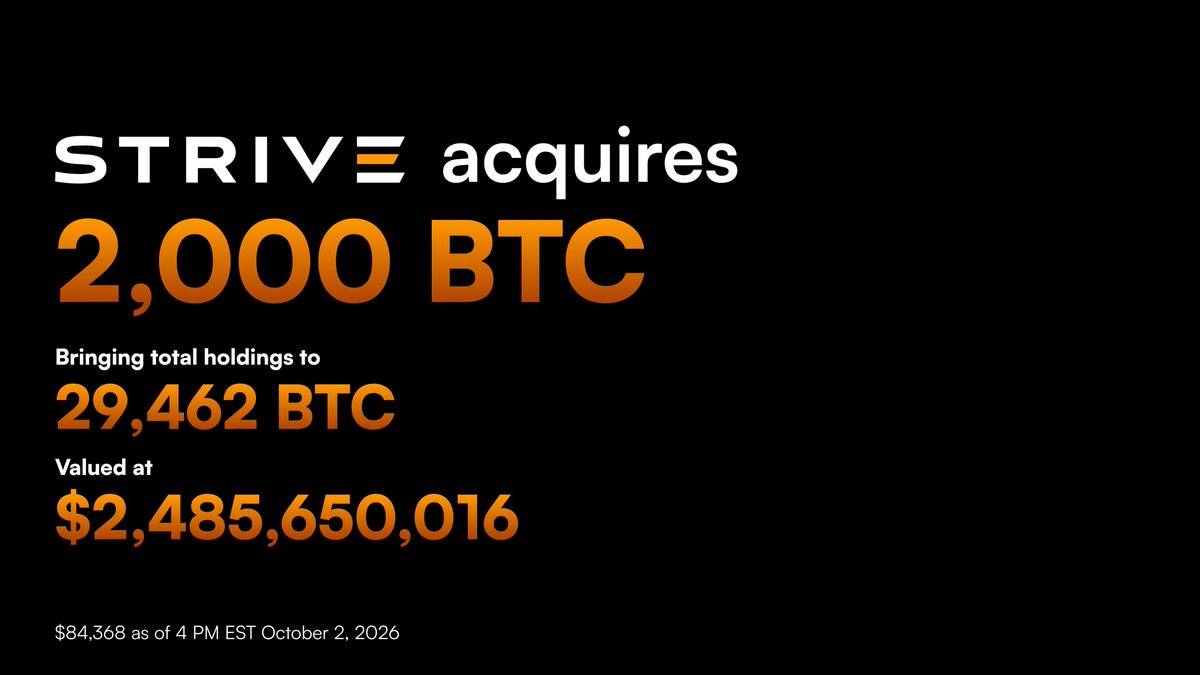
Strive acquired 2,000 $BTC for $169M at an average cost of $84,422 per bitcoin, bringing total holdings to ₿29,462.
61.5% of capital raised came from SATA, with warrants generating $56.7M.
Today’s 8-K also highlights key metrics and KPIs through 3Q26.
$ASST $SATA
SATA traded at par during every second of trading today.
1 penny of volatility.
$78 Million in volume (57% greater than the 30 day average trading volume)
Hummmmmmming
MSCI has enormous influence over capital markets, with more than $21 trillion benchmarked to its indexes. That makes its longstanding promotion of ESG-driven investing, documented hostility toward Bitcoin, and treatment of Bitcoin companies a serious concern.
This goes far beyond Bitcoin. Index providers can influence the flow of billions of dollars and the cost of capital for innovative American companies. Those decisions demand transparency, objective standards and accountability.
Unfortunately, MSCI has built a track record of falling short of those standards in ways I believe have harmed U.S. capital markets. Regulators should take this seriously for the benefit of American investors, businesses and innovation.
Excellent investigative work from @BitcoinConner and the @btcpolicy team.
$STRC and $SATA are among the two most liquid preferred equities issued to date.
18-month distribution reserves. Tax-advantaged distributions. Governance protections. Digital credit sits between traditional fixed income and common equity.
DCAP is built to own it.
For more information, including risks and to view a prospectus, visit https://t.co/u5gRfkJIHs
Distributed by: PINE Distributors LLC
Congress may be stalled. American regulators don’t have to be.
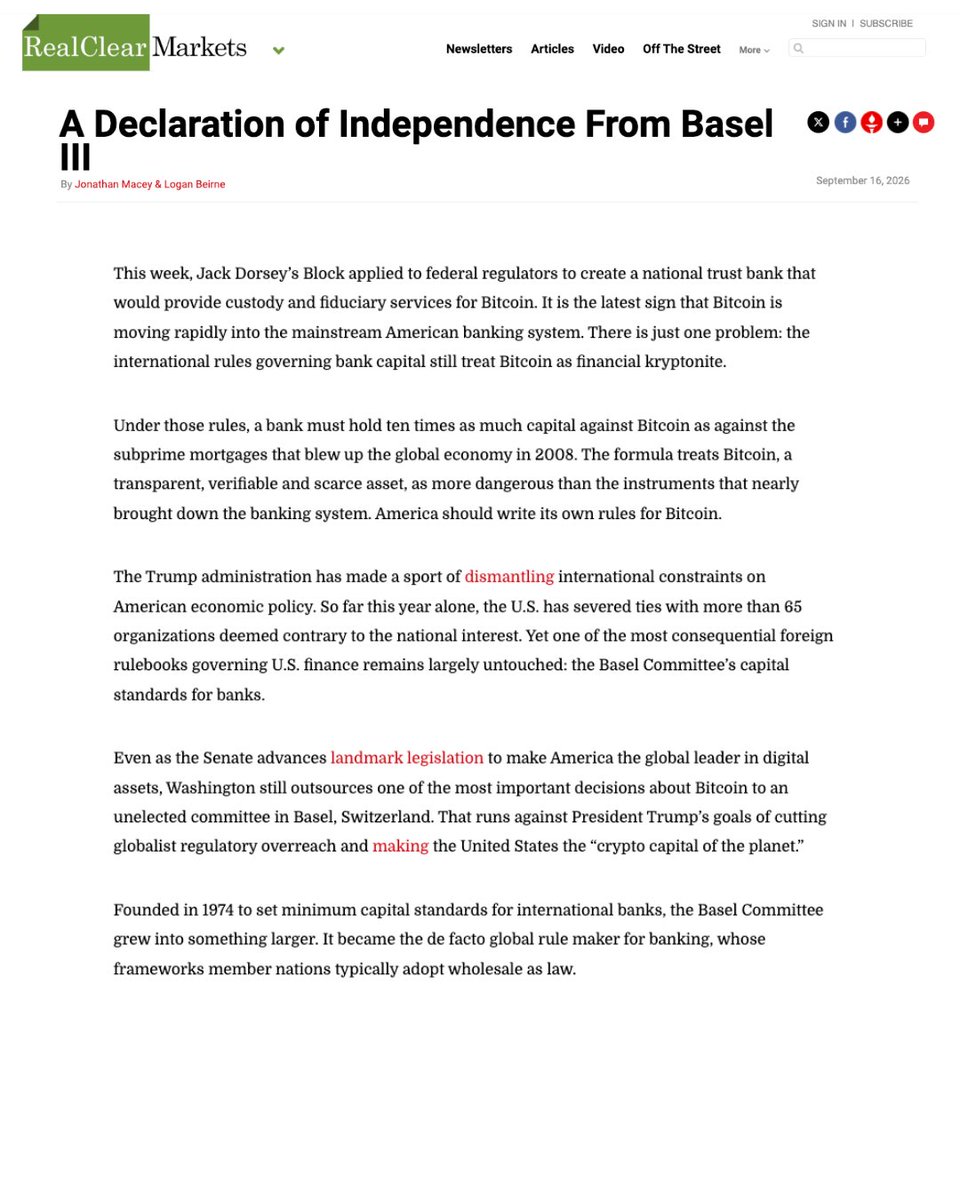
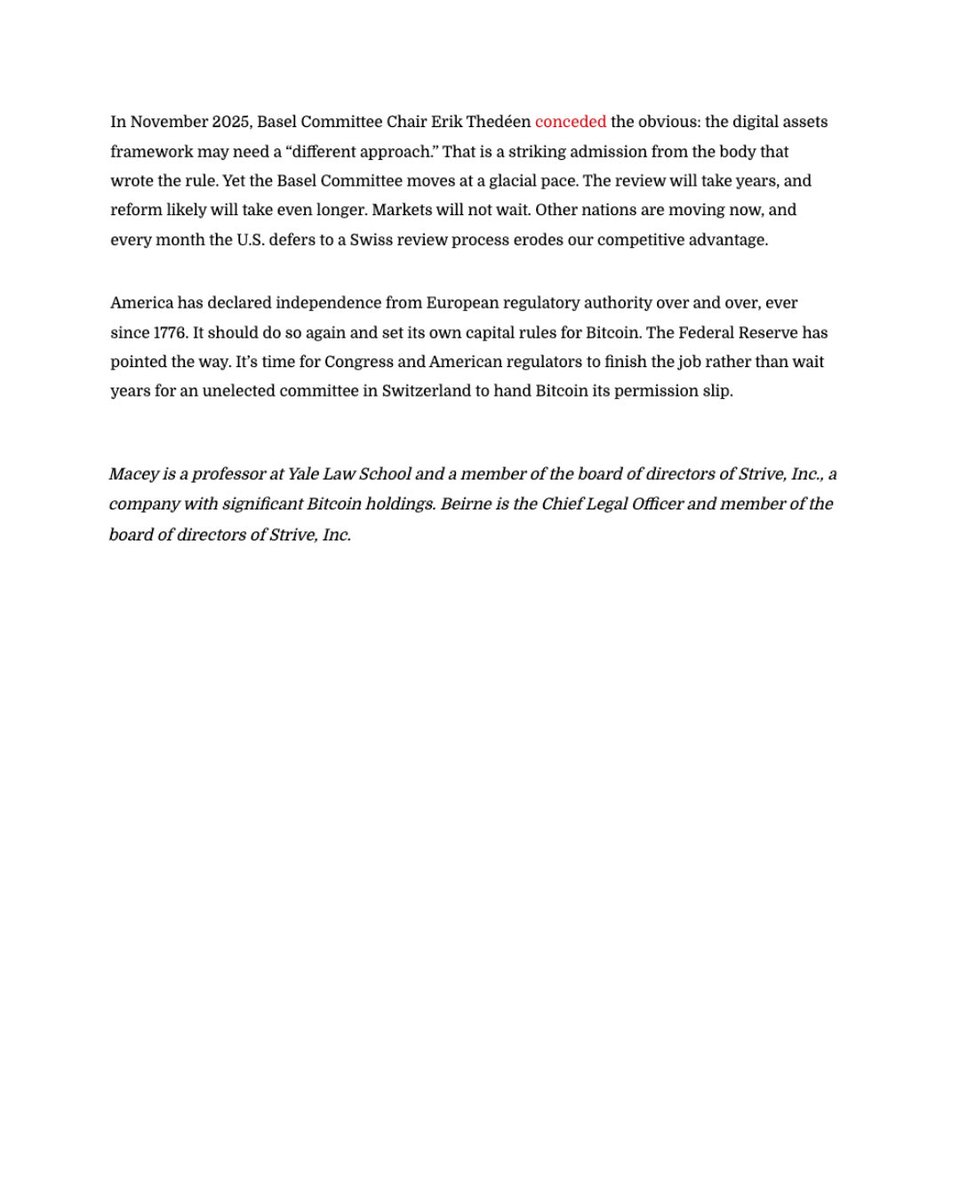
The U.S. can, and should, write its own bank-capital rules for Bitcoin. @JonathanMacey and I in @rc_markets: “A Declaration of Independence From Basel III”
Strive had gone far too long without hiring a podcaster. As our Bitcoin holdings have grown exponentially through accretive capital formation, our podcasters-per-share metric was beginning to move in the wrong direction. Several astute investors have been calling on us to defend our lead in this critical metric, and I agree with them: now is the time to lean in.
Today, I’m excited to announce that @AdamBLiv has joined @Strive. Adam represents true excellence as a podcaster, but the reason for this hire is rooted in one of Strive’s foundational principles: meritocracy.
Strive has been publicly opposed to DEI from the beginning, but we have also consistently opposed credentialism. Rejecting credentialism has been one of the main reasons we have been able to hire with excellence throughout Strive’s Bitcoin journey.
Credentialism causes institutions to outsource their judgment to resumes, pedigrees, titles, and conventional career paths. It puts too much weight on what someone has previously been permitted to do and not enough on the agency, principles, original thinking, work ethic, and demonstrated ability of the person in front of you.
At Strive, we give people significant responsibility because of how they think and what they have demonstrated they can do. The results speak for themselves. Our board and management team are young by public-company standards because we select for deep, principled belief in Bitcoin and demonstrated track records, not age, pedigree, or the number of boards someone has served on or executive positions they have already held.
When True North was getting started, I publicly supported the “kid analysts” there because they represented the same principle. They were not waiting for an institution to give them permission or a title. They were doing the work, publishing thinking that was better than both traditional media and institutional investment analysis at the time, and allowing the public to judge the quality of it.
Adam is an exceptionally clear example of that principle. Before becoming a Bitcoin analyst and creator, his last full-time role was as a manager at @Target.
A credentialist sees a former Target manager and asks why he should hold an important analytical role at a public financial company. A meritocrat studies Adam’s body of work and asks how quickly he can start.
Adam has consistently published deeply researched, first-principles analysis. He works extraordinarily hard, communicates complex ideas clearly, and has the courage to put contrarian views into the public record where everyone can evaluate them. It also does not hurt that he is freaking hilarious.
Nowhere has that been clearer than in his work on Strive. When Strive was at its weakest point in terms of public perception, Adam was buying and explaining why. What impressed me was not simply that he was bullish. It was that he independently arrived at his view through rigorous, first-principles work when sentiment was terrible and almost nobody else saw what he saw. Without any affiliation with Strive or access to internal information, his work was remarkably consistent with what we were seeing from the inside and, at times, even pushed our own analysis a step further. His analysis of Strive’s future growth has been among the most holistic I have seen anywhere, including internally. Most importantly, he was right.
There was real value in having such a credible and completely independent voice analyzing Strive. But Strive has too many opportunities, too much complexity, and too much work ahead of us not to bring the best talent we can find in-house.
I view Adam as a potential generational talent in financial analysis. The idea that someone could go from being a manager at Target to helping the most ambitious public company in capital markets navigate an extraordinarily complex competitive landscape may seem absurd to a credentialist. To me, it is meritocracy working exactly as intended.
Adam will join Strive as Vice President of Investments, working within our investment function and reporting to our Chief Investment Officer, @Werkman. He will build a systematic research function around the most important companies across the pure-play Bitcoin landscape. He will read every consequential filing, analyze capital structures and capital-markets decisions, and continuously evaluate positioning, valuation, growth rates, competitive dynamics, risks, and forward trajectories.
Adam will apply an even deeper level of that same rigor to Strive, now with full access to our internal data and dashboards. His work will help us pressure-test our assumptions, identify opportunities earlier, and make better long-term decisions for our shareholders. He was able to see Strive with extraordinary clarity from the outside. Imagine what he will be able to do from the inside.
We also intend for Adam to continue publishing through his existing channel under the @TNorth brand, now with the appropriate disclosures and responsibilities that come with working for a public company. His ability to research deeply and communicate complex ideas in an entertaining way is part of what makes him special, and we want him to keep doing it.
The bad news for public markets is that what I consider the best source of independent Strive analysis will no longer be independent. The good news for Strive shareholders is that we are bringing that mind in-house and putting it to work for them.
Adam did not earn this opportunity despite lacking a conventional Wall Street resume. He earned it because his public body of work is better evidence of his ability than any conventional résumé could be. Credentialism would have missed Adam. Meritocracy brought him to Strive.
Welcome to Strive, Adam.
$ASST $SATA
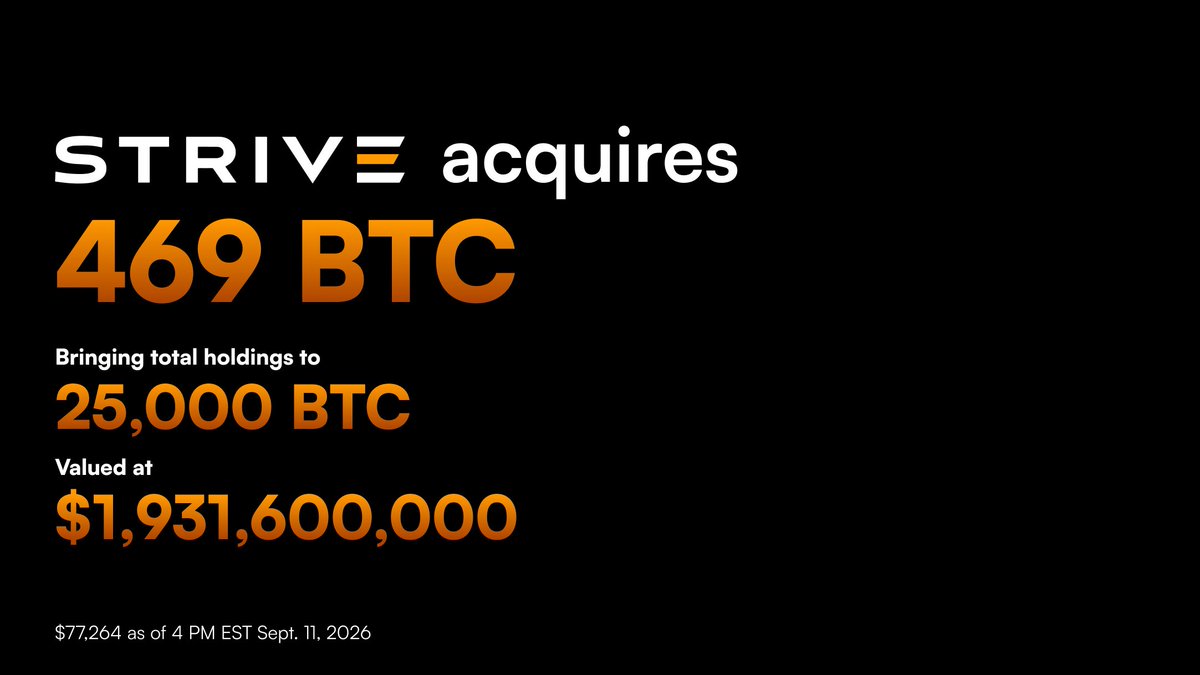
Strive acquired an additional 469 $BTC for $36.6M at an average cost of $77,954 per bitcoin, bringing total holdings to ₿25,000.
100% of the capital raised came from SATA, which now has over $1B notional outstanding.
We increased amplification ratio to 53.5%.
$ASST $SATA
We are expanding our Bitcoin Stewardship Commitment to support @OpenSats' Red Team Fund, which backs researchers red teaming critical Bitcoin software. This joins our ongoing support for @bitcoinpolicy on sound Bitcoin public policy and @bitcoinbrink on open-source Bitcoin development.
AI capabilities are advancing rapidly, making vulnerabilities in Bitcoin software easier to find and exploit. Bitcoin’s defenders need access to the best available AI models and the compute required to use them at scale, helping them find and fix vulnerabilities before attackers can exploit them. We are grateful to @Rob1Ham, @callebtc, and the broader Bitcoin Red Team for their critical work to date.
Protecting the network that underpins our most important asset is prudent long-term stewardship and part of our fiduciary responsibility.
For additional context, see the @Strive Bitcoin Stewardship Commitment:
One year ago today, I wrote this after Charlie Kirk was murdered.
Two days later, Strive became a public company. It was one of the biggest moments of my professional life, and yet I could not get my mind off Charlie, his family, and what his life had meant to mine. If you look back at what I was talking about publicly during those days, it was mostly about Charlie, because that was where my mind and heart were, and it felt inauthentic to spend that moment talking only about Strive.
During COVID, my wife and I were living in Northern California. @GavinNewsom had deemed churches “non-essential” and ordered them closed while “peaceful protests” were encouraged. In May 2020, @destinyrocklin church, which was close to where we lived at the time, opened its doors in defiance of those orders. We believed at the time that its pastor could potentially be arrested for taking that stand. He did not care, and neither did the people who filled that building, including my wife and me. We were there because church is essential and because nothing is more important than our faith in Christ.
We had never been to Destiny and probably never would have walked through its doors that weekend without Charlie. We heard on The Charlie Kirk Show that he would be there supporting the church, so my wife and I went. We found a church full of Christians on fire for God, unafraid to live their faith publicly, and that experience helped set my family on the Christian journey we have been on ever since. It also directly gave my wife and me the conviction to take a stand against the ramifications of ESG and DEI, which we came to believe represented not only breaches of fiduciary duty, but a broader cultural movement increasingly hostile to Christian conviction. We would not be where we are in our Christian journey without Charlie, and I am certain I would not be at Strive without Charlie Kirk.
When Strive was founded in 2022, Charlie was a seed investor. He supported Strive from the beginning in its fight against ESG and DEI, and he was excited about Strive’s evolution into a Bitcoin-focused company. Charlie understood that these fights were about much more than markets or business, and his energy and conviction were unmistakable.
I spend a lot of time talking about Bitcoin, the debt crisis, markets and Strive, and I have always promised myself that I will be authentic about what is actually on my mind and speak what I believe to be true. I could not live my life any other way. Make no mistake about what sits beneath all of it for me: Christ comes first. My faith is my foundation, my inspiration and ultimately my why.
Charlie blessed this country with an extraordinary amount of energy during a tragically short life. It is fitting to me that his final book was about honoring the Sabbath. Of all the subjects Charlie could have chosen to write about, his final message pointed people back toward God. A year later, what I wrote that day remains true: Charlie changed my family’s life, and his legacy lives on in our home and in countless others.
We will never forget Charlie Kirk.
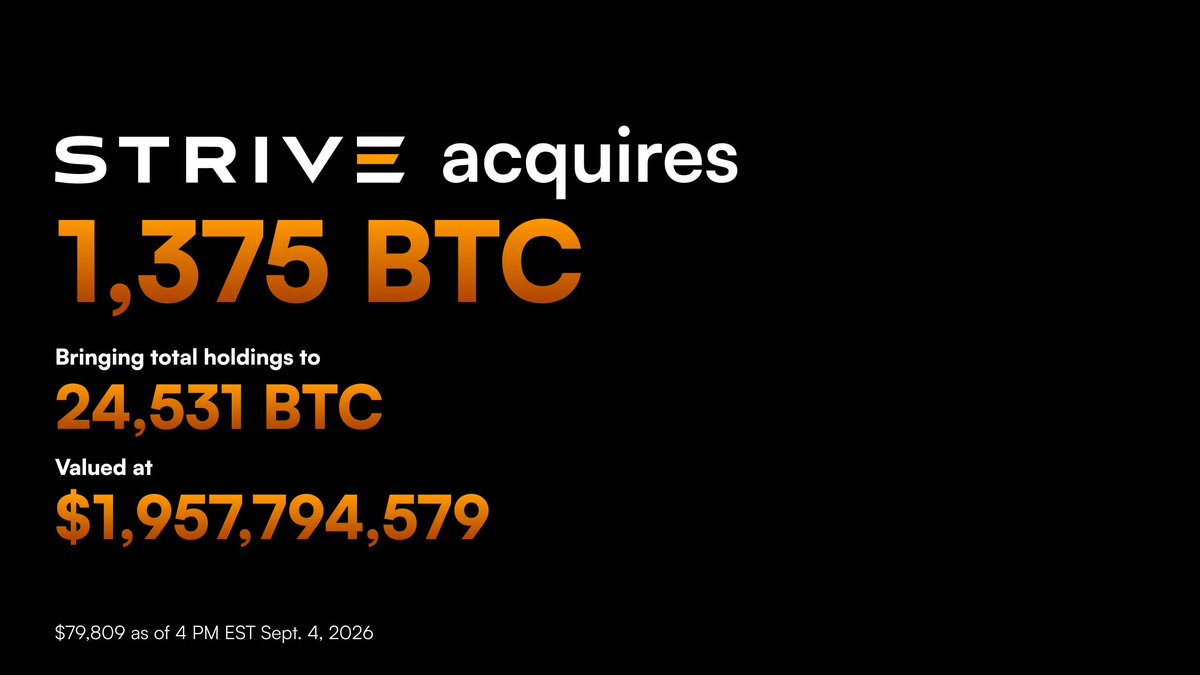
Strive acquired an additional 1,375 BTC for $109M at an average cost of $79,281 per bitcoin, bringing total holdings to ₿24,531.
70% of the capital raised last week came from $SATA, which now has $999M notional outstanding.
Time to break the billion-dollar wall.
$ASST $SATA
Strive’s OG mission was restoring shareholder primacy & meritocracy across corporate America by crushing the fiduciary breaches happening via proxy advisors & large asset managers.
Job’s not done but great to see these fiduciary breaches get punished.
Great work @SECPaulSAtkins
$51M in volume today on $SATA
6.24% turnover (volume as a % of notional outstanding). A “liquidity” measure.
11x @BankofAmerica preferred
21x @jpmorgan preferred
56x @WellsFargo preferred
At today’s “turnover” rates, it would take $SATA ~16 days to turn over the entire notional outstanding.
It would take Wells Fargo preferred $WFC.PRL 909 trading days (about 3.6 years)
A lot happened at Strive over the last week, but the bigger story is the macro backdrop developing around Bitcoin.
On this week’s Hurdle Rate, we went deep on both: the recent capital markets execution at Strive and the dollar, liquidity, gold and Bitcoin framework I’ve been writing about over the past week.
If you want the full version of how we’re thinking about the environment we’re entering, this is the episode.
We're hiring!
Strive is looking for a Director, Enterprise Technology to shape how our technology evolves alongside our bitcoin treasury business.
We’re cooking with gas.
Apply here:
$SATA $ASST
https://t.co/h9qVjjXb7A
A quick rewind: last year, MSCI proposed excluding companies from its broad-based indexes if digital assets represented 50% or more of total assets. Strive pushed back in the article below, arguing that a blunt asset threshold could misclassify operating companies as investment funds and make broad-market indexes less representative of the market they are intended to track. There was also broad pushback across the Bitcoin and capital markets industry around many of the same concerns.
Fast forward to today, and I have what may be a contrarian view in the industry: MSCI is listening. Their new proposal is a meaningful improvement. Rather than singling out Bitcoin or digital assets, MSCI is now attempting to distinguish operating companies from non-operating entities using a broader set of financial and operating characteristics. That is a significant reframing and addresses many of the concerns raised by Strive and others across the industry last year.
It still gets the most critical part of the answer wrong. Companies using structured finance, capital markets and operating activities to build and manage substantial Bitcoin treasuries are operating companies, and the proposed framework can still classify them otherwise. But the fact that MSCI has already moved this far is a good reason to keep engaging. Thoughtful engagement on the merits can change frameworks, and I think there is still room for further improvement here, whether in this consultation or over time as institutional understanding of these companies develops.
The purpose of a broad-based index is to give investors exposure to the market as it actually exists and evolves. We believe companies with significant Bitcoin exposure are an increasingly important part of that market, particularly in a world where fiat currency debasement is eroding purchasing power and AI is increasingly challenging traditional corporate moats. Bitcoin and this industry will continue to develop regardless of any individual index methodology, but MSCI plays an important role in how investors access broad market exposure, which is why getting the framework right matters.
Our interest also goes beyond Strive's own index eligibility. Strive's clients have direct exposure to MSCI through our ETFs, giving us a fiduciary responsibility to advocate for decisions that maximize MSCI's long-term shareholder value. If broad-market indexes become less representative of important parts of the market, that can ultimately hurt both index investors and MSCI shareholders.
We are still reviewing the proposal and do not want to prescribe the final answer before completing that work. We expect to engage constructively with MSCI and others across the industry as we formulate our response. We will disagree where appropriate and make that case forcefully on the merits, but MSCI has shown a willingness to listen and materially evolve its approach. That is worth recognizing, and it is a good reason to keep the engagement going.