This week I wanted to touch on the minority languages of Hong Kong, since the convo around language in HK always tends to be very Cantonese-centric
I've picked 5 spoken languages (Weitou, HK Hakka, Hoklo, Tanka, and Tingkok/TPC) and 1 signed language (HKSL) to focus on
🖐️☝️
感謝棟篤笑 #阿V 講解學廣東話嘅難處同策略
Hong Kong stand-up comedian Vivek Mabubani explains why learning Cantonese is difficult for Chinese-as-an-additional-language students, and the "oracy-over-literacy" strategy of Hambaanglaang.
https://t.co/g2Ij2Cd9as
One male contributor recorded 7000 sentences for the Cantonese Common Voice dataset. I appreciate his effort but we do need more voices from other contributors. Forward this to any Cantonese-speaking friends who may want to help. https://t.co/tkTn9e1kP4
#幫手CLS#Channel需要女聲
@Ah_Gan@chaakming im a heritage speaker and i have [ɕ] before /y/! picked it up from my boomer parents, but yea it's atypical among younger HK speakers
@LowRisingTone @chaakming generation and location also play an important role !! when im talking about stereotypical 港女 speech, im referring to a specific subset of young HK female speech, so older HK women won't have this allophone. my mom (mid 50s, from HK) has [tɕ] but not [tʃ]
@colaceirios v common in hk to hear tɕ/tʃ before the vowels yu/oe/u/eo/ou/o
some older speakers will do tɕ before any front vowel, younger gz speakers tend to do [ts] for everything, and some Hoa canto speakers do [tɕ~c] for any instance of <z>
@chaakming i think gender and gender identity might also play a role? this is subjective ofc, but i associate a really strong tʃ with stereotypical 港女 speech, so the appearance of the allophones might also depend on the interlocutor/the social environment/etc
@chaakming THISSSS my tʃʰ is much more prominent in spontaneous speech, but in careful speech, or in high register/customer service situations, i immediately switch to tɕʰ
there's something to investigate there with respect to the sociolinguistics of <c> and <z> 👁️
@fluentinaka@colaceirios just a small note that the first two screenshots are talking about a historical distinction that was lexical and has since merged! the one in question is touched on in the last screenshot tho, and it seems to have a lot to do with vowel rounding
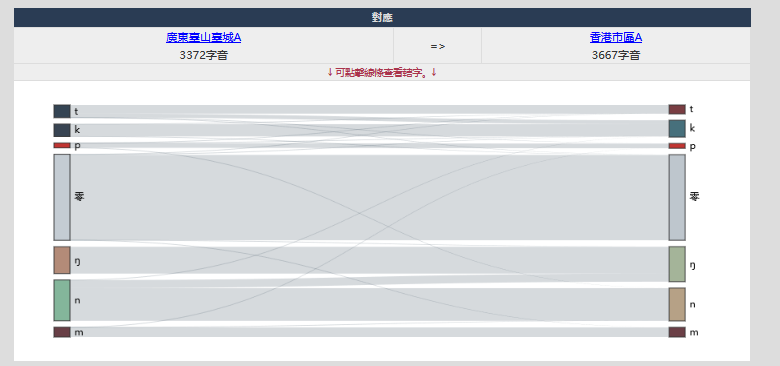
i've been staring at this chart showing the mapping of initials and finals between HK Cantonese and Toisanese and getting the urge to just try to learn the language
look at those clean mappings! i already have some of this internalized it's great
The trial version of the #Taiwan#Hakka Corpus is now available online. Launched by HAC in 2017, the corpus has collected more than 6-million-word Hakka language material, in written or spoken form. Read more: https://t.co/yGPmytvpUf and check out: https://t.co/O9z3DV8lzL.