https://t.co/quQyblwFWg
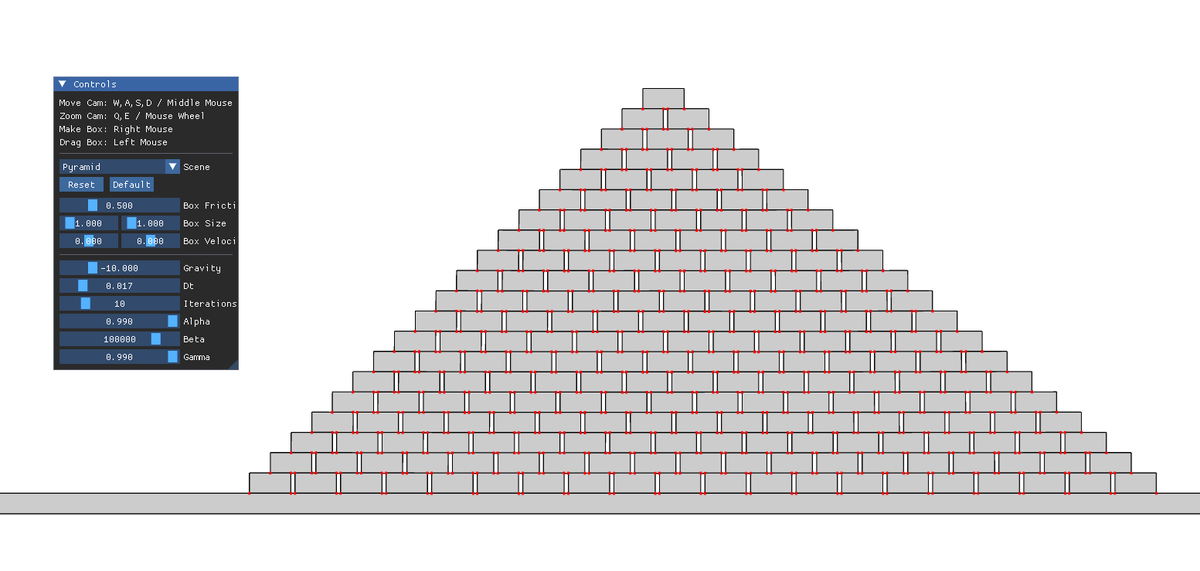
Proud to present our paper: Augmented Vertex Block Descent
This is a new physics solver which can accurately simulate HUGE numbers of objects in real time! Demo code coming later this week. Checkout the project page for details: https://t.co/Bk1IBYDfmc
I'm vibe coding a new *GPU rigid body physics engine* from scratch for @levelsio 's #vibejam ! 💥
- Supports Rust & Web (via WASM+WebGPU)
- 100% written by @anthropic 's Claude Code + Opus 4.6
- Performance optimized by @karpathy / @uditg 's autoresearch: https://t.co/aoMbSwJgvI
- Uses Augmented Vertex Block Descent (AVBD) paper: https://t.co/bXWDG2SYip
Finally got around to finishing the minimal 3D example implementation of AVBD: https://t.co/IDnOD1uWDQ
You can play with the prebuilt web demo here: https://t.co/Bk1IBYDfmc
@PierreTerdiman@leonard_coder In that case, sorry for misrepresenting physx! Real number is definitely less than 50x. No sdk available in the short term, so easiest test is probably just reproducing one of my test scenes in peel. Pyramids svene for example was 500k bodies, 10 ms excluding rendering on a 4090
@leonard_coder@PierreTerdiman That number came from just dividing the frame time of AVBD by that of physx for the 20k scene, which was about 50x. Though that's a good point about the rendering overhead. I guess I incorrectly assumed the rendering overhead was minimal in the physx sample
If you are attending Siggraph this year, please come see our talk later today on Augmented Vertex Block Descent (AVBD). We will also be showing a live demo at Real Time Live shortly after!
@MichelVandegaer No 3D is not really much more difficult, in terms of the AVBD solver. Mainly it's collision detection that is a hassle. I may work on a minimal 3D version of this when I have more time after Siggraph, if nobody else has already made one by then.
Added post stabilization to the AVBD example implementation. This removes one of the tuning parameters, which should help make implementing the method a little easier: https://t.co/4X3qiwYYiY
This new sim method from Roblox + Univ. of Utah runs 100 FPS, handles chains, cards, cloth - all the hard stuff - correctly. Even at 1 iteration, it beats old methods at 100. It's called Augmented Vertex Block Descent. You can try a mini version in your browser, for free. 🧠🔥 Full video here: https://t.co/yTiQsa8OLM
@marcinignac@codybennett Looks great! I'm very curious how crisp the shadows are (tough to tell with this scene). I guess it depends on the probe resolution
For anyone who is interested in implementing our new method Augmented Vertex Block Descent (AVBD), you can find the source code for the 2D demo implementation here: https://t.co/4X3qiwYYiY
You can also play with the demo in your browser!
https://t.co/yYGiEW2nXm
https://t.co/quQyblwFWg
Proud to present our paper: Augmented Vertex Block Descent
This is a new physics solver which can accurately simulate HUGE numbers of objects in real time! Demo code coming later this week. Checkout the project page for details: https://t.co/Bk1IBYDfmc