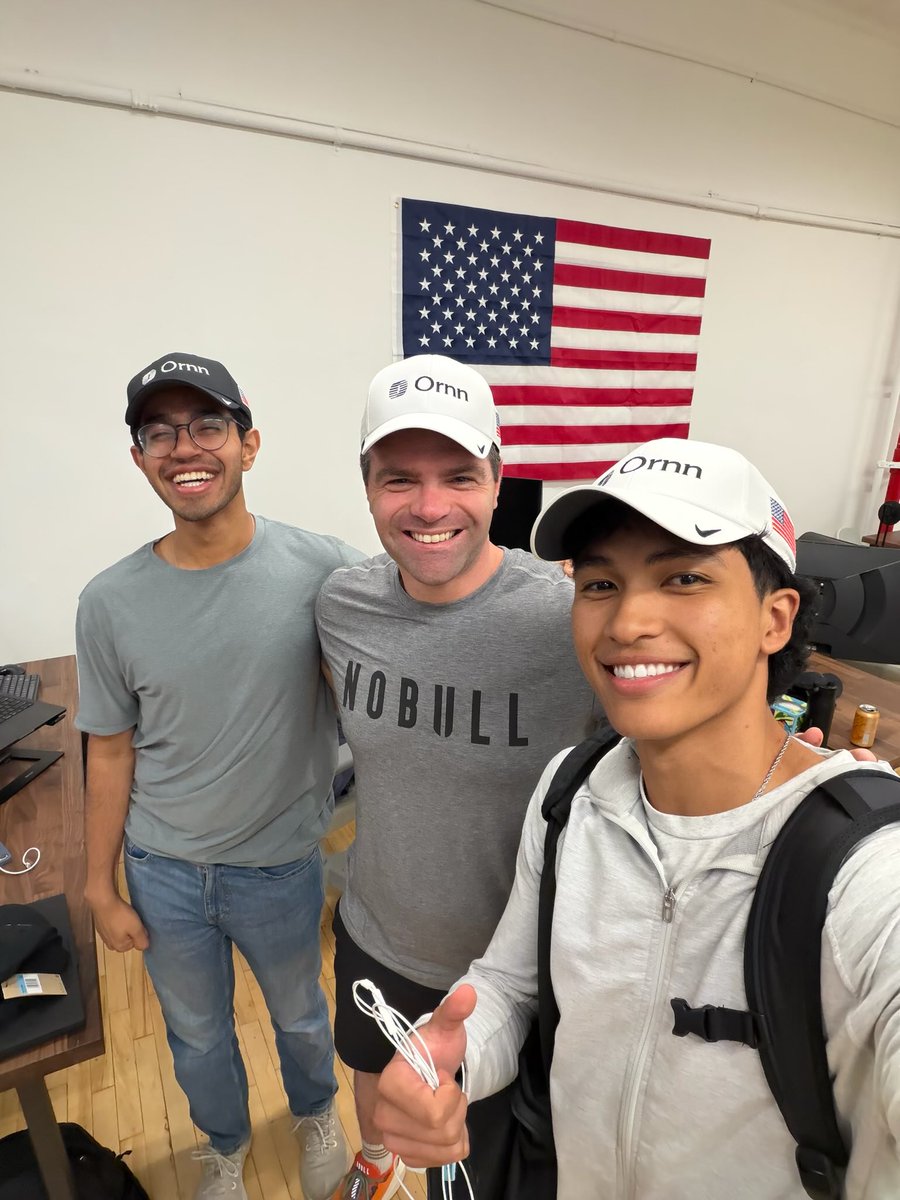
He is going to hate me for saying this, but I think one of the smartest people in venture is @milesgrimshaw, hands down.
So when he calls me and tells me about an incredible entrepreneur that I have to have on 20VC, I listen.
He told me the tale of @bavaria_kush:
- 23-year-old whiz
- Built viral sports betting platform from his dorm at MIT
- Started @OrnnExchange, the financial market for AI compute.
- Insanely profitable
So I got on a call with him. Within 5 mins of the call, I asked him to join me on the show.
I summarized the notes from our discussion below:
Thanks to @AdamValkin, @fachlib, @Melt_Dem for amazing questions. (Links in Comments)
--
1. Why NYC Is a Better Place to Build a Company Than SF
Kush argues that people in the Valley are coin-operated, so $100K more in pay or 50 bps more equity is enough to move a researcher to another company. New York has a culture of loyalty to colleagues and family, with much more camaraderie between people than in SF.
Love your thoughts on this given your time both in and outside the valley @paulg@rabois
2. Humans Will Simply Be a Vessel to Carry AI Around the World
Kush believes AI will become so much smarter than people that humans end up as a biological vessel for it. The human role then is less about controlling AI and more about teaching it feelings and emotions, almost as a parent.
Love your thoughts on this @bryan_johnson and how that impacts your work?
3. How Undersupplied on Chips Are We Truly?
Compute is very undersupplied. Buying from CoreWeave today likely means a quote for Q4 2027 or Q1 2028. Building your own takes about half a year, with 20 to 22 weeks to get chips from OEMs, who tend to promise earlier dates, plus two to three weeks to install.
What does no one know that everyone should know about the current state of chip supply @andrewdfeldman@goodwin_ml@UbertiGavin
4. Why Factory Is So Much Better Than Cognition
Ornn used Devin for a while, but the problem with Cognition was how expensive it was. Kush sees the two as competitors on the same product and says Factory is much cheaper to use. He also rates Factory's underlying harness above Devin's.
I am sure @shaunmmaguire will be smiling here.
5. Why You Should Always Choose Boutique Investors Over Mega Fund Investors
Boutique investors care more about founders because their success is tied directly to the company's. Partners at boutique firms are often there for the mission, and the firm itself is like a startup trying to make its name, so they work extremely hard to make their companies succeed.
Love to hear your thoughts on this @wquist@honam@annbordetsky
6. Why Infrastructure Investors Will Never Lose
Kush compares data centers to apartment buildings, with infrastructure investors as landlords and inference providers, OpenAI and Anthropic as tenants renting GPUs. As long as there are tenants, the landlords keep collecting rent. If enterprise demand weakens, GPU prices fall the way rents do in a bad economy.
7. Chip Prices in Three Years Could Be Higher Than Today
When Ornn started, many assumed GPU hour prices three to five years out would be lower, so contracts often included free options to renew at prices like $2.50.
No one gives that for free now, because the market expects prices in three years may be higher than today. Kush would not be surprised to see $20 to $30 per GPU hour.
What does no one see that everyone should see about the price of compute moving forward @AnjneyMidha?
A TRILLION DOLLARS OF COMPUTE IS NOT ENOUGH ⚡️
Ornn’s Kush Bavaria believes that the world needs way more than a trillion dollars worth of compute
$SPCX $NBIS $CRWV $IREN $GOOGL $META
Since the beginning, I’ve been arguing that freezing AI progress would be the worst thing we could do. That safety is an engineering problem with engineering solutions, not a risk knob we dial up and down. This paper an extension of that argument.
If we’re going to accelerate, we should be deliberate about where compute capacity actually goes. Justin Milligan (@Justin_m34) and I landed on three uses that make sense today: making intelligence cheaper, making lives measurably better for the average person, and ensuring AI reliably does what we intend it to. Efficiency, flourishing, and alignment. Everything else is a waste, until we resolve our compute shortage.
First of many from @lightwave_ai.
https://t.co/hn2YcojIXK
When people talk about running AI inside a bank, the conversation usually starts with what model. In practice, the first real decision is how to secure the compute to run it - @Farsight_AI's partnership with @OrnnExchange now makes this simple.
Ornn is the leader in financial markets for compute. With our partnership, banks can now source capacity through Ornn and run Farsight's model-agnostic solutions directly through it - all in their own environments on-premise. This brings the full stack to the firm, from the infrastructure to the work product that their teams rely on.
More + the press release in the thread below.
Our diploid aware genomic language model is out!
The genomes we train AI models on do not exist. Most genomic language models read a single haploid sequence, but human genomes are diploid.
100% of cash-settled compute markets volume today settles against an @OrnnExchange index.
Compute markets are being created in real time, and America has an opportunity to lead from the beginning. We have always been the first to accept, adopt, and institutionalize new innovative asset classes.
In partnership with @ICE_Markets and @Kalshi, we’re excited to be the next pioneers in financial markets.
I'm delighted to share that Physical Superintelligence PBC (PSI), which I co-founded with @matthew_pines and @AKlokus, has raised a $58M seed round to build the world's most advanced research lab for discovering and commercializing transformative physics breakthroughs at scale with AI, safely, verifiably, and for broad public benefit.
We gave our AI system a spec, and in under 2 weeks, it designed, verified, and deployed a chip that beats NVIDIA.
It’s built for low-power physical AI workloads. We’re running live inference on >B+ parameter models like Llama, Qwen, and Kimi, serving at 3.4x better perf/watt than NVIDIA Jetson.
From just a specification, our AI system autonomously generated all of the RTL Design, UVM verification, formal proofs, firmware, drivers, and kernels, co-designing the model, software and silicon as one optimization loop.
Better AI can now design better chips to run AI, leading to a loop of recursive-self improvement towards our path to abundant intelligence.