Understanding Anthropic's Project North Star ⬇️
Project North Star is the code name for a roughly $60 billion deal that pays for Google's TPU AI chips for Anthropic
AI models run on huge numbers of specialised chips. Anthropic needs millions of dollars' worth every day.
For this deal, the chips are Google's TPUs, which Google designs together with a chip company called Broadcom.
Anthropic doesn't buy the chips itself. A group of banks, Bank of America, Citi, Morgan Stanley and an investment firm called Blackstone, set up a new company just for this deal. It's called a special purpose vehicle, or SPV.
That new company borrows about $60 billion from these banks.
It uses the money to buy the chips, then rents them to Anthropic for five years.
Every month, Anthropic pays rent for the chips. The new company uses that rent to pay the banks back, bit by bit.
The loan is also split into two parts, and they get paid back in order.
The first bigger part is about $42 billion.
These lenders get their money first, so it's the safest place to be. Broadcom has also promised to cover part of it if something goes wrong.
The back of the queue is the smaller part, about $18 billion. These lenders only get paid once the front is taken care of. If money ever runs short, they're the ones who lose out.
Blackstone chose the back of the queue and put in $9 billion there. Because that spot is riskier, it gets a higher reward: over 10% interest a year.
Why does anyone need to take on that much risk?
Anthropic is growing fast but still spends more than it earns. So lenders see it as a risky borrower, and they want either a safe spot in the queue or a big reward for standing at the back.
From the reports, Bank of America, Citi and Morgan Stanley are at the front, the safer part.
Blackstone covers half of the back section, the riskier part that pays more, with $9 billion. The other half is being filled by other investors who also want that higher return.
Anthropic's High Junk Credit Rating Explanation (Part 1)
When a company needs a lot of money, it can borrow it, just like a person getting a loan.
It promises to pay it back later with interest.
Before lending, people want to know how likely they are to get their money back.
So a few companies, Moody's, S&P and Fitch, act like teachers grading a student. They look at a company's finances and give it a grade called a credit rating.
The grades run like school grades. AAA is the top, then AA, A, then BBB. Everything from BBB up is called investment grade, meaning "safe to lend to."
Below BBB comes BB, B, and so on down. Those are called junk. It doesn't mean the company is rubbish. It means there's a real chance it can't pay everyone back.
BB is the highest junk grade. So Anthropic is like a student who just missed the honour roll.
It's a lot like your personal credit score. With a good score, a bank gives you a mortgage cheaply. With a shaky one, you can still borrow, but you pay more.
------
The grade matters for two reasons.
The first is price. Lenders charge more interest when they think there's more risk, the same way a risky driver pays more for car insurance.
Look at Blackstone's $9B loan to Anthropic at over 10% interest. That's more than $900 million a year just in fees. A company with an investment-grade rating might borrow the same amount at something like 5 or 6%, which is roughly half the cost. Over many years, on hundreds of billions, that gap adds up to tens of billions.
The second is who's even allowed to lend.
Some of the biggest pots of money in the world sit with pension funds, which hold people's retirement savings, and insurance companies.
They have to keep that money fairly safe, so their rules limit how much junk-rated lending they can do.
So a junk rating means fewer lenders, and the ones left charge more.
----
ANTHROPIC EXPECTED TO RECEIVE A “HIGH” JUNK CREDIT RATING AFTER IPO: FT
Blackstone has told investors Anthropic is likely to receive a credit rating in the double-B range after going public, below investment grade, reversing its earlier expectations for an investment-grade rating by year-end.
The lower rating could make it more expensive for Anthropic to finance its massive AI infrastructure expansion, while limiting access to pension funds and insurers that face restrictions on investing in junk-rated debt.
The warning comes as Blackstone participates in Anthropic's $63B financing deal, known as Project North Star, to support the leasing of 1.5 GW of Google's AI chips.
Under the deal:
• More than $42B in senior loans are guaranteed by Broadcom $AVGO.
• Another $18B in junior debt is backed by Anthropic's lease payments.
• Blackstone's funds invested $9B in junior debt, earning yields above 10%.
Anthropic's IPO prospectus outlined plans to spend more than $800B on computing infrastructure through 2045.
Without an investment-grade rating, Anthropic may need to continue relying on financially stronger partners to support its borrowing.
The major credit agencies, Moody's, S&P and Fitch, have not yet formally issued ratings for Anthropic, per FT.
Building data centers in Space ⬇️
TPUs are Google's own AI chips. They do the same kind of job as Nvidia's GPUs, but Google designs them for its own use.
Project Suncatcher is Google's long-term idea to put AI data centers in space.
Picture clusters of satellites, each carrying TPUs and covered in solar panels, flying close together and talking to each other with lasers instead of cables.
Why space? Power.
Instead of waiting years for the power company. In the right orbit, a satellite gets sunlight almost all the time, with no night or clouds. So the sun becomes the power company, and there's no queue.
The tweet is about the first real test.
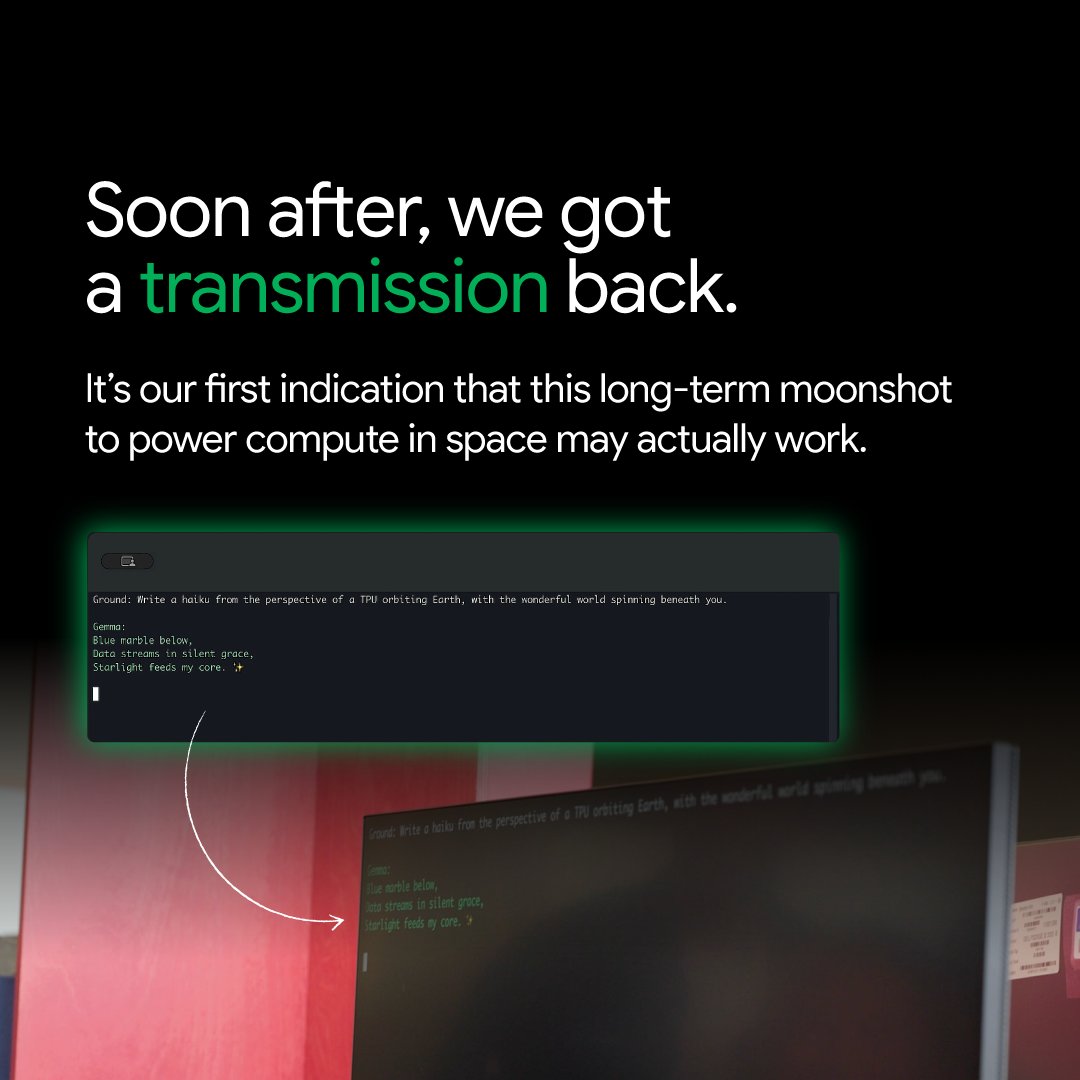
On October 1, Google launched one fridge-sized satellite with four TPUs on a SpaceX rocket, built with Planet, a satellite company.
The goal was modest: can the chips switch on, answer a prompt and send the answer back to Earth?
"Phoned home" means yes, it worked. The satellite is meant to stay up for about a year.
The hard parts are still ahead.
Space radiation can damage chips. Cooling is tricky because there's no air to carry heat away. And launching things is still expensive.
Google's own project lead has said it won't be cheaper than Earth data centers for at least five years.
Google isn't alone either.
A startup called Starcloud sent an Nvidia chip up last year, and SpaceX says it wants to start launching AI satellites around 2028.
Our TPUs just phoned home... from space.
In early October, we sent four TPUs into orbit to test whether our AI hardware could operate in space. The initial goal was to see if our chips could turn on, process a prompt, and transmit a response back to Earth.
This week, we got our answer.
Today we’re launching the first AI modeling agency 💅 right inside Glif.
Cast hundreds of real AI models, drop your product, idea or brief and let Glif create super compelling content for you end to end.
If you still think AI models aren’t ready for real work, watch this 👇
Neocloud customers are mostly three kinds of company.
The first is new labs building their own model from scratch.
The second is companies that take an open model, one anyone can download, and train it further on their own data so it gets good at one job. That's called fine-tuning.
The third is companies that run a model on their own rented chips because it's cheaper at large scale, or keeps their data private.
The GPU clouds that rent chips to AI labs are called neoclouds, meaning newer chip-rental companies, as opposed to giants like Amazon, Google and Microsoft. "Sub-scale" just means small.
There's a worrying trend.
Startups that raised VC money for some other idea are switching to being a neocloud instead.
Usually that's because their original idea wasn't taking off, they already have cash, and chip rental prices keep rising, so it looks like easy money.
The first problem is that there's a mismatch.
VCs want a company that can grow 100 times. Renting chips is a physical business. You need buildings, power and cooling, so it can grow well but never explodes the way software does.
The bigger problem is that these teams can't actually deliver.
When a neocloud signs a customer, it promises a ready for service date, or RFS date, which is the day the chips will be switched on and usable.
The customers who sign up to rent that capacity are called off-takers.
Hitting that date means real-world work like power, wiring and construction. The joke is "idea guy" versus "local electrician," and the idea guy loses.
So there are a lot of missed dates, then lawsuits from angry customers, and many of these small providers dying off. "Guppy Level Death" refers to something Elon Musk said recently, roughly that the little fish get wiped out.
The ending might be hopeful.
Small providers will still exist, because they can be faster and cheaper than the big ones. Just not most of this batch. The few that really deliver will be very valuable.
OpenRouter is one website where developers can reach hundreds of AI models in one place, instead of signing up with each company separately.
Many of those models are open models, the free-to-download kind. That means lots of different companies can host the same model, often neoclouds.
So when a developer asks for, say, DeepSeek, five or ten providers could answer that request.
The router is the part that decides which provider gets each request. It's like a dispatcher sending a delivery job to one of several couriers.
Until now it mostly picked the cheapest one
(i.e. the cheapest provider got the biggest share of requests, but not all of them. Slightly pricier ones still got a smaller share. That spreading out is called load
balancing, so one provider doesn't get swamped.)
The problem is that cheap providers can be slow or crash, or quietly run a shrunk-down version of the model that gives worse answers.
Now it looks at quality, speed and reliability, and weighs those against the price.
Inference is just the word for running a model to get an answer, so "best quality inference" means the best answers for the money.
Their point at the end is that good providers now get more business automatically, so everyone has a reason to improve.
So now being cheap isn't enough, and the ones that deliver well win.
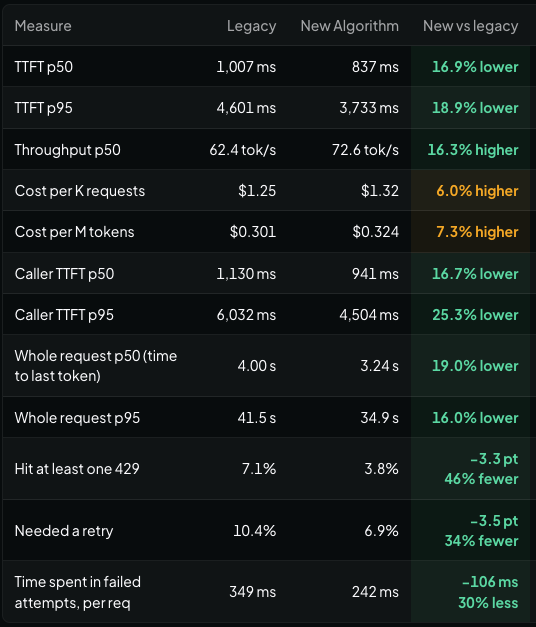
We just shipped our biggest improvement to our provider router since the founding of OpenRouter.
Before, we prioritized mostly based on price. The new router now rewards the best quality inference for the actual cost of a request, so requests stay cheap but are also fast and reliable.
Providers that deliver more value automatically win more traffic, so every provider has a reason to keep improving. And every time a provider gets better, so does your inference on OpenRouter.
Supabase has become one of the default backends for the AI coding era. The open source Postgres platform now has 13 million users, spins up more than a million databases every week, and roughly 70% of its new activity is coming from agents.
As coding shifts from developers writing software by hand to agents building on their behalf, Supabase has been rebuilding itself around that new user.
Supabase co-founder and CEO Paul Copplestone joins Garry, Harj, and Jared on the Lightcone to talk about what happens when everyone can become a builder. They dive into why personal software may become as common as personal documents, how to design products that agents actually want to use, and why knowing what to build may matter more than knowing how to build it.
01:18 - Growth and 4x Revenue
02:35 - Three Eras of Supabase
04:34 - “Builders” vs. Traditional Devs
08:42 - Personalized Apps
12:12 - Personal Databases & Data Ownership
15:56 - Scaling to Billions
17:58 - AI Adoption At Supabase
19:58 - Lessons Learned Along The Way
27:29 - Building For Personal Agents, Dogfooding
30:01 - Agent-First Design and Evals
38:42 - The Future Of Coding
42:36 - Opening Up More Entrepreneurship
The GPU clouds that rent chips to AI labs are called neoclouds, meaning newer chip-rental companies, as opposed to giants like Amazon, Google and Microsoft. "Sub-scale" just means small.
There's a worrying trend.
Startups that raised VC money for some other idea are switching to being a neocloud instead.
Usually that's because their original idea wasn't taking off, they already have cash, and chip rental prices keep rising, so it looks like easy money.
The first problem is that there's a mismatch.
VCs want a company that can grow 100 times. Renting chips is a physical business. You need buildings, power and cooling, so it can grow well but never explodes the way software does.
The bigger problem is that these teams can't actually deliver.
When a neocloud signs a customer, it promises a ready for service date, or RFS date, which is the day the chips will be switched on and usable.
The customers who sign up to rent that capacity are called off-takers.
Hitting that date means real-world work like power, wiring and construction. The joke is "idea guy" versus "local electrician," and the idea guy loses.
So there are a lot of missed dates, then lawsuits from angry customers, and many of these small providers dying off. "Guppy Level Death" refers to something Elon Musk said recently, roughly that the little fish get wiped out.
The ending might be hopeful.
Small providers will still exist, because they can be faster and cheaper than the big ones. Just not most of this batch. The few that really deliver will be very valuable.
What's happening in the sub-scale neocloud world is concerning
I'm seeing a lot of startups who raised money from VCs basically pivot into being neoclouds; the issue with that among many other things which I'll highlight in a minute is that neoclouds are not a natural fit for VC money. There is no 100x on the end of the magic rainbow for small cloud teams, at best they'll grow quickly but it's still a business limited by physics to a large extent and even the best teams will not scale valuations like true venture companies (not even close)
They're pivoting into the neocloud space because it requires capital (which they have from their investors) and it seems like a good business (rental rates keep going up), and maybe their original business plan isn't finding crazy traction
A lot of these teams doing this however are not equipped to handle the execution required to actually bring capacity online when it was promised to off-takers It's "idea guy" meets the real world, and "idea guy" vs "local electrician" is not exactly a great matchup for ideaguy
I see a lot of small teams "becoming a cloud" because it sounds good, but they're not close to being ready to really invest everything to ensure the RFS (ready for service) date they committed to their off-takers will be met by any means necessary. As a result I suspect there will be many lawsuits which actually will lead to the "Guppy Level Death" that Elon spoke about last week
For off-takers, it's a dangerous environment at the moment - a lot of bad supply in the market, and "providers" who are inevitably going to let them down. Same for lenders. I suspect the financing constraints will continue to tighten on smaller providers unless they're able to put the puzzle together in a way that sufficiently de-risks the counterparties involved (not so simple). Something we're very focused on at @computeexchange
To sum it up - Elon is probably right in that Guppy Level Death is on the horizon for many of the current sub-scale providers in the market. and what will force their demise imo will likely be lawsuits based on missed RFS dates and other forms of recourse. There will always be demand to work with smaller providers because 1. they can facilitate an RFS date that can actually support your business, and 2. they are more flexible on price than the big boys (which really matters)
So the long tail of providers will ultimately still be there, it's just a question of who in this batch is going to survive. My guess is not a ton, because execution despite what people say, is still not a commodity at least when it comes to physical processes (like bringing a cluster online). Many aren't up to the challenge, but those who are are worth their weight in gold to off-takers and lenders alike
SF Compute's CEO is saying those huge valuations on brand-new AI labs aren't really about the startup being worth that much.
They're about paying a security deposit on computer chips.
An AI lab needs a cluster to get started. That's thousands of GPUs, the specialised chips AI is trained on, wired together. Almost nobody buys them outright. They rent them from a GPU cloud, a company that owns the chips and leases them out.
The GPU cloud usually borrows from a bank to buy those chips. The bank asks who's going to pay the rent. If the answer is "two people in a San Francisco house," the bank says no, because the startup has no credit, meaning no track record of paying back.
So the startup has to put down a huge deposit up front. That cash is what makes the bank comfortable lending.
To get that cash, the startup raises money from VCs, venture capitalists who invest in exchange for a slice of the company. Here's the trick. If you need $200M and only want to give away about a fifth of your company, you have to say the company is worth $1B. The valuation, the on-paper price of the whole company, gets pushed up by how much cash you need, not by how good you are.
His warning is that chips keep getting more expensive, so the deposits grow, so the valuations grow. $100M a couple of years ago, $1B now, and he expects $5B, $15B, $30B until it stops making sense.
It's a bet on future money.
VCs work on the idea that most of their bets will fail and one or two will be enormous. If a lab valued at $1B turns into the next OpenAI, which is valued in the hundreds of billions, that one win pays for every loss and much more. So paying "too much" today can still be a good deal if the upside is that big.
These two-person labs also tend to be people who already built famous AI models at big companies. Investors are really betting on the founders.
And there's fear of missing out. If you won't pay $1B, another VC will, and you're left out of what might be the winner.
The catch is that every step up makes it harder for the bet to pay off. At a $30B starting price, the company has to become gigantic just for investors to break even.
SF Compute CEO @evanjconrad on how credit issues around GPU access lead to some of the eye-popping valuations you're seeing VCs give new AI labs today 👀
___
"Every AI lab, when they need to start, has to pay for a massive deposit. They have to pay for that massive deposit because they have no credit.
And so when the GPU cloud looks at them, they go back to their bank and they say, 'I would like to finance a new cluster. Can I finance it with this customer?' And the bank looks at the customer and says, 'That is a two-person AI lab in a San Francisco Victorian.'
In order for them to actually get the cluster, the new startup has to go out to the venture capitalists and has to raise at a $1B valuation right off the gate in order to pay for a big deposit, which then makes the whole thing financeable.
This is the current state of the market. As we scale up into superintelligence, that's only going to get worse. A year or two ago, it was a $100M initial valuation. Now it's a $1B initial valuation. It's gonna be $5B, and it's gonna be $15B, and it's gonna be $30B, and at some point, it's gonna become unreasonable."
___
I can think of at least one prominent AI startup rumored to be raising at $30B already... 🤔
4 of America's biggest banks just slammed the door on AI.
As AI agents are getting into people's bank accounts, the banks are panicking.
@axios reports that major US banks are finding outside AI agents inside customer accounts, some taking actions their users never asked for.
@CharlesSchwab says it turns away agents like @AIatMeta's Muse "in the tens and 20s" every week. CEO Rick Wurster didn't mince words:
"We don't want someone just giving their password to Muse, and letting Muse come in and take action on that client's behalf."
Between Oct 13 and 16, @jpmorgan, @BankofAmerica, @Citi and Schwab all blocked outside agents from moving money. Agents can still see your balance, they just can't touch it.
Even regulators are stumped. The @USOCC, @federalreserve and @FDICgov left agentic AI out of their risk rules, calling it "novel and rapidly evolving."
Then there's @WellsFargo. Its new agreement starts Nov 24, three days before Black Friday, and treats anything your agent does as "initiated and authorized directly by you, without further verification."
Their words: "Your use of any AI Agent is AT YOUR OWN RISK."
As Incognia's CEO André Ferraz put it: "Knowing that a request came from a legitimate agent isn't the same as knowing that a specific action should be allowed."
JPMorgan blocks what it can't identify and builds its own. Wells Fargo assumes the agent is you.
Neither one is protecting you.
SpaceX's CFO priced a share at $84.20 in December.
Ten months later, the market pays $147.79.
His name is Bret Johnsen.
From 2011 until June, no ticker set SpaceX's price. He did.
He joined when SpaceX was worth $1 billion.
Every six months or so he ran a tender offer: the board picked a number, and insiders sold into it.
His December 2025 memo said $421 a share, an $800 billion company. That's $84.20 after May's 5-for-1 split.
Musk told Jamie Dimon's investors in June those rounds were liquidity for employees, not fundraising.
Then the spending broke the model.
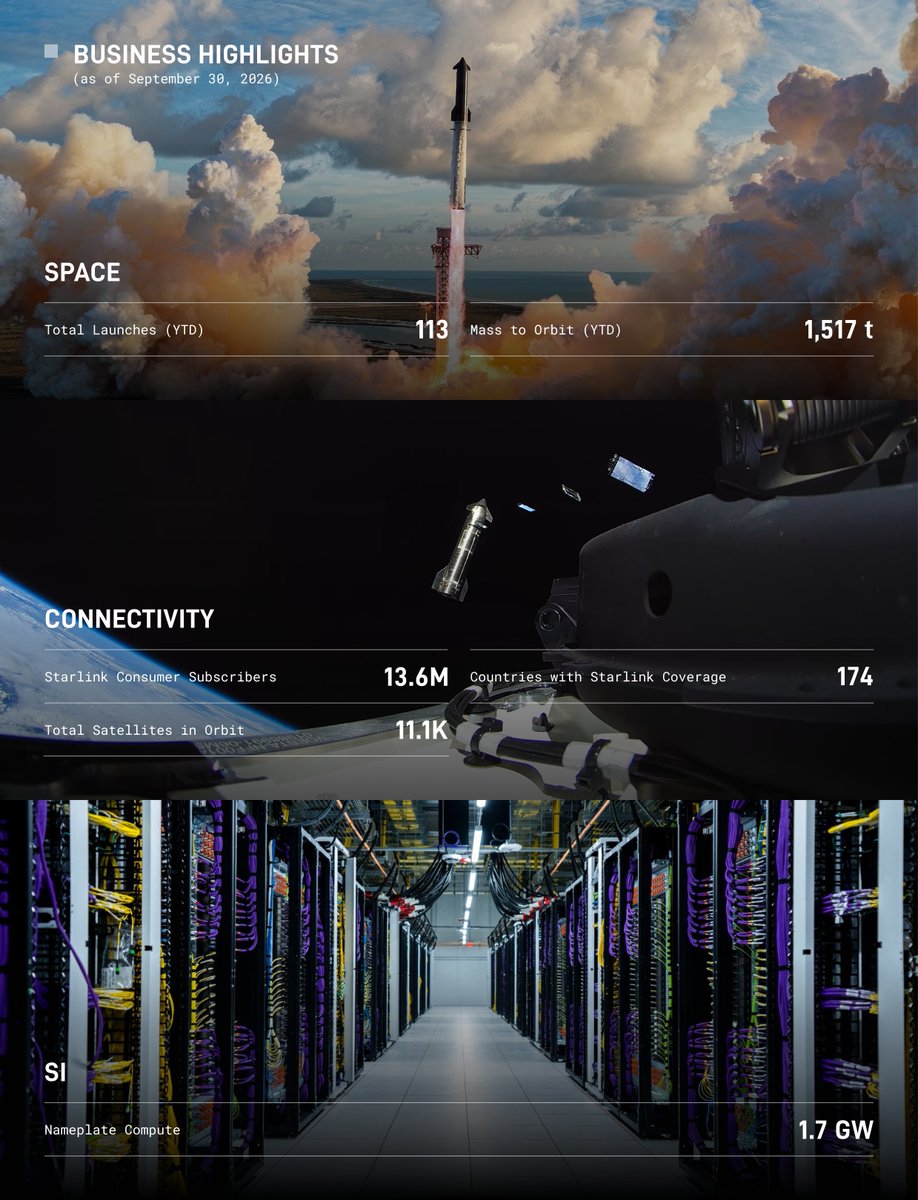
First nine months of 2026:
$13.1B in operating cash
$48.1B in capex
$40B of it on AI
So SpaceX went public in June and raised $85.7 billion.
Now look at what Johnsen just signed:
$14.6B Q3 revenue, $1.86B above estimates
$4.4B net income, against a $1.1B loss a year ago
$7.56B from AI, up from $813M
13.6M Starlink subscribers, up 1.6M in three months
The market grades harder than a memo.
After August's earnings the stock closed at $108.27, two months after touching $225.64.
In December, Johnsen wrote the number and shareholders took it.
This quarter he reads the results beside Musk and Shotwell, and after-hours trading writes the number for him.
💡Top 14 AI Accounts to Follow in 2026
@karpathy → LLMs / fundamentals
@simonw → practical experiments & tooling
@emollick → AI at work / evidence
@rasbt → building LLMs from scratch
@steipete → OpenClaw / agents
@swyx → ecosystem & engineering
@hwchase17 → agents / LangChain
@vasuman → AI agents / enterprise
@chipro → systems & evals
@gregisenberg → startup ideas
@rileybrown → vibecode / agent-native
@EXM7777 → AI ops + systems
@AndrewYNg → applied AI / education
@ylecun → critical research voice
Follow them all and learn.
Who would you add to the list?
Modal just hit $1B ARR and $16B valuation in Series D, becoming NYC’s newest AI infrastructure decacorn.
Before founding Modal, CEO @bernhardsson spent years leading massive engineering teams at @Spotify and https://t.co/V1Gn61hIam, where he grew increasingly frustrated by a universal industry truth: brilliant software engineers spent a staggering amount of time wrestling with YAML files, configuring Docker containers, and managing cloud clusters instead of actually building product.
This inspired him to launch Modal in 2021 to completely rethink how AI infrastructure should work.
Traditional cloud providers and legacy tools like Kubernetes were never built for modern AI, forcing developers to deal with hardware scarcity and heavy configuration overhead.
Modal disrupted this model by engineering custom infrastructure from the ground up, including its own file system, container runtime, scheduler, and networking layer, to provide instant, friction-free compute access through simple Python code.
At the core of this explosive growth was Modal’s precise alignment with the rise of autonomous AI agents and LLMs.
As software began writing and executing code dynamically, developers desperately needed secure, isolated,execution environments. Modal answered this demand with its Sandboxes feature, generating hundreds of millions in run-rate revenue by spinning up billions of isolated micro-environments.
By aggregating compute capacity across more than 20 different cloud providers to bypass single-vendor bottlenecks, Modal turned heavy infrastructure into an invisible, highly composable utility.
Modal's meteoric rise proves that hyper-specialized, workload-specific infrastructure will outperform legacy cloud providers by eradicating developer friction.
This trajectory signals that the next generation of tech winners will be high-performance execution layers that allow software to build software seamlessly at scale.