This umbrella review of 44 systematic reviews found that resistance training consistently increases muscle mass, strength, and physical function in healthy adults.
https://t.co/EbpJBAtAy8
Stop overcomplicating strength training
For health, strength and hypertrophy, the basics are enough:
✅Pick up weights
✅Move them explosively.
✅Lift some sets close to failure
Exercise choice and equipment matter less than progressive muscle loading
https://t.co/EbpJBAtAy8
Interesting paper on "how low can you go" when it comes to training intensity...
Researchers compared 6 weeks of training at VT1 versus ~12% below VT1, with total volume matched.
Result?
Both groups improved endurance performance by essentially the same amount:
• Critical Speed ↑ similarly
• 3600m performance ↑ similarly
• Jump performance ↑ similarly
• D′ (anaerobic capacity) ↓ similarly
The only real difference was that the VT1 group reported:
• Higher RPE 🥵
• More fatigue 😫
• Higher training strain 💔
In other words, running ~10-15% slower than VT1 produced the same fitness gains with less overall training stress.
A useful reminder that just because it feels harder, doesn't mean it's more productive...
Sometimes, slower really is smarter!
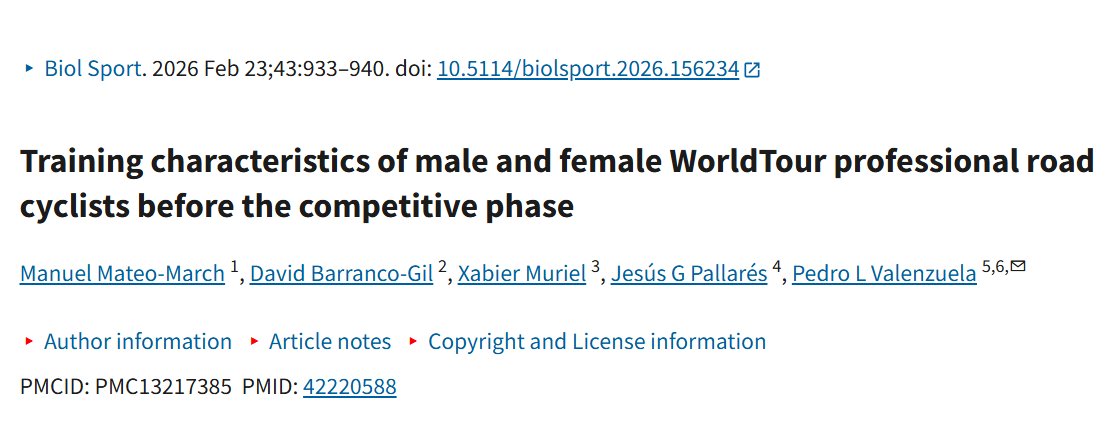
Attention cyclists: I always have a soft spot for papers like this bc they let the public see what pro athletes are really doing for training.
Some crazy numbers here. Kudos to authors!
https://t.co/g1YrZM0poc
Low back pain is defined as pain located below the costal margin and above the inferior gluteal folds, with or without leg pain and is the leading cause of years lived with #disability worldwide, affecting people of all ages.
📝 This JAMA Review summarizes the epidemiology, pathophysiology, clinical evaluation, prognosis, and treatment of nonspecific low back pain in the outpatient setting.
https://t.co/FBOXpOrkWn
📢Nueva evidencia en Nature Metabolism: cada +5 kg/m² de IMC se asocia a mayor riesgo de algunos tipos de cáncer, especialmente endometrio (+58%) y adenocarcinoma esofágico (+47%)⚖️
Eso sí: para la mayoría de cánceres, la asociación parece modesta o nula
https://t.co/Cic3x2jCDd
Resistance training is not “more is always better” for runners and endurance athletes.
🏋️can improve strength, force production and injury resilience—but excessive hypertrophy may add mass, impair running economy and reduce speed/endurance efficiency.
https://t.co/vGJk1fpSce
El caso de feminicidio del que se burla y además justifica ADLE, ocurrido un 31 de diciembre enfrente de sus hijos, corresponde al feminicidio de una prima mía. Jamás habría considerado votar por ese señor, pero esto lo convierte en personal.
This narrative review examines both the mechanistic rationale and empirical evidence supporting the role of creatine as a potential neuroprotective intervention, particularly under conditions of metabolic stress.
Interesting review on the current High Carb trend in endurance athletes. We just covered the debate between Dr Burke and Dr Noakes. This review adds some interesting insights.
https://t.co/QIS0YtxWna
💪 Cuando el músculo se contrae, no solo genera fuerza: libera señales químicas.
Mioquinas como irisina, IL-6, BDNF o FGF21 actúan como mensajeros entre músculo, cerebro, corazón, hígado, páncreas, grasa, riñón o intestino 🧠🫀
https://t.co/x8Ukqdhati
A review of the effects of marathon running on the heart
https://t.co/argjLSDkMO
including release of blood biomarkers cardiac troponin, NT-proBNP without known clinical significance
Athleticism is not just being strong.
It is the ability to express strength rapidly: sprinting, jumping, decelerating, changing direction and producing force at the right moment.
Strength builds the engine. Lift heavy. Move fast. Stay athletic.
https://t.co/J0oT6qcrLT
¿Y si diabetes, infarto, ictus o hígado graso no fueran problemas aislados? 🫀🧠
🆕 Artículo en The Lancet recuerda que comparten raíces: resistencia a la insulina, grasa visceral, inflamación, estrés oxidativo, contaminación y desigualdad social 🌍🔬
https://t.co/lJk8c9BEoY