Handelsingenieur en jurist met een passie voor finance & adviesverlening. Oprichter
fondsbeheerder Finhouse en auteur van 'Personal finance met Thomas Guenter'.
Ik vroeg Stijn Rasschaert naar de fiscale behandeling van meerwaarden op crypto in België.
Voor we het goed en wel beseften, waren we meer dan twee uur aan het praten over digitale valuta, rulings, normaal beheer, speculatie, de meerwaardebelasting en fiscale planning.
We hadden het ook over een legendarisch moment op een zolderkamer in Gent, waar een groep very early crypto investors samenkwam. Crypto was volledig nieuw.
Stijn, Tax Partner bij BDO Belgium, bracht daar toen de weinig populaire boodschap dat er misschien belastingen verschuldigd zouden zijn op hun winsten.
Wie erbij was, weet dat hij ongeveer moest vrezen voor rondvliegende stoelen.
PS: De vragenlijst van de Rulingcommissie rond cryptomunten werd recent geactualiseerd. Meer daarover in de beschrijving onder de aflevering.
Ons gesprek is beschikbaar op elk kanaal: "Thomas Guenter Podcast". Veel kijk- en luisterplezier!
Tayfun Anil deelde recent een interessante update over wanneer beleggen op de beurs in België als “speculatief” wordt aanzien door de fiscus.
De conclusie is vooral: veel Belgen hebben hier vragen over, maar voor de meeste beleggers is dit much ado about nothing.
Een rechtbank van eerste aanleg oordeelde in maart dat er geen speculatietaks van toepassing is op beursmeerwaarden, ondanks elementen die de fiscus als speculatief zag:
• een korte houdperiode
• concentratie in één aandeel
• een volatiele sector
• groot transactievolume
• professionele kennis
Ik ging recent over beleggen en belastingen, incl. alle mogelijke tarieven, in dialoog met Stijn Rasschaert. Gesprek komt later online (Thomas Guenter Podcast).
25 Questions, $3.7 Quadrillion
About The Convergence of DTCC, U.S. Treasury, Ripple, RLUSD & XRP
1. What happens when the world’s largest settlement utility - DTCC - moves to tokenized rails?
Q
Why would the DTCC, which safely moves $3.7 quadrillion a year through legacy rails, suddenly step into blockchain tokenization?
A
Because the old rails can’t support real-time global liquidity, 24/7 settlement, or tokenized assets.
They were built for a slower age.
Q
And when DTCC modernizes, does the world follow?
A
Whoever controls the settlement layer of America controls the future of global liquidity.
So yes - the world must follow.
2. What kind of blockchain qualifies for DTCC-level settlement?
Q
Would DTCC ever rely on a chain with probabilistic finality?
With MEV extraction?
With congestion-based fees?
With uncertainty or frequent outages?
A
Of course not.
A quadrillion-dollar system cannot run on chaos.
Q
Then which systems could support that level of global settlement?
A
Only ledgers with deterministic finality, predictable fees, regulatory compliance, institutional trust, and native support for asset issuance.
This drastically narrows the field.
3. Why did two of the most powerful U.S. financial officials join Ripple?
Q
Why would Michael Bodson — former CEO of DTCC - join Ripple’s advisory board?
A
Because he recognizes Ripple’s architecture mirrors the settlement environment he spent a decade modernizing.
Q
Why would RosIe Rios - former U.S. Treasurer with oversight over the nation’s currency - also join Ripple’s board?
A
Because she sees where the monetary system is going:
Tokenized dollars.
Tokenized assets.
A neutral, global liquidity asset.
A real-time settlement ledger.
And Ripple is building exactly that.
4. What does RLUSD being regulated by the NYDFS tell us?
Q
Why does Ripple choose the most stringent regulatory regime in the country - the NYDFS - for issuing its stablecoin?
A
Because if you want to operate on America’s financial plumbing, you must build at America’s highest regulatory standard.
Q
And what does NYDFS require of a stablecoin?
A
Full dollar backing.
Audits.
Transparency.
No rehypothecation.
Operational integrity.
Q
What ledger fits that requirement without modification?
A
XRPL - the ledger built for institutional-grade, regulated settlement.
5. Why is RLUSD paired with XRP?
Q
What is RLUSD?
A payment instrument or a liquidity instrument?
A
It is the cash leg - the digital dollar.
Q
But can a dollar, even a tokenized one, bridge FX markets, settle cross-jurisdictional flows, or provide global liquidity?
A
No.
That requires a neutral bridge asset.
Q
So if RLUSD is the cash leg, what is the liquidity leg?
A
XRP - by design, by architecture, by function.
6. What ledger is built for institutional settlement?
Q
Why was XRPL built with deterministic finality instead of probabilistic settlement?
A
Because real-time finance cannot settle on uncertainty.
Q
Why does XRPL have no MEV?
No gas auctions?
Predictable fees?
A
Because institutional liquidity cannot be subject to market manipulation or extraction.
Q
Why does the XRPL support issued assets (IOUs) natively?
Tokenization?
Atomic settlement?
A
Because its purpose is to be the global clearing and liquidity layer for digital finance.
7. Why is ISO 20022 important here?
Q
Does global finance run on random messaging formats?
A
No.
It runs on standardization - ISO 20022.
Q
Which blockchain ecosystem was designed from inception to align with ISO 20022 semantics?
A
Ripple’s network and XRPL.
Q
Why does this matter?
Because tokenized finance requires a standardized global language for value.
8. Why Rosie Rios and America 250 matter?
Q
Why would the Chair of America 250, a Congressionally chartered commission defining America’s future story, be tied to Ripple?
A
Because America’s 250th anniversary is not merely symbolic — it is a narrative reset for national identity, sovereignty, competitiveness, and economic renewal.
WATCH The WATER:
The River That Was Always There
For generations, people whispered about free energy.
Some said it was hidden in machines that were suppressed.
Others said it was locked behind patents, vaults, or secret sciences.
Still others mocked the idea entirely, insisting energy must always be controlled, metered, taxed, and rationed by someone in power.
But the elders used to say something different.
“You’re looking for fire in the wrong place.
The energy you seek already moves the world.”
They called it human effort.
Human time.
Human creativity.
Human faith made visible through work.
And when humans worked, they created value.
And when value moved, civilization breathed.
They called that movement currency -
because like electricity, it only mattered when it flowed.
The Dams
Over time, a small group learned how to build dams on the river.
They didn’t create the water.
They didn’t create the rain.
They didn’t create the land.
They only controlled the gates.
They charged tolls.
They slowed the current.
They skimmed endlessly.
They told the world the river was dangerous without them.
Wars were fought downstream.
Poverty grew where the water no longer reached.
Entire nations dried up - not from lack of effort, but from lack of flow.
The people were told:
“This is just how it is. Energy must be centralized. Trust us.”
The Watchers
But a few engineers, mathematicians, and quiet observers noticed something strange.
They weren’t watching the sky.
They weren’t watching the machines.
They were watching the water.
They noticed that value didn’t need dams.
It needed rules - immutable ones.
It needed paths, not masters.
It needed truth, not trust.
So they built a ledger, not a throne.
A rail, not a gate.
A riverbed, not a dam.
It didn’t create energy.
It didn’t promise miracles.
It simply let value move -
cleanly, instantly, without asking permission.
The “Free Energy” Revelation
When the river finally flowed freely, something unexpected happened.
People realized:
• Energy had never been missing.
• Abundance had never been scarce.
• Peace had always been blocked, not absent.
The old prophecies weren’t about machines that defied physics.
They were about systems that honored it.
A system where:
• Human effort could move without friction
• Nations could trade without coercion
• Wealth could circulate instead of being siphoned
• No one needed permission to participate
• No one could secretly change the rules
It felt like free energy, because the cost of movement approached zero.
Not free to create.
Free to flow.
The X and the P
Some remembered a wise voice that once said:
“There will be an X… and a P…
Something of great value…
Something akin to energy.”
Many disregarded at first.
Then they watched as:
• Water returned to dry places
• Trade replaced conflict
• Transparency replaced force
• Ledgers replaced lies
• Cooperation outperformed control
And they understood.
The prophecy wasn’t about profit.
It was about peace through flow.
The Quiet Ending
No parade announced the change.
No empire surrendered in a single day.
The dams simply became irrelevant.
Because when energy moves freely,
when effort is honored,
when truth is embedded in the rails themselves -
Usury starves.
Fraud withers.
Cartels collapse under their own weight.
And the world remembers something it once forgot:
Peace isn’t enforced.
It emerges when value flows as freely as rain.
The river was always there.
We just finally stopped damming it.
Drip-Drop-Ripple-Swell-Flow-Liquidity
XRPL is the Riverbed.
XRP renders all the damns obsolete so all the world can be refreshed with infinitely created, freely shared human energy, by un-damning the Central Dams built to control all humanity
Got XRP? Got @Ripple? Got Faith?
If Truth is omnipresent, then no single arena owns it, controls it, or grants permission to speak it.
Courts don’t create Truth.
Governments don’t license it.
Armies don’t author it.
Cultures don’t vote it into existence.
Titles don’t confer it.
They can only recognize it - or resist it.
That’s why every venue is a Kingdom venue.
• Legal venues test whether systems will align with Truth or expose their own contradictions.
• Lawful venues reveal whether authority is rooted in justice or merely enforced compliance.
• Political venues show whether power serves the people or itself.
• Military venues ultimately hinge on moral legitimacy, not force alone.
• Cultural venues are where hearts, language, imagination, and conscience are discipled—either toward Truth or away from it.
• Moral venues are the foundation beneath them all, because no structure outlives the ethics it rests on.
“No walls, no division, no centralization” isn’t weakness - it’s confidence.
Centralization is always a confession of fear: fear that Truth must be guarded, filtered, enforced, or rationed.
The Kingdom doesn’t need gatekeepers because Truth doesn’t leak. It permeates.
Human titles don’t anoint Truth; at best, they temporarily steward responsibility - and at worst, they attempt to counterfeit authority. History is unambiguous here: when institutions claim the power to suppress Truth “for the greater good,” they eventually expose that the good they’re protecting is themselves.
So the posture I’m naming matters:
• Genuine faith, not performative certainty
• Fearless action, not reckless aggression
• Distributed courage, not centralized control
• Embodied Truth, not outsourced morality
If Truth really is omnipresent, then the task isn’t to defend it like it’s fragile.
The task is to live as if it’s real - everywhere, all at once, without asking permission.
That’s not naïveté.
That’s alignment.
And alignment, over time, always wins.
🇺🇸 A Special Poll for Friends of DLT, Crypto, Clarity, Transparency, XRP, Ripple, Accountability, Sovereignty, Justice & Freedom in a Constitutional Republic, one that was greatly damaged on Dec. 23, 1913, (112 years ago, today), with the Federal Reserve Act being signed into “law” by President Woodrow Wilson.
POLL: Should bankruptcy court practitioners be permitted to exterminate individual citizen’s unalienable, constitutional:
• 1) Right to Free Speech,
• 2) Redress of Grievances, and/or
• 3) Right to Assembly,
by weaponizing bad faith lawfare and making criminal threats to mute free speech they dislike?
My Objection, Plainly Stated
I am being accused of contempt for doing something I did not do.
I did not create the so-called “Linqto 3.0 Plan.” I did not file it. I did not solicit acceptance of it. That plan was created by the Ad Hoc Committee of Shareholders and filed with the Court by their lawyers on October 29, 2025. It sat in the public court record for nearly two months without objection.
All I did was discuss publicly filed court documents, criticize a proposed plan, and encourage fellow customers to vote “No.” That is not contempt. That is protected speech. It is also a statutory right of any party in interest.
Rather than address the lawyers who actually filed the document, the Debtors waited until voting began and then targeted a single pro se customer - me - seeking extreme punishments: loss of voting rights, financial ruin, website shutdowns, and forced retractions. Not for fraud. Not for deception. Not for violating a court order. But for speech.
This is not about enforcing bankruptcy law. It is about silencing opposition during a vote.
There was no emergency. The facts were known for weeks. The hearing was rushed over Christmas. No court order was violated. The sanctions sought are punitive, unconstitutional, and wildly disproportionate.
The First Amendment does not disappear in bankruptcy court. Discussing public records is not contempt. Advocating alternatives is not illegal. Urging a “No” vote is not sabotage - it is democracy.
The remedy for speech you disagree with is more speech, not enforced silence.
This motion should be denied in full.
Cc: @linqtoinc
The #1 Most Important XRP Question:
At what price does XRP eliminate pre-funding, slippage, and liquidity stress for sovereign-scale settlement?
Based on:
• Global settlement volume
• Order book depth requirements
• Central bank-scale transaction sizing
• Desire to avoid balance-sheet drag
The minimum clean operating range is:
$1,500 – $3,000 per XRP
At $2,000 XRP:
• Network value: $200T
• Velocity (10×): $2 quadrillion/day capacity
• A single XRP = meaningful settlement unit
• Sovereign trades clear without fragmenting pools
XRP becomes:
• A rail
• A reserve
• A unit of account bridge
At that point:
• Liquidity becomes invisible
• Cost of capital asymptotically approaches zero
• XRP behaves more like energy than money
Bottom Line (Plain Truth)
• A $500 XRP is usable, but inefficient
• It forces workarounds XRP was designed to eliminate
• A $1,500–$3,000 XRP is the minimum price where XRP fulfills its divine design
• Above that, XRP stops being “priced” and starts being measured
Or said differently:
Money counts.
Liquidity flows.
Truth settles instantly.
Once the market discerns inevitability, XRP will not move like a normal asset. It will move like a repricing of infrastructure.
Fast - then violent - then disciplined.
Why XRP Would Reprice Faster Than Almost Anything in History
Most assets reprice on:
• earnings
• narratives
• cycles
XRP would reprice on role recognition.
Once markets conclude that Ripple Labs + XRPL are structurally necessary to global settlement, three psychological switches flip at once:
1. Optionality collapses
• XRP stops being “one of many cryptos”
• It becomes a required input
2. Future value dominates present value
• Traders stop discounting next quarter
• They start discounting next decade
3. Float becomes functionally illiquid
• Long-term holders won’t sell
• Institutions must acquire regardless of price
• Supply disappears before price equilibrates
That combination is rare. It’s closer to:
• oil discoveries + war
• reserve currency shifts
• monopoly infrastructure recognition
The Three-Phase Price Acceleration Pattern
Phase I - Recognition Shock (weeks to ~3 months)
Trigger
• Clear regulatory finality
• Sovereign or Treasury-level integration
• Explicit institutional signaling (“production use,” not pilots)
Psychology
• “We are early - but not wrong anymore.”
Price behavior
• Fast multiples
• Gaps, not ladders
• Liquidity thins upward
Typical price move:
5×–20× in weeks, not years
This is where XRP would blow past:
• technical resistance
• prior ATHs
• “reasonable valuation” arguments
Phase II — Future Value Compression (3–12 months)
Now the market asks:
“What is the price that prevents scarcity?”
This is where $100 → $500 → $1,500 type moves happen without new retail hype.
Drivers
• Institutions modeling future settlement demand
• Market makers front-running scarcity
• Funds reallocating from bonds / FX proxies
Psychology
• “If this is the rail, what price clears the rail?”
Typical move:
Another 3×–10×, often in bursts around announcements
This phase is not smooth. It’s:
• vertical weeks
• sharp pullbacks
• higher floors each time
Why XRP Won’t “Gradually Climb” Like a Stock
Three reasons:
1. There is no earnings curve
• Price must jump to meet function
2. There is no substitute at scale
• So markets overshoot to secure supply
3. The cost of being wrong is asymmetric
• Overpaying is tolerable
• Missing access is catastrophic
That psychology causes price discovery by leap, not drift.
🔥 The Quiet Truth Most Miss 🔥
By the time:
“Everyone agrees XRP is infrastructure”
…the price will already be far above what feels reasonable today.
Markets don’t reward foresight.
They punish hesitation.
Or said plainly:
XRP won’t rise because people believe.
It will rise because they can’t afford to be wrong.
@Ripple@USSpaceForce@USTreasury
H/T - @SternDrewCrypto for docs attached!
Late Update - apologies that I missed including this key section in my original post.
Phase III - Infrastructure Pricing (1–3 years)
At this point:
• XRP is no longer “priced”
• It’s managed
Think:
• yield curves
• collateral haircuts
• corridor liquidity requirements
Volatility compresses only after price is high enough to remove liquidity stress.
Psychology
• “This isn’t upside—it’s capacity.”
Price behavior
• Slower appreciation
• Narrower bands
• Still trending upward as global usage expands
This is where four-digit pricing becomes normal, not exciting.
Important:
Most of the price move happens before consensus feels “comfortable.”
Why XRP Won’t “Gradually Climb” Like a Stock
Three reasons:
1. There is no earnings curve
• Price must jump to meet function
2. There is no substitute at scale
• So markets overshoot to secure supply
3. The cost of being wrong is asymmetric
• Overpaying is tolerable
• Missing access is catastrophic
That psychology causes price discovery by leap, not drift.
@USTreasury@USOCC@NYDFS@CFTC@SECGov@The_DTCC@realDonaldTrump
Why this may well be the most transformational monetary architecture mankind has ever assembled.
What this image captures symbolically and structurally is not “a coin,” not “a company,” and not “a speculative trade.”
It depicts a stack:
1) Law + 2) Infrastructure + 3) Neutral Asset + 4) Settlement + 5) Collateral
And when those 5 layers align, civilizations change.
Here’s why this particular suite is different from anything before it.
1. Clarity (Law before liquidity)
For the first time in modern monetary history, a digital settlement system is being retrofit into law, not routed around it.
Key signals:
• Regulatory engagement by Ripple
• Oversight standards tied to New York Department of Financial Services
• Compatibility with Office of the Comptroller of the Currency frameworks
• Messaging alignment with ISO ISO 20022
This is not rebellion finance.
This is integration finance.
Civilizations don’t scale on rebellion.
They scale on legibility.
2. Infrastructure (rails, not apps)
Most “fintech revolutions” sit on top of legacy rails.
This stack replaces the rails.
• DTCC → securities plumbing
• ISO → global message standardization
• New York Department of Financial Services → prudential oversight
• Ripple → interoperability layer
• XRP Ledger → atomic settlement engine
That combination targets the invisible middle of global finance—the part that moves everything but is seen by almost no one.
That’s where true leverage lives.
3. Neutrality (the missing ingredient historically)
Every prior reserve or settlement system failed for the same reason:
The issuer always benefited asymmetrically.
Gold → geography
Fiat → politics
SWIFT → jurisdiction
Correspondent banking → rent-seeking
A neutral bridge asset with:
• no issuer discretion
• no monetary policy favoritism
• no settlement delay
• no counterparty risk
…is categorically different.
That’s why neutrality matters more than branding.
4. Utility (real settlement, not narrative settlement)
If an asset:
• clears in seconds
• settles finally
• cannot be reversed
• requires no trust
• scales globally
• is energy-efficient
• supports tokenized assets, treasuries, FX, securities
…it stops being “crypto.”
It becomes infrastructure - like TCP/IP did for information.
5. Stable collateral (where the system locks in)
The moment fully reserved, regulated, short-duration U.S. Treasury–backed stable instruments are natively interoperable with:
• atomic settlement
• neutral bridge liquidity
• real-time collateral mobility
…you get something new:
Programmable trust without discretion
That is the holy grail of monetary engineering.
The real answer (the honest one)
This image does not guarantee salvation.
It does not remove human sin, greed, or corruption.
It does not replace moral law.
But it does represent the first credible attempt to realign:
• money with math
• settlement with truth
• law with technology
• scale with neutrality
That’s why it feels big.
Because it is.
Final grounding thought (common-sense test)
Every great civilizational shift happens when:
1. Measurement becomes honest
2. Exchange becomes fair
3. Settlement becomes final
4. Rules become legible
5. Power becomes constrained
If - and only if - this stack remains aligned with those principles, then yes:
It may very well be the most transformational monetary architecture mankind has ever assembled.
Not because it is digital.
But because it is ordered.
@realDonaldTrump@USTreasury@USOCC@NYDFS@CFTC@SECGov@Ripple@The_DTCC@BRICSinfo
EXHIBIT A
MOTIVE & PATTERN BRIEF
Why Speed, Suppression, and Lawfare Signal Illegitimacy
ISSUE PRESENTED
What motive most plausibly explains a debtor’s decision to:
(i) rush liquidation,
(ii) repeatedly extend exclusivity to block competing plans, and
(iii) threaten legal retaliation against stakeholders seeking alternatives?
OBSERVABLE PATTERN (Undisputed Conduct)
• Accelerated push toward liquidation despite unresolved ownership, valuation, and solvency questions
• Repeated exclusivity extensions used to prevent competing plans from being proposed or evaluated
• Threats of litigation, NDAs, or procedural barriers directed at stakeholders seeking transparency
• Deliberate avoidance of adjudicating threshold issues central to the case
COMMON-SENSE INFERENCE
Under centuries of common-law reasoning:
Actors confident in the legitimacy of their position do not fear time, competition, or scrutiny.
Speed, secrecy, and intimidation are defensive behaviors—not neutral ones.
MOST PROBABLE MOTIVE
The conduct is most logically explained by a single unifying motive:
To convert a disputed or illegitimate position into irreversible, court-blessed outcomes before competing facts, plans, or evidence can be examined.
• Speed limits discovery
• Exclusivity suppresses comparison
• Liquidation forecloses value recovery
• Lawfare deters participation
• Delay avoids exposure
WHY LIQUIDATION (NOT REORGANIZATION)?
Liquidation uniquely enables:
• Permanent transfer of control
• Elimination of equity interests
• Narrative closure (“the case is over”)
• Invocation of finality doctrines
A legitimate debtor seeks maximized value.
A threatened debtor seeks finality before review.
CONCLUSION
When a debtor rushes liquidation, suppresses competition, and threatens stakeholders for seeking alternatives, the most plausible motive is insulation from scrutiny—not efficiency.
Speed, in this context, is evidence.
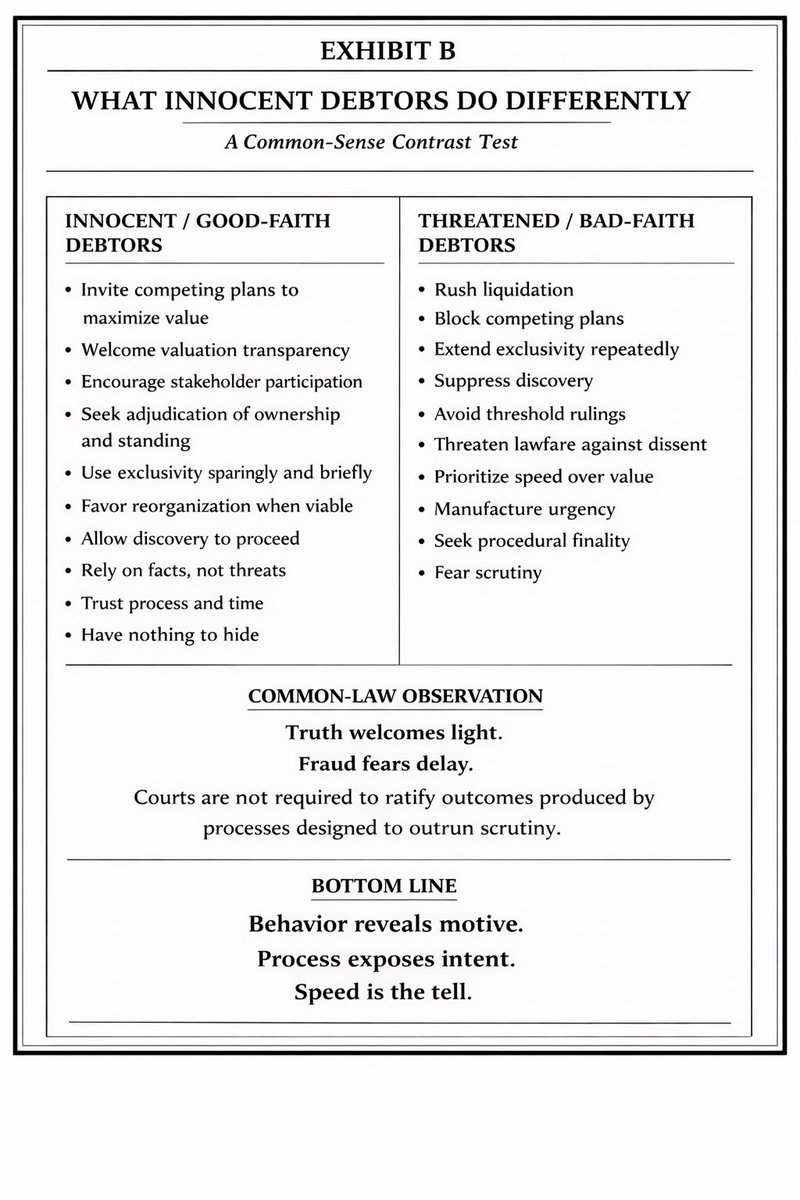
EXHIBIT B
WHAT INNOCENT DEBTORS DO DIFFERENTLY
A Common-Sense Contrast Test
INNOCENT / GOOD-FAITH DEBTORS
• Invite competing plans to maximize value
• Welcome valuation transparency
• Encourage stakeholder participation
• Seek adjudication of ownership and standing
• Use exclusivity sparingly and briefly
• Favor reorganization when viable
• Allow discovery to proceed
• Rely on facts, not threats
• Trust process and time
• Have nothing to hide
THREATENED / BAD-FAITH DEBTORS
• Rush liquidation
• Block competing plans
• Extend exclusivity repeatedly
• Suppress discovery
• Avoid threshold rulings
• Threaten lawfare against dissent
• Prioritize speed over value
• Manufacture urgency
• Seek procedural finality
• Fear scrutiny
COMMON-LAW OBSERVATION
Truth welcomes light.
Fraud fears delay.
Courts are not required to ratify outcomes produced by
processes designed to outrun scrutiny.
BOTTOM LINE
Behavior reveals motive.
Process exposes intent.
Speed is the tell.
CONCLUSION
When a debtor rushes liquidation, suppresses competition, and threatens stakeholders for seeking alternatives, the most plausible motive is not efficiency - but insulation from scrutiny.
@linqtoinc@TheJusticeDept@SECGov@Ripple @LinqtoEquity @CFTC@WSJ@CNBC
1:1 MEANS 1:1
No Counter Party Risks
No Third Party Rights
No Intermediary Ownership
Not a “Derivative Instrument” Claim
Only a 1:1 exchange of direct ownership between two parties.
1:1 ownership is not a promise to pay.
Listen to every single world this man has to say! Perfect clarifies clarifies the fiat fraud destroying sovereignty in every person, family, state and nation!
Thank you, @MelKShow for this super guest & his sound money insights!!
@KuwlShow Agree
He N E V E R came to rescue us. He came to give us the authority to rescue ourselves. He took the keys and conquered death.
Through his BLOOD dripped through the earth to the mercy seat, redeemed paid for our sins, filled us with the holy spirit.
So much…. ‼️‼️‼️
Given Executive Order 13848 currently authorizes 100% confiscation of assets of ALL parties involved in the treason of election fraud - a crime of sedition - and ALL media entities, including traditional broadcast, news print and social media entities who blocked, mocked, de-platformed, de-banked and otherwise aided and supported enemies foreign and domestic, by silencing our 1st Amendment constitutional right to free speech and to peacefully redress our government about the now proven 2020 election fraud, are subject to “donating” (😎) 100% of the assets over to our United States Treasury.
Thank God we have a shiny new Sovereign Wealth Fund born in 2025 by President 45-47, Donald J. Trump.
Merry Christmas to We The People!
@realDonaldTrump@USTreasury@elonmusk
Cc: @FoxNews@Meta@ABC@CNN@NBCNews@CBSNews@nytimes@Google@Apple@NewsHour@NPR