Proud supervisor moment today. 🎓
My 1st PhD student, Alex Wang, officially graduated today.
It’s been a pleasure to be part of the journey and to watch Alex grow as a researcher and entrepreneur, building https://t.co/x6RiwuEe4e, while completing a PhD. Congrats, Dr Alex!
Thank you to Dr Patrick Ho for visiting us last month and delivering an insightful seminar on memristor-FPGA integrated platforms for intelligent edge computing.
A great discussion on the challenges of connecting analogue emerging devices with digital FPGA systems.
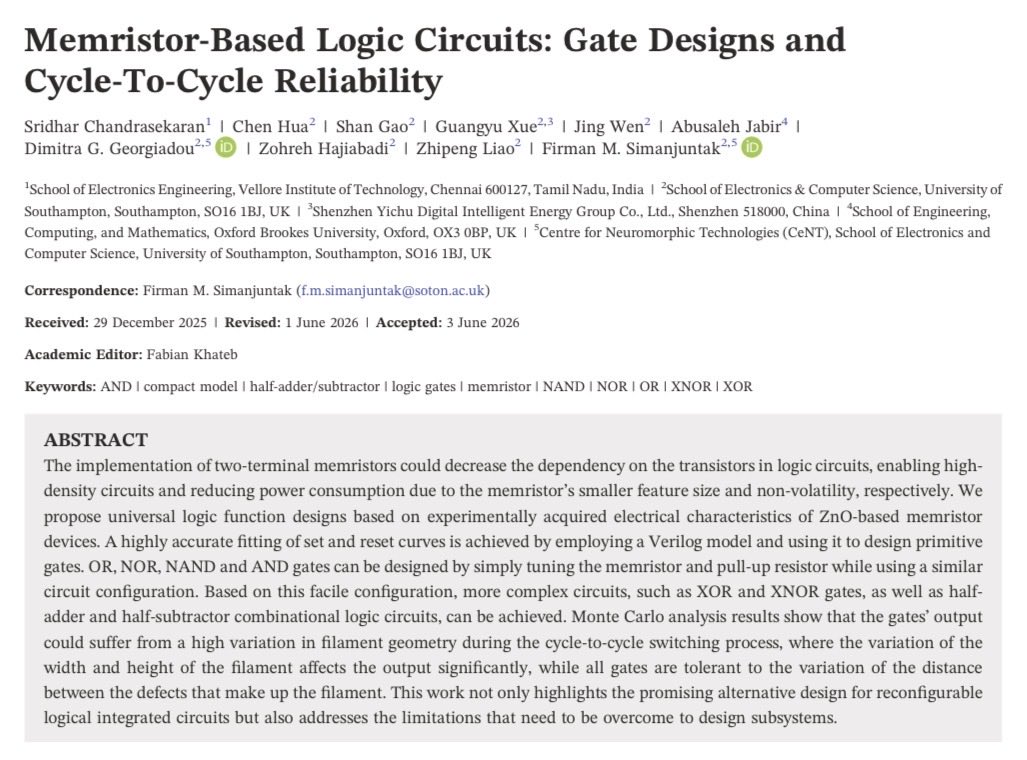
We studied the cycle-to-cycle reliability of memristor-transistor hybrid logic gates under cycle-to-cycle switching variability. The results highlight both the potential and the reliability limits of memristor-driven logic for future low-power, high-density computing systems.
Earlier this month, we had the pleasure of hosting our industry partners, Dr. Wahyu Diyatmika and Dr. Nikol Lambeva from VON ARDENNE (Germany). This invited talk is part of the activities of the EPSRC-funded SPICA project.
Check out our critical review on memristor synapses in @Nano_MDPI (https://t.co/kKFYMTLqOF), overviewing device physics, synaptic emulation, optoelectronic advances & hardware for AI—from MNIST recognition to retinal implants & organ monitoring. Brain-like computing awaits!
Another paper has been published led by my MSc students.
We propose a new statistical metric “Fluctuation Factor (FF)” to predict how likely the circuit is to produce good random bits by quantifying variations in the switching process, which other commonly used metrics can’t.
Most low-temperature fabricated devices are not CMOS compatible because they wont survive back-end thermal process which induce element intermixing, damaging interfaces. In this paper, we intentionally exploit the intermixing to make better devices for #AI applications!
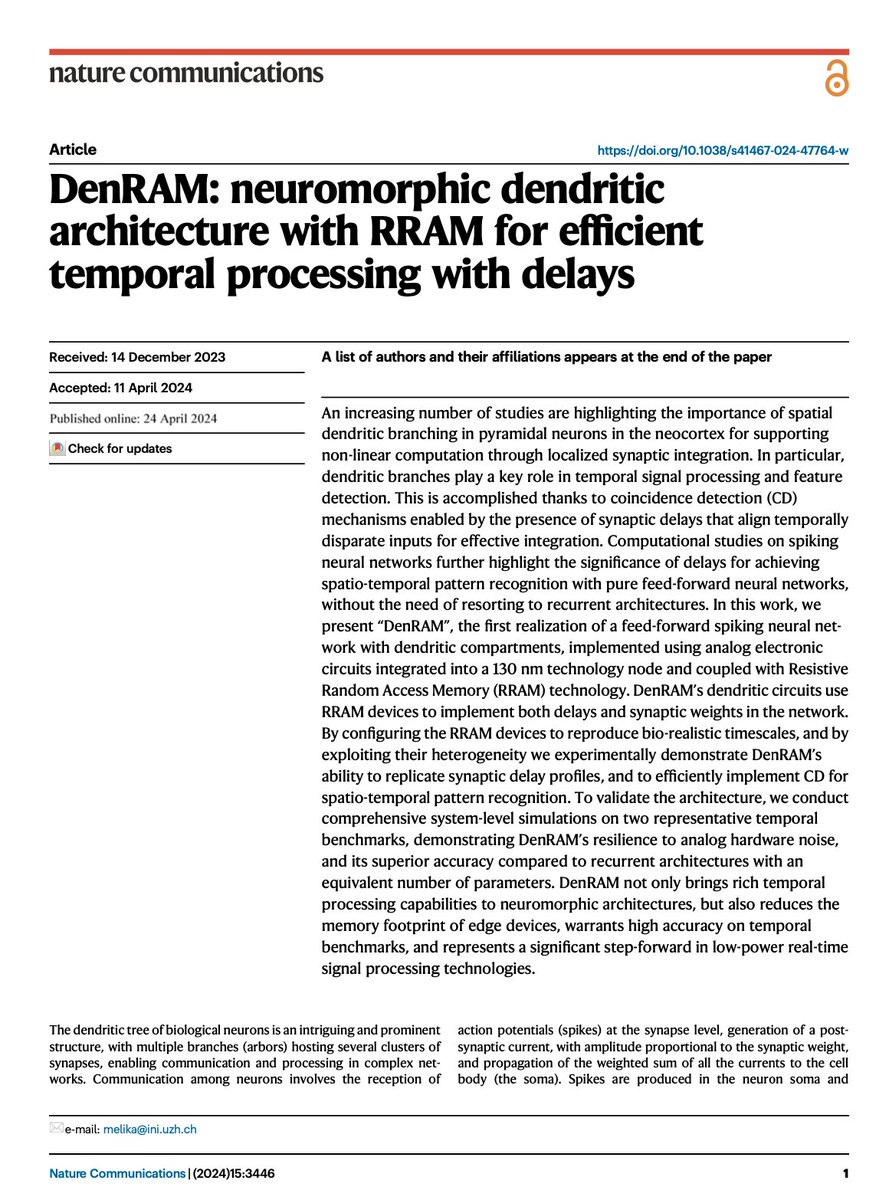
Check out "DenRAM", the first implementation of delay-based dendritic architecture using #RRAM+CMOS technology, which we show is a natural match for efficient temporal signal processing @NatureComms.
paper: https://t.co/ddNtHahAvQ
code: https://t.co/I9WTqjgkd9
Thread 🧵
"Neurons are noisy" is one of the bigger (and for neural computing, detrimental...) misconceptions around the brain.
Everything about brains' development and anatomy is so intricate, why would communication be random and unpredictable? Any variation is there for a reason.
Wang et al. report a nanoscale #LED with memory #electroluminescence, which can realize multiple action potentials combinations through a single optical channel in bio-inspired #afferent#nerves.
Now out 👉 @NatureComms https://t.co/rn6q7E4cfE
This @IEEESpectrum article written by Mark Liu (@TWSemicon chairman) and my colleague, Philip Wong (@HSPhilipWong), is required reading for anyone working on semiconductors and AI today. https://t.co/tgqyXnjAuf
Researchers from @UTAustin report an ultra-fast #memristor based on thin sheets of hexagonal Boron Nitride exhibiting the shortest observed switching #speed (120 ps) among #2D#memristors and low switching #energy (2pJ).
Now out👉@NatureComms https://t.co/kEXjZSecwK