@ScienceMagazine@fluidity_x The molecular origin of this rapid softening remains unknown. Future studies and new genetic tools are needed to uncover the signals driving the ultra-fast mechanical remodeling of the cell wall.
Paper here: https://t.co/oPGOElqqG9
@ScienceMagazine@fluidity_x Together, these measurements rule out rapid water transport or sudden turgor changes as drivers of closure.
Instead, closure is triggered by rapid softening of the epidermal wall: bending comes from release of pre-stress in the turgid mesophyll after weakening of the outer layer
@ScienceMagazine@fluidity_x In a plant cell, reduced stiffness come from either pressure loss or softer cell wall, each leaves opposite shape signatures. Profilometry shows increased bulging, exactly what is expected from cell wall softening, not pressure loss.
FEM quantify it: 40% drop in wall stiffness!
@ScienceMagazine@fluidity_x To probe the trap’s active mechanism, we measured cell stiffness using indentation.
One side changes, the other doesn't! The outer epidermis softens while the inner epidermis remains unchanged. Real-time measurements show that this softening occurs within seconds of triggering.
@ScienceMagazine@fluidity_x A natural idea is hydraulics: plants move by redistributing water, so why not the Venus flytrap?
Because it's too slow! Tissue-swelling and cell pressure-probe experiments show that water transport cannot keep up with the trap’s rapid active closure.
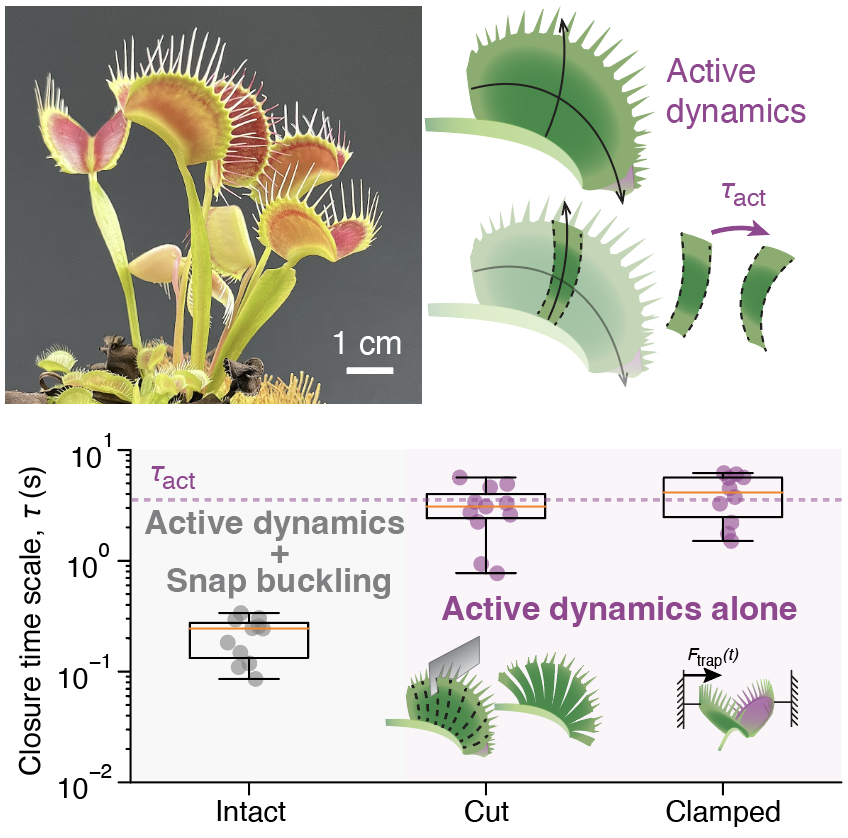
@ScienceMagazine@fluidity_x We isolate the plant’s active motor from its mechanical amplifier by cutting the trap or measuring the force generated by a clamped trap.
Even without the snap, the active deformation remains surprisingly fast, unfolding in just a few seconds.
Fresh off the press in @ScienceMagazine! @fluidity_x and Yoël’s work on the actuation of the Venus flytrap. 🪴⚡
No muscles. No nerves. So what powers the trap?
Cutting the trap suppresses its mechanical amplifier, the snap-through instability, and reveals the active motion.
Ever since Charles Darwin proclaimed the carnivorous Venus flytrap one of the “most wonderful” plants in the world, scientists have been trying to work out how it snaps shut so quickly on its prey. A research team has now snapped a key piece of the puzzle in place.
https://t.co/NOpZHsSzWZ
The Venus flytrap is renowned for its ultrafast snap traps, which can capture insects in a fraction of a second.
New research reveals that trap closure is triggered by a rapid softening of the epidermal cell walls, uncovering the physical mechanism behind this remarkable movement.
Learn more this week in Science: https://t.co/35uDGps8Qe
Faced with a long-haul flight, Tadashi Tokieda decided to do what he likes best. He started folding a sheet of paper.
Watch the full @OxUniMaths Public Lecture, including lots of paper, an elephant & the mathematical magic of origami.
https://t.co/5IkMU4CdMh
New pre-print out. Colloids can assemble into Turing patterns through diffusiophoresis. I hadn't fully appreciated the focusing effect of diffusiophoresis in biological systems until I saw the Ornate Boxfish on display at @Birch_Aquarium
PRFluids Editors' Suggestion: Downslope granular flow through a forest of obstacles
Baptiste Darbois Texier, Yann Bertho, and Philippe Gondret
https://t.co/h1wlFZAXUl
#GranularFlow
Experiments at various inter-pillar distances observe how forest density slows granular flow.
When I was in Death Valley many years ago, I wondered on the origin of polygonally patterned crusts of salt which one can see there. Today I bumped into the beautiful @PhysRevX of Jana Lasser et al: The answer is diffusive convection in porous media,
https://t.co/20HVzGt5oc