Preprint with @jtdudman: Behavior that emerges from classical conditioning improves mice’s policies for reward collection. Dopamine sets the rate of this direct policy learning independent of updating value. 1/n
https://t.co/vN5lizpOTv
Excited to share out labs’ latest: Congrats to @ReaganLPennock, @fluketc, Xiaohiu Yan, @LindaWadiche & @jwadiche. 'Afferent convergence to a shared population of interneuron AMPA receptors' (2023) Nat Comm. https://t.co/XSSeWByBM9. A thread:
The latest installment of @fluketc studies on how dopamine (DA) shapes learning https://t.co/YqCnhd3G5q This was a tricky one; it combines a few ideas that together argue for a new way to understand DA function and account for data that evaded prior models. 1/n
@KateWassum@_JaeeonLee_ @garrface @KateWassum do you think this addresses the original question or just what @_JaeeonLee_ was following with ... i.e., what was your prediction about Eric's proposed experiment?
@garrface I vote you collect predictions on here then do the experiment! Agree it doesnt seem like the mice would be trained in the same way as with actual reward, especially if you calibrated your DA stim to match actual reward responses...
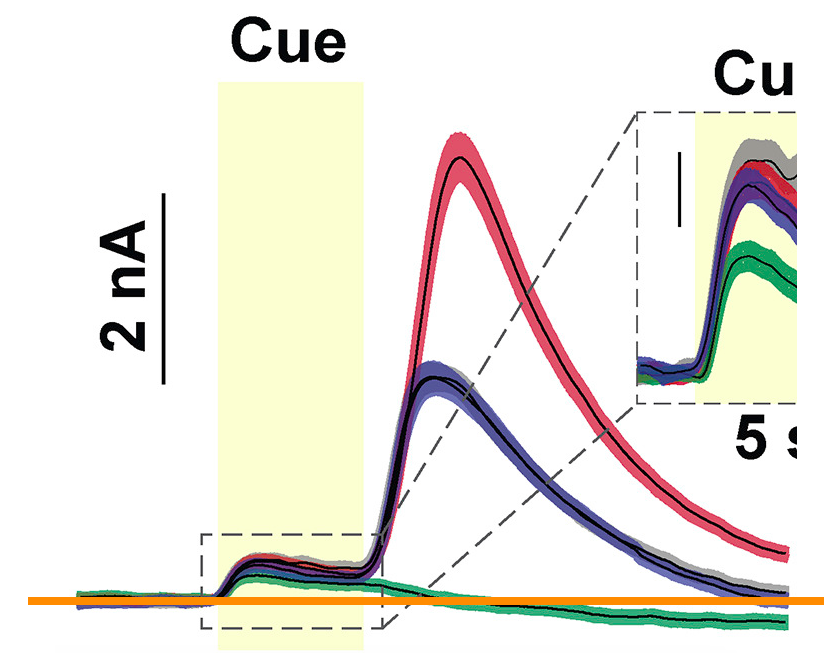
@dennis_a_burke@SergeAhmed@dp_covey @JoeyCheers Yah I just saw a smooth decline back to baseline. You're saying the smooth decline dips below baseline? Had to copy and paste and draw a line (the orange one)... I do agree it goes below baseline eventually ... But I don't infer well-timed inhibition like in the others
@dennis_a_burke@SergeAhmed@dp_covey @JoeyCheers Yah I think Nick's paper (and I) would argue that actions being initiated/controlled at the time of omission are key to explaining DA neuron inhibition with some stim omissions but not others. Think Ben et al get into that too, though papers/posters/convos blurring into eachother
@dennis_a_burke@SergeAhmed@dp_covey @JoeyCheers Would you say there is omission-related inhibition in the Covey/Cheer paper? Just looks like the signal is relaxing back to baseline after cue response. Important bc there's not action-initiation there, as in both Saunders and Hollon
Very excited to have this out! Though this is "only" a perspective piece, I personally feel that this is my most important work yet. 1/15 https://t.co/kzLSwn6xKy
We have some fun news to share:
2 years, 160 figures, & 22 videos later, our central complex connectome paper is now out @eLife! A pandemic labor of love & true team effort w/ @HannahHaberkern @RFranconville @DanTurnerEvans1
https://t.co/KO9Um0WkZA
Speaking of news...(1/11)
“Most people, I think, don’t even think of the fly as having a brain,” said neuroscientist Vivek Jayaraman. “But, of course, flies lead quite rich lives.” https://t.co/N8SA5M7BSC
A comprehensive blueprint of the central complex and its role in behavior, context, and internal state
A 75-page paper (just the results!) with 75 primary figures (plus supplements!)
[Hulse, Haberkern, Franconville, Turner-Evans]
https://t.co/9eaYYNdqu0
Philosophers often assume that beliefs are *necessarily* responsive to evidence. But the belief that one should change one's beliefs according to evidence is not universal. Many people explicitly reject it. For evidence (& much more), see this great paper: https://t.co/8wwWVGzbBP
This is why basic research is important! Insights from slice physiology led to our discovery about how to make DBS more long lasting. https://t.co/7BIA1n2lUk
@jtdudman @meletislab @dav_robbe@WiringTheBrain@YttriLab@adrianhaith Was going to mention that Haith et at study earlier. On similar note - point is that categorically different actions are not selected in BG - lift arm or kick a ball. Goals are selected (cortically) and then a single action planned - BG might bias it. Latter not selection.