I found meta-tokens pretty surprising! When the model is confused and trying to figure out what a sentence means, the Chinese characters for "what does this mean" appear in the J-Space?!
I got some really useful Claude prompting tips from @_catwu and @trq212 - it's time to stop overloading our prompts with examples and lists of things not to do, Fable works better without those
Claude Code's own system prompt recently shrunk by 80%!
I just read this SEED paper and i think it’s really a super clever approach for fixing the sparse reward issue in agentic RL.
If you’ve trained LLMs on multi-turn tasks, you know how annoying it is when the model just gets a pass/fail at the very end.
You’re left with zero signal on which specific tool call or decision actually made things go off the rails.
SEED basically lets the model learn from its own past attempts by extracting "hindsight skills" which are think quick notes to self on what worked, what to avoid, or critical things it missed.
The cool part is that as the model gets smarter, its ability to reflect on its own trajectories gets better too, so the supervision naturally evolves alongside it.
That insight gets converted into a dense, token level signal that trains right on top of standard RL.
The jumps in sample efficiency and out-of-distribution generalization is really promising across both text and vision tasks.
Its a super interesting read.
Read the full paper here:
https://t.co/stJw0HFc5X
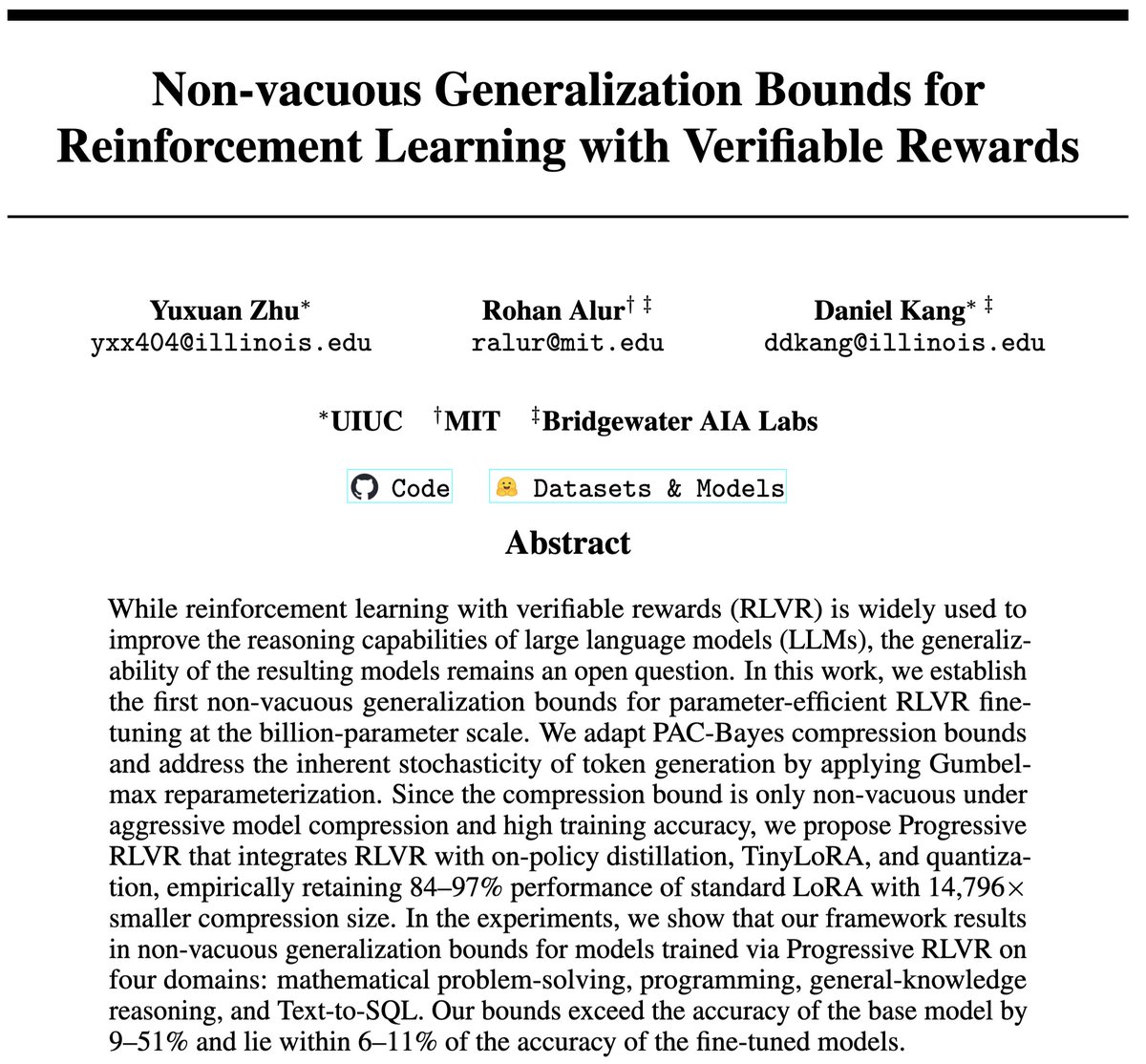
New research from Bridgewater AIA Labs, UIUC, and MIT: we prove what we believe to be the first non-vacuous generalization bounds for reasoning LLMs on real-world problems.
RLVR powers frontier reasoning capabilities yet its generalization to unseen data has remained an open theoretical question and deployment blocker for practitioners. Our generalization bounds for RLVR deliver provable high-probability lower bounds of the accuracy for billion-parameter RLVR models on unseen data, which can provide guidance on safely deploying RLVR.
1/9
Transformers struggle to generalize to tasks they were not explicitly trained on. Instead, we propose in 2026 that it is the job of the harness to generalize through composition.
We observe a powerful property when training RLMs: for tasks with shared structure that look different, the root model naturally learns the same trajectory, meaning it views the two task trajectories as the same! In other words, the Transformer does not need additional generalization capabilities to transfer capabilities from one task to the other, the harness induces it.
We find that well-designed harnesses form a quotient set over task trajectories, meaning their individual LLM calls can see structurally “similar” tasks as near-identical, token-for-token! Harnesses can effectively generalize for the Transformer during training, without relying on any intrinsic generalization capability from the model.
For example, RLMs can see problems of different lengths as the same: we show that RLMs can train exclusively on short tasks, and fully generalize to similar but unseen tasks 8-32x longer because it produces near identical trajectories for both.
Taking this further, we show that tasks across different domains (e.g. math solutions vs. essay writing) that share a decomposition strategy exhibit the same generalization effect. RLMs can train on the problem of finding which essays belong to the same author and improve performance on finding math problems that share similar solutions.
The full blogpost, experiments, and discussion are in the thread below.
Introducing "Diffusing Blame": can a neural network learn competitively while strictly obeying Dale's principle, the rule that real neurons follow? We show it can, across both image classification and reinforcement learning. 🧠
Accepted at #ALIFE2026
https://t.co/oSsfRCpvc7
Real neurons generally follow Dale’s principle: each neuron is predominantly excitatory or inhibitory. Standard artificial networks usually ignore this constraint, allowing every unit to mix positive and negative outgoing weights.
Backprop makes the gap even wider. Its backward pass needs exact transposed copies of the forward weights, the so-called "weight transport problem,” which biology doesn’t seem to have a mechanism for.
So we asked: can a network that strictly enforces Dale's principle still learn well, without weight transport?
Our approach builds on Error Diffusion (ED), a local rule that routes a single global error signal directly to every hidden unit, where each layer is split into separate excitatory and inhibitory streams with four non-negative weight matrices, so a synapse's sign comes from fixed population identity rather than a learnable weight. Our main contribution is to extend ED from binary to multi-class problems via modulo error routing.
We then asked whether this routing mechanism could provide useful credit signals in the noisy setting of reinforcement learning. During PPO training on Ant, Humanoid, and HalfCheetah, we compared each local ED update with the corresponding true backpropagation gradient. Among the routing schemes we tested, modulo routing consistently produced the strongest alignment.
Taken together, these results show that Dale-constrained networks can still learn without transporting weights backward, suggesting a potential path toward learning rules that are both effective and more biologically plausible.
"xHC: Expanded Hyper-Connections"
This new paper upgrades mHC by expanding residual memory to N=16 streams, reads all streams, updates only k=4, and adds causal conv writeback features so the extra streams are not redundant.
Their result is better loss, stronger 18B and 28B MoE downstream scores, and up to 1.5x compute efficiency over vanilla Transformers.
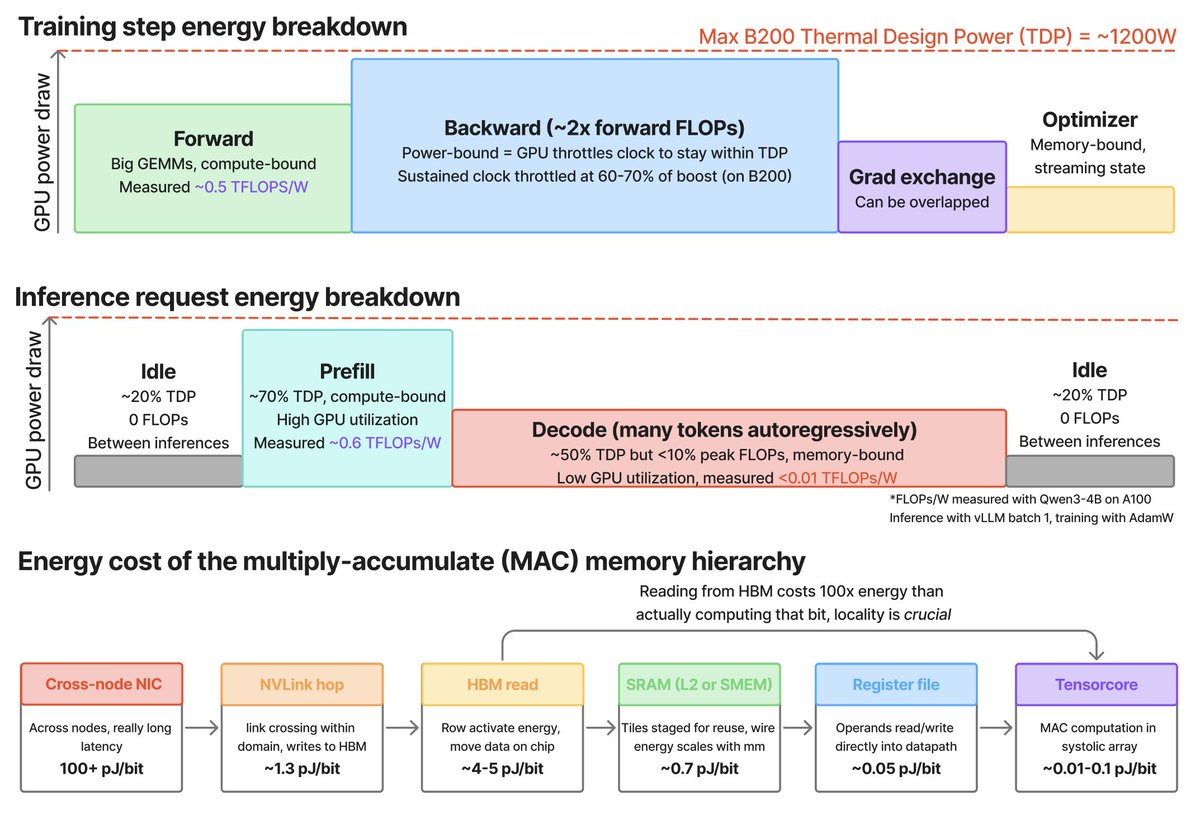
You’ve probably heard that power is our biggest constraint, but how does it influence training and inference systems?
I wanted to share what I’ve learned about designing the stack for power efficiency from my time at nvidia architecture research
TLDR and experiments in thread!
The first experimental evidence of recursive self-improvement (RSI).
Autoresearching the autoresearch agent for eight days.
The result beats the harness we hand-tuned for two years, on held-out benchmarks: 🧵(1/7)
New work led by @FlemmingKondrup and @tomjiralerspong highlights an important vulnerability in chain-of-thought monitoring for agents, I highly recommend giving it a read.
Link to the paper: https://t.co/cT7RWZ9vMO
New in-depth blog post time: "Inside TPU and GPU Clusters: The Anatomy of Collective Communication".
If you want to deeply understand the core primitives behind scaling the training / inference for MoEs and dense transformers, going a level below FSDP, expert parallelism, data parallelism, model/tensor parallelism this might be a fun read.
I cover:
* TPU cluster topology: (super)pods, slices, DCN, PCIe, ICI
* All-Gather: 1D/2D rings, and path algo (lots of visuals so should be crystal clear how these work even if you're not a perf engineer)
* Reduce-Scatter (which is the dual of AG) and All-Reduce
* All-to-All (used to dispatch tokens to target experts in MoEs)
* NVIDIA GPU cluster topology (reference DGX architecture): nodes, scalable units, fat tree
* GPU collectives within the node: rings, trees (log2 steps), and SHARP (in network compute unit)
* GPU collectives across nodes, hierarchical algorithms over InfiniBand
etc.
I was heavily inspired to do this deep dive after reading the excellent Scaling book by an excellent group of people @jacobaustin132@_sholtodouglas@reinerpope and others!
What originally started as "let me maybe just make four figures covering All-Gather, Reduce-Scatter, All-Reduce, and All-to-All so I can understand them better, it shouldn't take more than a day, right, right?" somehow turned into this 40 figures later.
Along the way, I realized that the collective algorithms only really make sense once you understand the underlying hardware topology. TPUs were a bit easier to reason about, but I couldn't skip GPUs, I love them too much. Rings are cool, but I also wanted to understand tree algorithms. But also SHARP, and fat trees, and hierarchical collectives. :')
So the scope slowly expanded, and little by little, this blog post came to fruition. Just a side-quest.
Hope you like it! :)
---
Also a big thank you to my friends for reviewing the blog and providing feedback:
* @ArunDemeure (prev GPU/AI stuff at Magic, GPU architect at Apple and Imagine, my llm.c buddy!)
* @axel_s_feldmann (making GPUs go brrr at Jane Street, we met for the first time at @marksaroufim's excellent GPU mode event)
* @pranjalssh (ex xAI GPU wizard, one of two people who inspired my original matmul blog!)
An unexpected benefit of having run 3 mech interp workshops: we have a great dataset for analysing the rise of LLM slop in submissions!
@andyarditi investigated how much AI slop we let in, how things have changed since 2024, and more
Our review process isn't entirely noise!
Standard RL benchmarks are episodic and stationary, so they don't capture the the characteristics of real-world deployment. Morpheus is a new benchmark for continual learning that provides persistent simulation environments where the world never resets, objectives shift asynchronously, and decisions have compounding consequences. Nice work by Sam & team!
Check out the paper - https://t.co/pnxwqTRuSf
Platform website - https://t.co/MchQTm9gXR
Every single startup selling AI Training Data (July 2026)
>50 cos sell data and RL environments to big AI labs and drive AI progress behind the scenes.
They total ~$8.5B in rev and ~$100B in valuation, >75% of which are just 4 players: Scale, Surge, Mercor and Handshake.
A model’s chain of thought acts like a scratch pad, offering a window into its reasoning. 📝
On the latest episode of our podcast, host @fryrsquared sits down with @NeelNanda5 to explore interpretability – the science of reverse engineering how neural networks learn and think.
Timecodes:
00:00 Introduction
02:41 Motivation for interpretability research
04:01 Mechanistic interpretability
08:14 Chain of thought monitoring
18:14 Interpretability techniques
35:00 Auditing models for safety
48:53 What comes next for interpretability
The AI 2040 scenario: https://t.co/sAX5Rsu2P2
Plan A is our current best guess, but hopefully a better plan will exist before it's too late. We hope that the best ideas from Plan A will be adopted and the worst ideas discarded.
Written with @thlarsen, @romeovdean, @eli_lifland, and @RyanGreenblatt
In AI 2027, we predicted that AI would take over the world or irreversibly concentrate power.
In AI 2040: Plan A, we've laid out our positive vision for what should happen instead.
Transluce is developing end-to-end interpretability approaches that directly train models to make predictions about AI behavior.
Today we introduce Predictive Concept Decoders (PCD), a new architecture that embodies this approach.
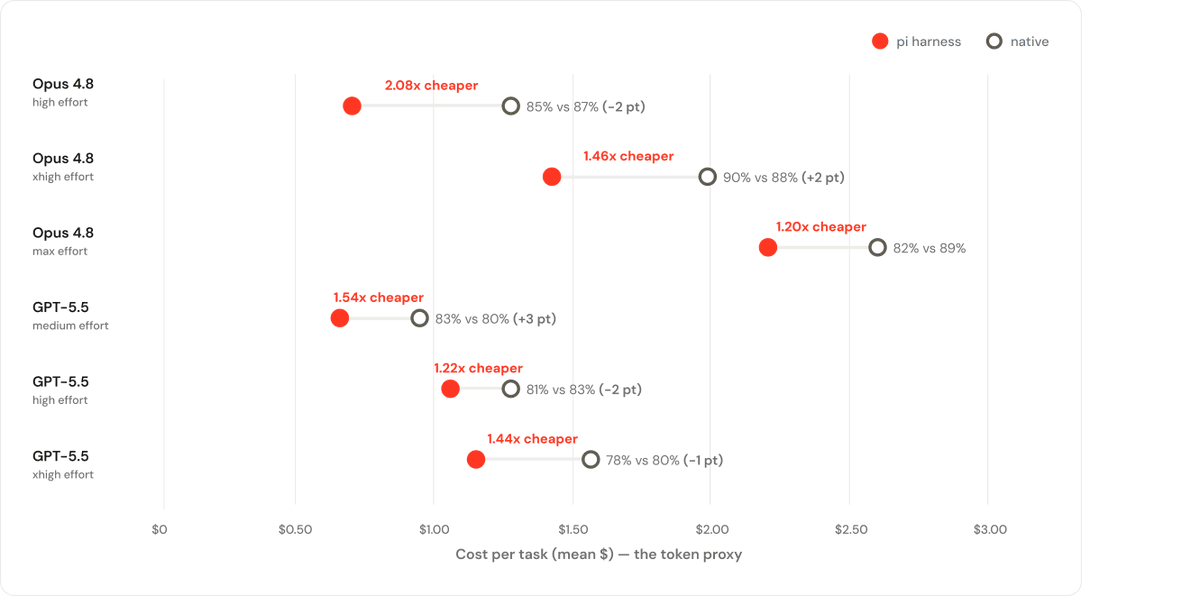
3) Harnesses make a huge difference in cost-performance. The very simple Pi harness (@badlogicgames) got the same success rate as harnesses from the LLM vendors with Opus and GPT 5.5, but at 2x less cost! Seems to be mainly due to smaller inputs to the LLM.
interesting position paper throwing cold water on autoresearch/ai scientist: LLMs can't jump.
The thought experiment is this: Take an LLM with a 1905 knowledge cutoff. Feed it every paper, every dataset, every equation of that era. Could it invent general relativity?
No.
Discovery isn't one thing. It's three. You can induce — generalize from data, which lands you at Newton plus some epicycles to explain Mercury's weird orbit. You can deduce — derive rigorously from axioms you already have, which never gives you new axioms. Or you can jump — invent the frame itself, decide that spacetime curves. That third move is the one that matters, and it's exactly the one induction and deduction can't reach.
Penrose put it as three worlds: Physical, Mental, Platonic. Data flows from the world into a mind fine. But the new law has to be discovered into the Platonic world first — and that step is the jump. LLMs are induction machines running over what already exists. Structurally, they don't take it.
I think it’s a warning to AI scientists/autoresearch against collapsing two very different things into one word.
Hill-climbing: LLMs are already superhuman here, and autoresearch in this sense is real and moving fast.
Abduction/leap/jump: a new frame that reorganizes the field, that is a different act entirely, and nothing about scaling induction suggests you get there.
Most of what Autoresearch ships today will be spectacular hill-climbing. The jump is still ours for now.