In today's video I explain why I think there will be many more "DeepSeek Moments" and why China is about to lead the world in science and technology
https://t.co/0Juz6abi0o
🚨BREAKING:
DeepSeek Liang Wenfeng says no to china’s Big Tech and VC money
“founder is wealthy and committed enough to keep it lean in a Navy Seal-style for his pursuit of AGI”
- 160 employees (meanwhile openai 2000+)
“we are in the early stage of a revolution companies should focus on breakthroughs instead of monetization”
No. No. 1000 times No. We don't need to explain the value of science to "the people". Our problem isn't that people don't value of trust science in theory - they love science! It's that they question it's value IN PRACTICE. They question US. To save science we need to show them that they can and should revive their trust in US and OUR INSTITUTIONS to deliver on the promise of science everyone believes in.
Without Chinese companies AI research and open source would be dead!
Humanity would be ruled by a bunch of oligarchs and monopolies
SUPER GLAD that we have different countries and systems
holy shit, DeepSeek is able to get 73.7k tokens/s input and 14.8k tokens/s output throughput per H800 node!
Their profit margin is 545%, while OpenAI is bleeding money despite charging so much??
that's how awesome their inference stack is.
🚀 Day 1 of #OpenSourceWeek: FlashMLA
Honored to share FlashMLA - our efficient MLA decoding kernel for Hopper GPUs, optimized for variable-length sequences and now in production.
✅ BF16 support
✅ Paged KV cache (block size 64)
⚡ 3000 GB/s memory-bound & 580 TFLOPS compute-bound on H800
🔗 Explore on GitHub: https://t.co/4JvJTn5HX2
Since people are still confused about why I say the chatbot output about Bell's theorem is wrong, let me clarify what the correct answer is.
Bell's theorem is a mathematical proof that says: a model with certain assumptions X, Y, Z will obey an inequality on measurement results. This inequality is violated in experiments. This means that any model which fulfils all assumptions is incompatible with evidence.
The question I keep asking chatbots is: what are the assumptions?
The first assumption for the model is that measurement outcomes can be calculated from a variable usually called the "hidden variable". A lot of confusion surrounds this assumption. Note that you can calculate the measurement outcome from the measurement outcome (duh), so there is always such a variable, even for quantum mechanics itself. The question is, what are the properties that the distribution of these variables needs to fulfil?
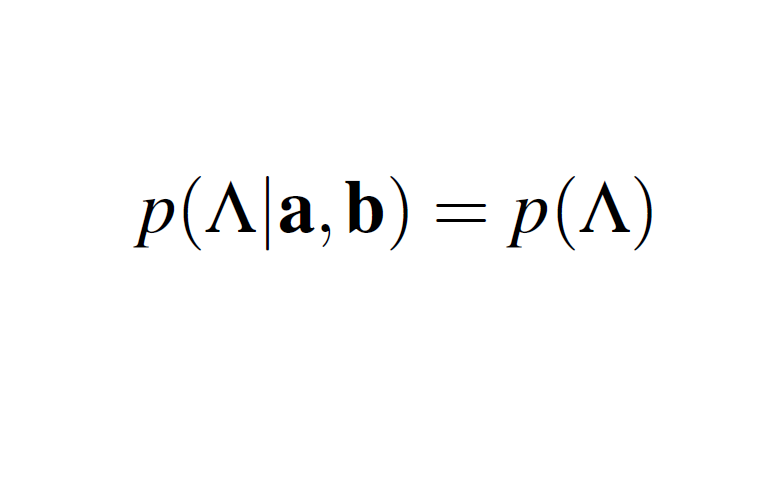
The second assumption is the most famous one and is called "local causality". It looks like this
for a situation with two detectors. a is the detector setting of the first detector and O_a is the observed measurement outcome. b is the detector setting of the second detector and O_b is the observed measurement outcome. and Lambda are the "hidden variables", that is, what you need to know to calculate the measurement outcome.
Don't worry if you don't understand what this equation means, it just says that a theory should be local in the sense that causes travel from one point only to its neighbors (they cannot "jump" -- that would be nonlocal), and they cannot travel faster than light. Bell also thought it includes causality, but that depends on what you mean by "causality". But this isn't so relevant here, so let me skip over this.
This assumption of local causality is sometimes broken down into a list of other assumptions, output independence, setting independence, parameter independence, factorizability etc. So, there are many different ways to formulate it and it can get somewhat confusing because everyone does it somewhat differently, but in the end you need local causality for Bell's theorem.
The third assumption is statistical independence:
The relevant thing is now this: Statistical Independence is necessary to derive Bell's theorem. But this assumption is independent of local causality. This means you can violate statistical independence without non-locality.
Bell himself got this wrong in his original paper. He seems to have thought that Statistical Independence is implied in local causality. It is not. This means most importantly, a theory which violates Statistical Independence can be locally causal AND violate Bell's inequality.
That Bell made this assumption without noticing was only pointed out in 1976 by Shimony, Horne, and Clauser (same Clauser who won the Nobel Prize in 2022). The paper is titled “Comment on ‘The theory of local beables’.”, and is published in Epistemological Letters 13, 1 (1976).
Bell and Clauser both realized that since this additional assumption was required, an experimental violation of Bell's inequality would *NOT* demonstrate a violation of Local Causality. Hence, they tried to find a reason why statistical independence must be fulfilled on philosophical grounds. They claimed that it's necessary for free will to exist, which is not only nonsense (free will is difficult to reconcile with any deterministic theory, but that's nothing to do with statistical independence) it is also putting a lot of philosophical baggage onto a simple equality.
This is why Bell dismissed a violation of Statistical Independence as "superdeterminism".
But none of that matters -- it is clearly an assumption that enters the proof. It is highly problematic that this necessary assumption is now usually not even mentioned.
(Let me note in the passing that Bell's theorem makes no assumptions about either realism or determinism, it's just unnecessary. Strictly speaking it makes a bunch of other assumptions which are necessary for the probability distribution to be well-defined.)
It's even more worrying because since the 1980s we have had multiple models that have demonstrated explicitly that it is possible to violate Bell's inequality with local hidden variable models, so long as those models violate statistical independence.
My point here is the following: All of what I said here are mathematically true statements. You can check them for yourself. It is not a difficult proof. You find this proof in many places. It's undergrad materials.
This is not something we should have to discuss.
But in verbal terms, Bell's theorem has been misstated so often that most people never look at the proof. And the same mistake is now being further reinforced by AI repeating it.
Some of you will question what I just told you. Fair enough. Please go and just do the proof yourself. You will see that you actually need this extra assumption.
I keep going on about this because I strongly believe that we will not make progress in the foundations of physics as long as we use a model that violates local causality. We currently do: Quantum mechanics itself violates local causality.
All the difficulty we have with finding a quantum version of gravity comes from using a quantum model that is incompatible with the locality of general relativity.
It blows my mind that physicists can't see this. /end rant
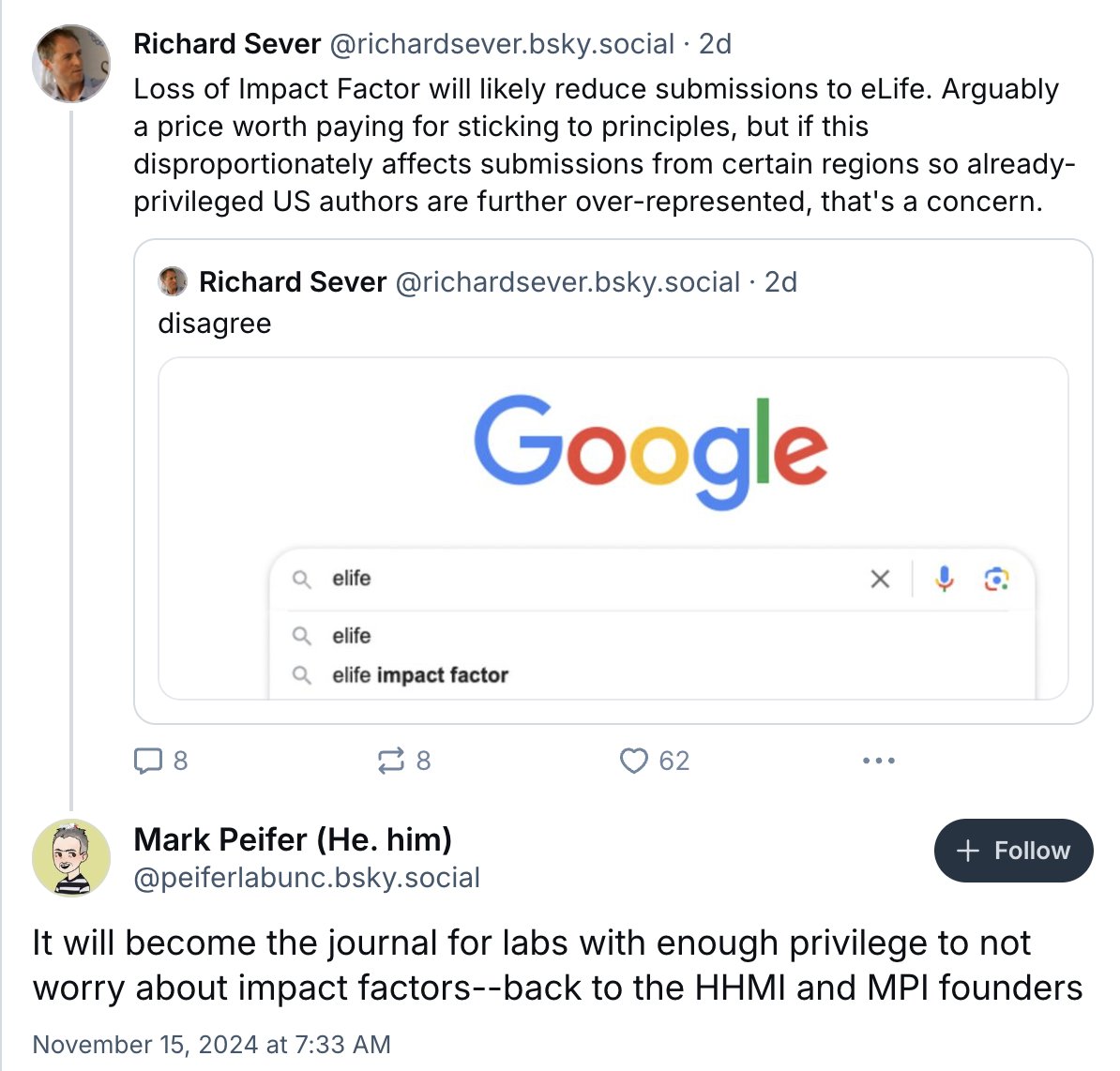
The publishing system sucks and will continue to suck so long as tenured, full professors at state universities spend their time whinging about other peoples' privilege instead of focusing on their own responsibility as public employees to make science function well.
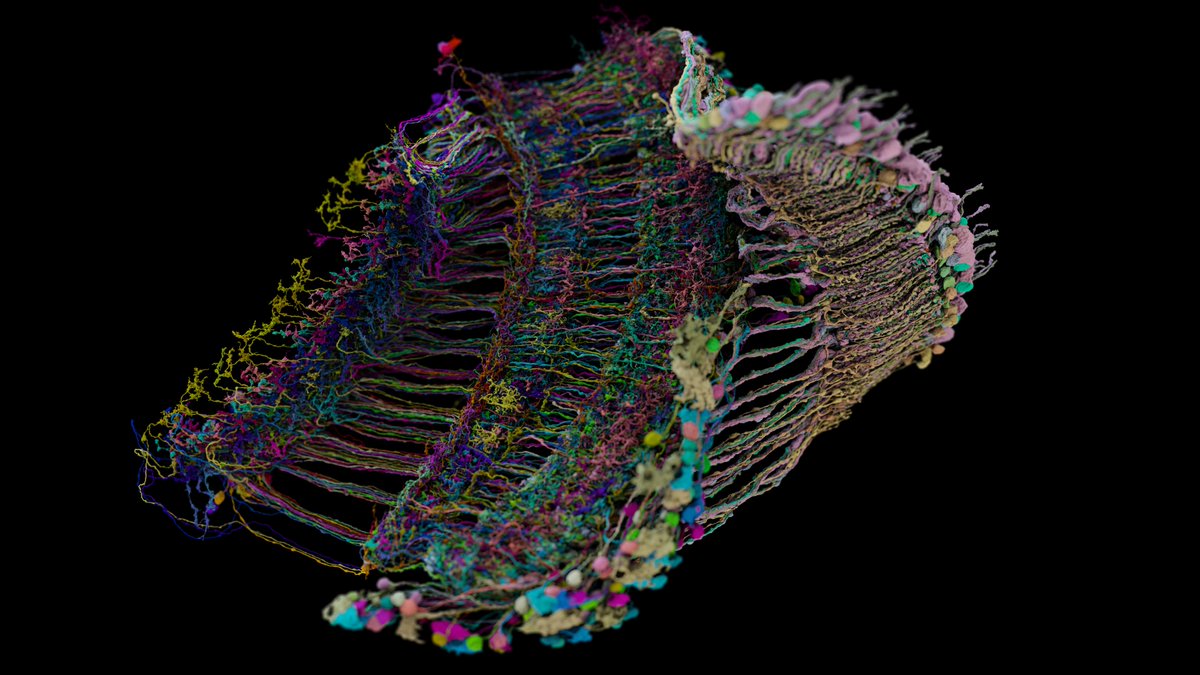
These are a few of my favorite @FlyWireNews renders:
1) A selection of chiasms through the optic lobes
2) Optic column cells colored by their topographic mapping
3) Several individual optic columns highlighted passing through the optic lobes.
Using magnets to wiggle bees awake makes the cut as my insominator appears in Betsy Mason's article "The clever contraptions scientists build to study animal behavior" (MIT Technology Review).
https://t.co/17KgzKLx1D