Most new things in life amuse me, but currently curious about Local Economy, Housing and Urban Data.
Thy hates describing thyself and tweets irrelevant memes.
Elon becomes the world's first trillionaire via an overvalued SpaceX IPO. It allows the billionaires who took Twitter private to cash out after new investors raise the stock price (a pump and dump), and now they're integrating it into indexes so retirees are left holding the bag.
An incredible bit of sports journalism by The Guardian here. A short summary of the playing style of all 48 World Cup nations and a short profile of all 1248 World Cup players. Bookmark and refer to the resources when watching the obscure matches: https://t.co/tdLGq8en0o
@shalakulkarni@Taanya_K@divyarrs the link is https://t.co/X6VZPilwdq on the website and it works perfectly fine.
I think you forgot to added the 1 at the end D.
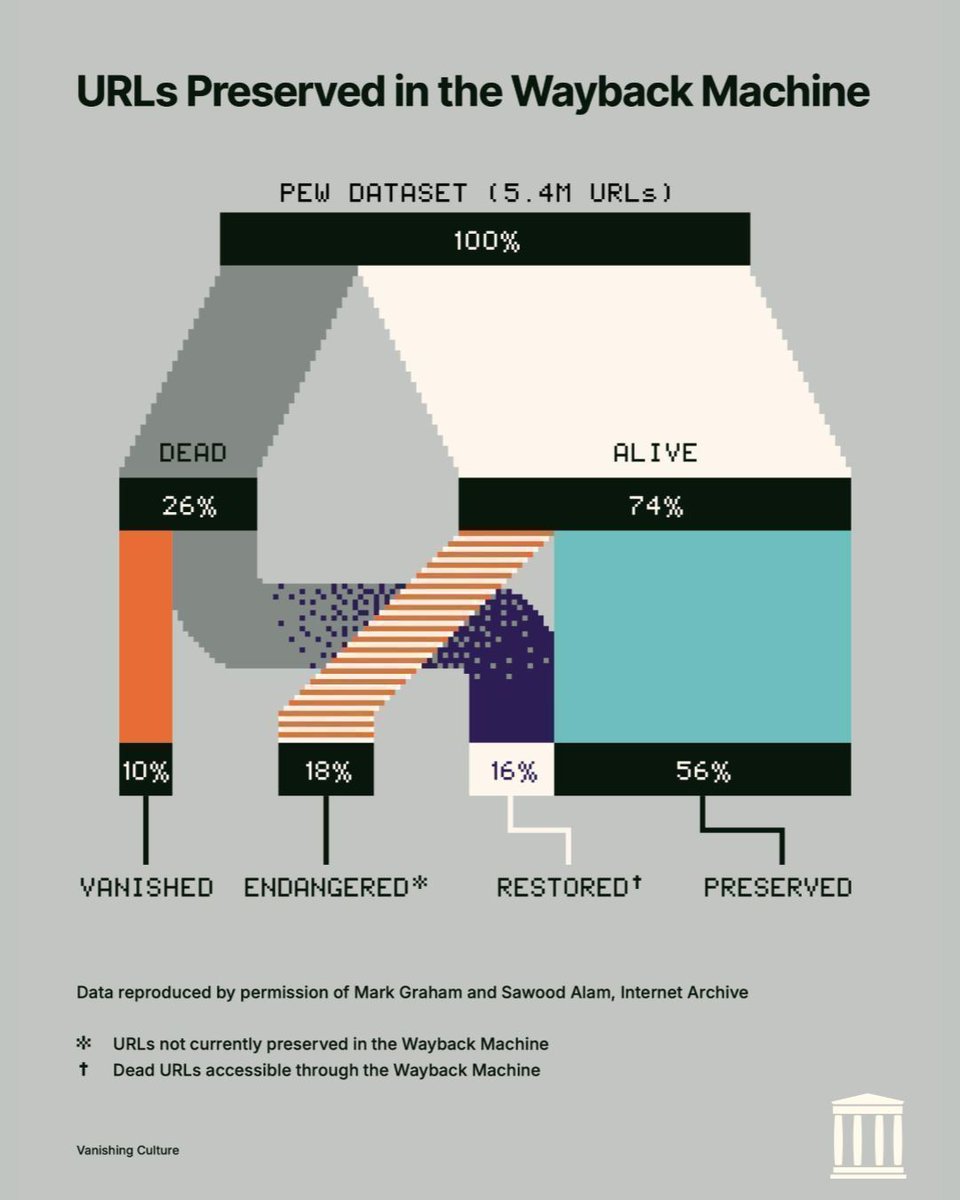
The web is disappearing 🕳️
According to a Pew Research Center report, 26% of pages from 2013-2023 are no longer accessible.
But that’s not the whole story.
In a new study published in Internet Archive's book, VANISHING CULTURE, data scientists working with the Wayback Machine have found:
16% have been restored through the Wayback Machine.
56% are preserved before they disappear.
Preservation is the remedy for cultural loss.
📚 Read VANISHING CULTURE free from the Internet Archive
📖 Download & read: https://t.co/BrawXOwMBr
🛒 Purchase in print: https://t.co/EB58IliqDm
#VanishingCulture #DigitalMemory #InternetArchive #BookTwitter
We aren't big on hyperboles but Shashwat Bulusu is one of the most capable indie artists in India when it comes to soaking each musical element with a deep emotionality.
A late-night gathering involving liquor and non-vegetarian food by Bengali workers was allegedly exposed by locals in Kalupur. The residents claimed that outsiders had set up a gathering inside a house. Locals recorded videos of the scene and informed the police.
The Versova-Bhayandar Coastal Road is being sold to you as progress. 26 km of high-speed corridor. Less congestion. Faster commute.
But who actually benefits? Let's do the math Mumbai's planners don't want you to do. 🧵
On Sunday afternoon, my colleague @deshkar_ankita called from a government hospital in Nagpur.
This was not going to be just another accident brief....
19 workers were dead.
SIXTEEEN of them were women.
#Thread (1/8)
Explore declassified satellite imagery of the Hyderabad region from 1967, 1974, and 1979 - https://t.co/VftJwvMxoG
These high resolution images provide an incredibly detailed snapshot of what Hyderabad looked like in the late 1960s and 1970s.
#Hyderabad
I really want people to see the story above the story here, which is that whether you're reading Citrini, or listening to Jamie Dimon at a cocktial party, the conversation about AI is a marketplace of competing science fiction narratives.
That's not to say I think the technology is a parlor trick. But rather that the level of uncertainty is so high, and the quality and supply of real-world, real-time information about AI's macroeconomic effects so paltry, that very serious conversations about AI are often more literary than genuinely analytical.
And I think that observation sets up another important point: I feel lucky to be able to have conversations about the frontier of AI with executives and builders at frontier labs; economists at AI conferences; investors in AI; and other AI folks at off-the-record dinners where important truths can theoretically be shared without risk. I can't emphasize enough that "nobody knows anything" is about as close to the reality here as three words are going to get you.
Nobody what's going to happen this year, or next year, or the year after that. There is no secret cigar-filled room of people who have unique access to some authentic postcard from the future. When you drill down underneath the bluster, the boosterism, the fear, the anxiety, what's there at the bottom is genuine uncertainty, a vacuum into which storytelling is flooding. The frontier labs don't really know what they're building exactly, and economists don't really know how to model the thing they claim they're building (genuine recursively self-improving AI agency isn't really analogous to something we know about).
I wish more people talked about and thought about this subject thru that sort of lens: We're trying to model the economy-wide effects of a technology whose properties the frontier labs can't even really describe yet. Whatever you think about AI today, be prepared to change your mind soon.