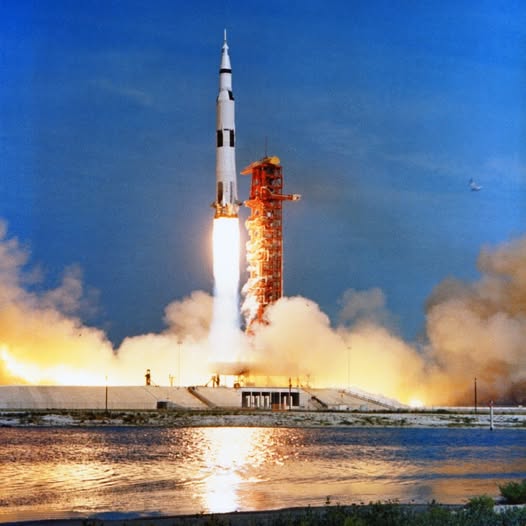
The West has so much dormant potential.
It is time to awaken it.
It is time to usher in the Age of Prometheus.
To charge fearlessly into chaos, unleash all the energy, and bring order to the universe.
One giant leap for mankind
History was made on July 20, 1969, when Apollo 11's Neil Armstrong and Buzz Aldrin became the first to set foot on the Moon.
For more than 5 decades, the total number of moonwalkers has remained at 12. NASA will change that with Artemis IV.
The Five Sisters Race is complete! Congratulations to the cadets and crew of USCGC Eagle. From New York to Boston under sail, four of five remaining sister ships made history together. Official results July 12. Free public tours aboard in Boston July 12 to 14. #Sail250
For me, it is the depth of our understanding, acquired from our lonely vantage point in the inky black stillness of a cold and forbidding cosmos, that reverberates across the expanse of reality and marks our arrival.
- Brian Greene
That’s one big chandelier…
The @NASAHubble team captured this sparkling photo of the Chandelier Cluster, a globular star cluster within our Milky Way galaxy. A globular cluster is a dense collection of thousands to millions of stars bound by gravity. https://t.co/hkks3ngsPU
This image of Messier 64 is a combined view from @NASAHubble and @NASAWebb.
The gas in the outer regions is rotating in the opposite direction from the gas and stars in its inner regions. This strange behavior may be due to a merger between M64 and a satellite galaxy.
While cruising around Saturn, be on the lookout for picturesque arrangements of moons, rings, and shadows.
One such striking sight occurred in 2005 and was captured by the then Saturn-orbiting Cassini spacecraft.
In the featured image, moons Mimas (left) and Tethys (right) are visible on either side of Saturn's thin rings, which are seen nearly edge-on. Across the top of Saturn are dark shadows of the wide rings, exhibiting their impressive complexity.
The violet-light image brings up the texture of the backdrop: Saturn's clouds. Cassini orbited Saturn from 2004 until mid-2017, when the robotic spacecraft was directed to dive into Saturn to keep it from contaminating any moons.
Image Credit: NASA, JPL-Caltech, Space Science Institute