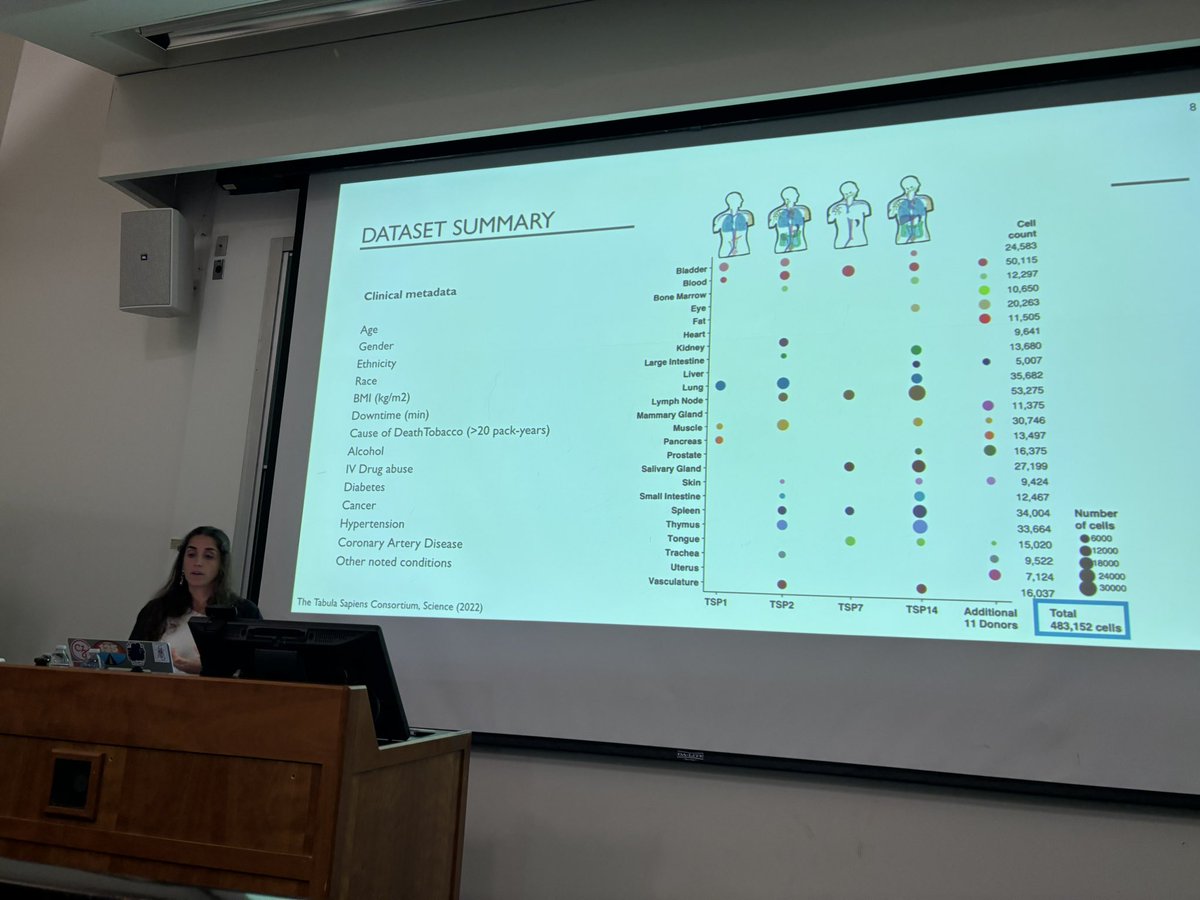
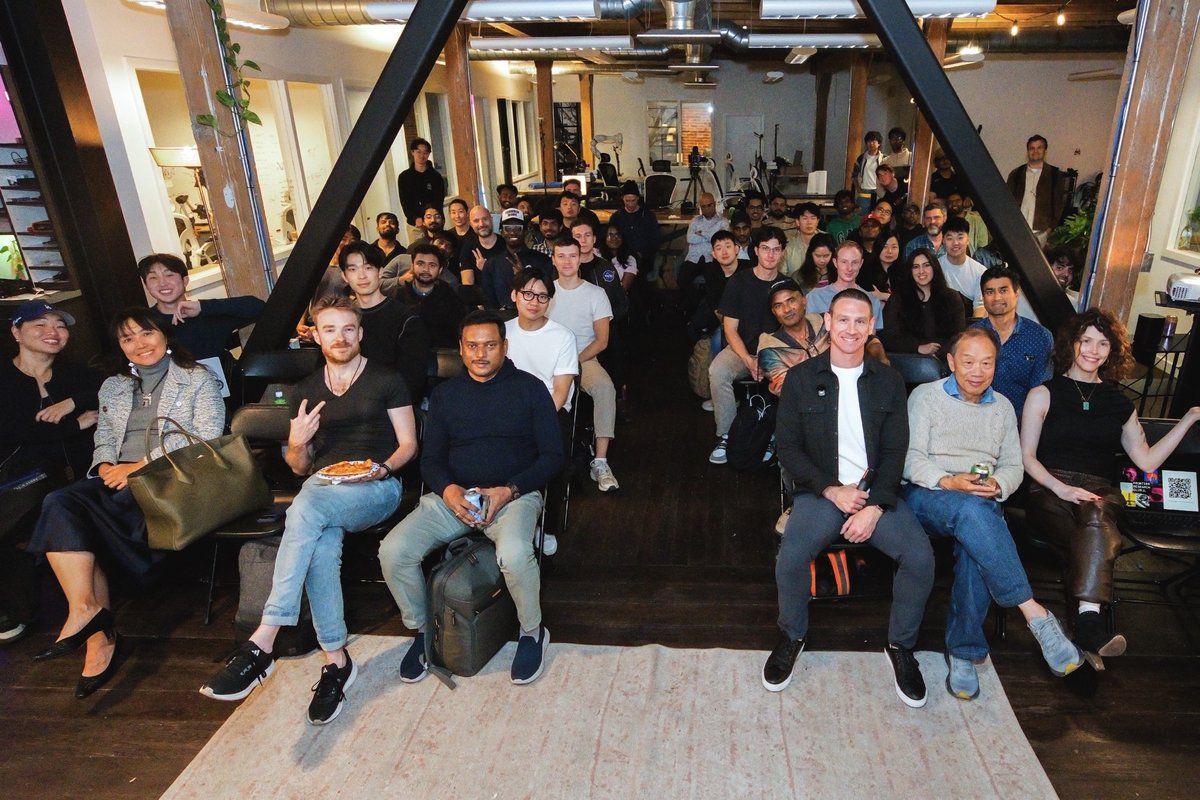
@drAOPisco talked about @biohub’s efforts in building a virtual cell, trained on corpuses of cell data like Tabula Sapiens, with a goal of simulating effects of drugs and genetic changes
great talk @frontiersynd
@yalda2009@Stanford Akram Baharlouei, From Tokens to Cells
https://t.co/g7MOisGOFn
Slides: https://t.co/C2N1lUHzfS
Tonight: FRC #28 at Stanford with Ganesh Pusapati and Angela Oliveira Pisco
https://t.co/vzMq8VUuMp
What if you trained a model to read a cell like a sentence of genes?
Akram Baharlouei @yalda2009 of Altos Labs tested that at FRC #16 at @Stanford. In her team's benchmarks, those BERT-style foundation models didn't do well against simpler, even linear, models. Small flow-matching models that skip compressing the data did better.
Tonight FRC #28 is back at Stanford. Ganesh Pusapati on the broken machine behind most colorectal cancers. Angela Oliveira Pisco @drAOPisco on what a virtual cell can actually predict.
Full talk 👇
Congratulations to @GradiumAI on the open-source release of Phonon, a family of text-to-speech models under 50M parameters. The smallest model, Phonon-31m, is 64 MB and is released under Apache 2.0.
Open releases like this give the whole field a stronger foundation to build on.
Gradium's cloud model, Gradium-TTS, already records the lowest median time to first audio among the cloud TTS APIs we measure, at 68 ms. Phonon begins speaking in 7.5 ms on a Snapdragon 8 Elite Gen 5, with no network hop involved.
On-device inference also changes the operating constraints. Once the model and a voice are downloaded, no connection is required, the text never leaves the device, and usage is unlimited at no extra cost. Launch partners are already applying it to game characters and automotive R&D.
The family covers five languages and is supported at launch in Hugging Face Transformers, MLX-Audio and Ollama. Phonon-31m runs faster than real time on a Raspberry Pi 5.
A significant contribution to open, on-device speech.
.@BradPorter_ and John Giannandrea on why one research paper could make models ten times faster, and what it takes to move AI from research to deployment.
https://t.co/9vfp7uEVDh
@joseph_lee_25@Stanford@MissionRobotBay Joseph Lee, When Reasoning Helps Action
https://t.co/7tqYzGEbCY
This week: FRC #28 at Stanford tomorrow, and FRC #29 Thursday at @arrayvc https://t.co/dcykMxpR8F
If you fix a robot's reasoning, does it act differently?
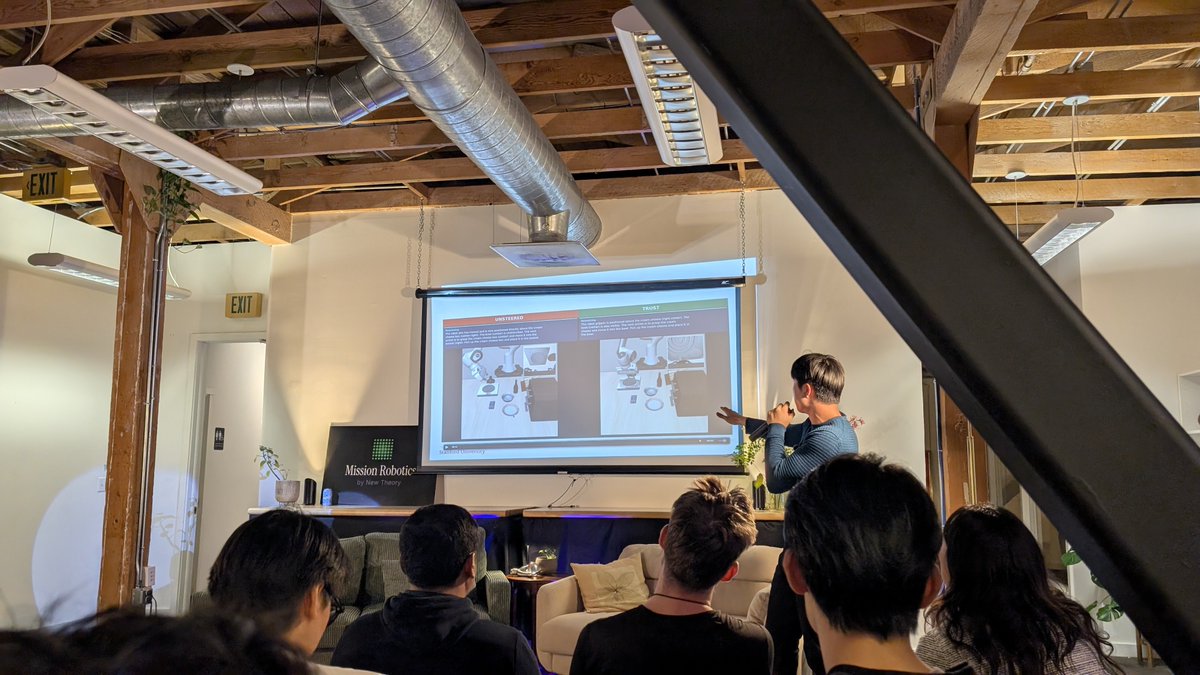
@joseph_lee_25 from @Stanford tested it at FRC #27 at @MissionRobotBay. Steering a driving model's chain of thought cut collisions 30.4%. On a manipulation robot, better reasoning barely changed actions.
Full talk 👇
@OpenAI@bonniesjli@GVteam@GoogleDeepMind The Art of Scaling Reinforcement Learning Compute for LLMs
https://t.co/IEO3LRX14h
Paper: https://t.co/fd5Y962lGl
This week: FRC #28 at Stanford tomorrow, and FRC #29 on learning human preferences Thursday at @arrayvc
https://t.co/dcykMxpR8F
Before she joined @OpenAI, @bonniesjli gave the most-watched talk on our YouTube channel.
Back in May at @GVteam, while she was at @GoogleDeepMind, she walked the room through The Art of Scaling RL Compute for LLMs.
The big idea: RL doesn't scale like pretraining. Reward follows a sigmoid with a real ceiling, and the recipe sets that ceiling. You can't train longer to fix a bad one.
One quiet fix stood out. Matching numerical precision between the training and inference stacks lifted the ceiling by a relative 17%.
Full talk 👇
@MissionRobotBay@Stanford Joseph Lee, When Reasoning Helps Action
https://t.co/7tqYzGEbCY
Shashank Tripathi, Where Humans Touch the World
https://t.co/soaofeCTN4
Next up: FRC #28 at Stanford this Wednesday
https://t.co/vzMq8VUuMp
@Stanford@RohatgiLab@NatureGenet Request a spot on Luma 👇
https://t.co/vzMq8VTWWR
Pre-read: Mutational scanning reveals substrate-assisted autoregulation of the WNT destruction complex
https://t.co/KTUPygWdRr
More than 80% of colorectal cancers break the machine that keeps WNT signaling in check.
Next Wednesday, Frontier Research Club #28 is at @Stanford for Cell Biology x AI: From Cancer Mechanisms to Virtual Cells.
Ganesh Pusapati of the @RohatgiLab co-led a @NatureGenet paper that found ~150 previously unreported mutations in that destruction complex, then showed that strengthening one interface restored its function and slowed cancer-cell growth in the lab.
@drAOPisco of @ChanZuckerberg takes the other half: what can a virtual cell trained on atlases like Tabula Sapiens actually predict, and what evidence would make you trust it for the next experiment.
Dinner, two short talks, most of the night for critique. Wed Oct 21, doors 5:30 PM.
FRC community member @qianjiang___ helped shape Microsoft's new design vision for Copilot.
Her argument: AI should help you think, not think for you. That means designing Copilot to protect your attention and keep you in control, instead of just adding another chat box.
Her full piece is live on Microsoft Design.
My new video on ai and design is now live on @Microsoft’s official website!
I believe designing intelligence means shaping humanity.
In the video, I talk about:
- Building @copilot into a thinking partner
- Designing beyond interfaces: models, memory, evaluation...
And a question I keep coming back to: as ai reshapes our world, how can we live fully, creatively, and meaningfully?
Great evening at @MissionRobotBay for the Embodied AI research forum hosted by @frontiersynd 🤖
Two fascinating talks by Joseph Lee (Stanford) and Shashank Tripathi (Max Planck Institute), exploring reasoning in VLAs and contact-rich learning from human demonstrations.
My biggest takeaways:
1. Improving a robot's reasoning doesn't necessarily improve its actions. The gap between reasoning correctness and actual policy performance is an important one to understand.
2. Better sensing, especially understanding physical contact, can be just as important as high-level reasoning. The challenge is figuring out where each adds the most value.
As someone working on world models and autonomous robot exploration, it was particularly interesting to think about how these ideas translate to building more reliable and capable policies.
Beyond the research, one of the highlights was meeting people. Great connecting with @shenyshawn22, @nickinpractice, and @ja_rothschild. Looking forward to following what you're building!
Frontier Research Club #27 is tonight: Feel or Think? Robotics & Embodied AI.
Does a robot need richer senses or better reasoning before it acts?
Joseph Lee (Stanford, Somil Bansal's lab) on TRUST: monitoring & steering robot reasoning
Shashank Tripathi (@MPI_IS) on DECO & PICO: learning from human contact
Dinner + paper discussion at Mission Robotics, SF. 5:30 to 8:30 PM.
Limited capacity, request to join: https://t.co/V6f9N0AdyH
Big shoutout to @marcelluzs, @GuralNuriyev and @shoobiedoo313 for bringing their research to FRC #25 at @theresidency.
Three founders, three lightning rounds, one question: what does self-improving AI actually take?
They're building it, not just talking about it. Keep an eye on all three.