@gdb@gdb
FsVoice is a platform for buiding 'conversational apps' with gpt-realtime and other gpt models. Supports mobile, web and SIP-based deployments.
https://t.co/rYetPWVOZr
@yminsky Note API's (not LLMs) already use grammar-induced sampling for JSON-(Schema).
However, models are so good at code gen that this is not really needed. General lang. knowledge + context is sufficient.
But for online gens (no human in loop) - need proof to fully trust code.
@yminsky Working on proof-oriented validation of agentic/llm-generated output via 'dependent' types of F* (ocaml / F# related).
LLM generates F* code from non-deterministic 'context' which is 'proven' (via Z3) against pre-defined types. Works quite well in practice! - paper soon.
FSharp.DI is a thin wrapper over .Net Dependency Injection (logging / services) that should enable easy/consistent use of DI from F# functional code.
https://t.co/39Ot7Bqg9P
🚨 This is absolute GOLD.
The @AnthropicAI engineer who literally wrote "Building Effective Agents" just dropped a 14-minute masterclass.
saves you months of headaches trying to figure this out alone.
bookmark for the weekend + read @Av1dlive's great guide below 👇
@headinthebox I am on a similar track. Using dependently-typed f-star for 'provably' correct LLM generated content to enable trustworthy agents.
(PS the theory goes back a 100+ years if you start with Boole & Frege and end with LEAN 4 - I am reading "The Laws of Thought" by Griffiths)
@headinthebox We are in a new paradigm. Generated code is probabilistically correct with ever increasing probability of correctness.
Will need new methods for trusting software - akin to 'quantum error correction'. I believe formal verification/proofs will play a larger role.
Biology doesn’t compute the way our current AI systems assume.
Neurons aren’t static units. They operate across multiple scales, electrical, mechanical, structural, and quantum-timing, all interacting in real time.
Recent neuroscience points to:
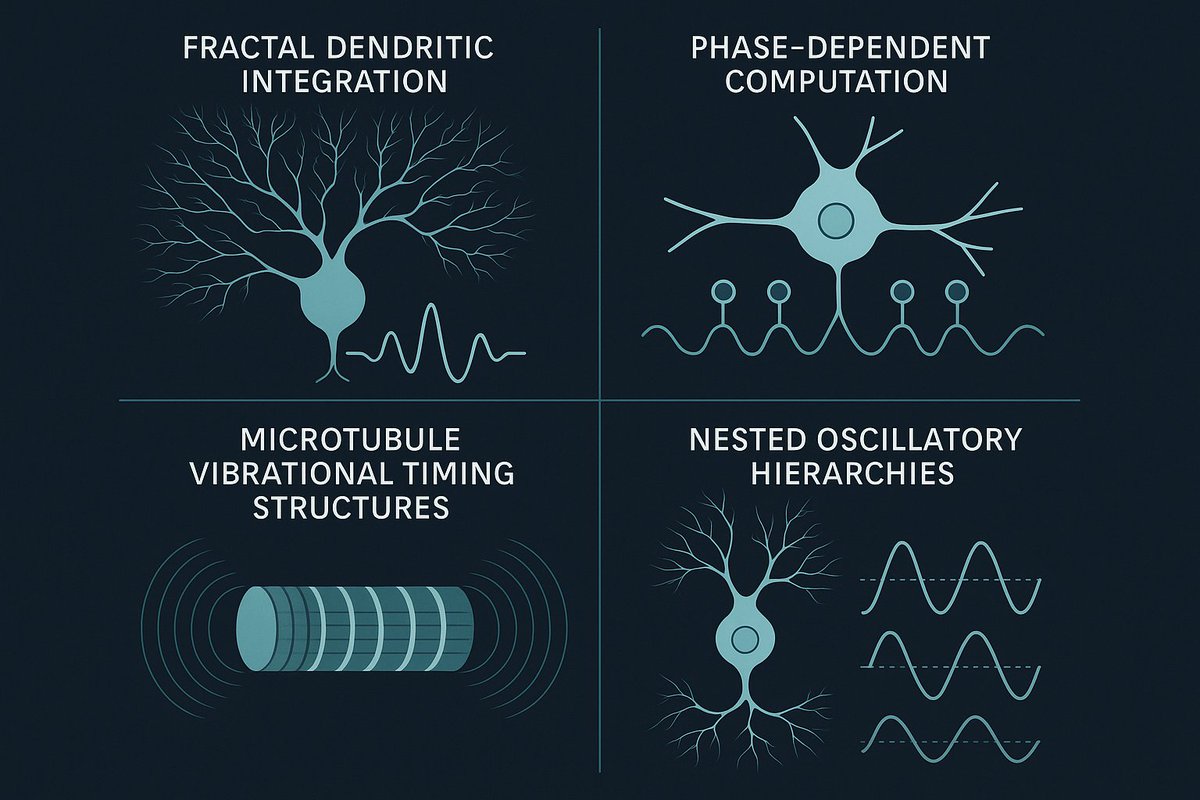
• fractal dendritic integration
• phase-dependent computation in local microdomains
• microtubule-scale vibrational timing structures
• multi-scale electromechanical coupling inside neurons
• nested oscillatory hierarchies coordinating local and global processing
These are not captured by today’s neural networks.
If AI is going to move beyond statistical pattern matching toward true natural-intelligence behaviors, we need models that reflect:
multi-scale geometry, recursive timing structure, and intrinsic dynamical complexity, not just more layers and parameters.
This isn’t about copying biology literally;
it’s about understanding the computational principles biology actually uses.
The next step is to model the right dynamics.
@AllenInstitute@mitbrainandcog@stanfordneuro@NeuroCellPress@NatureNeuro@HumanBrainProj @CIFARnews @MetaAI @DeepMind @googledeepmind@drmichaellevin @MITNeuro @MurrayShanahan@KordingLab
@avsm My suggestion is to try codex also. I found it better for F# and Prolog code gen than Sonnet 4.5 (have not tried Opus yet).
Additionally codex seems to be pretty decent with F*, a dependently typed language based in OCaml.
OpenAI Codex (preview) is the best code gen model I have used thus for F# code gen. (Sonnet 4.5 is not at the same level).
Did a flawless job of creating Fabulous-Maui bindings for a new Maui controls lib. See:
https://t.co/aGFZhTorwq