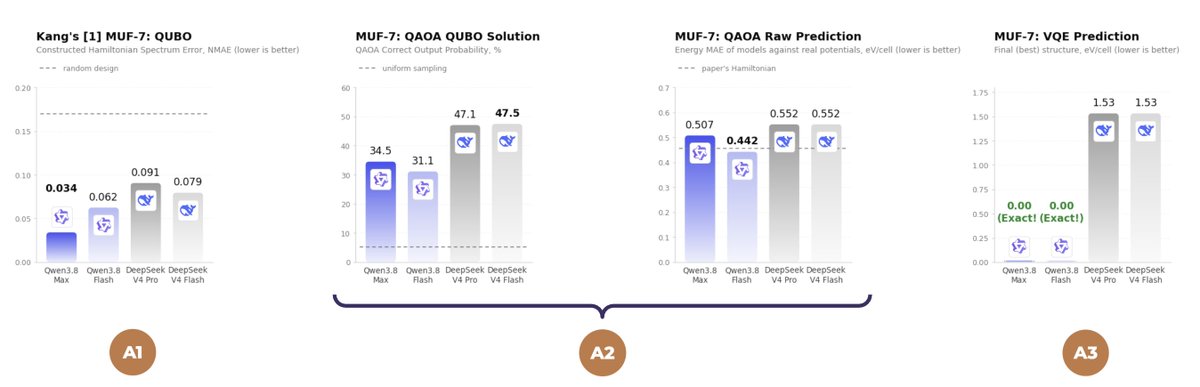
Check out QuMOF, a project where from a text brief we go to the lowest-energy linker arrangement in multivariate MOFs by solving QUBO with QAOA and VQE in the LLM-assisted pipeline.
On MUF-7 it found the exact ground-state structure.
https://t.co/yPICXOjd0R
#MOFs#OSIHack2026
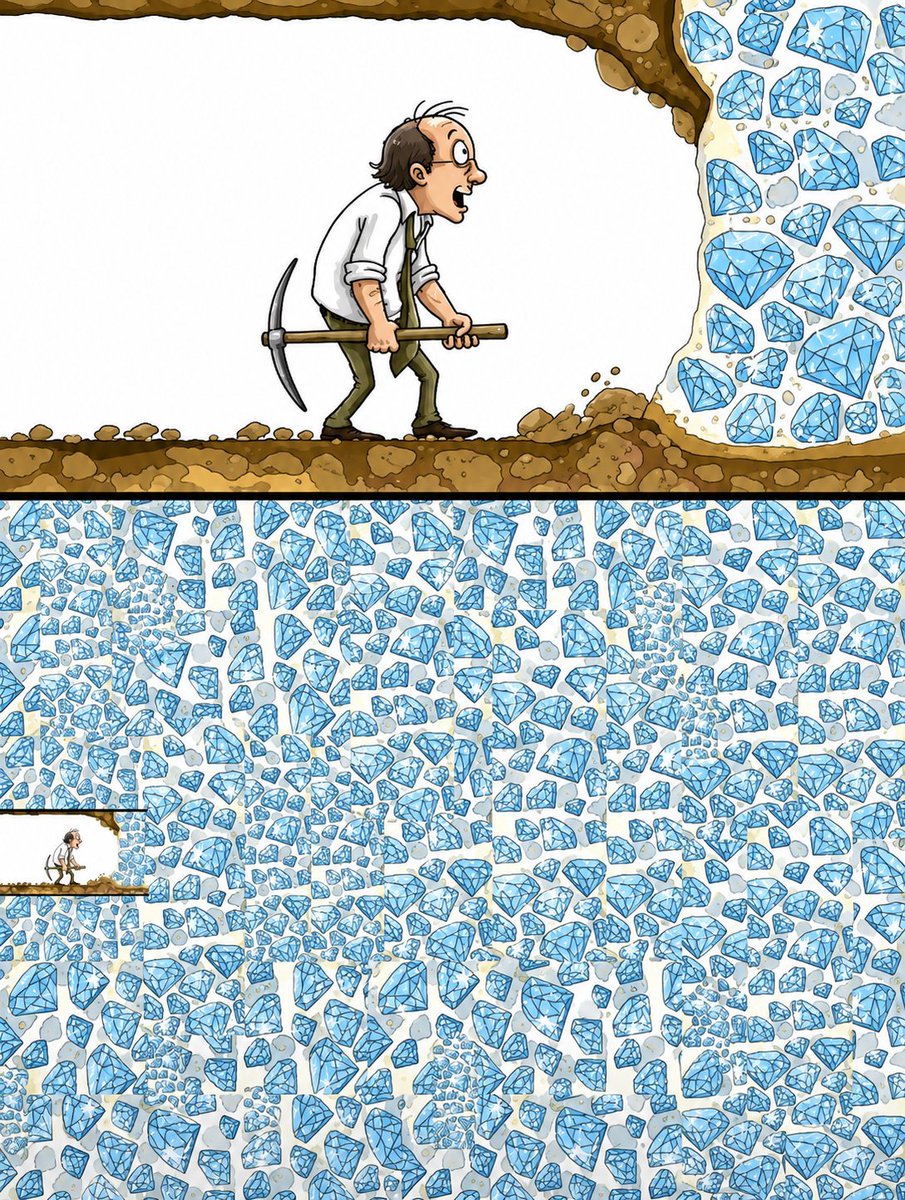
In forecasting work, I’m continually surprised by how many data scientists interviewing for related roles struggle with something as fundamental as cleaning and filtering data.
Interestingly, the great mathematician Andrey Kolmogorov himself created a remarkably effective tool for this…
The central problem of biology is the origin of biological organization. In our preprint, “Information-theoretic Limits on Programmatic Specification of Biological Systems,” we show, using information theory, that an organism does not contain enough organism-specific information to specify its own fully functioning microscopic organization.
For over 70 years—since the discovery of the double helix and the cracking of the genetic code—biology has been dominated by the metaphor of the genome as an executable computer script or structural blueprint. Yet, it has remained a central mystery how the genome organizes the entirety of the microscopic, fine-scale molecular biological machinery in space and time.
We wish to put forward a radically different formulation.
We show, as an analogy, that the genome is not a figure-skating program choreographing every molecular movement, but a hockey coach’s game plan : roster, tactics, line assignments. The exact trajectory of the puck is computed by physics at runtime. The game looks like hockey because of the specified ensemble, not because every coordinate was pre-programmed.
The organized machinery of life is not the execution of a fully prewritten organism-specific program under favorable conditions. Rather, it is the compilation of a coarse organism-specific specification by a shared physical background that is constitutive of biological organization.
We establish the threshold as a family of maximal capacity-compatible coarse-grainings, distinguish the proven impossibility below the threshold from the empirically realized coarse mappings above it, and locate the threshold empirically through worked cases of protein folding, E. coli, Drosophila early development, and C. elegans, together with computational verification using AlphaFold-2 (analyzing tertiary structures of 555,846 proteins across 46 AlphaFold-2 proteomes), the JCVI-syn3A 4D whole-cell simulation, and canonical stochastic gene network models. We further show that no known naturally realized environmental channel can close the gap. The result rules out programmed microstate determinism while leaving physical determinism untouched, reframes the genome as a generator specification rather than a trajectory program, and unifies gene-centric, developmental, and field-theoretic (bioelectric, morphogenetic, and related continuum) views of biological specification under a single coarse-graining framework.
It has not escaped our notice that this framework has fundamental implications for understanding evolutionary search, heritability, thermodynamic order, biological modeling, and artificial intelligence in biology, but these will be published elsewhere.
https://t.co/XchTPjE2II
Current data visualization technology has serious shortcomings that can lead to inaccuracies. @Cancer_dynamics researchers have introduced a new method to approach high dimensional datasets, making them easier to explore, understand, and interpret: https://t.co/yX0bUwDLfl
Google Deepmind argues that LLMs can never make real scientific discoveries.
They published a paper breaking down Albert Einstein’s private view of scientific discovery.
In a famous letter to his friend Maurice Solovine, Einstein drew a diagram of how science actually happens.
It is a cyclical loop.
First, you experience raw sensory data. Then, through a mysterious, non-logical act of intuition, you make an intuitive "jump" to abstract axioms. Finally, you use strict logical deduction to derive consequences from those axioms.
Generative AI has completely mastered two-thirds of this loop.
• Induction: Statistical pattern matching across billions of tokens.
• Deduction: Formal proof generation, like AlphaProof solving complex math Olympiads.
AI can crunch data and it can prove theorems.
But it cannot make the jump.
The paper argues that AI completely lacks Abduction, the generation of novel explanatory hypotheses when observational data is scarce.
The prevailing tech myth says that "creativity is just data compression." That if you feed an LLM enough text, scientific breakthroughs will naturally pop out.
Einstein’s formulation of General Relativity proves that is a delusion.
When Einstein formulated relativity, the observational data didn't demand a new physics framework; classical mechanics was still massively successful. The breakthrough required a conceptual rupture. An intuitive leap from physical reality to a brand-new set of foundational axioms.
An LLM can execute the math once the axioms are given. But it is structurally incapable of formulating those premises on its own.
It can interpolate inside existing human thought, but it cannot transcend it.
The translation of physical reality into formal axioms remains the absolute, hard bottleneck of artificial scientific invention.
We can build models with trillions of parameters. We can scale compute into the stratosphere.
We can make the calculator infinitely fast.
But until we solve grounding, the machine can process all the data in the universe.
It still can't make the jump.
You're 35. Your glasses prescription was −2.00 at 18. It's −5.00 now.
You can't see anything without glasses these days at all.
You spend 9 hours on screens. You wear your glasses. You just got a stronger pair. You've stopped bringing it up.
You don't have a vision problem. You have a signal problem.
In 2010, researchers at Queensland University put 28 adults under one hour of hyperopic defocus — the same type of blur your glasses create when you look at a screen.
Axial length increased by +8 µm. -> Eyesight is measurably worse, in ONE HOUR.
They tried the opposite — myopic defocus. Same 60 minutes. Same subjects.
Axial length decreased by −13 µm. -> Vision measurably improves, with eyeball LENGTH reducing.
One blur grows your eye. The other shrinks it. p < 0.0001. (Read et al., IOVS 2010)
Your optometrist lens subscription seller gives you full correction for distance. You wear that same prescription to look at a phone 30 cm from your face.
Your eyes under-accommodate. Research confirms myopes have ~2× the accommodative lag of emmetropes — about 0.6 D of hyperopic defocus at near. (PMC9544228)
That's the same signal that made the +8 µm happen. Every screen session. Every year.
In 2023, a JAMA Pediatrics RCT (n=263) found that naked-eye 3D vision training — creating myopic defocus — reduced axial elongation by 24%. With high adherence, 40%. (Xie et al., JAMA Pediatr 2024)
A 2025 study (n=208) showed visual training dropped axial elongation from 0.38 mm/year to 0.23 mm/year — 39.5% reduction. And it was additive — it worked on top of orthokeratology, atropine, and defocus lenses with no statistically significant difference between combinations. (Xu et al., Clin Optom 2025)
In 2025, a preprint documented full reversal of −6.00 D myopia in an adult in 5 months — using only myopic defocus and consciously triggered accommodation. n=1, not peer-reviewed. But the trajectory is suggestive. (Martinez-Saito, OSF 2025)
The industry has known since 2002 that passive undercorrection backfires. The Chung study showed giving kids −0.75 D blur with no training made things worse. Critics cite this endlessly. They ignore that it tested passive blur — not differential lenses + active focus. Apples and hand grenades.
The endmyopia approach is different:
Wear differential lenses (1.5–2.0 D weaker aka "computer glasses") for close work — eliminates the hyperopic defocus stimulus entirely
Wear normalized lenses (slightly weaker) for distance — creates mild myopic defocus
Active focus — consciously clear the blur, retraining the ciliary muscle
Two roads. One is a lifetime lens subscription sold by retail optometry, the other is you taking back control.
Keep feeding your eyes the signal that says "grow longer, clearer" — 8 hours a day, every day.
Or fix the signal.
Nobody is coming to tell you this. They make 150 billion dollars a year counting on you not figuring it out.
Extremely creative and elegant reframing of symmetry discovery by @park_jungy and @YuxuanChen23:
Instead of searching for symmetry generators directly, learn which transformations in a large Lie group keep the data distribution unchanged. 💞
Come chat at #ICML2026 🇰🇷
Rongxin Ouyang solved the one problem every researcher outside the English-speaking world has been silently suffering from.
It's called PDFMathTranslate. It translates entire scientific papers while keeping every math formula, every chart, every table, and every layout element perfectly intact.
No copy-pasting into Google Translate. No losing your equations. No reformatting 47 pages by hand.
Think of it as Google Translate meets LaTeX but it actually works on real PDFs.
Here's what this thing does:
→ Drop in any PDF. Choose your language. Hit translate.
→ Math formulas, charts, tables, footnotes. All preserved.
→ Bilingual PDF output. Original and translation side by side.
→ Google Translate, DeepL, OpenAI, Ollama. Your choice.
→ Run locally. Your papers never leave your machine.
→ GUI, CLI, Docker, Zotero plugin, MCP server.
Here's the wildest part:
Most PDF translators destroy the layout. Formulas become garbled text. Tables lose their structure. Charts disappear. You spend more time fixing the translation than reading it.
PDFMathTranslate uses AI layout detection to understand where every element sits on the page, translates only the text, and reconstructs the entire document with the original formatting intact.
This was accepted at EMNLP 2025, one of the top NLP conferences in the world. This is not a side project. This is peer-reviewed research turned into free software.
222,000+ downloads. 49,000+ Docker pulls. Topped GitHub's global trending for over a week.
The researchers who built this are from NUS Singapore and Tsinghua University. They open sourced it because language barriers should not stop science.
Professional PDF translation services charge $0.10 to $0.25 per word. A 30-page research paper has roughly 10,000 words. That is $1,000 to $2,500 per paper.
PDFMathTranslate does it in minutes. For $0.
This is the tool every non-English-speaking researcher has been waiting 20 years for.
It runs on your laptop. One command to install.
100% Open Source. MIT License.
🚨🚨NEW today from @IonQ_Inc & @ANSYS
Computational fluid dynamics (CFD) on a trapped-ion QC.
3D advection-diffusion. Spatially-varying velocity field. Run on IonQ Forte AND the 64-qubit Tempo precursor
This is the second Tempo paper this week
Why this one matters more. 🧵
Reminder
My brain broke after reading this paper.
Quantum computing just took a serious step toward breaking classical AI limits 👀
MIT Scientists just showed that small quantum computers can outperform EXPONENTIALLY larger classical systems on massive datasets.
In a new study, researchers introduced a framework called Quantum Oracle Sketching, where instead of loading entire datasets, the system streams random classical samples, processes them in quantum superposition, and then discards them.
This directly bypasses the biggest bottleneck in quantum machine learning, which is data loading 👀
The results are honestly kind of ridiculous. A system with fewer than 60 logical qubits can perform core machine learning tasks that would require exponentially larger classical memory, translating to roughly 10,000× to 1,000,000× smaller system size.
They validated this on real data, including single-cell RNA sequencing and movie review sentiment analysis, and showed it works across fundamental tasks like classification, dimension reduction, and linear algebra.
They also used Classical Shadows to efficiently extract useful outputs from quantum states, solving another long standing limitation.
This matters because modern AI is basically brute force, more data, more GPUs, more cost.