In 1948, a 32-year-old at Bell Labs published a paper nobody fully understood.
Engineers found it too mathematical. Mathematicians found it too engineering-focused. One prominent mathematician reviewed it negatively.
That paper - "A Mathematical Theory of Communication", became the founding document of the digital age.
The man was Claude Shannon. Father of Information Theory.
At 21, he wrote the most important master's thesis of the 20th century.
Working at MIT on an early mechanical computer, Shannon noticed its relay switches had exactly two states - open or closed. He had just taken a philosophy course introducing Boolean algebra, which also operated on two values: true and false.
Nobody had ever connected these two things.
His 1937 thesis proved that Boolean algebra and electrical circuits are mathematically identical, and that any logical operation could be built from simple switches.
Howard Gardner called it "possibly the most important, and also the most famous, master's thesis of the century."
Every digital computer ever built traces back to this insight.
At 29, he proved that perfect encryption exists.
During WWII, Shannon worked on classified cryptography at Bell Labs. His work contributed to SIGSALY, the secure voice system used for confidential communications between Roosevelt and Churchill.
In a classified 1945 memorandum, he mathematically proved the one-time pad provides perfect secrecy, unbreakable not just computationally, but provably, permanently, against an adversary with infinite power.
When declassified in 1949, it transformed cryptography from an art into a science. It laid the foundations for DES, AES, and every modern encryption standard.
At 32, he defined what information is.
His 1948 paper introduced one equation:
H = −Σ p(x) log p(x)
Shannon entropy. The average uncertainty in a probability distribution. The minimum bits required to encode a message.
Three things followed:
> He defined the bit - the fundamental unit of all information. His colleague John Tukey coined the name.
> He proved the channel capacity theorem, every communication channel has a maximum rate of reliable transmission. You can approach it. You can never exceed it.
> He unified telegraph, telephone, and radio into a single mathematical framework for the first time.
Robert Lucky of Bell Labs called it the greatest work "in the annals of technological thought."
Where his equation lives in AI today:
Cross-entropy loss - the function training every classifier and language model, is derived directly from H. Decision tree splits use information gain, which is H applied to data. Perplexity, the standard LLM evaluation metric, is an exponentiation of cross-entropy.
Every time a neural network trains, Shannon's formula runs inside it.
He also built the first AI learning device.
In 1950, Shannon built Theseus, a mechanical mouse that navigated a maze through trial and error, learned the correct path, and repeated it perfectly. Mazin Gilbert of Bell Labs said: "Theseus inspired the whole field of AI."
That same year he published the first paper on programming a computer to play chess. He co-organized the 1956 Dartmouth Workshop, the founding event of AI as a field.
The man:
He rode a unicycle through Bell Labs hallways while juggling. He built a flame-throwing trumpet, a rocket-powered Frisbee, and Styrofoam shoes to walk on the lake behind his house.
He called his home Entropy House.
When asked what motivated him: "I was motivated by curiosity. Never by the desire for financial gain. I just wondered how things were put together."
In 1985, he appeared unexpectedly at a conference in Brighton. The crowd mobbed him for autographs. Persuaded to speak at the banquet, he talked briefly, then pulled three balls from his pockets and juggled instead.
One engineer said: "It was as if Newton had showed up at a physics conference."
He died in 2001 after a decade with Alzheimer's, the cruel irony of information slowly leaving the mind of the man who defined what information was.
Claude, the AI model, is named after Claude Shannon, the mathematician who laid the foundation for the digital world we rely on today.
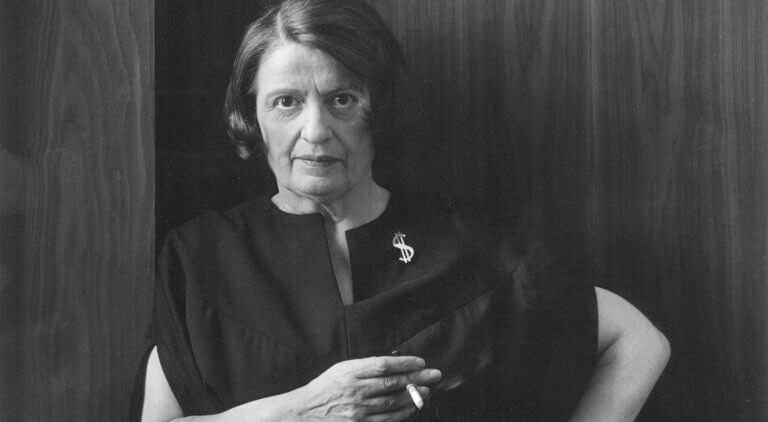
Escapó de la Rusia soviética a los 21 años con solo sus ideas.
A los 32, apareció en la TV nacional.
Pero sus opiniones sobre el dinero y la moral la convirtieron en la filósofa más odiada en 1950.
‣ 8 ideas de Ayn Rand que transformarán tu visión sobre la Riqueza y el Éxito:
Hay artistas que son juzgados por su físico: siempre ha pasado. Y si eres rubia y atractiva, eres poco menos que un maniquí.
Pero esta rubia demostró, al frente de su banda, estar llena de talento.
Y llamó a su banda así: Blondie.
Hoy, en #LaHistorietaMusical, Debbie Harry.
Grande, Charles Leclerc, winner of the 2024 Formula 1 Monaco Grand Prix! 😭😭😭🙌🙌🙌
Some of you know what a huge Scuderia Ferrari F1 and Charles Leclerc fan I am. He’s a romantically tragic and inspiring story of heartbreak and perseverance. If you’re a hopeless sporting romantic, grab a seat and a tissue, and indulge me by having a read at my little take on sports writing. This is what it means.
/// The Origins of “Il Predestinato”
One of only a few thousand native Monegasques, Charles grew up in a working class family in the Principality of Monaco surrounded by non-native billionaires and professional F1 racers who had adopted it as home. Watching cars zoom across the same streets where he walked to school each year at the Formula 1 Grand Prix through his home town became an intrinsic part of Charles’ passion from the start.
The son of a hairdresser mom and a never-quite-made-it Formula 3 racing driver Father, even as a young karting driver Charles was special. But in a sport where young prodigy karting kids with billionaire families are spending hundreds of thousands of dollars per year as young as age 8 or 9 for race entries, there’s no path forward without money backing you.
Charles’ brothers stopped karting so the family could focus every bit of their effort and finances to giving Charles the chance that his talent deserved. But eventually, the resources simply ran out. It was the end for Charles.
Enter the unlikely story of a young phenom Ferrari prospect, Jules Bianchi, a young driver racing through the junior ranks for the Ferrari Driver Academy, seeing the 8yrs younger Charles racing on karting circuits because of a friendship with Charles’ older brother. Jules immediately saw a “can’t miss” prospect, who had reached the end of his family’s ability to keep him racing.
Jules would have none of the thought that Charles could not keep racing because of money. He intervened, connecting the Leclerc family with the Todt family of legendary former Ferrari team boss Jean Todt, begging Todt and Ferrari to find a path forward for Charles and sign him to a Ferrari Academy contract. They did.
Jules became not only a mentor and career-saver, but also close family friend and Godfather to Charles. As Jules’ career began the ascendancy through a backmarker F1 team towards an almost assured Ferrari Formula 1 seat, he scored his very first points in a dreadful car with a backmarker team at the 2014 Monaco Grand Prix. An incredible achievement.
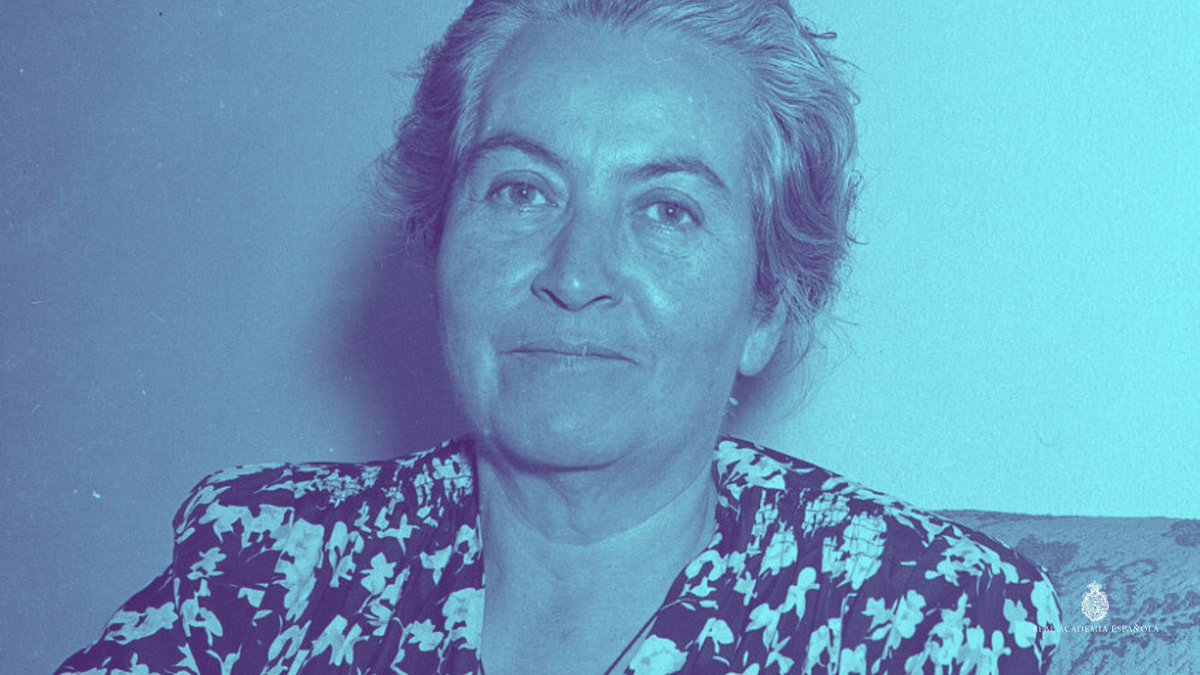
«Donde haya un árbol que plantar, plántalo tú. Donde haya un error que enmendar, enmiéndalo tú. Donde haya un esfuerzo que todos esquivan, hazlo tú. Sé tú el que aparta la piedra del camino». La poeta Gabriela Mistral recibió un día como hoy en 1945 el Premio Nobel de Literatura.
Proud to showcase the work the Okta FGA team to push the product to 1M RPS and 100B relationship tuples on top of @OpenFGA. To infinity and beyond🚀!
https://t.co/nTR55ApqDQ
España marcando con todo a Michael Jordan en los Juegos Olímpicos de Los Ángeles en 1984.
Llamen a las autoridades.
Noten el calzado Converse (pre-Nike).
Situación desesperante: ando en busca de trabajo para poder solventar los gastos que implica estudiar en Montevideo. Se me agotan los días de poder estar acá y también el dinero que tenia y tengo. Sinceramente no sé que hacer, me he movido y aún nada.