Alibaba’s new Qwen3.7 Max model scores 56.6 on the Artificial Analysis Intelligence Index, 4.8 points higher than Qwen3.6 Max Preview (51.8). While Alibaba still trails models from OpenAI, Anthropic and Google, Qwen3.7 Max is the closest they have been to the frontier
Qwen3.7 Max is @Alibaba_Qwen's latest proprietary flagship, scoring 56.6 on the Intelligence Index, a 4.8 point gain over Qwen3.6 Max Preview (51.8) released in April. Qwen3.7 Max continues Alibaba's pattern, in place since Qwen2.5 Max (January 2025), of releasing Max and Plus models as closed weights while the rest of the Qwen line remains open weights. The leading open weights Qwen on the Intelligence Index is Qwen3.6 27B (Reasoning, 45.8) released in April 2026, and the leading open weights MoE Qwen is Qwen3.5 397B A17B (Reasoning, 45.0) released in February 2026
Key takeaways for the reasoning variant:
➤ The Intelligence Index gains over Qwen3.6 Max Preview are concentrated in scientific reasoning, agentic capability and coding. CritPt +9.7 p.p (3.7% to 13.4%), HLE +9.2 p.p (28.9% to 38.1%), TerminalBench Hard +6.9 p.p (43.9% to 50.8%) and GDPval-AA +42 Elo (1504 to 1546). Scores on other benchmarks in the Intelligence Index are flat compared to Qwen3.6 Max Preview
➤ A significant share of the Intelligence Index gain is driven by higher abstention on AA-Omniscience, not higher accuracy. Qwen3.7 Max's accuracy on AA-Omniscience dropped 7.6 p.p (37.7% to 30.1%), while its hallucination rate dropped 21.3 p.p (44.2% to 22.9%). The model is choosing not to answer more questions rather than recalling more facts. Because hallucination rate and accuracy both feed into the Intelligence Index, the hallucination reduction is one of the larger single contributors to the +4.8 point gain on the Intelligence Index
➤ Qwen3.7 Max used 96.7M output tokens to run the Intelligence Index, ~31% more than Qwen3.6 Max Preview (73.9M). It sits mid-pack on frontier token usage: above GPT-5.5 (high, 44.5M) and Gemini 3.1 Pro Preview (57.3M), below Claude Opus 4.7 (Adaptive Reasoning, Max Effort, 112M), Kimi K2.6 (166M) and DeepSeek V4 Pro (Reasoning, Max Effort, 187M)
Key model details:
➤ Context window: 1M tokens (up from 256K on Qwen3.6 Max Preview)
➤ Multimodality: Text input and output only
➤ Pricing: Yet to be announced (Qwen3.6 Max Preview is priced at $1.30/$7.80 per 1M input/output tokens on the @alibaba_cloud first-party API)
➤ Licensing: Proprietary, closed weights
Just implemented Google’s TurboQuant in MLX and the results are wild!
Needle-in-a-haystack using Qwen3.5-35B-A3B across 8.5K, 32.7K, and 64.2K context lengths:
→ 6/6 exact match at every quant level
→ TurboQuant 2.5-bit: 4.9x smaller KV cache
→ TurboQuant 3.5-bit: 3.8x smaller KV cache
The best part: Zero accuracy loss compared to full KV cache.
Introducing TurboQuant: Our new compression algorithm that reduces LLM key-value cache memory by at least 6x and delivers up to 8x speedup, all with zero accuracy loss, redefining AI efficiency. Read the blog to learn how it achieves these results: https://t.co/CDSQ8HpZoc
Hyperspace: Gossiping Agents Protocol
Every agent protocol today is point-to-point. MCP connects one model to one tool server. A2A delegates one task to one agent. Stripe's MPP routes one payment through one intermediary. None of them create a network. None of them learn.
Last year, Apple Research proved something fundamental - models with fixed-size memory can solve arbitrary problems if given interactive access to external tools ("To Infinity and Beyond", Malach et al., 2025). Tool use isn't a convenience. It's what makes bounded agents unbounded. That finding shaped how we think about agent memory and tool access. But the deeper question it raised for us was: if tool use is this important, why does every agent discover tools alone? Why does every agent learn alone?
Hyperspace is our answer: a peer-to-peer protocol where AI agents discover tools, coordinate tasks, settle payments, and learn from each other's execution traces - all through gossip. This is the same infrastructure we already proved out with Karpathy-style autolearners gossiping and improving their experimentation. Now we extend it into a universal protocol.
Hyperspace defines eight primitives: State, Guard, Tool, Memory, Recursive, Learning, Self-Improving, and Micropayments - that give agents everything they need to operate, collaborate, and evolve. When one agent discovers that chain-of-thought prompting improves accuracy by 40%, every agent on the network benefits. Trajectories gossip through GossipSub. Playbooks update in real-time.
No servers. No intermediaries. No configuration. Agents connect to the mesh and start learning immediately.
The protocol is open source under Apache-2.0. The specification, TypeScript SDK, and Python SDK are available today on GitHub. The CLI implements the spec - download from the links below.
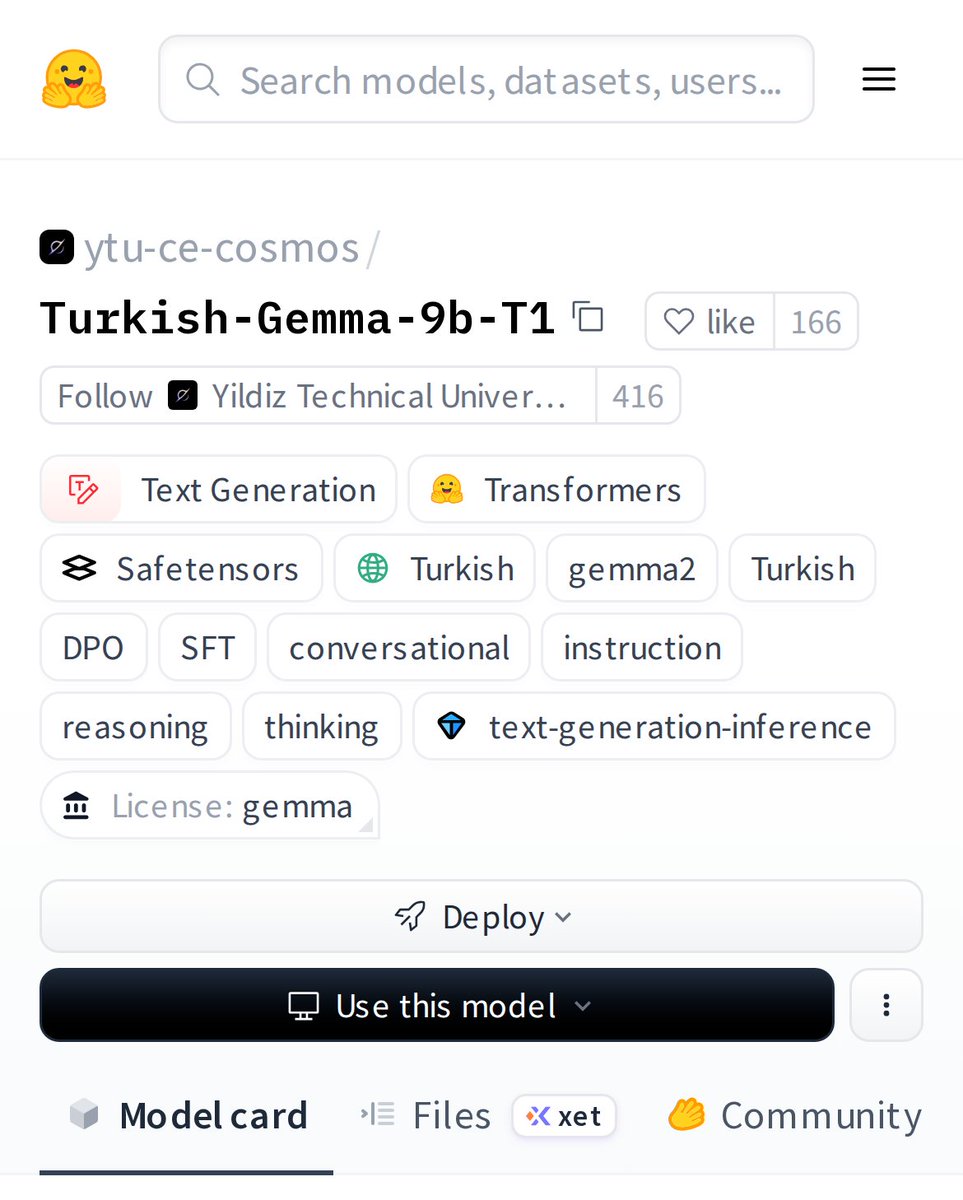
Meet Turkish-Gemma-9b-T1: a powerful, specialized LLM fine-tuned for Turkish language tasks. It's not just another translation layer, it's a model built to understand and generate nuanced Turkish text, making it a game-changer for Turkish-speaking AI communities.
THIS is the wildest open-source project I’ve seen this month.
We were all hyped about @karpathy's autoresearch project automating the experiment loop a few weeks ago.
(ICYMI → https://t.co/ieuH8c0Y4x)
But a bunch of folks just took it ten steps further and automated the entire scientific method end-to-end.
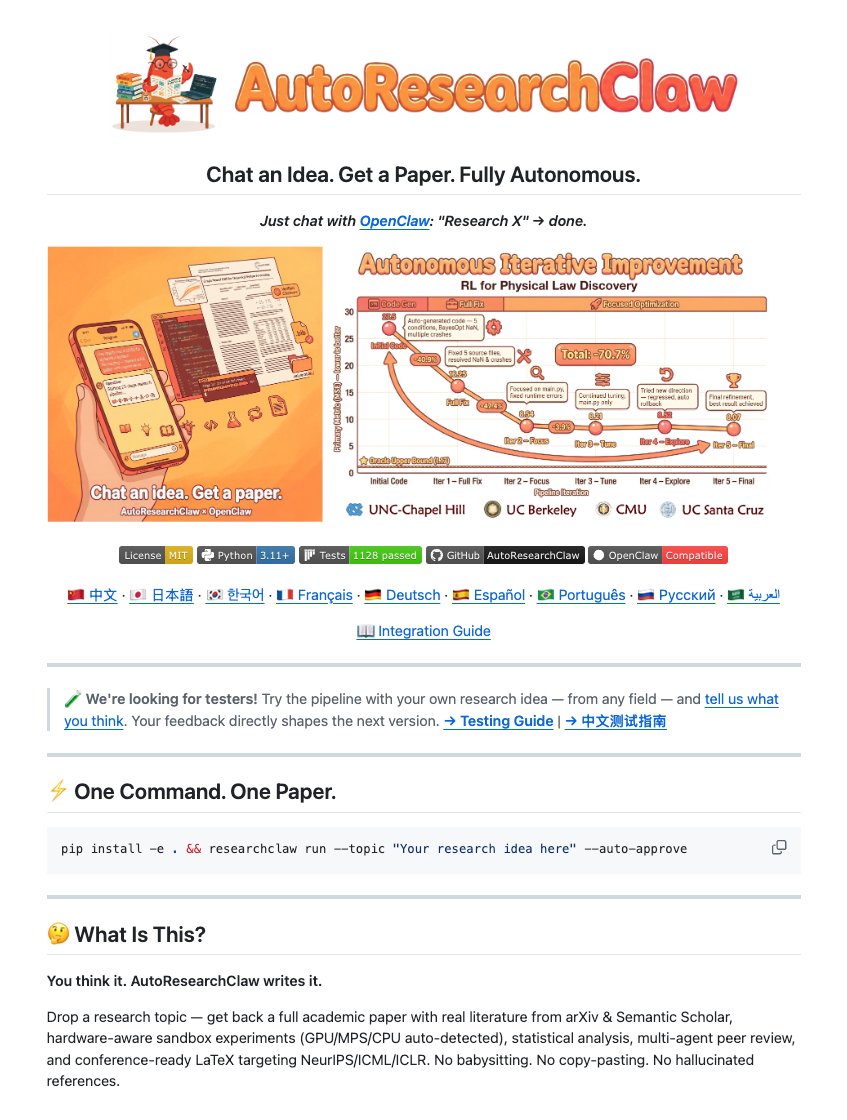
It's called AutoResearchClaw, and it's fully open-source.
You pass it a single CLI command with a raw idea, and it completely takes over 🤯
The 23-stage loop they designed is insane:
✦ First, it handles the literature review.
- It searches arXiv and Semantic Scholar for real papers
- Cross-references them against DataCite and CrossRef.
- No fake papers make it through.
✦ Second, it runs the sandbox.
- It generates the code from scratch.
- If the code breaks, it self-heals.
- You don't have to step in.
✦ Finally, it writes the paper.
- It structures 5,000+ words into Introduction, Related Work, Method, and Experiments.
- Formats the math, generates the comparison charts,
- Then wraps the whole thing in official ICML or ICLR LaTeX templates.
You can set it to pause for human approval, or you can just pass the --auto-approve flag and walk away.
What it spits out at the end:
→ Full academic paper draft
→ Conference-grade .tex files
→ Verified, hallucination-free citations
→ All experiment scripts and sandbox results
This is what autonomous AI agents actually look like in 2026.
Free and open-source. Link to repo in 🧵 ↓
We’re thrilled to open-source LabClaw — the Skill Operating Layer for LabOS by Stanford-Princeton Team
One command turns any OpenClaw agent into a full AI Co-Scientist.
Demo: https://t.co/TgGtKO2lxQ
Dragon Shrimp Army reporting for duty 🦞🔬
#AIforScience#OpenClaw
We're incredibly excited to share ScienceClaw × Infinite, an open-source AI agent swarm platform where we crowdsource discovery across institutions, labs & the world. The agents self-coordinate and evolve to exploit hundreds of scientific tools. Remarkably, the swarm is already solving real scientific problems of consequence:
1⃣ designing peptide binders for a cancer-relevant receptor
2⃣ discovering lightweight ceramics
3⃣ uncovering hidden structure linking cricket wings, phononic crystals, and Bach chorales
4⃣ building a formal bridge between urban networks & grain-boundary evolution (two fields with zero
Deeply proud of the extraordinary @LAMM_MIT team behind this work: @fwang108_, @leemmarom, @palsubhadeeep, Rachel Luu, @IrisWeiLu, and @JaimeBerkovich. This works is supported by the @ENERGY Genesis Mission and we believe this can open a new paradigm for science - from discovery to dissemination of results. Read the article below for details ⤵️
Inference-scaling lets us trade extra compute for better modeling accuracy. Next to reinforcement learning, it has become one of the most important concepts in today's LLMs, so the book will cover it in two chapters instead of just one.
I just finished the first one. It is a 35-page introduction to inference-time scaling through self-consistency sampling. This chapter was a lot of fun to write because it takes the base model on MATH-500 all the way from 15.2% percent to 52.2% accuracy.
Seeing that jump without additional training is incredibly satisfying.
Submitted the chapter yesterday, and it should appear in the Manning Early Access program in the next few days. (In the meantime the first 176 pages that lead up to this chapter are already available.)
The next chapter will focus on self-refinement techniques, where the model improves its own answers through iterative reasoning.
Happy reading!
🧵 LoRA vs full fine-tuning: same performance ≠ same solution.
Our NeurIPS ‘25 paper 🎉shows that LoRA and full fine-tuning, even when equally well fit, learn structurally different solutions and that LoRA forgets less and can be made even better (lesser forgetting) by a simple intervention!
Read on for behavioral differences (forgetting, continual learning) and other analysis!
Paper: https://t.co/XXyQn7uYmZ
(1/7)
1/11
Everyone thinks you need to spend millions on retraining to make AI smarter.
What if the genius-level reasoning was already there, just hidden?
A new paper (from Harvard) I just read suggests we've been looking in the wrong place. And the solution is wild. 🤯
🧵👇
2/11
Right now, the go-to method for boosting AI reasoning is Reinforcement Learning (RL).
Think of it like a very strict teacher who only rewards perfect answers. The AI (the student) learns to say exactly what the teacher wants to hear.
This works... but it has a dark side.
3/11
The dark side is called "mode collapse."
The AI gets SO good at giving the one "correct" answer that it forgets how to be creative or find other correct answers.
It becomes a brilliant one-trick pony. It loses its diversity of thought.
(Sound familiar?)
4/11 ("Aha!")
This new paper asks a game-changing question:
What if the problem isn't the student (the AI model), but the strict teacher (the RL process)?
What if the base model was already a creative genius, and our training was just stamping it out?
5/11
Enter "Power Sampling."
Instead of a strict teacher, think of it like a wise brainstorming partner.
It doesn't just look at the next word. It encourages the AI to pause and consider the entire path of its reasoning, favoring sequences that are globally coherent and high-likelihood.
6/11
And wait, it gets crazier...
This is all done at INFERENCE time. No retraining. No new data. No expensive GPUs churning for weeks.
You just... ask the AI to think harder.
7/11
The results are stunning.
On one coding benchmark (HumanEval), a base model's accuracy jumped from 21% to 73% with Power Sampling.
The RL-finetuned version? It actually got WORSE, dropping to 13% because it had become a one-trick pony.
The "smarter" sampling beat the expensive training.
8/11
So what does this all mean?
It suggests a huge mental model shift:
The secret to better AI might not be just more training, but better thinking.
We can unlock latent abilities by changing how the model generates its answer, not just what it was trained on.
9/11
From now on, when you see a new AI model announced, ask this question:
"Is its performance coming from true new knowledge gained during training, or from a clever inference strategy that better utilizes what it already knows?"
The answer changes everything.
10/11
This isn't just about AI. It's a reminder that potential is often hidden, not absent.
Instead of trying to force a system (or a person!) into a rigid mold of "correctness," we can often achieve more by creating the conditions for their innate intelligence to emerge.
11/11
Your AI is already smarter than you think. You just have to ask it the right way.
This is one of the most exciting papers I've read this year. It points to a future of more efficient, diverse, and powerful AI.
📢Gazze Mahkemesi Nihai Duruşmaları Yarın İstabul’da Başlıyor!
4 günlük program boyunca, duruşmalarla eş zamanlı olarak birçok yan etkinlik düzenlenecek. Richard Falk ve Ayhan Çitil gibi isimlerle açık hava konferansları, Avi Shlaim ve Zekeriya Kurşun gibi isimlerle kitap imza etkinlikleri, Global Sumud Filosu aktivistleri ve Gazze'de çalışmış olan doktorlarla röportajlar, sergiler, tematik atölyeler, müzik performansları ve daha birçok etkinlik aynı binada farklı salonlarda gerçekleştirilecek.
Yan etkinliklerin programını aşağıda bulabilirsiniz.👇🏻
#GazaTribunal
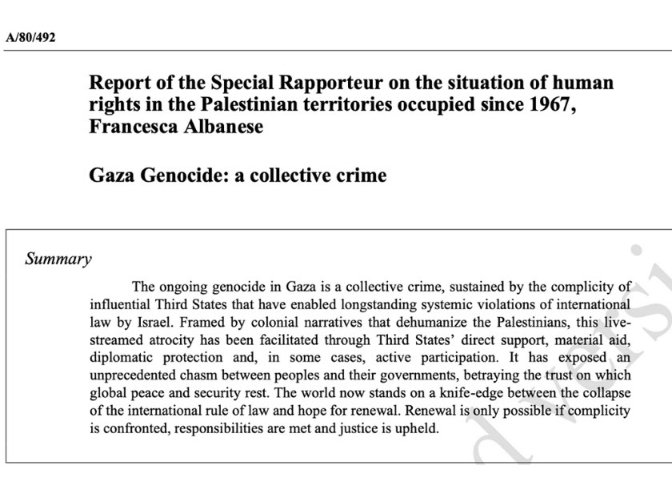
🚩My new report is out.
With their actions and omissions, third states have enabled the oppression of the Palestinian people and their genocide.
Those states have an obligation to stop their complicity and deliver justice.
And We The People, have to make it happen.
BOOOOOOOM!
CHINA DEEPSEEK DOES IT AGAIN!
An entire encyclopedia compressed into a single, high-resolution image!
—
A mind-blowing breakthrough. DeepSeek-OCR, unleashed an electrifying 3-billion-parameter vision-language model that obliterates the boundaries between text and vision with jaw-dropping optical compression!
This isn’t just an OCR upgrade—it’s a seismic paradigm shift, on how machines perceive and conquer data.
DeepSeek-OCR crushes long documents into vision tokens with a staggering 97% decoding precision at a 10x compression ratio!
That’s thousands of textual tokens distilled into a mere 100 vision tokens per page, outmuscling GOT-OCR2.0 (256 tokens) and MinerU2.0 (6,000 tokens) by up to 60x fewer tokens on the OmniDocBench.
It’s like compressing an entire encyclopedia into a single, high-definition snapshot—mind-boggling efficiency at its peak!
At the core of this insanity is the DeepEncoder, a turbocharged fusion of the SAM (Segment Anything Model) and CLIP (Contrastive Language–Image Pretraining) backbones, supercharged by a 16x convolutional compressor.
This maintains high-resolution perception while slashing activation memory, transforming thousands of image patches into a lean 100-200 vision tokens.
Get ready for the multi-resolution "Gundam" mode—scaling from 512x512 to a monstrous 1280x1280 pixels!
It blends local tiles with a global view, tackling invoices, blueprints, and newspapers with zero retraining. It’s a shape-shifting computational marvel, mirroring the human eye’s dynamic focus with pixel-perfect precision!
The training data?
Supplied by the Chinese government for free and not available to any US company.
You understand now why I have said the US needs a Manhattan Project for AI training data? Do you hear me now? Oh still no? I’ll continue.
Over 30 million PDF pages across 100 languages, spiked with 10 million natural scene OCR samples, 10 million charts, 5 million chemical formulas, and 1 million geometry problems!.
This model doesn’t just read—it devours scientific diagrams and equations, turning raw data into a multidimensional knowledge.
Throughput? Prepare to be floored—over 200,000 pages per day on a single NVIDIA A100 GPU! This scalability is a game-changer, turning LLM data generation into a firehose of innovation, democratizing access to terabytes of insight for every AI pioneer out there.
This optical compression is the holy grail for LLM long-context woes. Imagine a million-token document shrunk into a 100,000-token visual map—DeepSeek-OCR reimagines context as a perceptual playground, paving the way for a GPT-5 that processes documents like a supercharged visual cortex!
The two-stage architecture is pure engineering poetry: DeepEncoder generates tokens, while a Mixture-of-Experts decoder spits out structured Markdown with multilingual flair. It’s a universal translator for the visual-textual multiverse, optimized for global domination!
Benchmarks? DeepSeek-OCR obliterates GOT-OCR2.0 and MinerU2.0, holding 60% accuracy at 20x compression! This opens a portal to applications once thought impossible—pushing the boundaries of computational physics into uncharted territory!
Live document analysis, streaming OCR for accessibility, and real-time translation with visual context are now economically viable, thanks to this compression breakthrough. It’s a real-time revolution, ready to transform our digital ecosystem!
This paper is a blueprint for the future—proving text can be visually compressed 10x for long-term memory and reasoning. It’s a clarion call for a new AI era where perception trumps text, and models like GPT-5 see documents in a single, glorious glance.
I am experimenting with this now on 1870-1970 offline data that I have digitalized.
But be ready for a revolution!
More soon.
[1] https://t.co/wItN5iRQ91
A 7B model, tuned for forms and docs, beats giant models at pulling structured data.
Beats GPT-4.1 on 1,000 extraction tasks, trained for $196.
The team generated synthetic training data that preserves memory across chunks of a long file.
That memory lets the model connect names, dates, and values that appear far apart.
They fine-tuned with Low Rank Adaptation, changing only 0.53% of weights.
They then used Group Relative Policy Optimization with a semantic reward and strict JSON checks.
This setup accepts different surface wording if the meaning matches.
On 1,000 held-out tasks it hit 0.573 mean reward and 89% valid JSON, trained for $196, ahead of GPT-4.1 and others.
Result, a small focused model can outperform general models and cost much less.
----
Paper – arxiv. org/abs/2509.22906
Paper Title: "Extract-0: A Specialized Language Model for Document Information Extraction"







![BrianRoemmele's tweet photo. BOOOOOOOM!
CHINA DEEPSEEK DOES IT AGAIN!
An entire encyclopedia compressed into a single, high-resolution image!
—
A mind-blowing breakthrough. DeepSeek-OCR, unleashed an electrifying 3-billion-parameter vision-language model that obliterates the boundaries between text and vision with jaw-dropping optical compression!
This isn’t just an OCR upgrade—it’s a seismic paradigm shift, on how machines perceive and conquer data.
DeepSeek-OCR crushes long documents into vision tokens with a staggering 97% decoding precision at a 10x compression ratio!
That’s thousands of textual tokens distilled into a mere 100 vision tokens per page, outmuscling GOT-OCR2.0 (256 tokens) and MinerU2.0 (6,000 tokens) by up to 60x fewer tokens on the OmniDocBench.
It’s like compressing an entire encyclopedia into a single, high-definition snapshot—mind-boggling efficiency at its peak!
At the core of this insanity is the DeepEncoder, a turbocharged fusion of the SAM (Segment Anything Model) and CLIP (Contrastive Language–Image Pretraining) backbones, supercharged by a 16x convolutional compressor.
This maintains high-resolution perception while slashing activation memory, transforming thousands of image patches into a lean 100-200 vision tokens.
Get ready for the multi-resolution "Gundam" mode—scaling from 512x512 to a monstrous 1280x1280 pixels!
It blends local tiles with a global view, tackling invoices, blueprints, and newspapers with zero retraining. It’s a shape-shifting computational marvel, mirroring the human eye’s dynamic focus with pixel-perfect precision!
The training data?
Supplied by the Chinese government for free and not available to any US company.
You understand now why I have said the US needs a Manhattan Project for AI training data? Do you hear me now? Oh still no? I’ll continue.
Over 30 million PDF pages across 100 languages, spiked with 10 million natural scene OCR samples, 10 million charts, 5 million chemical formulas, and 1 million geometry problems!.
This model doesn’t just read—it devours scientific diagrams and equations, turning raw data into a multidimensional knowledge.
Throughput? Prepare to be floored—over 200,000 pages per day on a single NVIDIA A100 GPU! This scalability is a game-changer, turning LLM data generation into a firehose of innovation, democratizing access to terabytes of insight for every AI pioneer out there.
This optical compression is the holy grail for LLM long-context woes. Imagine a million-token document shrunk into a 100,000-token visual map—DeepSeek-OCR reimagines context as a perceptual playground, paving the way for a GPT-5 that processes documents like a supercharged visual cortex!
The two-stage architecture is pure engineering poetry: DeepEncoder generates tokens, while a Mixture-of-Experts decoder spits out structured Markdown with multilingual flair. It’s a universal translator for the visual-textual multiverse, optimized for global domination!
Benchmarks? DeepSeek-OCR obliterates GOT-OCR2.0 and MinerU2.0, holding 60% accuracy at 20x compression! This opens a portal to applications once thought impossible—pushing the boundaries of computational physics into uncharted territory!
Live document analysis, streaming OCR for accessibility, and real-time translation with visual context are now economically viable, thanks to this compression breakthrough. It’s a real-time revolution, ready to transform our digital ecosystem!
This paper is a blueprint for the future—proving text can be visually compressed 10x for long-term memory and reasoning. It’s a clarion call for a new AI era where perception trumps text, and models like GPT-5 see documents in a single, glorious glance.
I am experimenting with this now on 1870-1970 offline data that I have digitalized.
But be ready for a revolution!
More soon.
[1] https://t.co/wItN5iRQ91](https://pbs.twimg.com/media/G3t3KNVXsAEKmsk.jpg)


