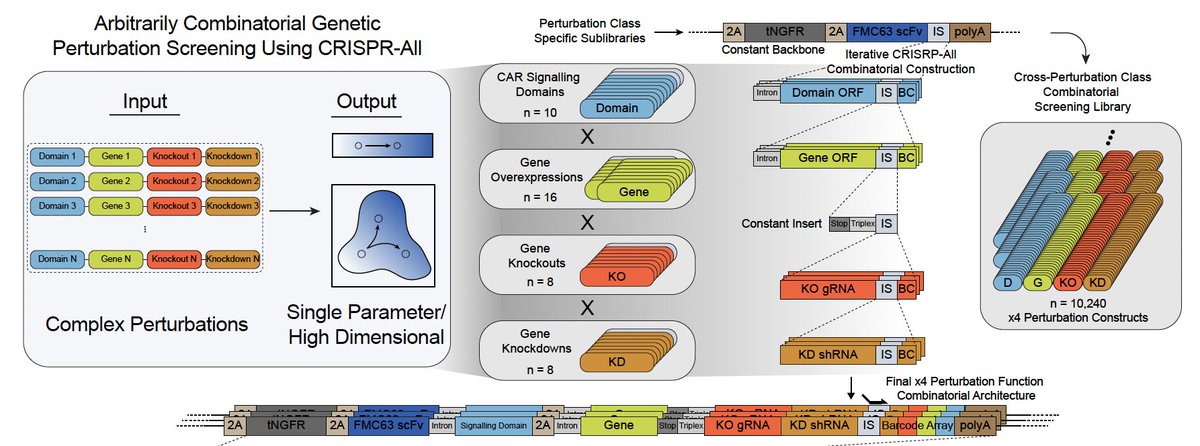
Excited to introduce CRISPR-All! – a flexible, high-throughput framework that combines virtually any perturbation modality (CRISPRko, CRISPRi, CRISPRa, shRNA, knock-in, base/prime editing, etc.) in the same cell, at scale.
Paired with single-cell RNA-seq @10xGenomics and rich phenotypic readouts, it unlocks massively combinatorial genetic screens and new cell states previously out of reach.
Outstanding work led by @Roth_Lab@AustinMHartman
https://t.co/hU3OKDfMSd
Congrats to my former @UCSF next door neighbor Sonja Schrepfer and colleagues on taking a key step towards restoring beta cell function in people with T1D without immunosuppression. This moves us towards a cure! @Sana_Biotech@NEJM@AtUcsf
🌟Exciting ‼️@UCSF Transplant Surgeon Dr. Shareef Syed has been selected as an Associate Member of the @AmCollSurgeons Academy of Master Surgeon Educators. This Fall, he'll be officially inducted into the academy in Chicago. Congratulations, Dr. Syed🏅
Achieving and maintaining harmony between the liver and the host immune system is critical for liver graft health. Dr. @SandyFeng8, Vice-Chair of Research has earned a $7.2M @NIAIDNews grant to decode the tipping point between calm and crisis in children with liver transplants‼️
Just released our pre-print on bioRxiv for UNCOVERseq, an improved off-target discovery platform for Cas9 and base editors! Great collaboration with the awesome team at IDT @idtdna
https://t.co/o39DHgvuUi
‼️We’re happy to share that @UCSF Fellow Dr. Hillary Braun is staying in San Francisco and will be joining the Division of Transplant Surgery @UCSFTransplant as Assistant Professor of Clinical Surgery after completing her Abdominal #Transplant Surgery Fellowship👏👏
CHOIR is officially published @NatureGenet. No more arbitrary decisions in clustering. Add this to your single-cell toolbox - it will save you so much heart ache. And now it can scale to millions of cells. Compliments of the very talented @cathrine_sant.
From “preprint” to “in press”!
Congrats @MValdearcos@RachelLippert and the rest of our outstanding team. @AtUcsf@UCSF#microglia#hypothalamus
Microglia mediate the early-life programming of adult glucose control: Cell Reports https://t.co/ORt1WPDMZZ
Spend some time reading the March Literature Watch "A trip down (obesogenic) memory lane" by Sarah Alshammery and Natasha M. Rogers: https://t.co/GHm1spaq48
🚨Excited to share our latest work, now out in @NatureBiotech ! We introduce SEED-Selection, a powerful method that enables high-efficiency enrichment of T cells edited at multiple loci in a single step 🧵👇
🔗 https://t.co/5Dh4hQIfDn
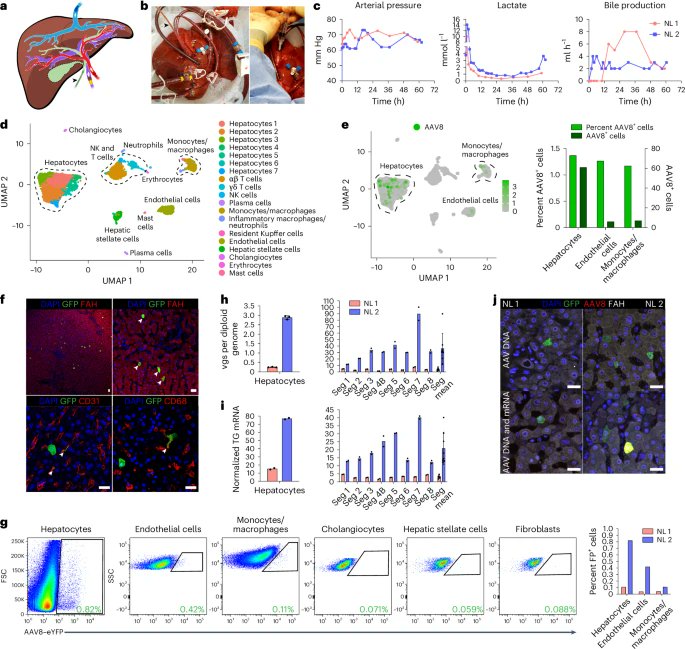
‼️Dr. Holger Willenbring, @UCSFLiverCenter Director and @UCSFTransplant Surgeon Dr. Garrett Roll explore AAV capsid prioritization in normal and steatotic human livers maintained by machine perfusion in their latest paper published in @NatureBiotech 👉 https://t.co/MbON3hHRT2
Our final section, Cell Engineering🧫🧬 @HuiCharlotte of @j_eyquem/@yimmieg labs will start things off, followed by Lauren Tabor of the Bruno lab and Marta Borowska of the Garcia lab! We are stoked for our keynote Dr. Jennifer Doudna @doudna_lab 🤩 can’t wait to see you there!
Happy to share our new work describing DESynR genes!
The evolution of new human protein-coding genes relies on repurposing protein domains from ancestral genes, rather than de novo sequence creation. New genes evolved from old parts, and while we have methods that enable high-throughput generation and screening of base-pair level sequence evolution (mutagenesis, directed evolution, CRISPR, etc), we lack similar scalable technologies for domain-level evolution.
We developed a high-throughput combinatorial molecular assembly method to generate thousands of barcoded novel genes from the domain building blocks of natural genes, termed DESynR (Domain Engineered via Synthesis and Recombination) genes.
Our latest paper with @Molofsky_lab is out! tweetorial to follow. Group 2 innate lymphoid cells promote inhibitory synapse development and social behavior | Science https://t.co/u2fQ2j2OeN
@jerika_barron @ Nick Mroz
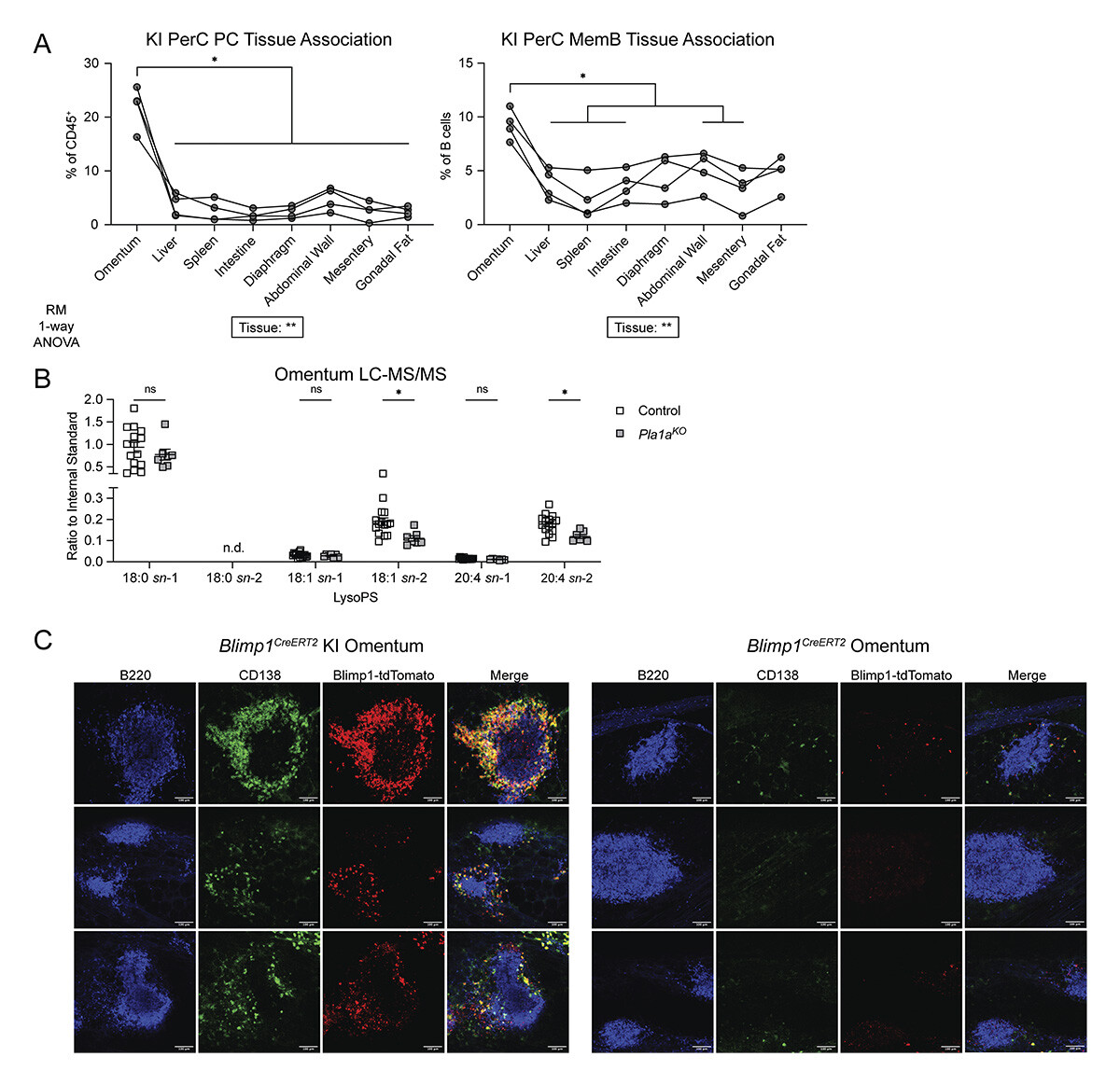
In @JExpMed Tam, Cyster et al @UCSF report that a lymphoma-associated gain-of-function GPR34 variant promotes immune cell accumulation in the peritoneal cavity & demonstrate that this accumulation requires the lysophosphatidylserine-generating enzyme PLA1A https://t.co/Avd8zPO2YI