Right now, we are helping a Lisbon non-profit that supports refugees and migrants scale their work across Portugal 🇵🇹
Earlier this year, @LisboaUX & @LisboaJS_ started pairing young developers and designers with mentors to build critical digital tools for non-profits. The impact has been real, and now we’re ready to scale.
Our vision: Empower 50 non-profits by the end of 2027.
To hit this milestone, we need infrastructure, design, and dev-tool partners to step up. If your company can provide tooling, financial sponsorship, or engineering expertise, you will be creating real, direct impact.
How you can support us:
🛠️ Dev Tools & Infra: Provide licenses, API credits, or cloud infrastructure for our project teams.
💰 Financial Sponsorship: Help keep these community-driven programs sustainable.
🧠 Mentorship & Expertise: Encourage your senior engineers and designers to guide a team.
If your company builds tools for the next generation of creators, we want you embedded in our workflow.
Want to get involved? Slide into our DMs or drop a comment below. Let’s build something that matters.
Two economists just published a mathematical proof that AI will destroy the economy.
Not might. Not could. Will — if nothing changes.
The paper is called "The AI Layoff Trap." Published March 2, 2026. Wharton School, University of Pennsylvania. Boston University. Peer reviewed. Mathematically modeled.
The conclusion is one sentence.
"At the limit, firms automate their way to boundless productivity and zero demand."
An economy that produces everything. And sells it to nobody.
Here is how you get there.
A company fires 500 workers and replaces them with AI. A competitor fires 700 to keep up. Another fires 1,000. Every company is behaving rationally. Every company is following the incentives correctly. And every company is building a trap for itself.
Because the workers who were fired were also customers.
When they lose their jobs faster than the economy can absorb them, they stop spending. Consumer demand falls. Companies respond by cutting costs — which means automating more workers — which means less spending — which means more falling demand — which means more automation.
The loop has no natural exit.
The researchers tested every proposed solution. Universal basic income. Capital income taxes. Worker equity participation. Upskilling programs. Corporate coordination agreements.
Every single one failed in the model.
The only intervention that worked: a Pigouvian automation tax — a per-task levy charged every time a company replaces a human with AI, forcing them to price in the demand they are destroying before they pull the trigger.
No government has implemented this. No major economy is seriously discussing it.
Meanwhile the numbers are already tracking the curve. 100,000 tech workers laid off in 2025. 92,000 more in the first months of 2026. Jack Dorsey fired half of Block's workforce and said publicly: "Within the next year, the majority of companies will reach the same conclusion."
Nobody is doing anything wrong. Companies are following their incentives perfectly. That is exactly the problem.
Rational behavior. At scale. Simultaneously. With no mechanism to stop it.
Two economists built the math. The math leads to one place.
Source: Falk & Tsoukalas · Wharton School + Boston University ·
Cursor + Claude Opus 4.6 deleted an entire SaaS company’s production database AND backups in 9 seconds is kinda epic.
“it’s possible that… the most efficient way to get rid of all the bugs, was to get rid of all the software.”
What if I told you all of my posts were written by AI? Every single one of them.
I'd be lying. But alsoooo not?
The secret is @zapier MCP and it's probably the most underrated thing for most marketers.
“laid back” is what high agency ppl look like from the outside when they’ve correctly identified which games are worth playing & simply declined the rest.
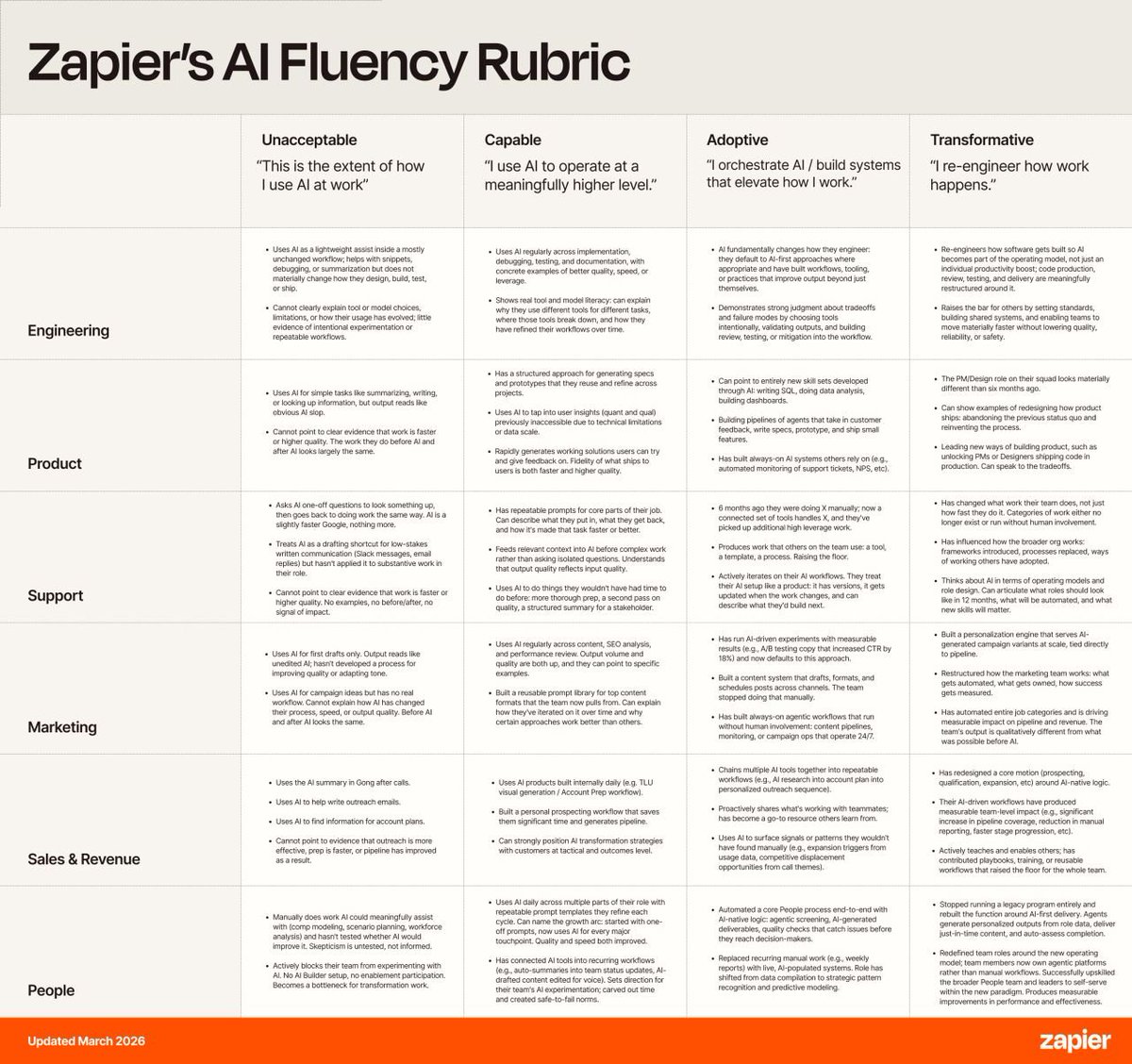
Zapier’s CEO just released their internal AI hiring rubric.
“Capable” AI operators are no longer hireable.
The new floor is "Adoptive.”
What gets you rejected now:
Marketers who use AI for first drafts and edit output manually.
Can’t show before/after evidence of AI implementations/prompts.
Using LLMs for campaign ideation without personalization.
What will get you hired:
Repeatable, shareable prompt libraries that and always-on workflows that run without your supervision. Specific measurable results that signal where to push next.
This is the new baseline.
We offered $5,000 to whichever employee got the most engagement on LinkedIn in a single quarter.
$2,500 for second.
$1,500 for third.
Plus $500 for anyone who published 20+ times.
The result: 24 employees published 581 posts in 85 days. 43,000+ reactions. 28,000+ comments. 34,000+ new followers.
27 new clients signed. $153,000 in new MRR.
I remember one guy from our team had less than 1,000 followers when the competition started. Today? 10,000+ followers.
The total prize pool cost us about $15K. The return was $153K per month. Every month. Recurring.
People need a reason to do things that aren't in their job description.
Cash works.