China isn't holding back.
If the USA is determined to play "Trade-War Tantrum" China is just going to move on, and leave the USA in a museum of 20th century artifacts.
The ONLY way the US advances is WITH China.
It was a huge honor to take part in #HelloAmerica, an extraordinary event looking at the ideas and innovations that will shape the country’s next 250 years that included the President of the United States, the entire cabinet, many of Silicon Valley’s greatest leaders and the worldwide media.
In an interview with the U.S. Secretary of Interior, @SecretaryBurgum, we discussed the centrality of critical minerals to the prosperity and the national security of the United States.
Held in an absolutely packed hall in Washington D.C. at the Andrew W. Mellon Auditorium, President Donald J. Trump @realDonaldTrump kicked the event off with an energizing speech…only to be followed by presentations and panel discussions with Secretary of State @SecRubio, Vice President @JDVance, Secretary of Energy @SecretaryWright, Secretary of Agriculture @SecRollins, head of the Small Business Administration @KLoeffler, tech luminaries @Elon Musk, @nvidia’s @JensenHuang, @Anthropic co-founder @NotTomBrown and so many more…
Sincere thanks to Secretary Burgum for elevating the importance of critical minerals. You can’t build super intelligence and data centers without enormous quantities of critical minerals.
The need for critical materials has never been as acute…while our financial system has raised massive capital for technology and super intelligence, many of us forgot the simple truth that everything you’ve ever touched was either mined, or grown…critical materials in our supply chain should never become a partisan issue in our domestic politics.
The absolute necessity for a broad all-of-government and academia effort to secure our great nation’s supply chain is the very basis for how our great nation will secure the next 250 years.
The United States has been blessed with the richest endowment of natural resources in the world…surrounded by oceans to the East and West and friendly neighbours to the north and south…It’s time to find, develop, mine and process all critical minerals to secure our country’s future and do it in a way that is clean and sustainable.
As you’ll hear in the clip, “the wealth under our feet dwarfs our national debt” and if #USA🇺🇲 “pulls together at the scale of our economy,” “nothing can stop us” from regaining #CriticalMinerals sovereignty and providing for the needs of 8 billion people.
We will do our part. @IvanhoeMines_ Electric is building America’s first major new copper mine in a generation…that will deliver 99.99% pure copper to American enterprises without using antiquated smelting technology.
@SunriseMetals will supply the nation with the rare earth metal scandium…that our country is now forced to buy from abroad…and @IPulseGroup is working to revolutionize the way we access critical materials and unlock this country’s huge geothermal potential by making it commercially viable to tap into the heat beneath our feet.
This is the first time in my living memory – and I was born in 1950 – that the United States government has paid so much attention and shown such support for securing the nation’s supply chain for copper, the king of all minerals, and all of the other elements in the periodical table required by our high-technology economy.
The work has begun and it will require everyone’s support. The previous administration allied with the G7 to take an early first step, backing the Lobito Corridor which provides an efficient corridor to bring @ivanhoemines copper to the Atlantic Ocean and global markets…The United States alone cannot achieve its aims. The task of bringing Africa’s incomprehensibly vast mineral endowment will take generations of sustained effort.
I also want to sincerely salute the Chief Brand Architect of the U.S. Peter Arnell @arnelldesign and Chief Design Officer Joe Gebbia @jgebbia and @ndstudio for their vision, putting together such a fantastic event and for the amazing work they did on https://t.co/30ypA6rNJA to simplify the way we interact with our government.
In 2003, Charlie Munger tried to talk BYD founder Wang Chuanfu out of buying what he called “a bankrupt auto plant” in China.
Twenty years later, BYD sold 3,024,417 vehicles in a single year. In his final interview, Munger explained why Wang had ignored him:
“That’s what geniuses do. They don’t listen.”
Li Lu found BYD when it was barely a public company. Munger saw two things in Wang: he worked 70 hours a week, and he was a genius. Munger invested a small amount through Li Lu.
When Li Lu told him about Wang’s plan to enter the auto business, Munger called it “a really dumb idea.” He asked Li Lu to help talk Wang out of competing with Toyota and Mercedes. Wang ignored both of them.
Munger added one qualification at the end of the story. Great records combine work, talent, and luck. Before rejecting advice from someone experienced, write down what you understand better than they do and what fact would prove you wrong.
In his 1995 speech The Psychology of Human Misjudgment, Munger described both traps: blindly following authority and being too confident in yourself.
In the article below, I organized Charlie Munger’s 25 Rules for Avoiding Costly Decisions into a practical checklist.
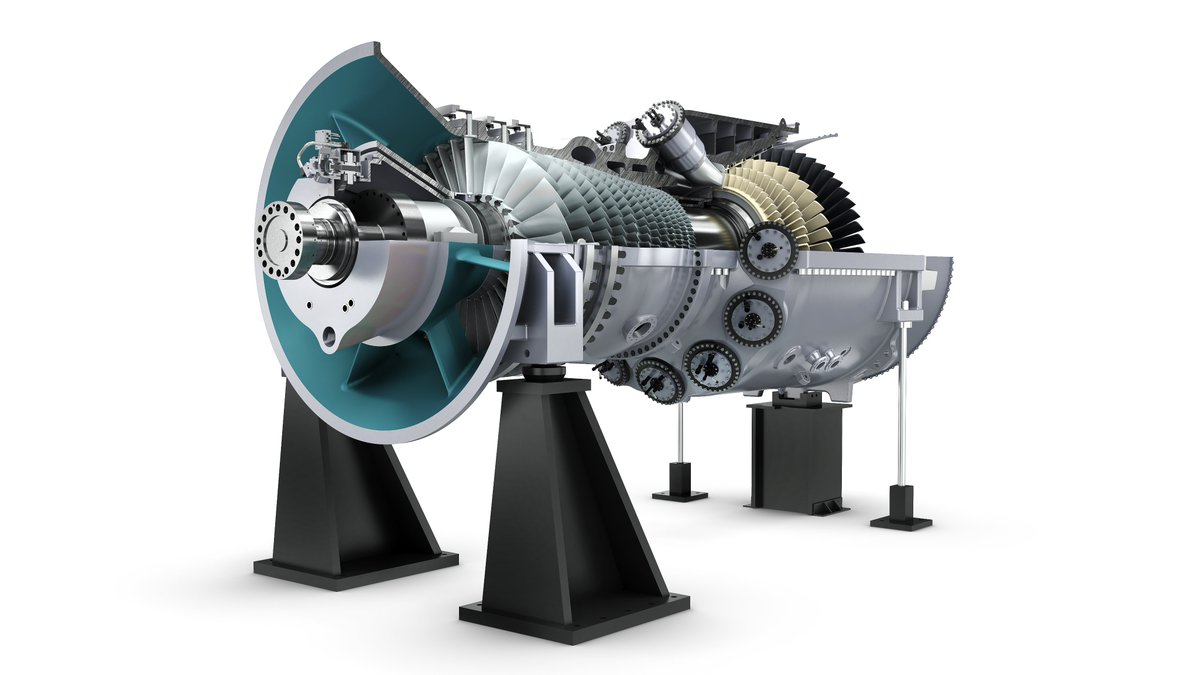
This is the most powerful single gas turbine engine ever built for electricity generation.
Siemens Energy's SGT5-9000HL weighs nearly 500 tonnes, spins at 3,000+ rpm and can produce 593 MW from a single machine.
Its exhaust leaves at around 670°C. Instead of wasting that energy, a combined cycle plant uses it to drive a second steam turbine, pushing total output to roughly 880 MW at over 64% efficiency, enough electricity for around 840,000+ homes.
Run it continuously for 24 hours and that's 21.1 GWh of electricity.
For perspective, to generate the same amount of electricity it would take roughly 1 million 600 W solar panels spread across 16 km² and would take around 6 average days to generate that much electricity.
Or 40 modern 15 MW offshore wind turbines would take roughly 3 average days.
This is the sheer scale and power density of modern gas-turbine engines, generating hundreds of megawatts, continuously, from a single rotating machine.
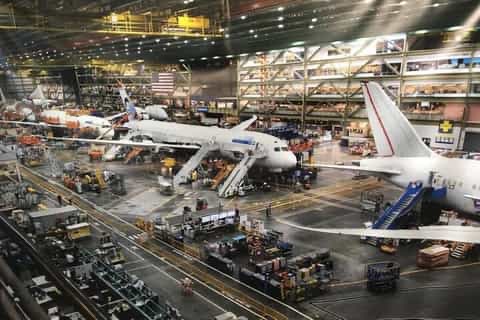
Boeing Everett
This is the largest enclosed manufacturing space in the world by volume, it has its own internal weather system and micro climates inside the building. It’s about 13m cubic meters.
It was built in 1967 to build the 747 jumbo jet.
What is interesting is that Everett operates as an assembly line, that is continually move in the same way a Ford autoplant does.
Before 67, jets were assembled in batches where the aircraft would sit stationary in assembly bays and several would be built side by side in a batch. The SR-71 was built in stationary batches.
The two production types warrant different quality systems, different tooling and capex requirements. But the MAIN issue between these two types of manufacturing method is the cycle time of each assembly step at each station.
In batch production, each assembly step can be different duration. Step 35 might take 45 minutes, step 235 might take 11 minutes and step 6235 might take 5 hours. This works because every aircraft in the batch does each step concurrently, in parallel.
In continuous assembly line production, all the steps have to be the same cycle time duration. Otherwise the entire plant moves at the cadence of the slowest station and your utilisation collapses.
This is why continuous production is so hard, you have to design for piecewise assembly, and if you do not start with piecewise assembly as a starting design philosophy you’re going to have a very bad time.
Being able to design for parallel and serial assembly is a super power. Product designers too often focus on performance and too rarely do they focus on how the product is built until it’s almost time to build it.
Anyway, Everett exists, so doing things at 1,000 acre scale is perfectly doable.
Farmers are selling their pre-purchased fertilizer at double what they paid instead of planting a crop.
Let that sink in. It is more profitable to sit out the season and flip your input costs than to put seed in the ground.
Soybean farmers lost $100 an acre last year. Corn farmers are looking at $50 to $100 losses this year. So what is the response? Switch from corn to soybeans.
Soybeans make their own nitrogen. They do not need the fertilizer corn demands.
The problem is we are already oversupplied on soybeans. More soybeans on a flooded market just drives prices lower.
Fertilizer prices have gone through the roof. The Strait of Hormuz disruptions made it worse. Farmers who locked in fertilizer early are reselling it instead of using it.
That is how broken the commodity food system has become.
Your rancher,
Jason Hanley | 208-714-0478
100 ton Propellerrrrrs
If you think about some things that are difficult to produce then large ship propellers are up there.
The largest propeller to date is fitted to the Emma Maersk, it is a 34ft diameter bronze casting that took 18 days to cool down.
The manufacturing process is a single pour sand casting, requiring 150 tons of liquid bronze, it undergoes controlled cooling whilst resting in sand.
The propeller is then removed, riser cut off, sand blasted and it gets CNC machined when it is milled ground and polished until it achieves rotary balance.
This huge piece operates at 110 rpm, the tip speed in the water is 130 mph!!
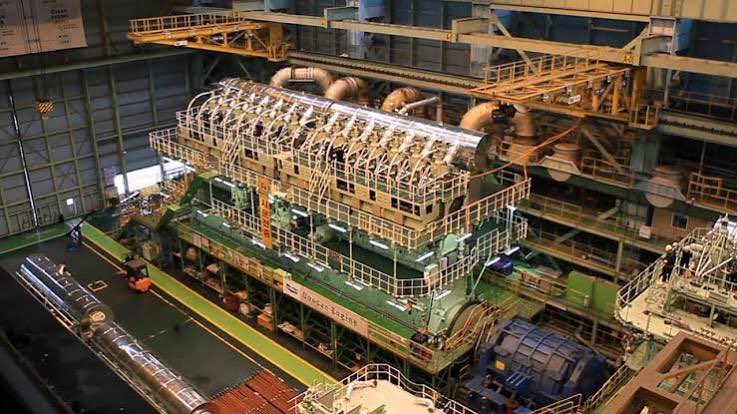
To achieve that the ship produces 107,000 hp via the ginormous Wärtsilä-Sulzer Flex 96C diesel engine, whose engine block and crankshaft are also incredible feats of jumbo manufacturing.
Giant cargo ships are at the limits of diesel propulsion and over the next 2 decade we’re going to see an entirely new class of propulsion emerging.
Ships will be able to get much bigger, yes really, and shipping will get faster, the world will get smaller. Perishable commodity prices will get flatter, and LNG arbitrage might well disappear.
But super giant metal pours are once again a gating item. Sooner or later someone needs to build the first gigaforge.
Norveç’in nüfusu 5,6 milyon.
Devletin yatırım fonu 2,3 trilyon dolar.
Her Norveçliye 400 bin doların üzerinde servet düşüyor.
Bugün dünyadaki halka açık şirketlerin %1,5’i Norveç fonuna ait.
Dünya genelinde yaklaşık 7.100 şirkete yatırım yapıyorlar.
Yani iPhone aldığınızda önce Apple para kazanıyor.
Apple kazanınca Norveç de kazanıyor.
Bir şirket Nvidia’dan yapay zekâ çipi aldığında Nvidia kazanıyor.
Nvidia kazanınca Norveç de kazanıyor.
TSMC Tayvan’da çip basıyor.
Toyota araba satıyor.
Dünyanın dört bir yanında milyonlarca insan çalışıyor, üretiyor, tüketiyor.
O ekonomik faaliyetin bir kısmı dönüp Norveç’in kasasına giriyor.
2026’nın sadece ilk 6 ayında fonun kârı yaklaşık 184 milyar dolar.
6 ayda.
Günde yaklaşık 1 milyar dolar.
Bu rakamı Norveç nüfusuna bölersen sadece 6 ayda kişi başına yaklaşık 33 bin dolar yatırım kazancı demek.
İşin ilginç tarafı şu:
Norveç bu sistemi zengin olduktan sonra kurmadı.
Petrol parasının ülkeyi bozabileceğini fark ettiği için kurdu.
Çünkü petrol bulan ülkelerin klasik bir sorunu var.
Bir anda ülkeye devasa miktarda döviz giriyor.
Devlet harcamaya başlıyor.
Maaşlar yükseliyor.
İnşaat patlıyor.
İthalat artıyor.
Yerel para değerleniyor.
Sonra ülkede üretim yapmak pahalı hale geliyor.
İhracatçı rekabet edemiyor.
Sanayi zayıflıyor.
Ülke giderek tek bir ürüne bağımlı hale geliyor.
Ekonomide bunun adı “Hollanda hastalığı.”
Norveç tam olarak bundan korktu.
“Petrolü bulduk, artık zenginiz.” demediler.
Tam tersine:
“Bu para başımıza bela olmasın.” dediler.
Petrol gelirlerinin büyük kısmını ülkenin dışına çıkardılar.
1990’da devlet petrol fonunu kurdu.
1996’da fona ilk para aktarıldığında miktar bugünün rakamlarının yanında neredeyse komik kalıyordu.
Sonra sistem büyüdü.
Petrolden para geldi.
Fona aktarıldı.
Fon hisse aldı.
Tahvil aldı.
Bina aldı.
Altyapı yatırımlarına girdi.
Kazandığı parayı tekrar yatırdı.
Sonra bileşik getiri devreye girdi.
Bir noktadan sonra petrolün kendisinden çok, petrol parasının kazandığı para önemli hale geldi.
Norveç’in yaptığı en kritik şeylerden biri de buydu.
Petrol gelirini tüketim parasına çevirmedi.
Sermayeye çevirdi.
Aradaki fark çok büyük.
Petrolü satıp 10 milyar dolar kazanırsın.
O 10 milyar doları harcarsan biter.
Ama 10 milyar dolarla dünyanın en iyi şirketlerine ortak olursan, o para onlarca yıl sana para üretmeye devam eder.
Norveç tam olarak bunu yaptı.
Üstelik fonun yatırımlarının neredeyse tamamı Norveç dışında.
Bu da bilinçli.
Çünkü 2,3 trilyon doları 5,6 milyon nüfuslu küçücük bir ekonominin içine sokarsan ülkenin dengesi bozulur.
Ev fiyatları uçar.
Maaşlar şişer.
Şirket maliyetleri artar.
İthalat patlar.
Yerel para aşırı değerlenir.
Norveç bunun yerine parasını dünyanın geri kalanına dağıttı.
Dünya büyüdükçe kendisi de büyüdü.
Amerika büyürse Norveç kazanıyor.
Asya büyürse Norveç kazanıyor.
Teknoloji sektörü büyürse Norveç kazanıyor.
Enerji şirketleri yükselirse Norveç kazanıyor.
Gayrimenkul değerlenirse Norveç kazanıyor.
Bir bakıma ülke tek bir petrol kuyusuna bağımlı olmaktan çıktı.
7.100 şirkete dağıtılmış dev bir ekonomik ağa ortak oldu.
Bu fon ise dünyanın tamamına yayılmış durumda.
Bugün Norveç’in serveti artık sadece Kuzey Denizi’nde değil.
Kaliforniya’daki teknoloji şirketinde.
Tayvan’daki çip fabrikasında.
Tokyo’daki otomotiv şirketinde.
Amerikan devlet tahvilinde.
Norveç’in yaptığı şey aslında bir ülkenin başına gelebilecek en büyük piyangolardan birini, yani petrolü, tek seferlik harcanabilir gelir olmaktan çıkarmaktı.
Petrolü çıkardılar.
Sattılar.
Parayı yemediler.
Dünyaya ortak oldular.
Şimdi dünyanın geri kalanı çalıştıkça Norveç’in serveti büyüyor.
Petrol bir gün bitecek.
Kuzey Denizi’ndeki kuyular bir gün boşalacak.
Ama Apple telefon satmaya devam ederse,
Microsoft yazılım satarsa,
Nvidia çip satarsa,
Norveç’in parası çalışmaya devam edecek.
Asıl başarı petrol bulmaları değildi.
Petrol parasını bitmeyecek bir varlığa çevirmeleriydi.
India just made its first export-grade shipping container for Maersk at Dadri, Maersk ordered 1000 more.
China makes 96% of all containers globally, so any Indian production counts But container is not just steel shaped into box. It lives 10-15 years. During that time it gets leased, tracked, repaired, repositioned, insured, and resold.
Over half of all containers belong to leasing companies, not shipping lines. Factory profit on building box is thin. Real money sits in managing that box across its full life, not in welding it together.
Container spends 56% of its life sitting idle or moving empty to where cargo is. 20% of containers on ships at any time carry nothing.
Companies like Textainer and Triton manage fleets of 7-8M TEU and earn returns from leasing cycles, insurance, digital tracking, and resale at end of life. Over $5B in securities fund their fleet growth.
Leasing contracts run 5-8 years with 87-91% renewal rates. India making containers is good. Building leasing and fleet management alongside is what turns boxes into competitive positioning.
Government backed container manufacturing with Rs 10000 crore in Budget 2026 to bridge cost gap with China and fund new factories.
India needs 350000 containers per year, makes only 10000-30000. US DOJ indicted 4 Chinese container makers in May 2026 for price-fixing cartel that doubled prices during pandemic. That creates rare opening for non-Chinese suppliers.
But building boxes is starting point, not destination. Leasing companies, tracking platforms, repair yards near ports, and container-backed finance through GIFT City would capture far more value than factory output alone.
just think about How everything is Inter-connected
https://t.co/FqqCrrfkcF
The most surprising stock recommendation Warren Buffett ever accepted came from a Chinese refugee sitting on Charlie Munger's living room sofa in 2003.
The stock turned Berkshire's $232 million position into over $8 billion in fourteen years.
His name is Li Lu. The stock was BYD.
Li Lu is 58 today. He runs Himalaya Capital, a hedge fund almost nobody outside the top of Wall Street has heard of. It has compounded at roughly 20 percent a year for twenty-five years. Charlie Munger invested his personal wealth with Li Lu from 2004 until his death in 2023.
The 2.5-hour clip in this video is Li Lu lecturing on the history of Chinese and Western civilization at his own office. It is in Mandarin with subtitles. It is on YouTube.
Li Lu was 23 in June 1989, leading the student protests at Tiananmen Square. When the tanks arrived he was on China's most-wanted list. He escaped the country with help he has never publicly named, arrived in the United States with almost no English, and enrolled at Columbia University the next year.
He then did something no other student in Columbia's history has done. He earned three degrees simultaneously. A bachelor's in economics, a JD, and an MBA. All finished by 1996.
He started Himalaya Capital in 1997 with money saved from Wall Street internships.
In 2003 a mutual friend introduced him to Charlie Munger. Munger sat down expecting a five-minute meeting. It lasted the entire day. By the end Munger had decided Li Lu was the only outside investor he had ever met who deserved his own family fortune.
Munger later called Li Lu "the Chinese Warren Buffett."
Buffett himself has said Li Lu is one of the few managers he would trust with Berkshire's cash after he and Munger are gone.
Li Lu has published exactly one book. It is a series of sixteen lectures on the modernization of civilization. The YouTube compilation is roughly the length of a graduate seminar and is free.
He has almost never given a public interview.
Every business school on earth teaches the Buffett-Munger framework and charges tens of thousands of dollars for the privilege. The one man both of them individually picked above every hedge fund manager alive gives his own version in Mandarin on YouTube for nothing.
Almost nobody who quotes Munger in a boardroom has watched a minute of it.
The lecture is free. The book is under twenty dollars.
The willingness to sit through a graduate seminar in a second language before making a serious allocation decision is a much rarer commodity than the network to hear one exists.
1997’de Çin’in büyük bir derdi vardı.
Ülkede metro ve demiryolu projeleri hızlanıyordu ama doğru düzgün tünel açma makinesi yoktu.
Aradılar, taradılar, sonunda Almanya’da iki tane buldular.
Makineler ikinci eldi.
Almanlar iki makine için 700 milyon yuan istedi.
Çinlilerin pek pazarlık yapacak hâli de yoktu.
Parayı verip iki makineyi aldılar ve ülkeye getirdiler.
Ama mesele makineyi satın almakla bitmedi.
Kurulum için Alman mühendislerin de Çin’e gelmesi gerekiyordu.
Gönderilen her Alman mühendis için günlük 800 avro ücret istendi.
O dönem sıradan bir Çinli işçi yılda 4.000 yuan bile kazanamıyordu.
Yani Alman mühendis Çin’e geliyor, bir günde Çinli işçinin neredeyse bir yılda kazandığının iki katını cebine koyuyordu.
Çinlilerin canını sıkan asıl mesele 700 milyon yuan değildi.
Makine senin değil.
Teknoloji senin değil.
Bir şey bozuluyor, Alman’ı çağırıyorsun.
Parça lazım oluyor, Alman’dan alıyorsun.
Adam fiyatı ne derse onu ödüyorsun.
Çin bu faturayı unutmadı.
2002’de mühendisleri masaya oturtup sıfırdan kendi tünel açma makinesini geliştirmeye başladı.
Kolay iş değildi.
Bir makinede 30.000’den fazla hassas parça vardı.
Kesici kafası ayrı dert, hidrolik sistemi ayrı dert, kontrol sistemi ayrı dert.
6 yıl uğraştılar.
2008’de ilk tamamen Çin yapımı tünel açma makinesi ortaya çıktı.
Ama Çinliler için asıl mesele makineyi yapmak değildi.
Almanlarla aynı işi yapıp yapamayacağını görmekti.
2012’de kendi makinelerini dünyanın en iyi üreticilerinin makineleriyle aynı projelerde yan yana çalıştırdılar.
Sonuç?
Çin makinesi geri kalmadı.
Sonra Çin’in klasik hikayesi başladı.
Önce kendine yaptı.
Sonra seri üretime geçti.
Maliyeti düşürdü.
Sonra dünyaya satmaya başladı.
Bugün dünyada kullanılan tünel açma makinelerinin yaklaşık %70’ini Çin üretiyor.
25 yıl önce Almanya’dan ikinci el iki makine bulabilmek için 700 milyon yuan veren ülke, bugün dünyanın en fazla tünel açma makinesi üreten ülke konumunda.
Aslında Çin’in elektrikli otomobilde, bataryada, dronda ve şimdi insansı robotlarda yaptığı şey de bundan çok farklı değil.
Önce dışarıdan alıyorlar.
Sonra nasıl yapıldığını öğreniyorlar.
Ardından kendileri üretiyorlar.
En sonunda da senden daha ucuza sana satıyorlar.
Zamanında Almanlar kurulum için Çin’e gidiyordu.
Şimdi Çinliler kurulum için Almanya’ya gidiyor.
Çin’de yapamıyoruz, üretemiyoruz, zor diye bir şey yok.
Çin Devleti sizden bir makine geliştirmenizi istiyorsa yapmaktan başka çareniz yok.
Aslında Çin’in sanayi politikasını yüzlerce sayfalık raporlarla anlatmaya gerek yok.
İki tane ikinci el Alman makinesi bütün hikayeyi anlatıyor.
Distillation runs the oil industry. Cryogenic distillation runs the chip industry. It is the same unit operation at minus 190 degrees Celsius instead of 400. Air is 21 percent oxygen, 78 percent nitrogen, 1 percent argon, and 18 parts per million neon. The column separates the first three by boiling point. Neon boils at minus 246, and minus 190 is above its critical temperature, so no amount of pressure will condense it. It stays with the helium and hydrogen in the overhead. Specialty gas companies like Linde, Air Liquide and Air Products capture that stream and purify it. Distilling one liter of neon takes 55,000 liters of air, and the refining runs until hydrocarbons are under 100 parts per billion. At that purity much of the contamination comes from the equipment itself. The lasers that print chip features at 193 nanometers drive a high voltage discharge through argon and fluorine. Neon is the buffer gas that carries the discharge. It is 96 percent of the gas inside the laser. The fluorine is about a tenth of one percent. If moisture or carbon compounds get in there, they absorb at 193 nanometers and the laser loses power and gas life. Semiconductor lithography consumes roughly 70 percent of the world's neon, and TSMC, Samsung and Intel all depend on it. Before 2022, two Ukrainian companies, Ingas in Mariupol and Cryoin in Odesa, purified close to half the world's semiconductor grade supply, most of that crude neon recovered off oxygen plants built for the former Soviet steel industry.
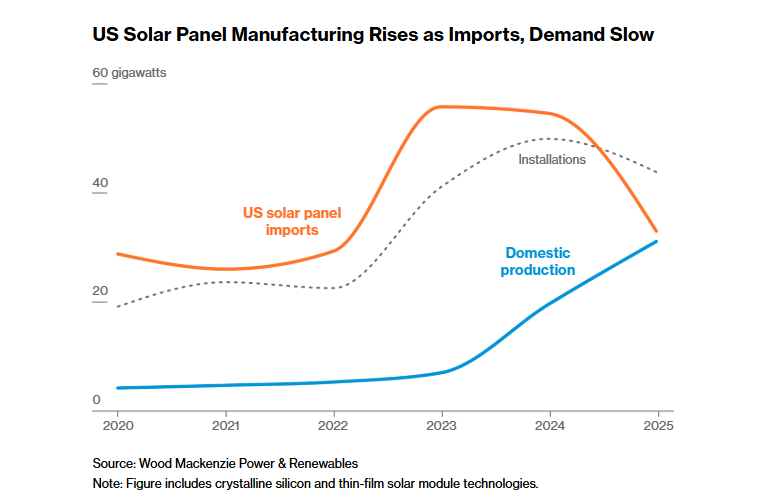
US has been trying to stop cheap Chinese solar panels for 14 years
Tariffs hit China in 2012, Factories moved to Vietnam. US tariffed Vietnam in 2024 at rates up to 3521%. Factories shifted to Indonesia, Laos. US is now tariffing those too. Philippines became latest route.
Every time 1 country gets blocked, production moves to next. New August 2026 approach targets polysilicon, raw material in all solar products. 15% tariff plus price floors start December 4. You cannot dodge material-level tariff by moving factories around.
China makes 93% of global polysilicon, 97% of wafers, 92% of solar cells, 86% of finished panels. US can assemble 65 GW of panels yearly but makes only 3 GW of cells and 5.3 GW of wafers domestically.
Wafers are biggest gap, Even when US assembles panels at home, key inputs still flow through Chinese supply chains. New tariff sets minimum prices of $0.22 per watt for cells and $0.38 for panels.
That is 40% higher than current global prices. US solar costs rise while global prices keep falling.
First Solar benefits most from new tariff because it does not use polysilicon. It makes panels using thin-film technology that skips wafers and cells entirely. Every other US panel maker imports polysilicon-based inputs now facing 15% tariff plus price floors.
First Solar faces no such cost increase. Company already makes about 1 in 3 US-produced panels. New tariff gives it built-in cost advantage over competitors relying on imported materials.
Policy designed to build domestic supply chain ends up especially favoring 1 company that sidestepped polysilicon dependence from start.
But overall if yu look intention US will get what it want when yu are biggest consumer sometimes yu can dictate yur own terms
https://t.co/0FgFgS6MEc
@YusufSerunkuma@Joshua_lawel Very interesting argument, @Joshua_lawel. However, I still do not understand the logic behind you using the colonialism narrative to dilute Kirunda’s point. Many western countries, some that were never colonized, are facing the same problem colonized countries are facing today.
This is what a Pratt & Whitney PW1500G Geared Turbofan looks.
A single engine costs roughly $10-15 million. But the engine itself is not the hardest part to build requires roughly 10,000-30,000+ direct manufacturing labour hours per engine, with millions more engineering hours behind its development and certification.
The hardest part is building the industrial ecosystem behind it.
A modern turbofan contains 20,000-40,000 precision components, single-crystal turbine blades, ceramic thermal barrier coatings, advanced superalloys, micron-level manufacturing, and a gearbox transmitting tens of thousands of horsepower while the low-pressure turbine spins at 15,000+ RPM.
The obvious question is, Why can't every advanced economy simply buy one, dissect it, reverse engineer it and build their own?
Because a jet engine is not a blueprint problem or theoretical understanding problem.
It is a manufacturing knowledge problem.
You can analyse every blade, measure every alloy, and scan every component, yet still miss decades of accumulated expertise in crystal growth, heat treatment, coating processes, machining, testing, and quality control.
Developing a new commercial turbofan from a clean sheet is not a small project. It can require $5-15+ billion, 15-25 years of development, thousands of engineers, and countless test cycles before it becomes a reliable passenger engine.
And that is with companies that already have generations of experience, mature suppliers, and decades of flight data.
A country starting from zero does not just need money.
It has to recreate generations of industrial know-how and still prove that its engine can survive tens of thousands of flight hours, thousands of takeoff cycles, and decades of commercial service.
Some technologies can be bought. Some have to be developed over decades of real intent and risk.
The world's most advanced manufacturing capabilities have to be built.
📷Flyingwithtee
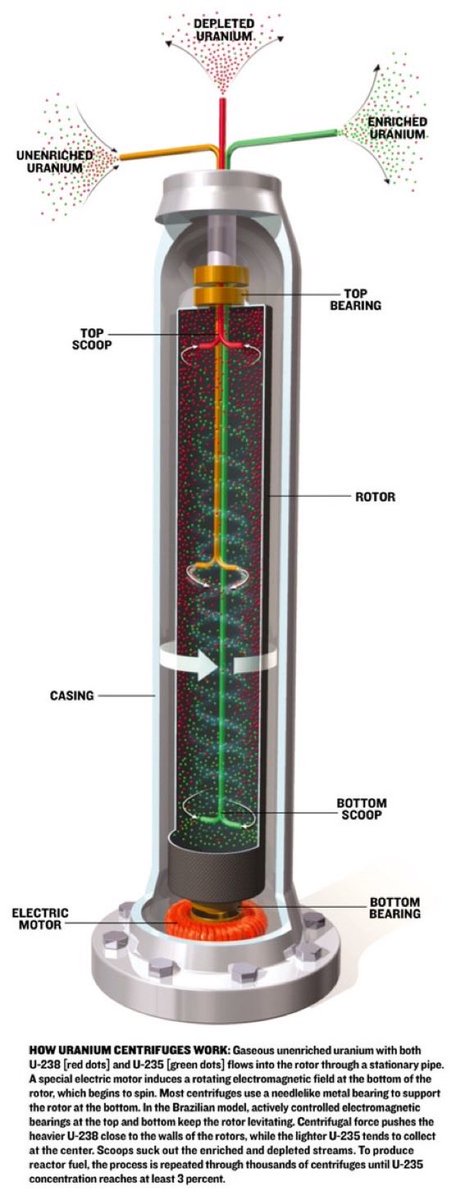
A Uranium Enrichment Centrifuge is not built to simply spin fast. It is built to maintain near-perfect mechanical stability while rotating at extreme speeds for years inside a vacuum.
The true constraint is manufacturing thousands of identical machines where microscopic defects in balance, material strength, or alignment can decide whether an entire industrial system succeeds.
The engineering challenge comes from separating uranium isotopes that are chemically identical but differ slightly in mass.
Natural uranium contains approximately 99.3% uranium-238 and only 0.7% uranium -235, forcing engineers to exploit a tiny physical difference through extreme precision and repeated separation processes to achieve concentration.
At the centre is a lightweight rotor operating at 80,000-100,000+ RPM, with advanced designs reaching rotor tip speeds of approximately 400-700 m/s.
At these velocities, centrifugal forces become enormous, a tiny crack, manufacturing defect, or imbalance can rapidly become catastrophic vibration and lead to failure, The rotor must operate continuously while maintaining structural integrity and precise alignment for 2-5 years.
This requires specialised materials such as maraging steels, titanium alloys, and carbon-fibre composites. Carbon fibre is particularly valuable because its high strength-to-weight ratio allows extreme rotational performance while reducing centrifugal stress.
Manufacturing requires aerospace-level composite control, precision machining, dynamic balancing, and strict quality verification.
The vacuum environment is equally critical. Removing air reduces drag, heat generation, and energy losses, requiring advanced vacuum systems, seals, contamination control, and monitoring technologies.
The real challenge is not one centrifuge but the industrial ecosystem, thousands of precision machines operating together with automated controls and long-term reliability.
Developing this capability requires $300-500 Million to billions of dollars in specialised infrastructure, including factories, testing facilities, advanced materials production, and decades of engineering know-how.
The Uranium enrichment centrifuge is a rare industrial achievement,
A machine only a few metres in size, yet controlled at microscopic precision, where materials science, manufacturing perfection, and rotating machinery physics combine to create a strategic technological capability.
Tungsten is the metal that survives where almost every other metal fails. With a melting point of 3,422°C, it remains solid in environments that would destroy conventional alloys, making it essential for rocket nozzles, plasma systems, and extreme-temperature furnaces.
The paradox is manufacturing it. Unlike steel or aluminium, tungsten cannot be easily melted and cast.
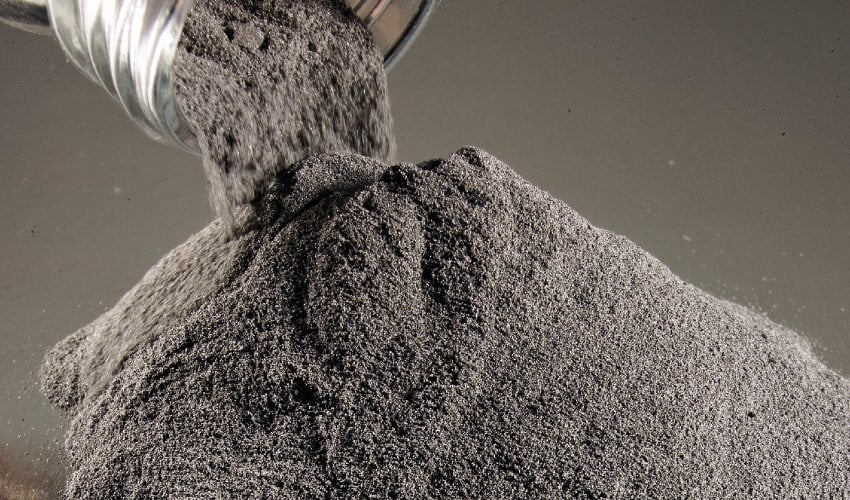
Industry builds it from micron-sized powder, produced through chemical refining, hydrogen reduction, and sintering above 2,000°C to create dense components with controlled grain structures.
For extreme applications, tungsten-rhenium alloys improve toughness and high-temperature stability.
The real challenge is not producing tungsten, but eliminating the microscopic weaknesses that cause failure. Tiny pores, impurities, or grain defects can become crack initiation points under thermal shock.
A material capable of surviving 3,000°C environments depends on controlling imperfections measured at the microscopic level.
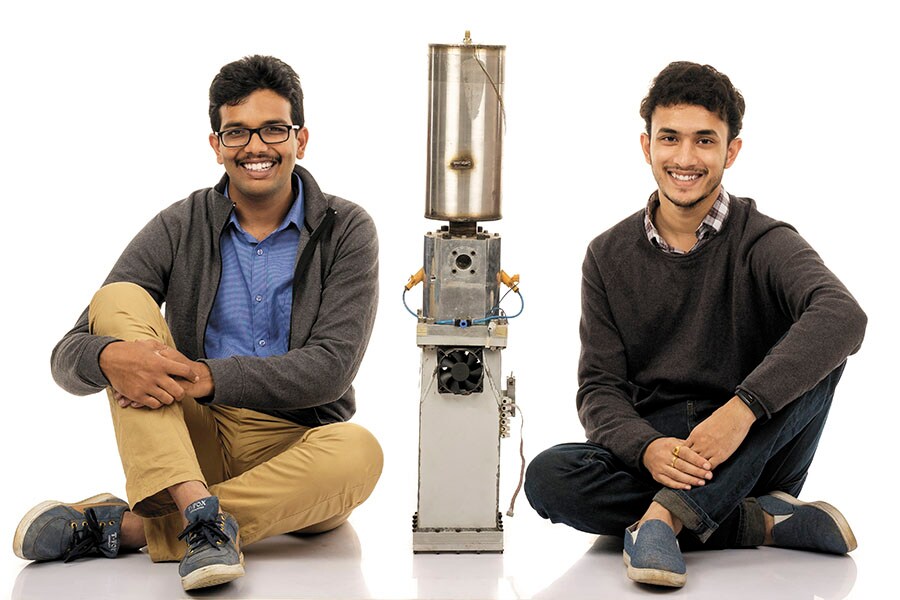
In 2012, a 19-year-old aeronautical engineering student from Coimbatore presented propulsion research at a NASA event. Dr. APJ Abdul Kalam noticed, sought him out for a meeting, and handed him a recommendation letter with one challenge: prove your concept.
That student was Rohan M. Ganapathy. Three years later, he and family friend Yashas Karanam co-founded Bellatrix Aerospace from IISc's incubation lab in Bengaluru. The problem they chose to solve touches every satellite in orbit.
Nearly all satellites run on hydrazine, a propellant that has been standard since the 1960s. It is deeply toxic, carcinogenic, and so hazardous that it requires specialized crews and loading facilities near the launch site. India imports all of it. Nobody was building an alternative.
Bellatrix built two. Rudra is India's first high-performance green propulsion system, delivering hydrazine-equivalent thrust while cutting handling costs by over 60%.
Jal is a microwave plasma thruster that uses water as propellant, which Bellatrix claims is the world's first such system built by a private company. Both have been tested in orbit: Rudra fired on ISRO's POEM-3 in January 2024, and again on POEM-4 in January 2025.
Their third product, Pushpak, is an orbital transfer vehicle the company says can bring satellite deployment costs from $45,000 to $25,000 per kilogram. In October 2024, Bellatrix signed an MoU with ISRO's commercial arm, NewSpace India Limited, to integrate Pushpak into its launch missions. The company has raised $31 million to date, backed by BASF Venture Capital, Inflexor Ventures, and Cactus Partners.
For India, a domestic green propulsion stack means less dependence on imported hydrazine, lower costs for Indian satellite startups, and export-ready technology in a global market actively moving away from toxic fuels.
Kalam asked Rohan to prove his concept. More than a decade later, the proof has been fired in orbit.
@rohanooty@BellatrixAero@YashasKaranam
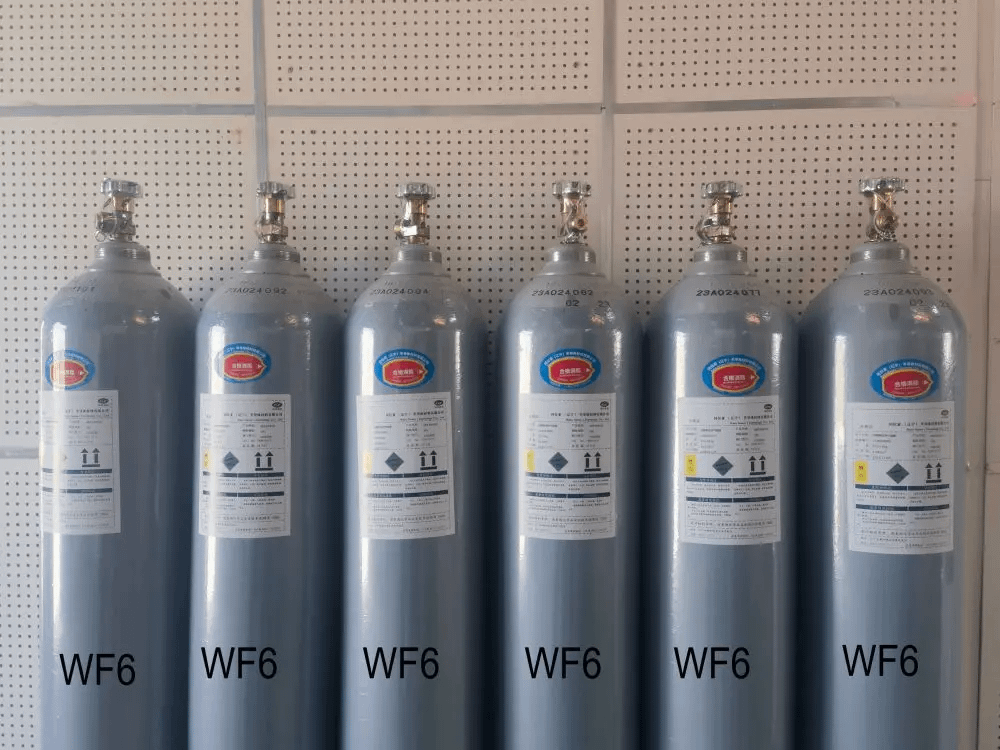
Samsung, SK Hynix, and TSMC source 80% of their WF6 from Japan. Two Japanese companies produce 25% of the world's tungsten hexafluoride. Both Kanto Denka and Central Glass are stopping all WF6 production on July 1. We manufacture chemicals. WF6 is a chemical. The semiconductor industry never asked what it's made from. WF6 deposits the tungsten contact plugs inside every advanced chip on Earth. There is no substitute for running production lines. Qualifying a new supplier takes 12 to 18 months. Building new capacity takes two to three years. China controls 80% of the tungsten powder WF6 is made from. Japan's tungsten imports from China have been zero since February. The two producers survived on stockpiles for five months. The stockpiles are gone. WF6 prices are up 232.7% year over year. Upstream tungsten powder is up 557%. Only six companies produce 90% of the world's supply. Two just quit. Every AI accelerator, smartphone chip, and SSD depends on a gas about to lose a quarter of its supply.
Disco Corporation is a Japanese precision toolmaker with 5,491 employees. TSMC, Samsung, Intel, Nvidia, Apple, and every semiconductor company on Earth uses their machines. Every chip on the planet must be cut from its wafer and ground to final thickness before it can be packaged. Disco controls over 70% of the global market for wafer dicing saws and grinders. Their diamond blades cut silicon at 40,000 RPM with a kerf width of 20 microns. A human hair is 70. The blades are consumables. A single 300mm fab burns through thousands per year. Standard industrial cutting tools cost a few dollars each. Disco's precision dicing blades sell for hundreds of dollars apiece. At 20 microns, every fraction of a micron saved in cut width recovers sellable silicon on a $10,000 wafer. The company runs on a system called Will. There are no managers. Instead, employees bid on tasks using an internal currency. The CEO who built this system, Kazuma Sekiya, has said Disco does not chase growth for the sake of market share. The semiconductor industry comes to them.