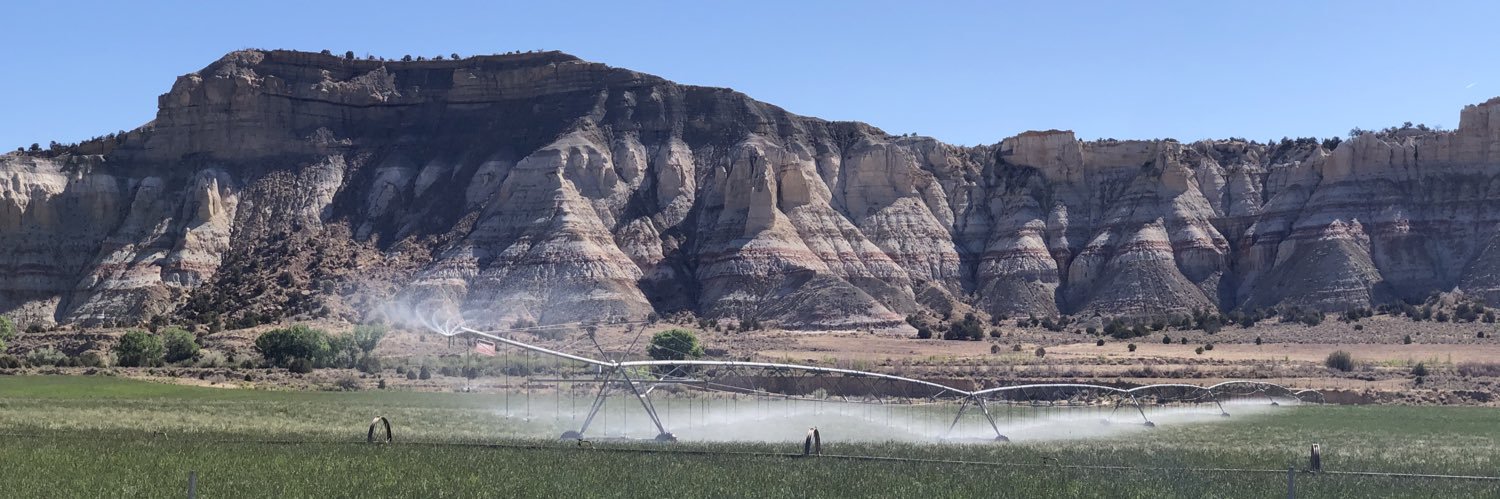
Check out our new paper! We find the climate-driven season sediment-transport regime shift in four types of cryosphere-fed rivers. Huge thanks to our amazing team @RiverSediment @AmyEast_gmph @KHwave Albert kettner @CSDMS Jinren Ni, and Xixi Lu
Explaining Markov Chain Monte Carlo (MCMC) to a Layperson
1/ 🧐 Introduction Ever wonder how scientists make educated guesses about complex things, like predicting the weather or understanding the spread of a disease? They often use a method called MCMC. Let's break it down!
2/ 🎲 Start with a Simple Analogy Imagine you're in a room blindfolded, and you're trying to map out the furniture without seeing it. You take small steps in random directions. If you bump into something, you know there's an object there. Over time, you get a sense of the room's layout.
3/ 🔄 Markov Chain This is the idea behind the 'Markov Chain' in MCMC. You take many, many steps starting from a certain position, and your next step only depends on where you currently are. The 'chain' is the path you walk.
4/ 🎰 Monte Carlo Now, think about casinos. The Monte Carlo method, named after the famous casino town, is about using randomness (like rolling dice) to solve problems. In our context, it's like using random steps to explore and understand a complex system.
5/ 🤔 So, What's MCMC Together? MCMC combines the Markov Chain (the walking around) and Monte Carlo (the randomness) to make educated guesses about systems that are hard to figure out directly.
6/ 📊 Sampling & Distributions Here's the magic! After taking many steps, the places you've been most often give us a good idea about the 'shape' or 'distribution' of what we're trying to understand. It's like understanding the furniture layout in the blindfolded room analogy.
7/ 👥 Why is MCMC Useful? It's super useful in situations where directly calculating the answer is tough or impossible. Scientists use it to estimate things like climate patterns, stock market changes, or even the structure of galaxies!
8/ 🔍 In Summary MCMC is a clever method that combines walking around (Markov Chain) with randomness (Monte Carlo) to make educated guesses about complex systems. Think of it as mapping out a room blindfolded using small, random steps.
9/ 📚 Keep Exploring If you're curious, there's a world of math, statistics, and stories behind MCMC. But at its heart, it's about understanding the unknown through randomness and persistence.
🔚 End of Thread. If you enjoyed this explanation, feel free to share and comment! #DataScience #ScienceForEveryone 🌍
In 37 years as a faculty member, I have never seen anything like this video.
It's the faculty senate at Texas A&M meeting with the university's president, Katherine Banks, the day before she resigned.
The reason she resigned is clear from the clip. https://t.co/JEtaxywjSX 1/
How much control do smallholder maize farmers have over yield?
We dig into this Q in a new study: https://t.co/SOcclHvn4y
Great collab led by Michael Cecil w @NVergopolan@kathy_baylis@kcaylor @tomgeog @justinosheff & several not on Twitter.
Thread 🧵
Very humbled and grateful to receive the GK Gilbert award of excellence in geomorphological research at #AAG2023 Many thanks to the award committee and board of @theAAG geomorphology specialist group! https://t.co/xSePt2yRfT
What is causing the land loss crisis on the Mississippi Delta? We can recreate observed land loss in Barataria with a mass balance that shows dams are secondary to building levees and resource extraction. Just published in @naturesustainab!
Article: https://t.co/130DgbMTa2
I have updated the data section of my group’s website. We are committed to making our research data products freely available & we hope you find something to build on!
Here are the databases we make available: (1/n)
https://t.co/zpzloIOBY4
Very proud of @LiyaGebriel whose wonderful paper characterising soils in the Ethiopian Highlands and their influence on runoff is published in the Journal of Hydrology "Women in Hydrology" Special Issue!
https://t.co/TC4xiIRviH
(Ping me if you can't get past the paywall).
@AlecStapp The one truly clear signal we get among the noise is: There are a LOT of single-use plastic bags in the ocean, and other surface waterways, where they cause a lot of direct harm to wildlife.
I recently switched to Zotero and it’s a dream compared to Mendeley. This is especially true after the addition of iOS apps and improved desktop annotation. You can save annotations (including figures) into notes, making it quick and easy to create paper summaries.
I've been using Mendeley Desktop daily for years, & have an annotated library of thousands of pdfs. Today, I switched to Zotero. Here's a 🧵of tips on how to do this, if you're also tired of Elsevier's BS and want to make the switch w/minimal effort while maintaining workflow.
Our new paper 'High Mountain Asia hydropower systems threatened by climate-driven landscape instability' is out in @NatureGeoscience with great co-authors @WaterSHEDLab @immerzeel @SantoshNepalH2O @yaqoobsufi @alp_wise and others not on Twitter. https://t.co/Lf5yEAdgta
Incredible.. 🤯 my satellite-image-deep-learning repo is now sitting at #1 spot in the remote-sensing category on @github with 3.1k ⭐️ Great validation that this is now a mainstream topic in the community 📡 https://t.co/RUf3Glx9bX
Releasing 'Rivers of Bengaluru' Map. It is a simple spatial representation of rivers of concern to Bengaluru and how we connect with them. It highlights the current state of affairs: The use and abuse of rivers. https://t.co/Tx5sBYjY4u
@Kspcbkarnataka @BBMPCOMM@JManjunathIAS
HydroSHEDS reinvented! Check out our latest announcements of upcoming global river data at https://t.co/h2DEA739Sf and our new website at https://t.co/r7lmXPbo7d
This is fantastic news! Prof Brutsaert’s research and - importantly - textbooks - have been invaluable to water practitioners & teachers everywhere. Congratulations Prof Brutsaert!