Anthropic engineer:
"You're not supposed to watch Claude Code work. You're supposed to wake up and review what it shipped."
In 22 minutes she builds the entire workflow live on camera.
Most people close their terminal and everything stops.
This setup keeps shipping while you sleep.
Watch the video, then save the exact setup below👇
Automation is a lie. CLIs are over. The SaaSpocalypse is dumb.
A year ago @danshipper came on the podcast to predict where AI was heading. He was remarkably right—including the call that everyone was sleeping on Claude Code.
Dan has a unique lens into where things are going because his team at @every is possibly the most AI-pilled group of people in tech. I always learn a ton talking to Dan.
So I brought him back for round two. We'll score these in exactly a year:
🔸 Every company will have one “super-agent” in Slack.
🔸 Codex and Claude Code will become the new operating system for knowledge work.
🔸 The AI job apocalypse is not happening.
🔸 PMs and designers will thrive.
🔸 We will read way more AI-generated writing and we will like it.
🔸 "I would buy SaaS stocks right now."
Listen now 👇
https://t.co/wzxQ5bz49h
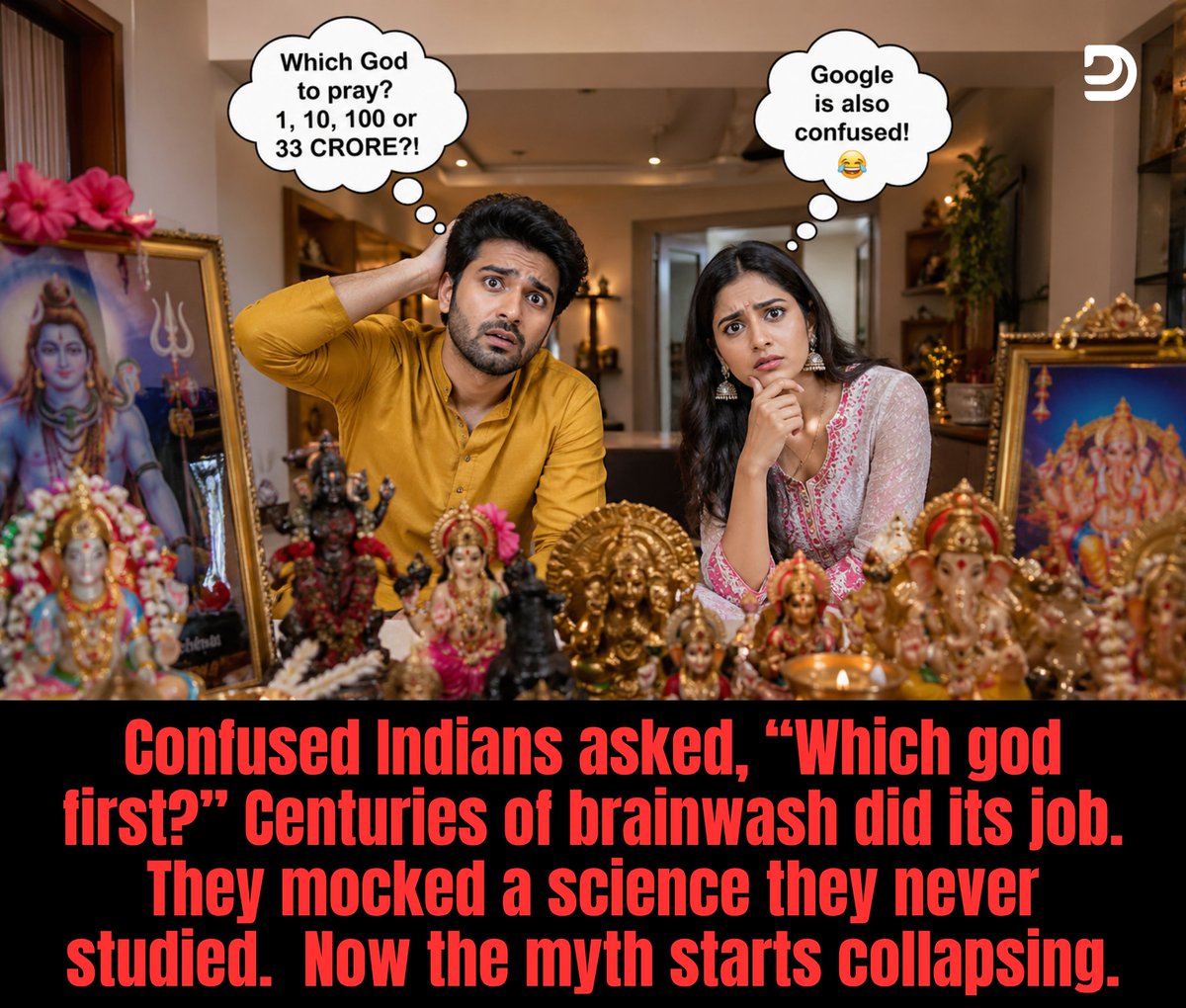
Why Hindus have 33 crore gods?
No wonder we look confused.
Which god to pray?
Which idol to choose?
Which day to fast?
Which ritual to follow?
That is the story many were taught.
That India is irrational.
That Hindus are superstitious.
That our ancestors worshipped randomness.
A civilization of chaos.
Nice story.
Fake story.
Let me break it.
There is no original Vedic claim of 33 crore gods.
The phrase is 33 Koti Devatas.
And primarily 'Koti' in Sanskrit means.
Type.
Class.
Category.
Order.
So the real meaning is:
33 classes of Devas.
Not 330 million gods.
Now watch the architecture.
The 33.
8 Vasus
Cosmic building blocks of existence.
Traditionally linked to:
Prithvi = Earth
Jala = Water
Agni = Fire
Vayu = Air
Akash = Space
Surya = Sunlight
Chandra = Moonlight
Druva = Radiance
Nature itself.
11 Rudras
Forces of life within the human system.
Many traditions list them as:
Kapali = Ego destroyer
Pingala = Vital energy
Bhima = Fearless strength
Virupaksha = All seeing vision
Vilohita = Red vitality
Shasta = Divine guide
Ajaikapada = Formless pillar
Ahirbudhnya = Deep guardian
Shambhu = Auspicious peace
Chanda = Fierce force
Bhava = Source of life
12 Adityas
Not random sky gods.
These were the twelve solar principles.
Twelve faces of time.
Twelve rhythms of the year.
Dhata = Creator, order
Aryama = Honor, nobility
Mitra = Friendship, harmony
Varuna = Law, waters
Indra = Power, victory
Vivasvan = Radiance, fire
Tvashtha = Craft, design
Vishnu = Expansion, pervasion
Amshuman = Rays, portion
Bhaga = Fortune, prosperity
Pusha = Nourishment, growth
Parjanya = Rain, fertility
Then Prajapati
Creation.
Generation.
Continuity of life.
Now count.
8 + 11 + 12 + 1 + 1 = 33
This is systems design.
Not superstition.
Now the bigger shock.
We never had a true English concept of “God.”
The word used was Deva.
From Sanskrit root Div.
To shine.
To illumine.
To radiate.
A Deva is not equal to the Abrahamic idea of one external ruler.
A Deva can mean:
Energy.
Intelligence.
Natural principle.
Conscious force.
Cosmic function.
That is why translation damaged understanding.
Eg. Agni is not “fire god.”
Agni is:
Fire in nature.
Fire in digestion.
Fire in transformation.
Fire in sacrifice.
Fire of will.
One symbol.
Five layers
What were ancestors really doing?
They encoded science into story.
Ecology into ritual.
Psychology into symbolism.
Astronomy into calendars.
Energy into mantra.
Sustainability into reverence.
When you worship river,
you don’t pollute it.
When you worship tree,
you don’t cut it blindly.
When you worship fire,
you respect energy.
Smart civilization move.
Even the scriptures say One Reality.
Rigveda:
Ekam Sat Vipra Bahudha Vadanti
Truth is One.
Wise people call it by many names.
So no.
We were never a people of 33 crore competing gods.
We were a civilization mapping one reality through many forces.
They called us confused.
Because if you understand this system,
you start asking who really misunderstood whom.
Brave Indian-American girl rips apart hate propaganda against Indian community and Hindus at a Texas counsil meeting 🔥:
"Hindu’s don’t force their religion onto you, Hindu’s don’t convert, We are the safest community in the world! We Contribute max...."
@alex_prompter I bet GitHub founders thought the same thing when Google released “Google Code” to compete with GitHub.
Or maybe when Google released Google Videos to “kill YouTube” back in the day.
It’s actually quite easy to compete with Google due to the lack of focus.
Linear’s CEO just described the biggest shift in product team structure since Agile.
For decades, product work meant: PM defines requirements → designers create specs → engineers translate to code. The middle step, translation, absorbed 70% of the time and created most of the friction.
Karri is saying that step is collapsing. AI agents don’t need handoff documents or sprint planning rituals. They need structured context about what matters, what constraints apply, and what success looks like.
This inverts the leverage points. The person who captures customer intent clearly now has more impact than the person who translates it into implementation. And the person reviewing agent output becomes the quality bottleneck.
Linear built their entire product around this bet: structured entities with clear ownership, context attached to work items, feedback connected directly to issues. It turns out the same system that helps humans coordinate also helps agents know what to do.
The teams figuring this out first will have a structural advantage. Everyone else will still be writing Jira tickets that read like riddles.
I wrote this quick piece while reading papers for another article that I’m still working on. It covers how I read research papers today by mixing my old manual flow with simple AI assisted reading.
On the manual side I still start with the famous three pass method.
On the LLMs side I share the prompts that give me better summaries and help me check ideas fast.
I also talk about the tools that are specifically created for this and that I use:
• @askalphaxiv -my go to for quick reading and clean views
• https://t.co/dLEhIaVooV by @sighjith a new one but the feed feature is great and helps with paper discovery
• Lumi has a thoughful UI
🔥🏈 FANTASY MIRACLE ALERT 🏈🔥
Down to the final 15 seconds of regulation time my kicker steps up and drills a 46 yard nuke to tie the real game… and WIN me the week! 🥹😄
#KickerSZN#PHIvsLAC
@ThePeterMick Building https://t.co/K1GLPzQDpM, a launch platform where makers post products, track launches, share progress via timelines, and offer discounts to early supporters.
Helping builders get seen while building in public 🚀
Christianity did not invent theology; it borrowed Greek reason and called it revelation.
India had theology—the rational study of the divine—long before Europe could define the word. The Upaniṣads and Brahma Sūtras are rigorous treatises on the nature of ultimate reality (Brahman), consciousness (Ātman), and causality. Śaṅkara, Rāmānuja, and Madhva debated existence with far greater logical precision than medieval scholastics who still thought the earth was the universe’s center.
Hinduism never feared inquiry. The śāstrārtha tradition demanded open debate between atheists, Buddhists, Vedāntins, and materialists. It is a philosophy that tests truth through experience, not obedience. Christianity, by contrast, subordinated reason to creed and silenced thinkers from Giordano Bruno to Galileo.
The claim that only Christianity unites the human and divine ignores the Hindu doctrine of avatāra—the descent of the Infinite into form—centuries older than the “Incarnation.” Hinduism’s Brahman is not an abstraction but sat-cit-ānanda: being, consciousness, bliss—the conscious field from which individuality arises.
Mocking deities like Hanumān as “zoomorphic” betrays ignorance. These are symbolic personifications of strength, devotion, and control of instinct—psychological science, not primitive idolatry.
Finally, the idea that Hinduism kept India backward is historically illiterate. India led in mathematics, astronomy, metallurgy, logic, and medicine while Europe was in the Dark Ages.
Hinduism thrives not by coercion but by coherence—because it unites logic with liberation. It is not dogma dressed as truth; it is truth discovered through reason, discipline, and consciousness itself.
Pretty Sad to see inquiry replaced by dogma .
Here’s why:
⸻
1. Origin: Revelation vs. Realization
Most world religions begin with a revelation — a prophet receives a fixed message from a divine source. Followers must believe that revelation as absolute truth.
Sanātana Dharma begins with realization — sages (ṛṣis) did not receive commandments; they discovered truths by entering deep meditative states. The Vedas are called śruti (“that which is heard”), not “dictated,” because they are observations, not orders.
👉 Thus Hinduism says: “Ekam sat viprā bahudhā vadanti” — “Truth is One, the wise express it in many ways.”
⸻
2. Method: Belief vs. Experiment
Faith-based religions ask you to believe first and then understand later.
Sanātana Dharma asks you to experience first and then believe.
Every concept — ātman, Brahman, karma, mokṣa — is verifiable through inner experiment: meditation, self-inquiry, mantra, breath, and ethical living.
It is repeatable consciousness science, not an inherited belief system.
⸻
3. Structure: Closed Canon vs. Open Inquiry
Dogmatic systems freeze knowledge in a single holy book or prophet — “truth” becomes property.
Hinduism has no final book and no founder. The Vedas, Upaniṣads, Purāṇas, and Darśanas form an open architecture of thought — continuously refined by seekers for over 5,000 years.
Hence there is no heresy in Hinduism; you can question even God.
⸻
4. Relationship with the Divine
In dogmatic faiths, God is separate — a ruler to be obeyed.
In Sanātana Dharma, divinity is within. The Upaniṣads declare:
अहं ब्रह्मास्मि — Aham Brahmāsmi
“I am Brahman.”
The seeker doesn’t worship out of fear but explores the divine as Self-awareness. The path is inner: ātma-vichāra (self-inquiry).
⸻
5. Goal: Salvation vs. Self-Realization
Dogmatic faith seeks salvation after death through belief.
Sanātana Dharma seeks liberation (mokṣa) while living, by understanding the laws of consciousness, karma, and nature. It is not escape — it is mastery of being.
⸻
6. Attitude Toward Difference
Faith systems often divide: believer vs. infidel.
Hinduism says, “Āno bhadrāḥ kratavo yantu viśvataḥ” — “Let noble thoughts come to us from all directions.”
Truth is universal, not tribal.
⸻
In essence
•Dogma demands obedience.
•Dharma invites observation.
•Faith separates man and God.
•Seeking unites them.
Hinduism is the laboratory of the soul — not a court of belief. It tells you not what to think, but how to realize.